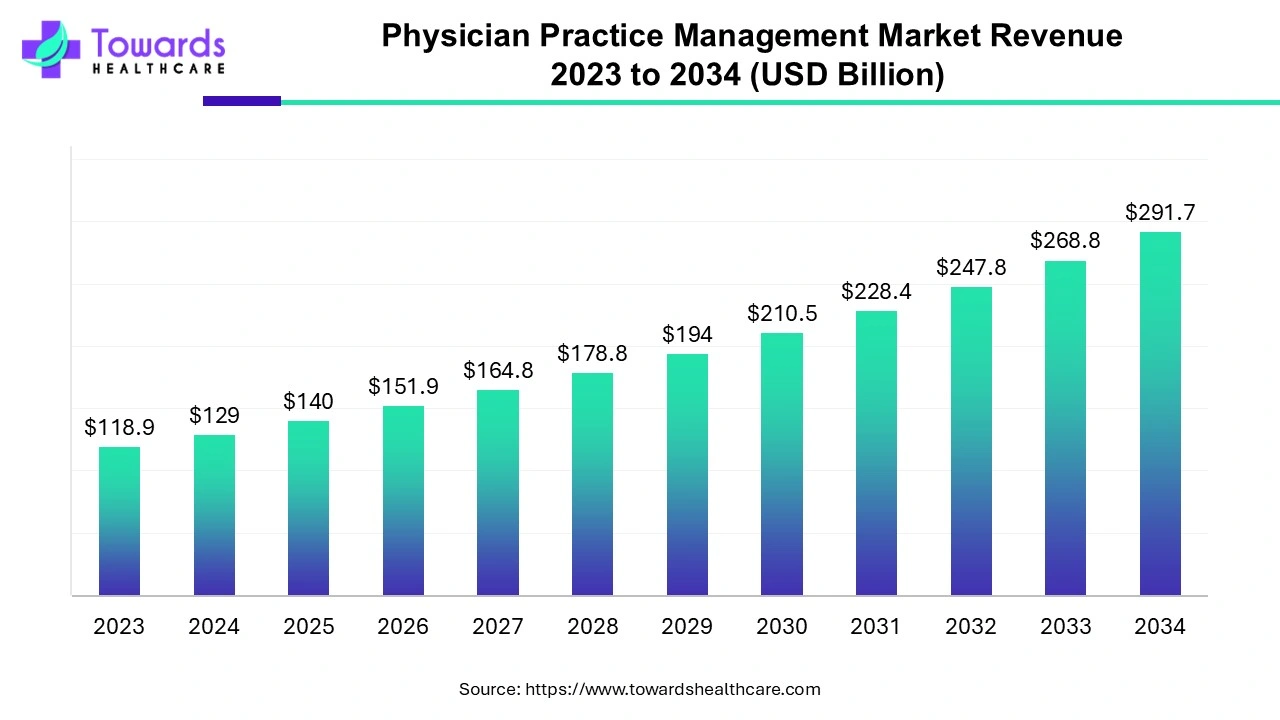
The physician practice management market was estimated at US$ 140 billion in 2025, set to grow USD 151.9 billion in 2026 and is projected to grow to US$ 291.7 billion by 2034, rising at a compound annual growth rate (CAGR) of 8.5% from 2025 to 2034.
Physician practice management is a non-medical service provided by an organization to simplify the tasks of a clinic or physician. The services offered by physician practice management include bookkeeping and accounting, human resources management, billing, claims submissions, financial management, marketing & public relations, technological & information support systems, and provision of administrative personnel. This facilitates the fulfillment of a physician’s daily tasks, enabling a physician to focus more on patient care and treatment. It also eliminates the need to appoint multiple employees for each particular task. Competent practice management is crucial to the development and expansion of the medical industry.
The increasing demand for revenue growth of a medical practice firm boosts the market growth. Technological advancements and favorable government policies result in high adoption of physician practice management. The demand for physician practice management also rises due to increasing investments in the healthcare sector. In addition, the increasing number of hospitalizations due to several chronic disorders and the COVID-19 pandemic demands physician practice management.
Physician practice management refers to the systems and services used to manage administrative and operational activities in physician practices, including scheduling, billing, patient records, claims, and revenue-cycle functions. The market is growing as healthcare providers seek greater operational efficiency, cost control, and streamlined practice administrative processes. Key trends include integrated practice management platforms, cloud-based deployment, digital scheduling, and telehealth integration. Technological advancements in AI, automation, data analytics, and cloud computing are improving billing, coding, documentation, and workflow management. Major drivers include increasing healthcare digitization, reimbursement complexity, regulatory requirements complexity, regulatory requirement, and demand for efficient practice operations. Future opportunities include AI-enabled revenue-cycle management, predictive analytics, automated claims processing, interoperability, and patient engagement solutions.
Technological Advancements: Opportunity for the Market
The advent of advanced technologies like artificial intelligence (AI), machine learning (ML), and cloud-based services promote market growth. These technologies have immense potential in the healthcare sector. Several mobile applications and software are available to simplify non-medical operations in clinics or hospitals. The software can be used for customization of appointments, timings, and locations. It can be used to create invoices and payment receipts as well as set schedules and reminders for healthcare professionals. Cloud-based services help store patient data, which can be easily accessed anywhere and at any time. AI can reduce the burden of documentation, improve efficiency, and alleviate the burden of administrative tasks. AI can also assist in optimizing revenue cycle management by improving claims processing accuracy and reducing claim denials. Thus, AI can automate the entire practice management system, streamline workflow, and improve decision-making.
Increasing Operation Costs Hinder the Market
The major challenge faced by the physician practice management market is the high operation costs. Common operations such as office supplies, software, IT support, and medical supplies require huge costs. The average cost of a physician practice management software ranges from $350 to $1,000, excluding other services.
Increasing Number of Hospitalizations as a Driver of the Physician Practice Management Market
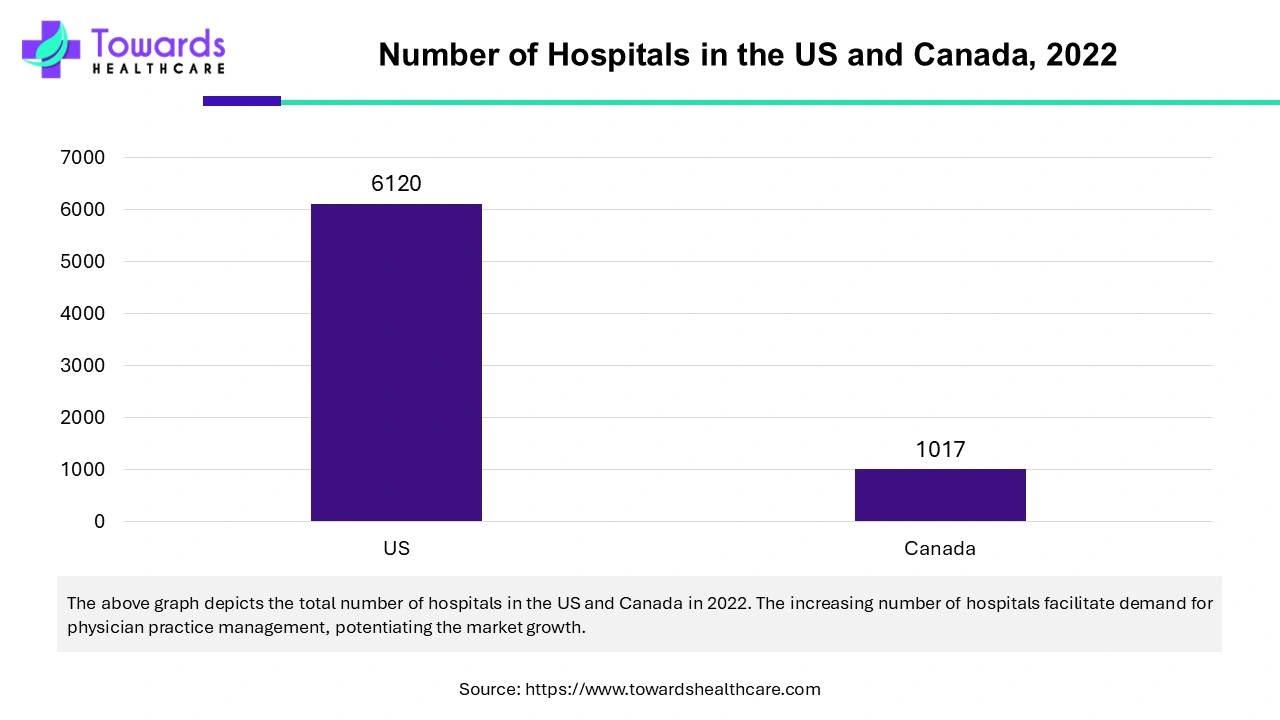
The major growth factor for the market is the increasing number of hospital admissions. This is due to the rising prevalence of chronic disorders, surgeries, and road accidents. The growing geriatric population and sedentary lifestyles are major causes of chronic disorders, leading to hospital admissions. According to the American Hospital Association (AHA), over 34 million people were admitted to hospitals in 2023. (Source: AHA) All these aspects necessitate healthcare professionals to adopt physician practice management in healthcare organizations to deal with multiple patients simultaneously. The management tools also offer professionals to manage their administrative tasks and generate revenue while providing state-of-the-art care.
North America dominated the physician practice management market in 2025. The advanced healthcare infrastructure, technological advancements, favorable government policies, and increasing investments drive the market. American Medical Association is at the forefront of providing physician management services in the region. In 2022, the healthcare venture capital fundraising hit nearly $22 billion in the US. Healthcare spending in the US accounted for $4.5 trillion and $331 billion in Canada in 2022. The Department of Health and Human Services promotes the use of AI in the healthcare sector to enhance the health and well-being of Americans.
U.S. Advancing Physician Practice Management
The U.S. physician practice management market is growing as practices increasingly adopt digital solutions to streamline scheduling, billing, claims processing, documentation, and revenue-cycle activities. Rising administrative complexity, reimbursement challenges, healthcare IT adoption, and demand for efficient patient management are supporting growth. Increasing use of cloud-based platforms, automation, artificial intelligence, and data analytics is further transforming practices’ operations across the country.
Canada: Accelerating Digital Practices Management
Canada physician practices management market is expanding due to increasing healthcare digitization, demand for streamlined administrative workflows, and growing adoption of electronic health solutions. Rising pressure to improve operational efficiency is encouraging practices to adopt cloud-based management platforms, automated billing, digital scheduling, and data analytics. Government-supported digital health initiatives and investments in healthcare technology are further creating opportunities for market development.
Asia-Pacific is anticipated to grow fastest in the physician practice management market during the forecast period. The rapid advancements in healthcare infrastructure, increasing investments, and technological advancements drive the market. The rising geriatric population in the region leads to increasing incidences of chronic disorders, thereby increasing the number of hospitalizations and requiring advanced physician practice management services. The Indian Council of Medical Research (ICMR), the Chinese Medical Council, and the Japan Medical Association govern the healthcare practices in India, China, and Japan, respectively. Implementing AI in the healthcare sector in these countries also potentiates market growth.
China: Accelerating Healthcare Digitalization
China’s physician practice management market is growing due to rapid healthcare digitalization, expanding medical infrastructure, and increasing demand for efficient administrative management. Growing adoption of electronic health records, cloud-based healthcare platforms, digital appointment systems, and automated billing is improving practice efficiency. Government-led healthcare modernization, rising healthcare spending, and technological advancements in artificial intelligence and data analytics are further supporting market expansion.
India: Accelerating Digital Healthcare Transformation
India’s physician practice management market is expanding due to increasing healthcare digitization, growing private healthcare networks, and rising demand for efficient practice operations. Wider adoption of electronic health records, cloud-based platforms, digital scheduling, and automated billing is improving administrative efficiency. Growing healthcare expenditure, expanding telemedicine services, and government-led digital health initiatives are further creating opportunities for technology-enabled physician practice management solutions.
Europe is expected to grow at a notable CAGR in the market in the foreseeable future. The increasing healthcare expenditure and the rising adoption of advanced technologies are the major growth factors of the market in Europe. The growing demand for personalized treatment and advanced care facilitates the use of physician practice management. The increasing integration of EHRs and telehealth tools potentiates market growth. Government organizations impose regulations to support the development and deployment of digital health solutions in healthcare organizations.
There are approximately 2 million practicing physicians across the EU. According to a recent survey, 2.9 million hospitalizations were recorded in France related to acute heart failure from 2013 to 2024. In the UK, the number of private hospital/clinic admissions reached 939,000 in 2024, an increase of 3% from 2023. (Source: Healthcare Property).
Moreover, it is estimated that over 70% of all hospitals in Germany have adopted EHR systems. European countries like Catalonia, Denmark, and Italy, allow the healthcare industry to use digital tools and solutions apart from the ones established by the government.
UK: Accelerating Digital Practice Management
The UK physician practice management market is growing due to increasing adoption of digital healthcare systems, demand for streamlined administrative workflows, and efforts to improve practice efficiency. Greater use of electronic health records, cloud-based platforms, digital appointment scheduling, and automated billing is supporting operational improvements. NHS digital transformation initiatives, rising healthcare service demand, and growing use of data-driven technologies are further creating opportunities for market expansion.
Germany: Advancing Digital Practice Management
Germany’s physician practice management market is expanding due to increasing healthcare digitalization, growing adoption of electronic health records, and demand for efficient administrative workflows. Investments in healthcare IT infrastructure are supporting cloud-based practice management, digital scheduling, automated billing, and data management. Government-backed digital health initiatives, interoperability efforts, and the need to reduce administrative workloads are further supporting adoption across physician practices.
By type, the billing of physician services segment accounted for the highest share of the market. This is due to the increasing number of out-patient and in-patient services in a hospital that increases the burden on hospital staff for the billing process. Physician practice management helps in handling billing. Advanced technologies and software simplify the billing service.
The hospital contracts are estimated to witness lucrative growth in the market over the forecast period. Hospital contract management is the systematic process of creating, negotiating, executing, monitoring, and optimizing contracts to ensure compliance, mitigate risks, and achieve healthcare organizations’ strategic objectives.
By application, the organization service segment held the largest share of the market. This segment dominated because physician practice management streamlines the workflow of the whole organization. It ensures that the business runs smoothly and is profitable, allowing physicians to work with patients more effectively and efficiently. Financial management, human resources management, regulatory compliance, and strategic planning and marketing are some of the tedious tasks of a healthcare organization, which can be easily governed by physician practice management.
The personal service market will gain a significant share of the market over the studied period. On a personal level, physician practice management schedules patient appointments, handles billing for patient services, and follows up with patients for billing. The latest technological innovations and rising physician burnout rates promote the segment growth.
In June 2025, Monarch launched a platform for women’s health physicians to establish independent, membership-based practices while retaining full ownership and clinical autonomy. Dr. Suzanne Gillberg, Chief Clinical Officer at Monarch, commented that the company allows for the practice of medicine rooted in deep relationships, centered on the full spectrum of health, and driven by clinical excellence. (Source: Femtech Insider)
By Type
By Application
By Region



Principal Consultant
Payal Rabde is a Healthcare Market Research Analyst at Towards Healthcare Research & Consulting with 4+ years of experience in pharmaceuticals, biotechnology, medical devices, and life sciences.
Learn more about Payal Rabde

Reviewed By
Aditi Shivarkar is a seasoned professional with over 14 years of experience in healthcare market research. As a content reviewer, Aditi ensures the quality and accuracy of all market insights and data presented by the research team.
Learn more about Aditi Shivarkar