Pipeline Programs

CGT Companies Tracked

Manufacturing Facilities
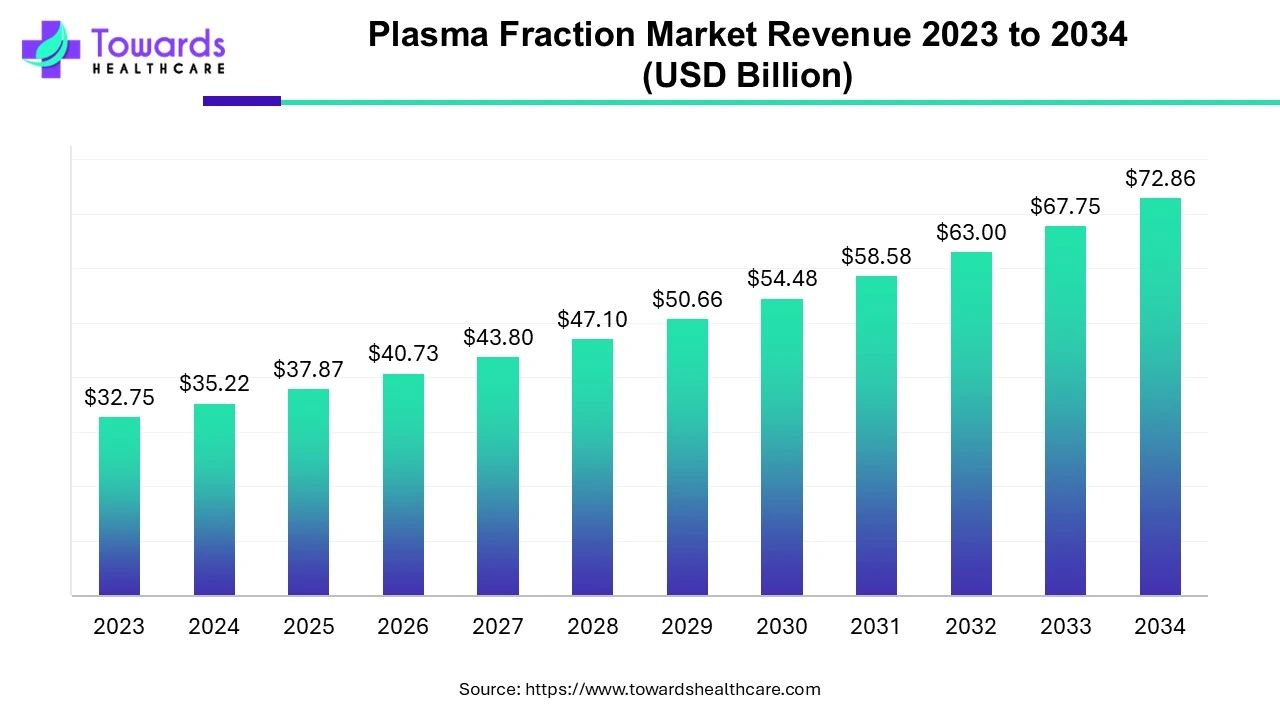
The global plasma fraction market was estimated at US$ 32.75 billion in 2023 and is projected to grow to US$ 72.86 billion by 2034, rising at a compound annual growth rate (CAGR) of 7.54% from 2024 to 2034. There is a rising demand to create medicine products derived from plasma to treat rabies, tetanus, shock, and trauma. This factor is owing to the growth of the plasma fraction market.
Plasma fractionation is a separation process dividing different components of protein. Human blood plasma undergoes the process of fractionation for a variety of purposes including pharmaceutical research and to increase fractionation technologies. The prevalence of global diseases such as immunodeficiencies and genetic defects propels manufacturing companies to produce large quantities of high-quality medicine to meet the demand which also boosts the market of plasma fraction.
In the course of time, the scope of plasma fraction is expanding in the healthcare industry and therapeutics/biologics. Till now there are over 20 different proteins used. Plasma comprises water (91.5%), protein (7%) and salt (1.5%). Protein consists of Albumin (54%), immunoglobulin (38%), and Fibrinogen (7%).
Plasma fractionation is the process of separating and purifying proteins from donated human blood plasma to produce therapeutic medicines. The plasma fractionation market is growing as healthcare providers face increasing demand for plasma-derived products used in managing immune deficiencies, bleeding disorders, and other complex conditions. Key trends include expansion of plasma collection centers, improved donor management, greater focus on supply security, and increasing use of automated processing. Technological advancements in chromatography, filtration, purification, viral inactivation, and chromatography, filtration, purification, viral inactivation, and process monitoring are improving product safety, consistency, and manufacturing efficiency. Major drivers include growing diagnosis of chronic and rare disorders, wider access to specialized therapies, and the development of more efficient fractionation processes, recovering a broader range of valuable plasma proteins, expanding production capacity, and strengthening plasma supply networks in emerging markets. These developments are supporting reliable access to essential plasma-derived therapies.
Integrating artificial intelligence (AI) and automation in the plasma fractionation processes streamlines the entire workflow, improving efficiency and accuracy. It also helps to eliminate human errors and lower operational costs for the fractionation process. The adoption of advanced technologies and improved manufacturing processes can produce products with enhanced purity and yield. AI can overcome several limitations of the plasma fractionation process. It can simplify the isolation of numerous plasma components, which is difficult to do through conventional methods. AI can also aid in the effective long-term storage of plasma components using automated storage systems.
The future of the market is promising owing to the increasing awareness of blood and plasma donations. The rising incidences of hematological disorders, organ failures, and the rising number of surgeries necessitate the demand for plasma transfusions, thereby promoting market growth. Several government organizations conduct blood donation camps to increase awareness about blood donations. The WHO also supports blood donations by celebrating World Blood Donor Day on the 14th of June every year. All these events significantly increase awareness among the general public. It is estimated that nearly 16 million blood components are transfused annually in the U.S. In 2023, Poland recorded a 5.2% increase in donations of blood and its components, accounting for 640.2 thousand blood donors.
With time immunoglobulin is leveraging its potential to treat immunodeficiencies, autoimmunity and many more. Immunoglobulin has a wide range of clinical applications in immune modulation. Initially, it was used to treat primary immunodeficiency disorders produced by insufficient development of antibodies. Currently, it is used as first-line therapy for genetic conditions such as immunodeficiency and X-linked agammaglobulinemia. Facilitation of immunoglobulin in inflammatory and autoimmune diseases such as Guillain-Barre syndrome, chronic inflammatory demyelinating polyneuropathy and still-person syndromes helps to calm the overactive immune responses by neutralizing cytokines and autoantibodies, fuelling the growth of plasma fraction market.
Despite the life-saving benefits of plasma and its derived protein, the high cost of plasma-derived medicine products is slowing the market growth. The increase in the cost of plasma has directly impacted the sustainability of PDMP production. During a pandemic, several countries were in shortage of immunoglobulin which caused rationing in the case of diseases. Even in countries such as Germany and the United States with higher supply of commercially sourced plasma has been observed at a shortage due to the increasing demand for PDMP production. In the last 5 years, the cost of plasma per litre has increased by 59.3% in Europe and 40.7% in the United States.
North America dominated the plasma fraction market in 2023. The growth of this region is attributed to rising numbers of exports of plasma from America. North America is the leading region for the largest exporter of plasma. The United States is one of the few countries to let companies pay for plasma, the U.S. supplies about 70% of the world’s plasma. The United States collects the majority of the world’s plasma for the production of plasma-derived medicinal products (PDMP).
Europe expected the grow at the fastest during the forecast period. The growth in this region is observed due to its strict regulations and restrictions. The rising shortage of plasma leads many countries to rely on imports to meet their medical needs. In Europe just 4 countries (Austria, Czechia, Germany, and Hungary) contribute more than 55% of total plasma collected goes under manufacturing.
By type, the immunoglobulins segment accounted for the highest market share in 2023. Plasma-derived Immunoglobulin is a significant part of the healthcare industry in the field of autoimmune inflammatory diseases. They are formed through the natural biological process in which the body is under recovery after an attack from an infectious organism (such as COVID-19). Oftentimes, immunoglobulins are the singular treatment to deal with rare conditions such as primary immunodeficiency.
The coagulation factors segment is expected to grow at the fastest rate during the projected period. The expansion of this segment is observed due to its use in the treatment of blood clotting diseases such as hemophilia and Von Willebrand’s disease.
By application, the hospital segment dominated the plasma fraction market by holding the largest market share. The dominance of this segment is credited to the use of plasma protein for patient treatment in hospitals. Plasma protein helps in recovering from burns, trauma, animal bites, shocks, major surgery, hepatitis, RH incompatibility, organ transplant, paediatric HIV, and liver conditions.
The retail pharmacy segment is expected to grow at the fastest rate in the plasma fraction market during the projected period. The expansion of this segment is observed due to the increasing number of human donors which provides enough supply of plasma. A rise in the number of patients eligible to be treated by plasma-derived therapy also increases the supply and sell in the retail pharmacy segment.
Dr. Ranjeet S. Ajmani, CEO of Aegros Asia, commented on his appointment as the new CEO of the company that the vision of the company is to change the landscape of plasma fractionation in Asia and other developing countries by creating sustainable models in the region using HeamaFrac process. He added that more than 2 million liters of plasma are wasted annually in Asia. He envisions collaborating with numerous blood centers, regulators, and local and international organizations. He concluded that the company aims to improve the quality of life of patients in Asia by consistently providing safe plasma-derived medicines.
The U.S. plasma fractionation market is significantly growing due to high demand for plasma-derived therapies and advanced healthcare infrastructure. Rising treatment needs for immune deficiencies, bleeding disorders, and neurological conditions are supporting consumption. Well-established plasma collection networks, advanced fractionation technologies, strong pharmaceutical capabilities, and increasing investment in biotechnology are further strengthening market development and ensuring availability of essential plasma-based medicines.
Canada’s Plasma Fractionation Market is Expanding
Canada’s plasma fractionation market is notably expanding due to increasing demand for plasma-derived medicines and growing treatment needs for immune and bleeding disorders. Efforts to strengthen domestic plasma collection and improve supply security are supporting market development. Advancements in plasma processing, increasing healthcare investments, and greater awareness of specialized therapies are further encouraging adoption and creating opportunities for expanded fractionation capacity across the country.
UK Plasma Fractionation Market is Advancing Rapidly
The UK plasma fractionation market is significantly expanding due ti rising demand for plasma-derived medicine and increasing treatment requirements for immune and bleeding disorders. Greater focus on maintaining a reliable plasma supply os supporting market development. Advances in purification and fractionation technologies, increasing healthcare investments, and growing access to specialized therapies are further strengthening production capabilities and creating opportunities for market expansion.
Germany’s Plasma Fractionation Market is Gaining Momentum
Germany’s plasma fractionation market is notably increasing due to strong demand for plasma-derived therapies and a well-developed healthcare system. Rising treatment needs for immune deficiencies, bleeding disorders, and other chronic conditions are supporting market growth. Advanced pharmaceutical manufacturing, established plasma processing capabilities, and continuous investment in biotechnology are strengthening the sector. Growing focus on treatment availability and reliable plasma suppliers is further creating opportunities for expansion
By Type
By Application
By Region



Principal Consultant
Payal Rabde is a Healthcare Market Research Analyst at Towards Healthcare Research & Consulting with 4+ years of experience in pharmaceuticals, biotechnology, medical devices, and life sciences.
Learn more about Payal Rabde

Reviewed By
Aditi Shivarkar is a seasoned professional with over 14 years of experience in healthcare market research. As a content reviewer, Aditi ensures the quality and accuracy of all market insights and data presented by the research team.
Learn more about Aditi Shivarkar