

Pipeline Programs

CGT Companies Tracked

Manufacturing Facilities


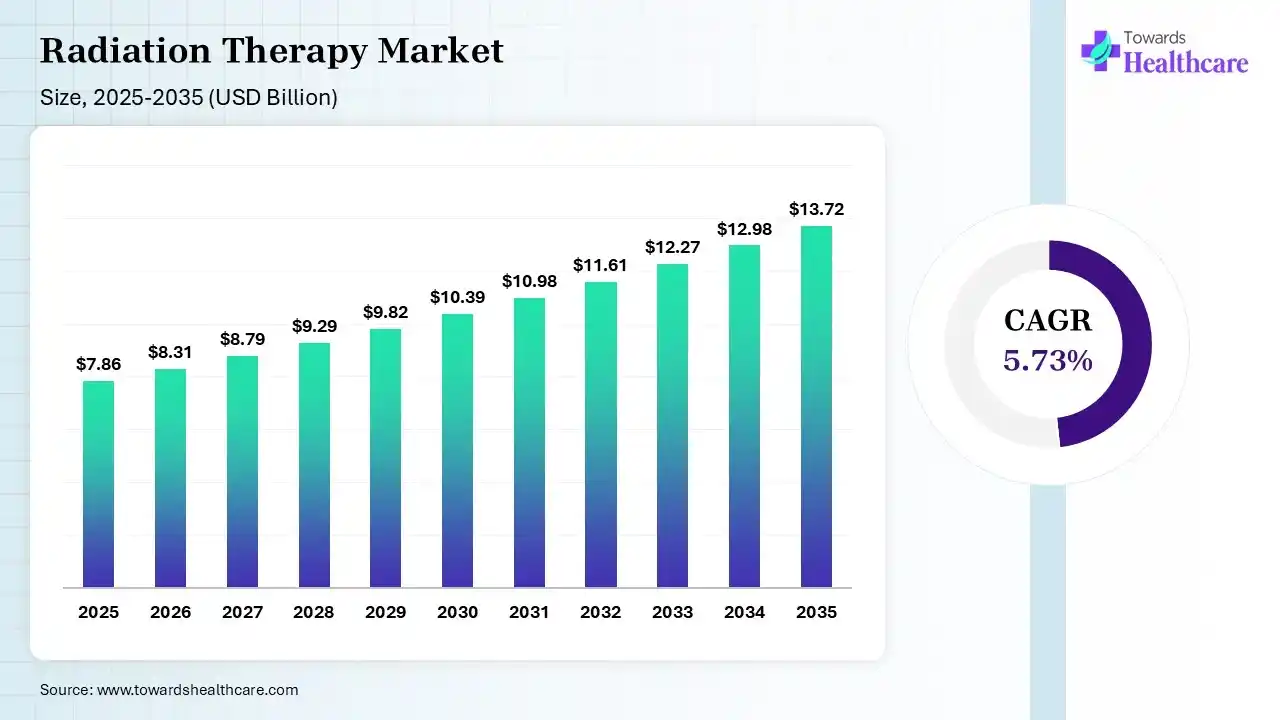
The global radiation therapy market size is calculated at USD 7.86 in 2025, grew to USD 8.31 billion in 2026, and is projected to reach around USD 13.72 billion by 2035. The market is expanding at a CAGR of 5.73% between 2026 and 2035. The rising cases of cancer, specifically in developing and underdeveloped countries, are driving the radiation therapy market.
One of the most popular cancer therapies is radiation therapy. Radiation therapy is part of the treatment for almost half of cancer patients. It may be referred to as radiation treatment, irradiation, radiotherapy, or x-ray therapy. It functions by destroying or harming cancer cells with high-energy radiation, such as X-rays. Radiation therapy can be used to treat cancer, reduce tumor size before surgery, or eliminate any cancer cells that remain after surgery, either alone or in combination with other therapies. In cases of advanced cancer, it may also be used to alleviate symptoms.
One of the main factors propelling the radiotherapy industry is the rising incidence of cancer worldwide. With an estimated 10 million deaths in 2020, cancer is the leading cause of death globally, according to the World Health Organization (WHO). According to the International Agency for Research on Cancer (IARC), the global cancer burden is expected to increase by 47% from 2020 to 28.4 million cases in 2040. The market is growing because of the growing patient population's need for easier access to effective cancer treatments like radiation. The radiation therapy market is expanding as a result of continuous improvements in radiation therapy techniques and apparatus.
In May 2025, the state government of Uttar Pradesh revealed a new health policy for developing private super-speciality hospitals in all districts. The treatment for diseases such as cancer, heart, neurological disorders, and kidney will be provided to enhance access to quality care for millions of residents by these facilities. The model A will offer radiation therapy, surgical oncology, cardiology, gynaecology, neurology, obstetrics, and urology. Model B will provide the same level of medical facilities similar to Model A. Model C will provide general medicine, maternal care, essential services, and basic surgery.
Shorter Treatment Courses
Radiation therapy is moving toward shorter treatment schedules. Hypofractionation and stereotactic techniques can deliver higher doses in fewer visits. This helps patients spend less time in hospitals. It also improves machine use and treatment capacity. Proton therapy is gaining attention where reducing healthy tissue exposure matters. Recent clinical experience shows fraction numbers continuing to fall, supporting faster care without losing treatment precision for suitable patients across cancer centers worldwide.
Wider Access to Advanced Care
More cancer centers are expected to add image-guided, stereotactic, and proton-based treatment options. Compact proton systems may make installation easier for smaller centers. Growth will also come from better treatment planning, stronger clinical evidence, and improved reimbursement. Emerging markets can benefit from new oncology centers and public healthcare programs. These changes should make advanced radiation treatment more available beyond major cities over time globally in coming years steadily.
Focus on Patient Convenience
Radiation therapy will increasingly balance treatment quality with patient comfort. Fewer sessions can reduce travel, waiting, and treatment costs. Outpatient care is likely to expand for suitable patients. Hospitals will also invest in reliable equipment, staff training, and maintenance services to keep treatment running smoothly. Proton therapy, adaptive approaches, and improved quality checks may support safer delivery as clinical evidence grows and protocols become more standardized worldwide for patients safely.
Radiation therapy is a cancer treatment that uses high-energy radiation to damage and destroy cancer cells while minimizing exposure to surrounding healthy tissues. The radiation therapy market is growing as the global burden of cancer increases and patients seek effective, targeted treatment options. A major trend is the shift toward precision radiation, image-guided procedures, and personalized treatment planning. Technological advancements such as intensity-modulated radiation therapy, stereotactic techniques, proton therapy, artificial intelligence, and real-time imaging are improving treatment accuracy and efficiency.
Future opportunities include adaptive radiation therapy, automated treatment planning, and integration of AI with imaging and clinical data. Increasing investments in oncology infrastructure and expanding access to specialized cancer care are supporting market development. Growing demand for minimally invasive treatment, better patient outcomes, shorter treatment schedules, and improved radiation delivery is further driving adoption across hospitals and specialized cancer centers.
The whole field of cancer treatment has been transformed by artificial intelligence (AI), and it is beginning to show significant promise for influencing radiation oncologists' jobs. AI is mostly used in radiation oncology to assist with radiation administration. AI can improve the accuracy of mobility management and adaptive radiation treatment. Additionally, AI has been used for critical therapeutic activities, including response evaluation and data exchange. Currently, AI is being included in diagnostic film computer-assisted detection.
For instance,
Driver
Technological Advancements in Radiotherapy
Technology is essential to the ongoing advancement of radiotherapy. The journey to contemporary "high-tech" radiation oncology has been filled with technological advancements and discoveries brought about by the collaboration of other disciplines. In a number of areas, including image guiding, adaptive radiation, artificial intelligence integration, heavy-particle treatment, and "flash" ultra-high dose-rate radiotherapy, technology-driven research is a vibrant and busy sector with significant possibilities. The shift to personalized oncology will have a significant impact on technology-driven research, which aims to incorporate omics studies and predictive models into quick and effective solutions to provide each patient with the best care possible.
Restraint
Complexity in Radiotherapy
Understanding the fundamentals of medical physics, dosimetry, radiotherapy planning, radiobiology, delivery, how radiation therapy interacts with other treatment modalities and radiation safety are all important components of the intricate process of radiotherapy. Operations have become more difficult as a result of the advancement of sophisticated radiation technology. Additionally, to achieve maximal tumor control with little danger to normal tissue, a high degree of precision is required at every stage of the procedure. Additionally, procuring a cobalt source presents regulatory challenges due to the source's high radioactivity and inability to be switched off, and the increased complexity of LINACs calls for more regular quality assurance testing. It is anticipated that these complications would prevent radiation from being widely used to treat cancer.
Opportunity
Development of Personalized Radiotherapy Treatment
Imaging, radiomics, and RT technical features can all be a part of personalized radiation oncology. In the age of precision medicine, the therapeutic window for radiation oncology is expanding due to recent technological advancements in imaging, adaptive radiotherapy, and treatment conformity. These advancements not only enable individual dose escalation strategies but also open up new possibilities for re-irradiation in recurrent situations.
For instance,
| Table | Scope |
| Market Size in 2026 | USD 8.31 Billion |
| Projected Market Size in 2035 | USD 13.72 Billion |
| CAGR (2026 - 2035) | 5.73% |
| Leading Region | North America |
| Historical Data | 2020 - 2023 |
| Base Year | 2025 |
| Forecast Period | 2026 - 2035 |
| Measurable Values | USD Millions/Units/Volume |
| Market Segmentation | By type, By application, By end-use, By region |
| Top Key Players | Accuray Incorporated, Brainlab AG, Curium, Canon Medical Systems Corporation, Elekta AB, Hitachi High-Tech Corporation, IBA Radiopharma Solutions, IsoRay Inc., Mevion Medical Systems, Mitsubishi Electric Corporation, Nordion Inc., NTP Radioisotopes SOC Ltd., RefleXion, Toshiba Energy Systems & Solutions Corporation, Varian Medical Systems, Inc. |
By type, the external beam radiotherapy segment dominated the radiation therapy market in 2025. The most popular type of radiation oncology treatment is external beam radiation therapy (EBRT). Radiation therapy is given to around one-third of cancer patients. High-dose radiation is used to shrink tumors or kill malignant cells. External beam radiation treatment (EBRT) is used by medical experts to treat a variety of cancers. In addition, it is used to treat many non-cancerous tumors and other ailments.
By application, the breast cancer segment captured the major share of the radiation therapy market in 2025. The most prevalent cancer diagnosed in American women is breast cancer, which is also the most common disease in women globally. Currently, one in four female malignancies worldwide is breast cancer. Breast cancer is predicted to be the most frequent cancer among American women in 2025, with an estimated 316,950 new cases identified in the country. In the United States, a woman is diagnosed with the condition every two minutes. In the United States, a projected 2,800 males will receive a breast cancer diagnosis in 2025. This area has seen significant advancements in radiation technology development in recent years, including the performance of segmentation times and the evaluation of the curative effects of different radiotherapy procedures.
By application, the prostate cancer segment held the second-largest share of the radiation therapy market in 2025. The fourth most frequent cancer in the world is prostate cancer. It is the second most prevalent kind of cancer in males. The need to boost access to care in these nations is further supported by the fact that the incidence and death rates of prostate cancer rose in 11 and nine of the countries in Africa, Asia, and Latin America/Caribbean, respectively. According to predictions, the aging and expanding world population alone would cause the PC burden to rise to over 2.4 million cases and 712,000 deaths by 2040. About 7.5 million life-years are lost as a result of this rise in mortality, with the largest increases in anticipated life-years lost occurring in Africa, Asia, and Latin America/Caribbean.
By end-use, the hospitals segment held the major share of the radiation therapy market in 2025. The most recent external beam radiation treatment equipment is housed in the sophisticated radiology departments of the majority of institutions. Additionally, they have clinically qualified teams of radiation oncologists, medical physicists, dosimetrists, and nurses to manage the intricacies of radiation therapy planning and administration. Additionally, radiotherapy's strategic placement in hospitals promotes vital interdisciplinary cooperation with medical oncologists, surgical oncologists, and other experts to develop the best possible coordinated treatment plans. Finally, hospitals offer a one-stop shop for cancer patients who need extra treatments like chemotherapy, palliative care, PDT, etc., all under one roof. Hospitals are the ideal location for radiation operations because of these characteristics.
By end-use, the radiotherapy centers & ambulatory surgery centers segment is estimated to grow significantly in the radiation therapy market during the forecast period. Advanced radiation equipment is being quickly adopted by the cancer clinic segment in order to deliver cutting-edge and efficient patient treatment. Their ability to provide streamlined and efficient services, frequently with decreased patient wait times, is a result of this. Furthermore, cancer clinics could offer more individualized care and more flexibility with regard to appointment scheduling. Because outpatient care environments are more convenient, less expensive, and less burdensome for patients than in-hospital treatments, there is a growing need for ambulatory radiation clinics.
North America dominated the radiation therapy market in 2025. This domination may be ascribed to a variety of things, including the region's high rate of cancer patients receiving radiation treatments, growing research, the existence of reputable medical institutions, advantageous reimbursement practices, and the industry's stronghold.
Because of its strict regulations and robust medical equipment sector, the United States leads the global market for radiotherapy. In the U.S., millions of new instances of cancer of all varieties are identified each year, indicating a high incidence of the disease. The requirement for sophisticated radiation modalities that provide accurate and focused treatment delivery while limiting harm to surrounding healthy tissues is fueled by the rising incidence of cancer, which in turn is driving market expansion.
U.S. Radiation Therapy Market: Leading the Shift Toward Precision Cancer Care
The U.S. radiation therapy market is significantly growing due to the rising burden of cancer and strong demand for precise, personalized treatment. Advanced healthcare infrastructure and high adoption of modern radiation technologies are supporting market expansion. Increasing use of proton therapy, stereotactic radiation, image-guided treatment, and AI-assisted planning is improving treatment accuracy. Strong oncology research, continuous technological innovation, and investments in specialized cancer centers are further driving the adoption of advanced radiation therapy solutions.
Canada Radiation Therapy Market: Strengthening Advanced Cancer Care
Canada holds a notable share of the radiation therapy market due to growing cancer care needs and increasing demand for advanced treatment technologies. Expanding oncology infrastructure and improvements in specialized healthcare services are supporting wider access to radiation treatment. Adoption of image-guided therapy, intensity-modulated radiation therapy, and other precision techniques is improving treatment quality. Continued investment in cancer research, healthcare modernization, and advanced radiation systems is further strengthening Canada’s position in the market.
Asia Pacific is estimated to host the fastest-growing radiation therapy market during the forecast period. Rapid economic growth in nations like China, India, Japan, and South Korea is making it easier for people to access cutting-edge medical facilities. The Asia Pacific radiotherapy market is being driven by a number of important reasons, including rising healthcare costs, an aging population, and increased public knowledge of cancer treatment choices. The market is seeing an increase in imports from large international companies in order to satisfy domestic demand. Additionally, a large number of international original equipment manufacturers (OEMs) have established production facilities or partnered with regional companies in high-potential nations. This has made gadgets more inexpensive and guaranteed a consistent supply. More individuals are choosing to undergo advanced radiation treatment procedures as the region's supply of technologically advanced items grows.
India Radiation Therapy Market: Expanding Access to Advanced Cancer Care
India is notably growing in the radiation therapy market due to the increasing cancer burden and rising need for effective treatment options. Expansion of oncology hospitals and improvements in healthcare infrastructure are increasing access to radiation services. Adoption of advanced technologies such as image-guided therapy, intensity-modulated radiation therapy, and stereotactic techniques is improving treatment precision. Growing healthcare investments, increasing awareness, and efforts to expand specialized cancer care are further supporting market development.
China Radiation Therapy Market: Strengthening Its Market Position
China has a significant share of the radiation therapy market due to its large patient population and increasing cancer treatment needs. Expansion of oncology facilities and healthcare infrastructure is improving access to radiation-based care. Growing adoption of advanced technologies such as image-guided therapy, intensity-modulated radiation therapy, and stereotactic treatment is enhancing clinical capabilities. Increasing healthcare investment, domestic technology development, and efforts to improve cancer care are further strengthening China’s position in the market.
Europe is expected to grow significantly in the radiation therapy market during the forecast period. Europe is experiencing an increase in the cancer incidence rates, which in turn, is increasing the demand for the use of radiation therapies. At the same time, the technological advancements are also being used to improve radiation therapies. Furthermore, the government is also supporting by offering different schemes.
UK Market Trends
The healthcare sector in the UK is advancing with the use of technological advancements, which are being used in enhancing the performance of radiation therapies. Moreover, the government is also providing the scheme to the patient, which helps in making these treatments more accessible.
Germany Market Trends
The industries in Germany are focusing on the development of cancer therapies to deal with the rising demand. At the same time, the rising prevalence of cancer is increasing the need for radiation therapy, increasing their production. Thus, all these factors promote the market growth.
In May 2026, Tina Yu, CEO and President of Mevion Medical Systems, emphasized the system's breakthrough potential, stating, "For the first time, proton therapy can be deployed within the same clinical framework as conventional radiotherapy. This innovation allows European health systems to reconsider their strategy from investing in separate proton facilities to integrating this technology into their existing programs."
By Type
By Application
By End-use
By Region



Principal Consultant
Payal Rabde is a Healthcare Market Research Analyst at Towards Healthcare Research & Consulting with 4+ years of experience in pharmaceuticals, biotechnology, medical devices, and life sciences.
Learn more about Payal Rabde

Reviewed By
Aditi Shivarkar is a seasoned professional with over 14 years of experience in healthcare market research. As a content reviewer, Aditi ensures the quality and accuracy of all market insights and data presented by the research team.
Learn more about Aditi Shivarkar









