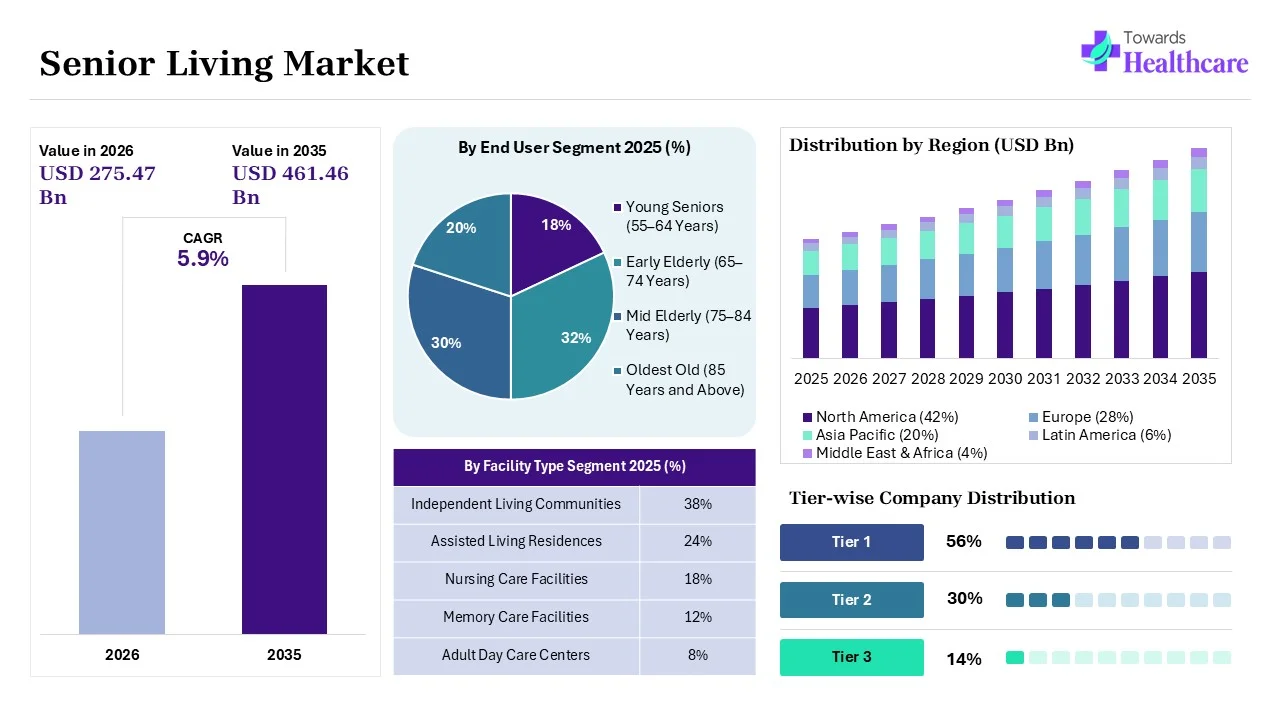
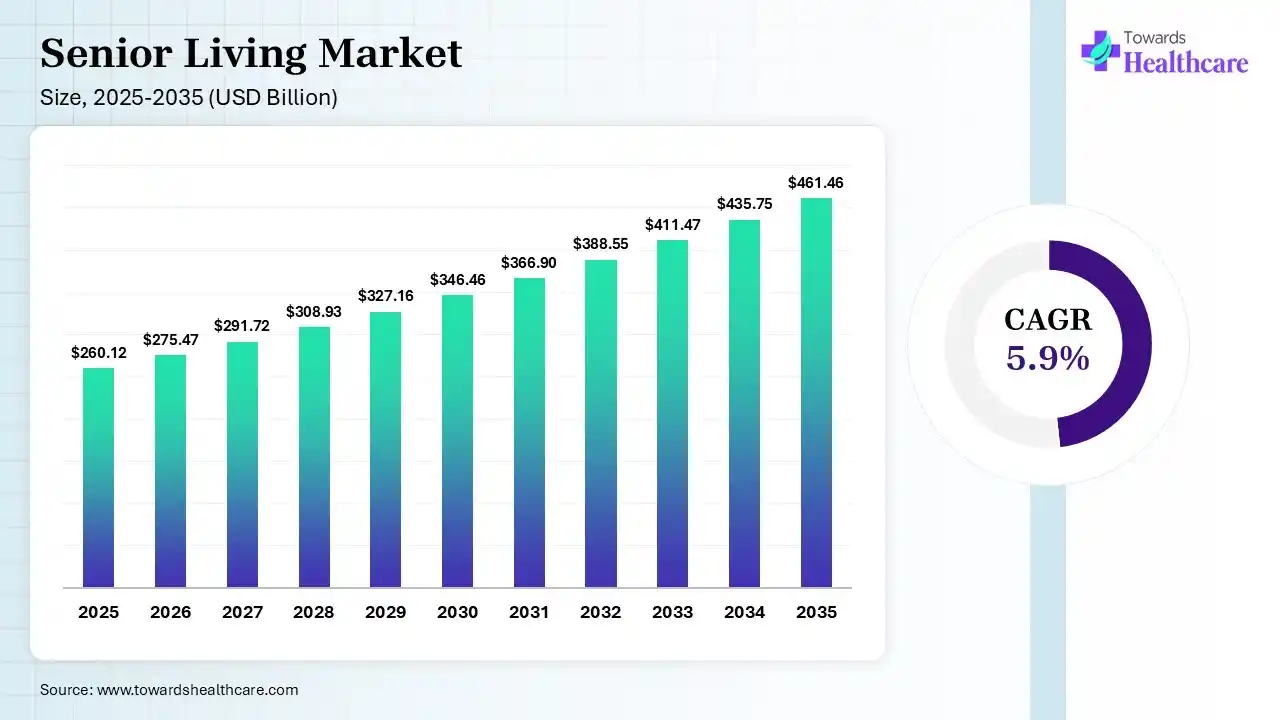
The senior living market size was valued at US$ 260.12 billion in 2025 and is projected to grow to 275.47 billion in 2026. Forecasts suggest it will reach approximately US$ 461.46 billion by 2035, registering a CAGR of 5.9% during the period.
Senior living is a concept that encompasses a wide range of housing and lifestyle standards for ageing people adapted to the interests and complexities of health challenges related to ageing, like restricted mobility and vulnerability to illness. Senior living includes various housing and care choices for aging adults, from senior apartments and self-governing living communities for active seniors to nursing homes for those with significant healthcare needs. Many seniors have symptoms of Alzheimer’s disease or a different type of dementia, and they require help with ADLs.
Senior living societies authorize seniors to remain as independent as possible while helping with their specific needs, improving their quality of life, and offering peace of mind to their loved ones. There are a variety of reasons for choosing to shift to senior living or employ a home care provider. Senior living refers to specialized communities intended to cater to the lifestyle, medical care, and social requirements of older adults. These various types of senior living communities provide a wide range of services from independent living to supported living, and even memory care services.
Senior living refers to residential communities that provide housing, healthcare, wellness, and supportive services for older adults, ranging from independent living and assisted living to memory care and skilled nursing, based on individual care needs. Growth is driven by the expanding elderly population, increasing life expectancy, and rising demand for comfortable, service-oriented living environments. Greater emphasis on active aging, personalized wellness programs, and integrated healthcare is further accelerating adoption. Technological advancements such as AI-powered care management, smart home automation, wearable health devices, telehealth, and remote patient monitoring are improving safety and quality of care. Future opportunities are emerging through age-friendly community development, digital health integration, sustainable residential designs, and value-based care models, enabling providers to deliver more connected, efficient, and resident-centric living experiences while supporting healthier and more independent aging.
AI-based technology in senior living provides a significant opportunity to increase care and processes implemented with a significant purpose. This technology is an innovative solution that improves health management, social engagement, safety, cognitive support, and targeted care for seniors. serves as a force multiplier for existing staff. AI is becoming a strategic asset for forward-thinking organizations. AI-powered marketing personalization, rapid response systems, and data-driven care optimization are differentiating leaders from laggards. senior living operators, embracing AI has evolved from a nice-to-have enhancement to a dual authoritative, simultaneously increasing resident results and securing business viability. Machine learning also supports communities in analyzing large volumes of information rapidly, whether forecasting resident health challenges or spotting economic trends. Natural language processing (NLP) powers voice assistants for inhabitants, allows multilingual communication, and systematizes staff documentation.
Tech-Driven Healthcare Platforms:
Advanced technology is renovating adult care by making health management more accessible, targeted, and proactive. Predictive monitoring in physical therapy, innovations support seniors in maintaining independence, safety, and quality of life. AI-driven tool addresses a specific requirement, from managing chronic conditions to helping mental health, allowing elderly patients to live more confidently and comfortably. Advanced systems analyze health records, genetic data, lifestyle factors, and healthcare histories to make a comprehensive outline of the patient.
Multi-Generational Integration:
Multigenerational living supports ensuring that seniors have someone available to help with day-to-day tasks, like managing medical care and getting to healthcare appointments. This type of living offers older adults significant opportunities to share their own perceptions and emotional support. Its goal is to meet the requirements of people of all ages and stages of life. These homes support parents and elders via thoughtful design, shared spaces, and family-focused planning.
Boomer-Led Consumer Demand:
Boomers have the support to shape the senior-living landscape by wanting customizable living choices via their amenities, housing, or community events. This involves significant optionality in everyday life, more intentional community design, and raised service models that reflect hospitality standards. Boomers rank proactive wellness and longevity. Major communities recently adapted by providing preventative health agendas and dynamic outdoor recreational access.
| Table | Scope |
| Market Size in 2026 | USD 275.47 Billion |
| Projected Market Size in 2035 | USD 461.46 Billion |
| CAGR (2026 - 2035) | 5.9% |
| Historical Data | 2020 - 2023 |
| Base Year | 2025 |
| Forecast Period | 2026 - 2035 |
| Measurable Values | USD Millions/Units/Volume |
| Market Segmentation | By Facility Type, By Ownership Model, By End User, By Accommodation Type, By Care Type, By Region |
| Top Key Players | Antara Senior Care, Ashiana Housing Ltd., Life Care Centers of America, Sunrise Senior Living, Brookdale Senior Living |
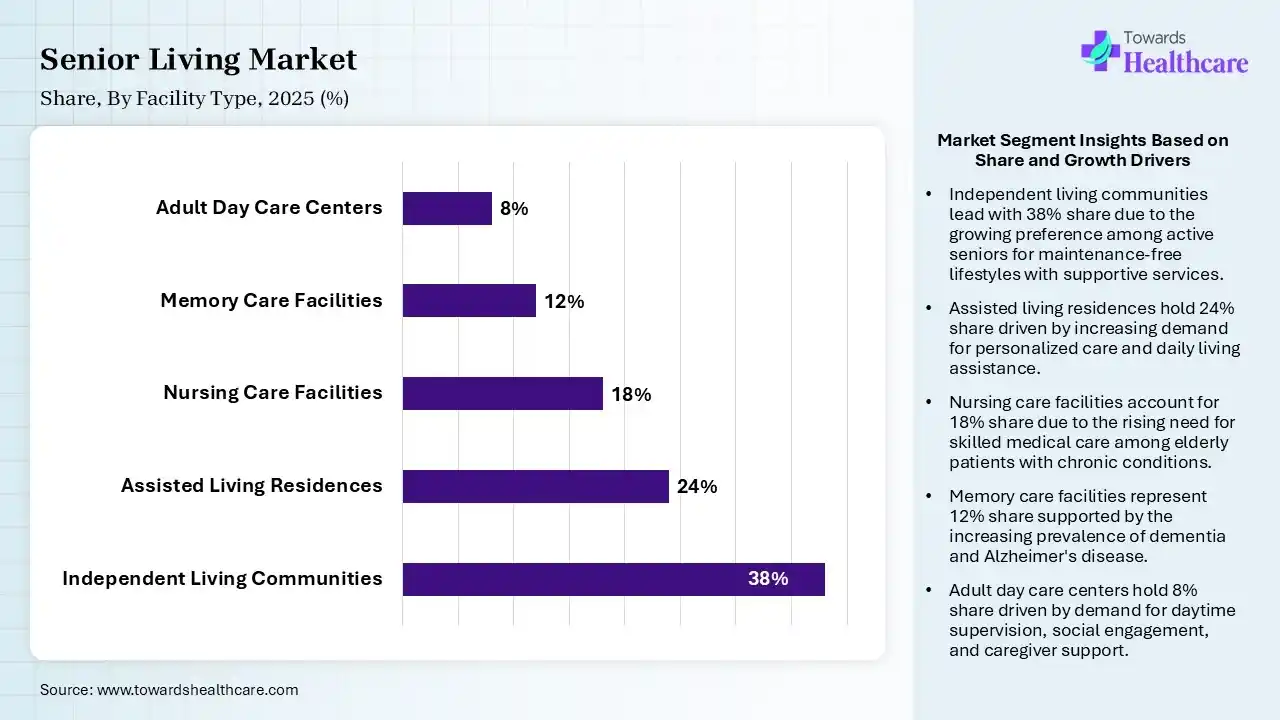
| Segment | Share 2025 (%) |
| Independent Living Communities | 38% |
| Assisted Living Residences | 24% |
| Nursing Care Facilities | 18% |
| Memory Care Facilities | 12% |
| Adult Day Care Centers | 8% |
The Independent Living Communities Segment Led the Senior Living Market in 2025
The independent living communities segment contributed the largest market share of 38% in 2025, as this type of living community provides a vibrant, maintenance-free lifestyle with a social network, healthcare programs, and conveniences, which makes everyday life simple and more pleasant. These communities boost and improve life in unseen pathways with advantages like greater social interaction and even peace of mind.
The assisted living residences segment held a significant share of 24%, and is expected to grow at the fastest CAGR of 7.2% during the forecast period in the market, as this living offers residents with extra support with actions of everyday living when and how they require it. It enables residents to enjoy their individuality with a bit of extra support, as well as all the benefits that come with assisted living.
The nursing care facilities segment held a significant share of the senior living market of 18% in 2025, as a nursing care plan involves enhanced society and coordination of care, targeted patient care, improved patient results, and efficient communication among healthcare professionals. It supports ensuring a systematic strategy to care, endorses consistency, and facilitates cooperative decision-making.
The memory care facilities segment held a significant share of 12% in 2025, as memory care is the specific level of care for patients with Alzheimer’s disease and various types of dementia. Memory care communities are precisely intended to meet the particular care requirements of those with cognitive impairment.
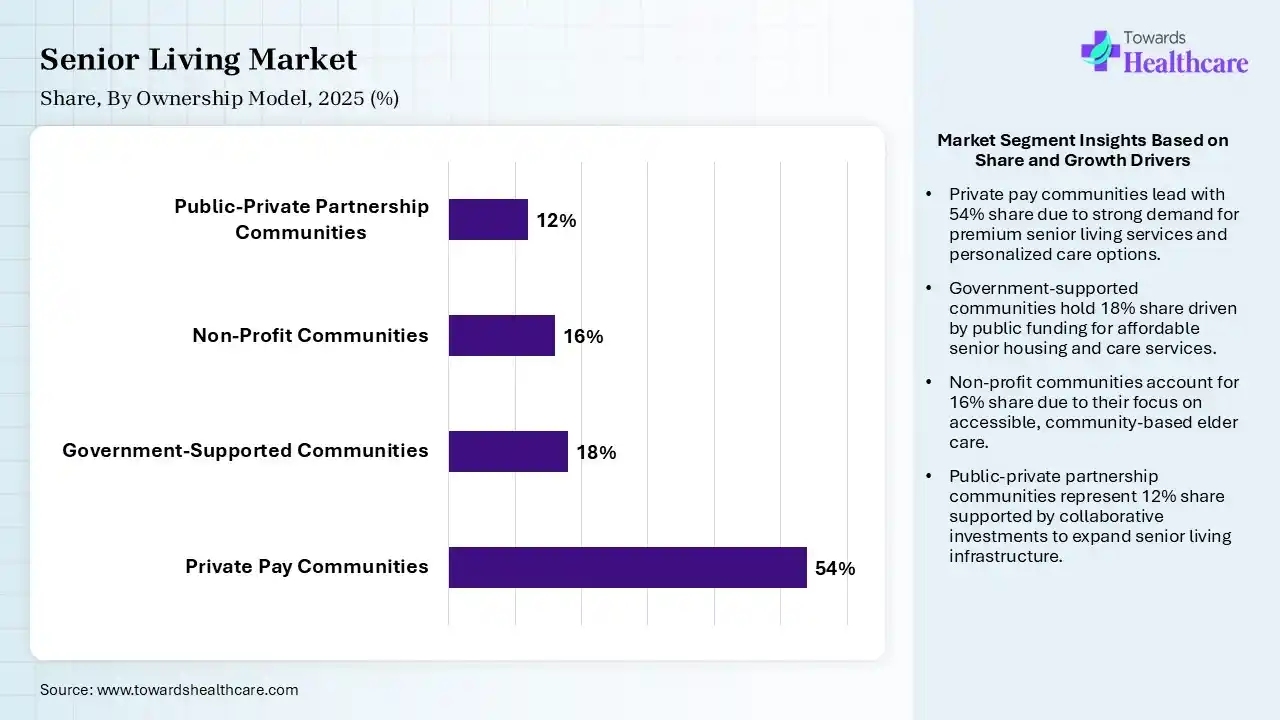
| Segment | Share 2025 (%) |
| Private Pay Communities | 54% |
| Government-Supported Communities | 18% |
| Non-Profit Communities | 16% |
| Public-Private Partnership Communities | 12% |
Private Pay Communities Segment Led the Senior Living Market in 2025
The private pay communities segment contributed the largest market share of 54%, as private-pay communities generally provide more flexibility and increasing quality as they are not restricted by public subsidy structures. Increasing clinical oversight, advanced lifestyle and wellness events, robust technology, and the capability to rapidly adjust targeted care plans are among the many advantages of a private-pay community.
The government-supported communities segment held a significant share of 18% of the market in 2025, as the government, realising the vulnerabilities of the adults, has started various measures towards their health services and housing. Senior living communities make it simple to connect with neighbors and promote relationships that are built on faith and shared experiences, lowering the challenges of anxiety or depression.
The non-profit communities segment held a significant share of 16% of the senior living market, as these communities required financial resources for the process; their significant motivation isn’t profitability. This spending goes straight into the maintenance and operation of the community, inspiring a living experience, in its place of serving shareholders or building profits. Non-profit senior communities, relieved by the requirement to deliver high returns on funds, often operate with a strong moral code and prioritize quality of solutions.
The public-private partnership communities segment held a significant share of 12% of the market, and is expected to grow at the fastest CAGR of 6.7% during the forecast period, as PPPs support building patient care centers, they also provide home care services, and dementia-friendly communities in collaboration with NGOs and local bodies. Government and private fields are providing safe, comfortable homes for adults with rising luxury facilities.
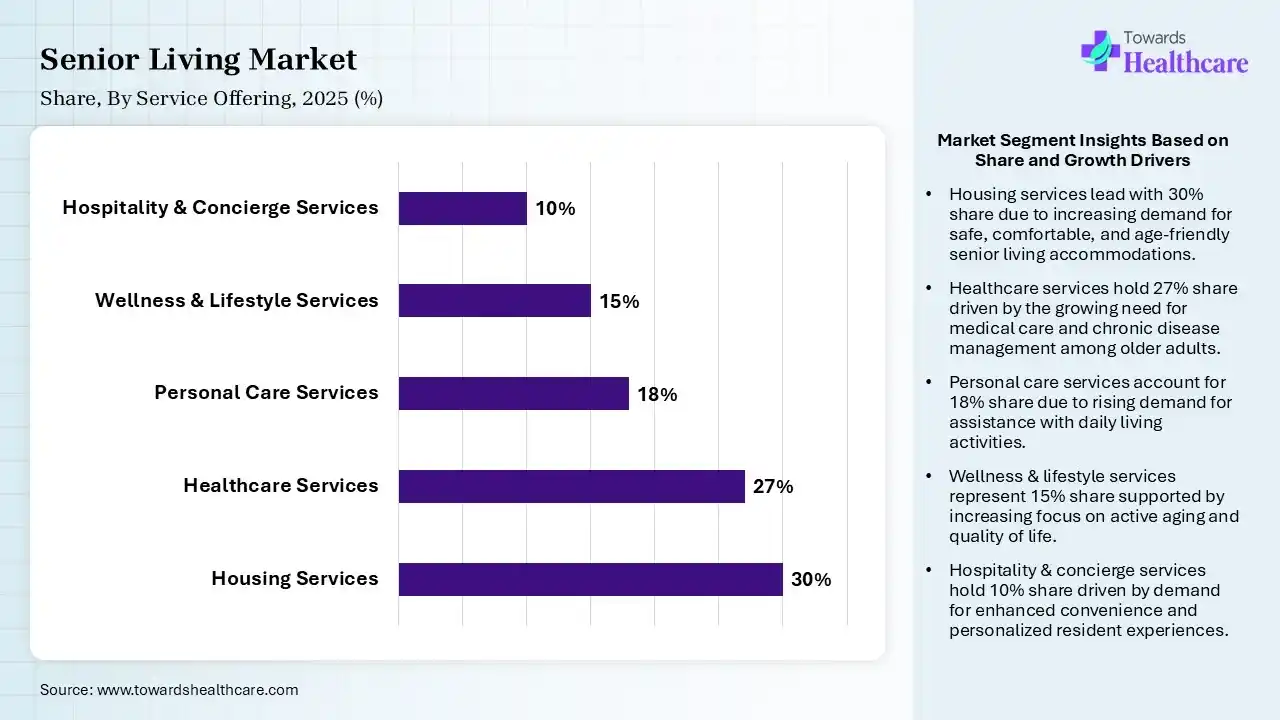
| Segment | Share 2025 (%) |
| Housing Services | 30% |
| Healthcare Services | 27% |
| Personal Care Services | 18% |
| Wellness & Lifestyle Services | 15% |
| Hospitality & Concierge Services | 10% |
The Housing Services Segment led the Senior Living Market in 2025
The housing services segment contributed the largest market share of 30% in 2025, as incorporating service housing units into regular senior housing is an important feature, adding to the comfort of the residents. Elder adults living in senior housing live more than one week longer and have a lower mortality rate.
The healthcare services segment held a significant share of 27% in the market in 2025 and is expected to grow at the fastest CAGR of 6.6% during the forecast period, as there are trained nursing staff available to assist the population at senior care centers. Which is to dispense medications at the suitable times and aid them in work that is too challenging for the residents. Home healthcare for seniors is the capability to obtain individual and personalized care.
The personal care services segment held a significant 18% share of the senior living market in 2025. Personal care services enable elderly adults to retain a sense of control over them survives while still receiving deferential and hands-on support. Trained staff support to prevent falls, manage terapeutics, and respond rapidly when help is required. Caregivers use real-world steps every day to keep people safe.
The wellness & lifestyle services segment held a significant 15% share of the market in 2025, as senior wellness programs help with overall healthcare of senior people and dealing with challenges like depression, lower mobility, and lack of independence. Senior living communities can improve social health and combat loneliness in older adults for a happy and well retirement.
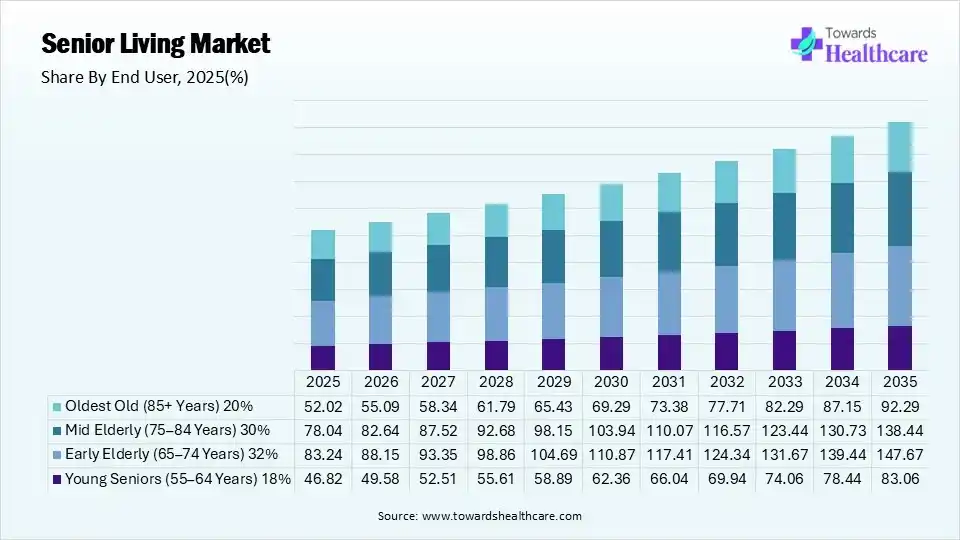
| Segment | Share 2025 (%) |
| Young Seniors (55–64 Years) | 18% |
| Early Elderly (65–74 Years) | 32% |
| Mid Elderly (75–84 Years) | 30% |
| Oldest Old (85 Years and Above) | 20% |
The Early Elderly (65–74 Years) Segment led the Senior Living Market in 2025
The early elderly (65–74 years) segment contributed the largest market share of 32%, as older adults often intended both independence and support when necessary. Living in a senior living community helps older adults meet people of the same age and have the same interests and daily requirements. Eradicate the challenges of household chores, landscaping, plumbing repairs, and meal prep for aging people.
The mid elderly (75–84 years) segment held a significant share of 30% in the market, as this type of living facility offers a wide range of targeted services to support seniors with their everyday living activities. From bathing, dressing, and medication organization to housekeeping and meal preparation, trained staff members are available to offer the required care. It provides a secure environment with round-the-clock security and skilled staff members.
The oldest old (85 years and above) segment held a significant share of 20% in the senior living market, and is expected to grow at the fastest CAGR of 6.8% during the forecast period as care services remove the effects of isolation and loneliness by offering companionship, triggering their minds, and constant community engagement. Involving in this comprehensive care approach supports families.
The young seniors (55–64 years) segment held a significant share of 18% in the market, as there are massive opportunities for individuality and community management via resident-led activities like gardening, dance, baking, choir, and a morning coffee conversation group. They provide freedom from everyday chores, adapt to resort-style services, and have a strong sense of community with like-minded aristocracies.
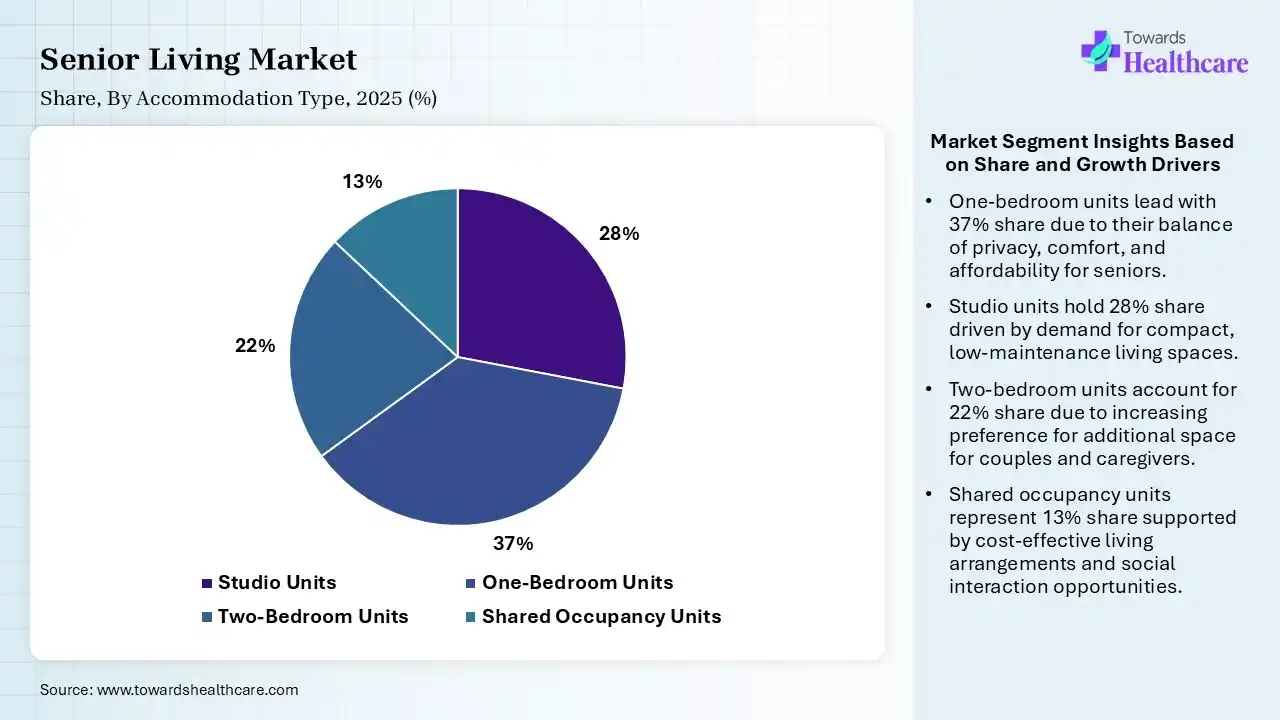
| Segment | Share 2025 (%) |
| Studio Units | 28% |
| One-Bedroom Units | 37% |
| Two-Bedroom Units | 22% |
| Shared Occupancy Units | 13% |
The One-Bedroom Units Segment led the Senior Living Market in 2025
The one-bedroom units segment contributed the largest market share of 37% in 2025, as one-bedroom units in a senior living community bring improved comfort, calmness, and the freedom to completely embrace the retirement years. A one-bedroom apartment is the opportunity to streamline life. Maintaining a big home can become overwhelming and time-consuming.
The studio units segment held a significant share of 28% in the market in 2025, as studios are simple for seniors to handle, and, as there are no stairs, a safer environment. It is more cost-effective to maintain. These studios still attach residents to each benefit of community living, such as daily prepared meals, assistance with targeted care when required, regular housekeeping, social activities, and healthcare support.
The two-bedroom units segment held a significant share of 22% in the senior living market, and is expected to grow at the fastest CAGR of 6.4% during the forecast period, as two-bedroom houses provide senior couples a considerate balance of closeness and private space. Two-bedroom senior living apartments offer benefits such as the space needed to stay organized. Two-bedroom offers senior couples space, privacy, and comfort while maintaining independence and room for visitors.
The shared occupancy units segment held a significant share of 13% in the market in 2025, as shared senior housing provides companionship, economic savings, and a more satisfying lifestyle. A shared room makes an instant sense of companionship, enables conversation during meals and activities, and helps reduce the feeling of isolation.
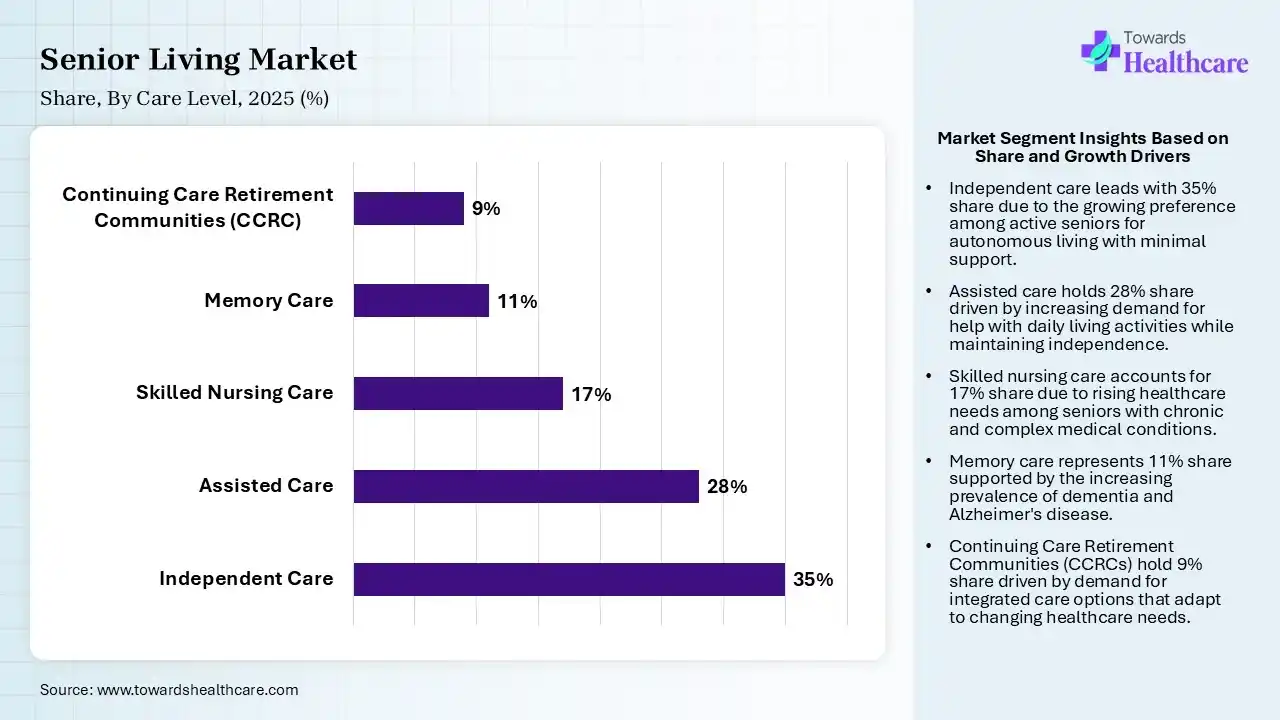
| Segment | Share 2025 (%) |
| Independent Care | 35% |
| Assisted Care | 28% |
| Skilled Nursing Care | 17% |
| Memory Care | 11% |
| Continuing Care Retirement Communities (CCRC) | 9% |
The Independent Care Segment led the Senior Living Market in 2025
The independent care segment contributed the largest market share of 35% in 2025, as independent living communities are intended with safety in mind, providing characteristics such as emergency call systems, secure entry points, and on-site staff who provide peace of mind for both people and their families. Self-governing living communities provide a variety of housing choices to fit various preferences and lifestyles.
The assisted care segment held a significant share of 28% in the market in 2025, and is expected to grow at the fastest CAGR of 7.0% during the forecast period, as assisted living provides a supportive, community-driven lifestyle where resistant enjoy daily events, social connections, and support with everyday tasks like meals, targeted care, and therapeutic management.
The skilled nursing care segment held a significant share of 17% in the senior living market in 2025, as skilled nursing care is round-the-clock nursing support. Health conditions do not follow a schedule and can occur at any time. In an accomplished nursing service, evolving response technologies are always active.
The memory care segment held a significant share of 11% in the market in 2025, as memory care services are intended to improve the well-being of residents via engaging actions, social interaction, and targeted care. Memory care lowers nursing home admissions in assisted-living residents with dementia.
The North America senior living market size stood at US$ 109.25 billion in 2025, grew to US$ 115.37 billion in 2026, and is forecast to reach US$ 188.39 billion by 2035, expanding at a CAGR of 5.9% from 2026 to 2035. North America contributed the largest market share of 42% in 2025, as rising disposable incomes and significant savings among baby boomers allow spending in premium self-governing living communities intended with age-friendly features. Integrate hospital solutions with territorial solutions, making a continuum of care that supports patients even outside traditional medical care services. Technology transformation in senior living homes in India addresses the critical requirement of the growing adult population via integrated health monitoring and emergency response, which drives the growth of the market.
U.S. Market Trends
The US senior living market size was valued at US$ 88.44 billion in 2025 and is projected to grow to 93.57 billion in 2026. Forecasts suggest it will reach approximately US$ 155.42 billion by 2035, registering a CAGR of 5.8% during the period. The U.S. dominated the market in North America with a share of 34% in 2025. In the U.S., the senior population continues to increase, and advanced technology expenses rise; inclusive technology incorporation becomes standard in senior living services, creating safer, further connected, and medical care-focused environments for adult residents in the country.
Canada Market Trends
Canada captured 5% share of the North American senior living market in 2025. Canada’s medical care system ranks seventh for elderly adults among its international peers, in France, Germany, and Sweden. A large quantity of Canadian seniors enjoys economic security and good health, and for these and other reasons, Canada is recognized as a good place to live and to grow old.
The Asia Pacific senior living market size reached US$ 52.02 billion in 2025 and is anticipate to increase to US$ 55.09 billion in 2026. By 2035, the market is forecasted to achieve a value of around US$ 92.29 billion. The Asia Pacific held a significant share of 20% in the market, and is expected to grow at the fastest CAGR of 7.1% during the forecast period, as increasing aging populations, development leading to smaller nuclear families, augmented middle-class pay, and helpful government strategies. Rapid urbanization in India, China, and Southeast Asia is fragmenting traditional joint-family households into smaller units, which drives the growth of the market.
China Market Trends
China captured 7% of the senior living market in 2025. In China, growing disposable incomes in the developing Asian markets enable modern seniors to proactively purchase or lease premium retirement characteristics. Digital integration enables solutions providers to increase home-based and community-care models.
Japan Market Trends
In Japan, this region's system lifted the physical and economic responsibility of eldercare from nuclear families to an organized public-private framework. Medical care providers deploy independent AI-based wheelchairs, convertible assisted beds, and body sensors to lower the physical load on staff.
R&D:
Patient Services:
| Company | Headquarters | Latest Update |
| Antara Senior Care | Haryana | Antara Care Homes are specialised residential facilities for short- and long-term care, pre & post-operative care, and memory care |
| Ashiana Housing Ltd. | India | In April 2026, Ashiana Housing acquired 28.55 acres of land in Pune for its largest senior living project to date. The advancement is expected to generate an estimated income of Rs 1,800 crore, catering to significant demand for senior homes in the region. |
| Life Care Centers of America | United States | Life Care Centers of America expanded its specialized memory care wings in its Sun Belt portfolio and developed a hub-and-spoke model to blend skilled nursing with home-based care |
| Sunrise Senior Living | Canada | Sunrise Senior Living, which operates communities in the U.S. and Canada, has consistently capitalized on training, leadership development, and team member wellness as part of its employee value proposition (EVP). |
| Brookdale Senior Living | Canada | The company is improving its signature B-Fit physical healthcare program via nationwide wellness days and presenting AI-based education guides. |
In June 2026, "Partnering with LTC marks an exciting new chapter for MorningStar Senior Living. We appreciate LTC’s strategic approach to SHOP and its reputation for building enduring operator relationships. With LTC's capital behind us, we are well-positioned to accelerate our growth and deliver exceptional lifestyle experiences for our residents," said Jamie Ranzen, President and Chief Investment Officer, MorningStar Senior Living.
By Facility Type
By Ownership Model
By End User
By Accommodation Type
By Care Type
By Region










Principal Consultant
Payal Rabde is a Healthcare Market Research Analyst at Towards Healthcare Research & Consulting with 4+ years of experience in pharmaceuticals, biotechnology, medical devices, and life sciences.
Learn more about Payal Rabde

Reviewed By
Aditi Shivarkar is a seasoned professional with over 14 years of experience in healthcare market research. As a content reviewer, Aditi ensures the quality and accuracy of all market insights and data presented by the research team.
Learn more about Aditi Shivarkar