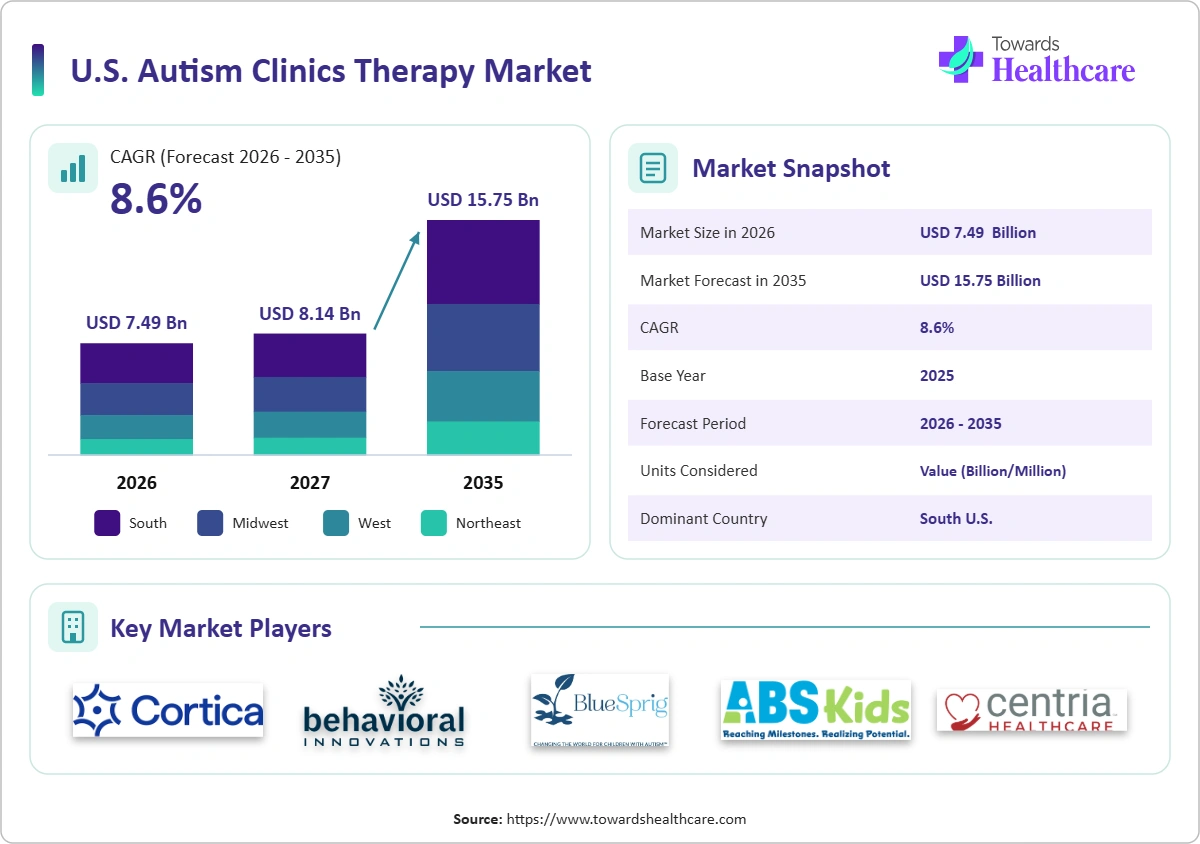
The market is expected to expand from USD 6.90 billion in 2025 to USD 15.75 billion by the end of the forecast period because autism diagnoses continue to rise and every state now requires insurance coverage for ABA. The market growth is being fueled by rising diagnoses, insurance mandates, and clinic expansion, propelling the market to USD 10.42 billion by 2030 and maintaining a CAGR of 8.60% during 2026-2035. Telehealth is increasingly used in autism therapy and is linked with behavioral health services.
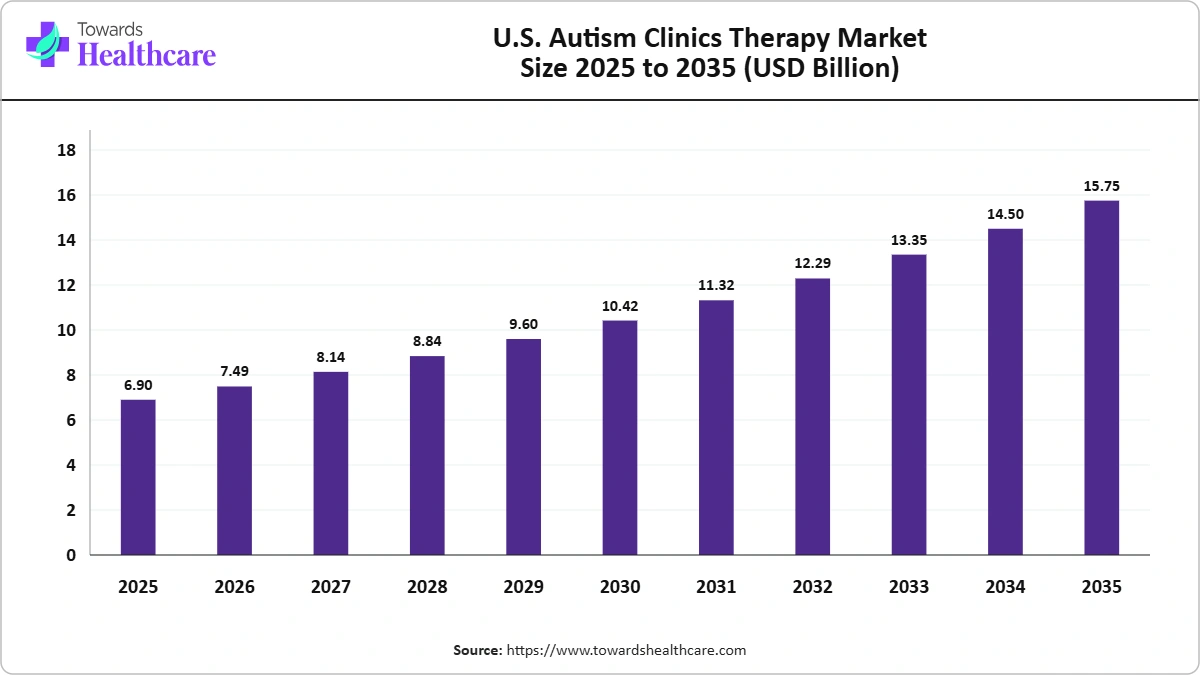
Analyst View: We developed the estimate from children and adults receiving therapy, average therapy hours and payment rates by service and payer, cross-checked against Medicaid spending data and provider activity.
Medicaid scrutiny of ABA billing: States are auditing billing and tightening authorization rules after a surge in spending.
Private equity consolidation: Investors are increasingly consolidating regional providers into larger national clinic networks.
Telehealth parent training: Remote coaching helps parents provide therapy at home.
Integrated multidisciplinary care: Providers combine ABA with speech, occupational therapy, and medical care.
Outcome measurement: Payers are asking for standard outcome measures to evaluate treatment progress and justify reimbursement.
The market has grown at a rapid pace as autism diagnoses rose and universal insurance and Medicaid coverage of ABA emerged. Private equity has supported the expansion of large clinic networks, but the rise in Medicaid spending has prompted some states to tighten oversight and reduce reimbursement rates. The shortage of trained analysts continues to be the key factor that determines the rate at which providers grow.
| Driver | Impact | ≈ CAGR Contribution | Time Horizon | Key Regions |
| Rising autism diagnosis | High | +3.36 pp | Short to long term | U.S.-wide, strongest in South |
| Universal insurance mandates | Medium | +2.83 pp | Medium to long term | U.S.-wide, fastest uptake in South |
| Clinic network expansion | Medium | +2.41 pp | Short to medium term | U.S.-wide |
| Growing awareness | Low | +1.89 pp | Long term | South |
Note: Contributions are indicative estimates of each factor's effect on annual growth.
Sources: Expert interviews, secondary sources, Towards Healthcare database and Towards Healthcare analysts.
Rising diagnoses and universal insurance mandates are the largest contributors to growth in the market, with clinic expansion adding capacity. The South benefits most from the establishment of new centers.
| Restraint | Impact | ≈ Negative CAGR Contribution | Time Horizon | Key Regions |
| Medicaid rate cuts and audits | High | -0.85 pp | Short to medium term | U.S.-wide |
| Clinician shortages | High | -0.62 pp | Medium term | Smaller and price-sensitive markets |
| Waiting lists for diagnosis | Medium | -0.42 pp | Short term | South and other mature markets |
Note: Contributions are indicative estimates of each factor's effect on annual growth.
Sources: Expert interviews, secondary sources, Towards Healthcare database and Towards Healthcare analysts.
Medicaid scrutiny is the largest restraint, followed by clinician shortages. Both slow down growth but also prompt the sector to improve quality and measurement.
Adult services: Adults with autism require support for employment, independent living and therapy support, but services for these needs remain limited.
Diagnostic capacity: Providers that expand their diagnostic capacity can minimize waiting times and allow families to access therapies sooner.
Technology-enabled care: Data collection tools and telehealth supervision let each behaviour analyst oversee more cases efficiently.
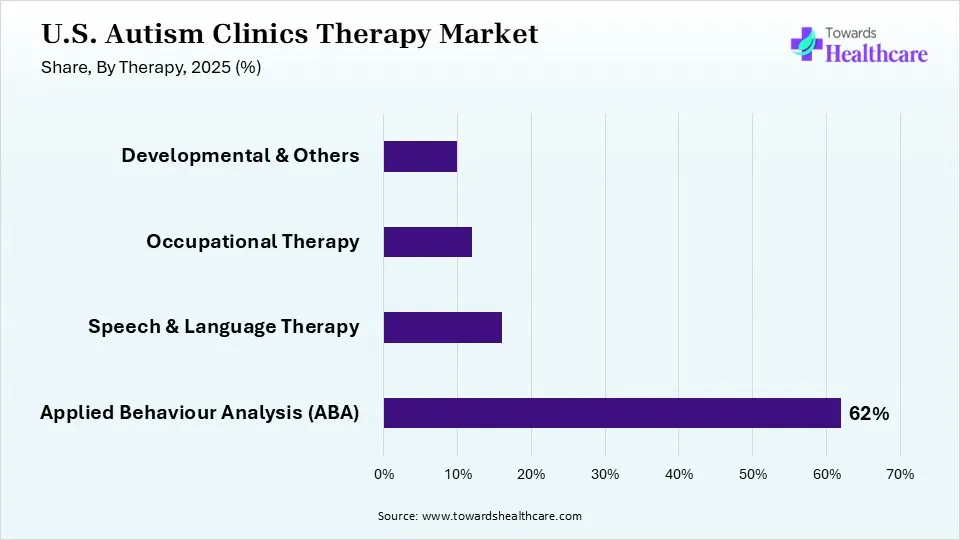
Note: 2025 is the base year; 2035 shares and CAGRs are forecasts.
Sources: Expert interviews, secondary sources, Towards Healthcare database and Towards Healthcare analysts.
Applied Behaviour Analysis (ABA) accounted for 62.00% of spending in 2025. All 50 states require insurers to cover it, and Medicaid covers it for children as well, which has driven rapid growth in clinic networks.
Speech & Language Therapy it addresses delays in communication and is often the first service families seek before a formal autism diagnosis.
Occupational Therapy it supports sensory processing, fine motor skills, and daily living tasks and is usually delivered alongside ABA.
Developmental & Others models such as the Early Start Denver Model and play-based therapies are forecast to grow during the forecast period as parents look for alternatives to purely behavioral approaches.
Centre-Based Clinics structured settings are suitable for intensive early intervention, allow close supervision of technicians, and let children practice their social skills with peers.
In 2025, Home & School therapists assist children in applying skills in everyday routines and classrooms, which is preferred by many families and school districts.
Telehealth revenue in the base year and is forecast to grow at a rate of 10.55% throughout the forecast period. Remote parent coaching and supervision help families in rural areas and improve access to scarce behavior analysts
Medicaid paid 46.00% of costs in 2025. States are reviewing rates and billing practices because ABA spending by Medicaid has risen sharply.
Private Insurance state mandates require employer plans to cover ABA, and self-funded employers increasingly add autism benefits.
Out-of-Pocket covering deductibles, uncovered services, and families that are waiting for covered care.
Analyst View: Developmental models and telehealth are gaining share at the fastest rate, while ABA and centre-based programmes continue to be the core of the market.
South: The South led the market with a 34.00% share in 2025 and is projected to expand at the highest rate of 9.38% between 2026 and 2035. This growth can be attributed to the fact that national clinic chains are opening a significant number of new centers across Texas, Florida, Georgia, and the Carolinas.
Midwest national providers are opening new centers in the growing suburbs of Ohio, Indiana, and Michigan.
West california is one of the largest Medicaid ABA markets, as it benefits from the presence of large providers as well as many independent agencies.
Northeast massachusetts and New Jersey, located in this region, have long-established autism mandates and a mature, fragmented provider base.
Analyst View: The South is growing at the fastest rate as national providers expand there, while the Midwest also adds many new centres.
| Rank | Company Name | 2025 Share (%) | Key Products / Business | Headquarters |
| 1 | Centria Healthcare | 4.00% | ABA services | United States |
| 2 | ABS Kids | 3.00% | ABA services | United States |
| 3 | BlueSprig | 3.00% | Centre-based ABA | United States |
| 4 | Action Behavior Centers | 3.00% | Centre-based ABA | United States |
| 5 | Hopebridge | 2.00% | Autism therapy centres | United States |
| 6 | Autism Learning Partners | 2.00% | ABA services | United States |
| 7 | Kyo | 1.00% | ABA services | United States |
| 8 | Behavioral Innovations | 1.00% | Centre-based ABA | United States |
| 9 | Positive Behavior Supports | 1.00% | ABA services | United States |
| 10 | Cortica | 1.00% | Integrated autism care | United States |
Note: Company shares are 2025 estimates.
Sources: Company press releases, expert interviews, secondary sources, Towards Healthcare database and Towards Healthcare analysts.
Centria Healthcare led the market with a 4.00% share in 2025, followed by ABS Kids at 3.00% share and BlueSprig at 3.00% share. Centria Healthcare dominates owing to its ABA services, ABS Kids competes with ABA services, and BlueSprig offers centre-based ABA. Action Behavior Centers, Hopebridge, Autism Learning Partners, Kyo, Behavioral Innovations, Positive Behavior Supports and Cortica compete through centre-based ABA, autism therapy centres, ABA services, centre-based ABA, ABA services and integrated autism care.
The top 10 companies accounted for 21.01% of revenue in 2025, while the remaining 78.99% was shared among thousands of independent clinics and practices. The market is highly fragmented, and competition centres on clinician recruitment, payer contracts, wait times, clinical outcomes, and centre locations.
Centria Healthcare: Headquartered in the United States, Centria Healthcare held 4.00% of the market in 2025, primarily due to its ABA services. The Towards Healthcare Companies Quadrant places it as a Leader.
ABS Kids competes mainly through ABA services. From its base in the United States, it captured roughly 3.00% of revenue in 2025 and is rated a Leader in the Towards Healthcare Companies Quadrant.
BlueSprig: With a 3.00% share in 2025, BlueSprig draws on centre-based ABA. The company is based in the United States and appears as a Leader in the Towards Healthcare Companies Quadrant.
In 2025, Action Behavior Centers captured a 3.00% share and is based in the U.S. Its centre-based ABA keeps it in the Leader group of the Towards Healthcare Companies Quadrant.
Hopebridge: The company held 2.00% of the market in 2025, which makes Hopebridge a notable participant in the market. It is headquartered in the United States, focuses on autism therapy centres, and is classed as a Leader in the Towards Healthcare Companies Quadrant.
Autism Learning Partners built its 2.00% position in the U.S. autism clinics therapy market around ABA services. Headquartered in the United States, it is shown as a Leader in the Towards Healthcare Companies Quadrant.
Kyo: Most of Kyo's presence in this market comes from ABA services. The company is headquartered in the United States, held roughly 1.00% of 2025 revenue and is rated an Innovator in the Towards Healthcare Companies Quadrant.
Behavioral Innovations captured a market share of 1.00% in 2025. Its range is built around centre-based ABA, and the company, based in the United States, is placed as an Innovator in the Towards Healthcare Companies Quadrant.
Positive Behavior Supports: Operating from the United States, Positive Behavior Supports offers ABA services. That portfolio gave it about 1.00% of the U.S. autism clinics therapy market in 2025 and a position as an Innovator in the Towards Healthcare Companies Quadrant.
Cortica: About 1.00% of 2025 revenue in the market went to Cortica, whose business here centres on integrated autism care. The company is headquartered in the United States, and the Towards Healthcare Companies Quadrant rates it as an Innovator.
The U.S. autism clinics therapy ecosystem connects training & credentialing, clinic operators, referrers, payers, and regulators, and each stage adds value before products reach end users.
| Ecosystem Stage | Role in the Market | Key Companies |
| Training & Credentialing | Train clinicians | BACB, universities |
| Clinic Operators | Deliver care | Centria, BlueSprig, Action Behavior Centers |
| Referrers | Diagnose and refer | Pediatricians, developmental specialists |
| Payers | Pay for care | Medicaid, insurers |
| Regulators | Oversee services | State Medicaid agencies, licensing boards |
Sources: Company press releases, expert interviews, secondary sources, Towards Healthcare database and Towards Healthcare analysts.
Training & Credentialing: The scarcity of board-certified behavior analysts is the main factor that constrains growth.
Clinic Operators: Many operators are backed by private equity and open and acquire new centers to expand their operations.
Referrers: Long waiting times for diagnosis delay the start of treatment.
Payers: Payment rates and authorization regulations have a significant influence on provider economics.
Regulators: States are strengthening oversight of autism therapy providers following billing investigations.
Market value flows from upstream material and technology suppliers to manufacturers and service providers, then through distribution partners to end users. Companies with integrated operations or strong, long-term customer relationships will be well-positioned to capture a large share of this value.
The Towards Healthcare Companies Quadrant evaluates key market participants based on market strength, including revenue scale, market share and geographic reach, along with innovation and growth strategy, reflecting product portfolio breadth, investment in research and development and strategic partnerships. Company positions reflect their market shares in 2025 and our evaluation of their innovation, portfolio diversity, and partnerships.
Sources: Company press releases, expert interviews, secondary sources, Towards Healthcare database and Towards Healthcare analysts.
Leaders: Centria Healthcare, ABS Kids, BlueSprig, Action Behavior Centers, Hopebridge and Autism Learning Partners bring together strong market positions, broad service portfolios and significant emphasis on innovation.
Innovators: Kyo, Behavioral Innovations, Positive Behavior Supports and Cortica differentiate themselves through technology adoption, specialized services, and innovative care models.
The market involves autism therapy services provided by clinics in the United States, including applied behaviour analysis (ABA), speech and language therapy, occupational therapy, developmental and play-based therapies and diagnostic services. These services are delivered in centre-based clinics, homes and schools and via telehealth to children, adolescents and adults with funding from Medicaid, private insurance and out-of-pocket.
The 2025 base year was developed using a bottom-up approach from demand volumes and average prices by therapy, setting and payer and region, and checked top-down against the market-specific revenues of leading companies and public industry data. Segment, regional and company values were allocated from therapy, setting and payer and region demand.
Key estimates were validated against company disclosures, regulatory and industry data, and published third-party estimates, and inputs that could not be reconciled have not been included. All segments, regional, and company figures were aligned with the same 2025 base year, and the 2026-2035 forecast, which applies a constant CAGR from the 2025 base, was recalculated and validated.
Analyst View: We expect the market to grow at a healthy rate, but more selectively than in the last five years. Rising diagnoses and coverage mandates support demand, while Medicaid scrutiny, rate cuts, and clinician shortages are expected to be the key differentiating factors for providers.