


The U.S. dental 3D printing market is estimated at USD 1028.64 million in 2025, driven by the increasing shift towards patient-specific dental solutions, greater adoption of digital impression systems, and the growing demand for efficient dental restoration manufacturing. The market is expected to witness steady growth USD 1259.16 million in 2026 as dental services providers expand in-house production capabilities and integrate advanced additive manufacturing technologies into clinical workflows. It is projected to reach USD 7770.2 million by 2035, expanding at a CAGR of 22.41% from 2026 to 2035 driven by continuous innovations in biocompatible printing materials, increasing applications in orthodontics and prosthodontics, and the rising focus on improving treatment accuracy, turnaround times, and cost efficiency across dental practices.
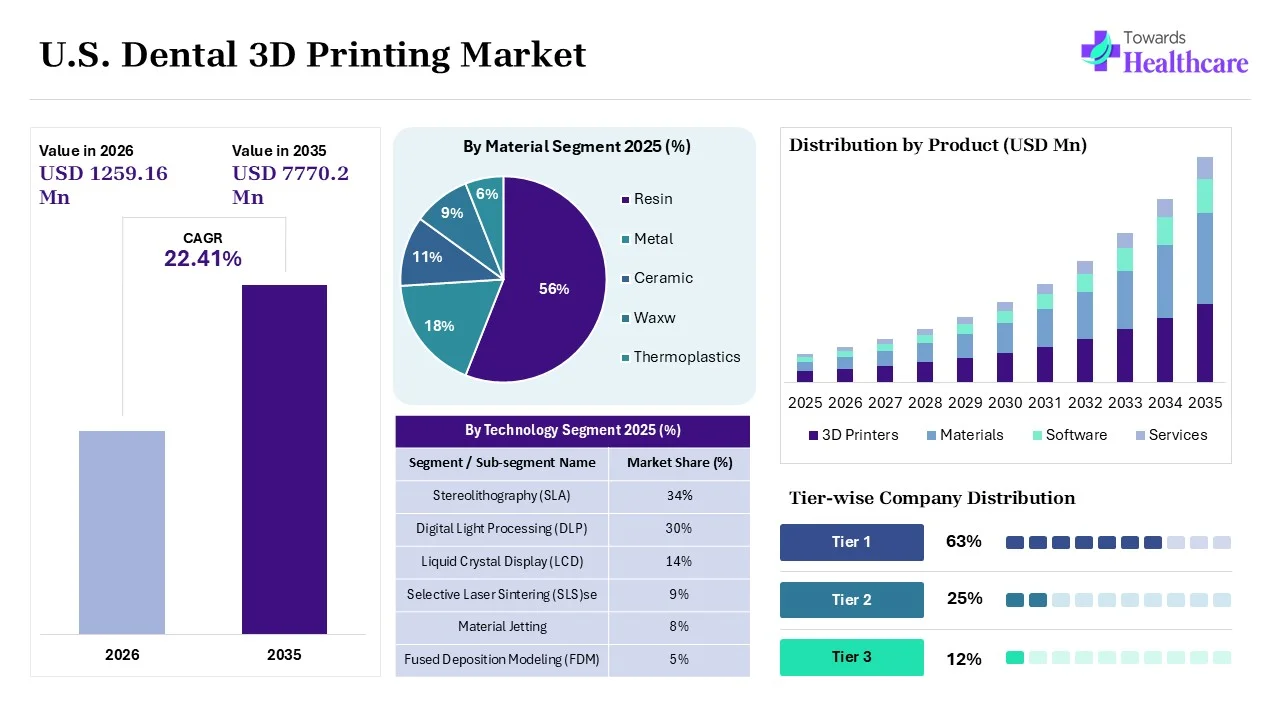
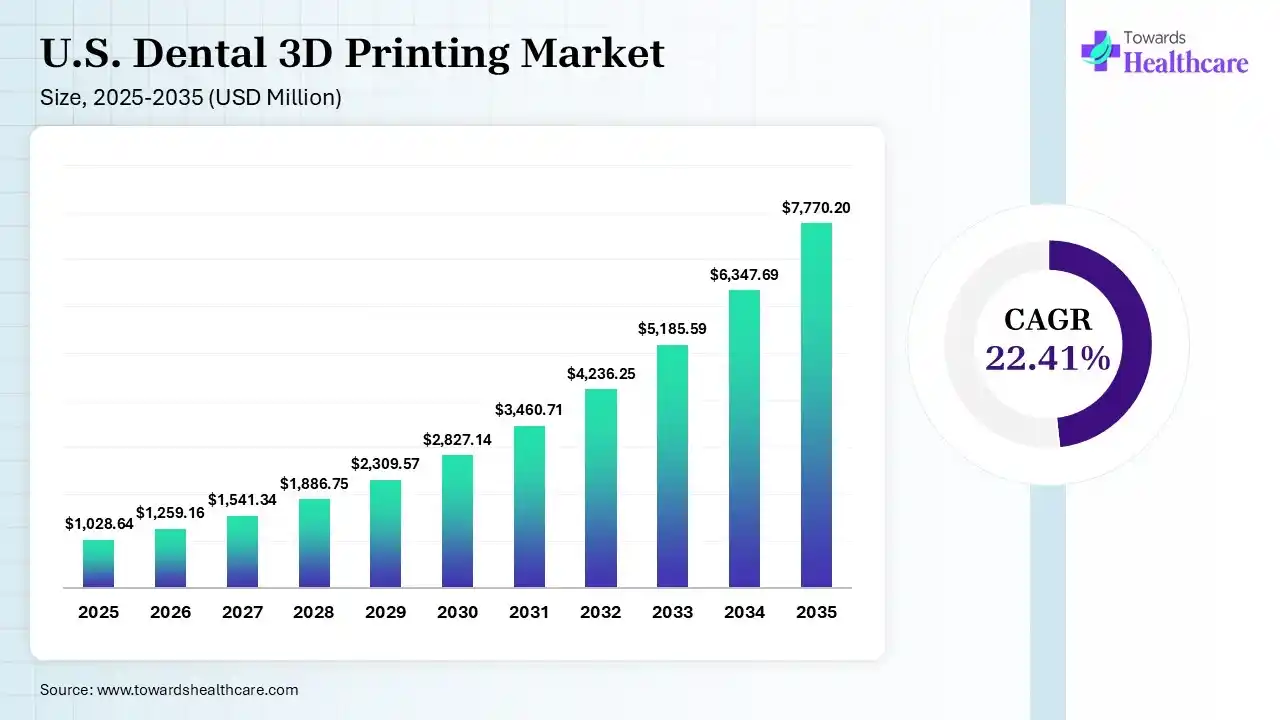
Dental 3D printing is an additive manufacturing technology used to produce precise dental models, crowns, bridges, dentures, surgical guides, clear aligners, and implants from digital design. It enables faster production, greater customization, improved accuracy, and more efficient dental workflows compared with conventional manufacturing methods. The market is witnessing rapid adoption of digital dentistry, chairside manufacturing, AI-powered design software, CAD/CAM integration, and advanced biocompatible materials, improving treatment precision and operational efficiency. Growing investments in digital dental laboratories, rising demand for customized dental solutions, and continuous innovations in printing technologies are creating significant growth opportunities and are expected to drive long-term market expansion. The U.S. dental 3D printing market is growing due to its increasing demand for customized dental restorations, faster treatment procedures, and digitally enabled dental workflows. Rising adoption of clear aligners, dental implants, and chairside manufacturing is improving clinical efficiency and patient outcomes. In addition, continuous advancements in 3D printing technologies, biocompatible materials, and AI-assisted design solutions are accelerating market growth across dental clinics and laboratories.
Artificial intelligence is transforming the printing market by enabling faster treatment planning, automated design optimization, and highly accurate patient-specific dental models. AI-powered software improves the precision of crowns, bridges, aligners, and implants while reducing production errors and material waste. Its integration with digital workflows also shortens turnaround times, enhances clinical efficiency, and supports more predictable treatment outcomes.
Expansion of Chairside 3D Printing
Chairside 3D printing is becoming more common across U.S. dental clinics as it enables same-day production of crowns, bridges, surgical guides, and dentures. This trend reduces laboratory dependence, shortens treatment times, lowers operational costs, and improves the overall patient experience.
Technology-Driven Digital Dentistry
Technological advancements are enhancing dental 3D printing by improving treatment planning, automating restoration design, and increasing manufacturing accuracy. Combined with digital scanning and CAD/CAM technologies, technology like AI helps reduce errors, optimize workflows, and deliver highly personalized dental solutions with greater efficiency.
Growing Adoption of Advanced Materials
The use of biocompatible resins, ceramics, and hybrid materials is expanding to improve the durability, aesthetics, and functionality of dental restorations. Continued material innovation is expected to support broader clinical applications, better patient outcomes, and increased adoption of dental 3D printing technologies.
Macro factors
Micro factors
| Table | Scope |
| Market Size in 2026 | USD 1259.16 Million |
| Projected Market Size in 2035 | USD 7770.2 Million |
| CAGR (2026 - 2035) | 22.41% |
| Historical Data | 2020 - 2023 |
| Base Year | 2025 |
| Forecast Period | 2026 - 2035 |
| Measurable Values | USD Millions/Units/Volume |
| Market Segmentation | By Product, By Technology, By Application, By Material, By End User |
| Top Key Players | 3D Systems, Formlabs, SprintRay, Desktop Metal, Carbon, Dentsply Sirona, Envista Holdings, Align Technology |
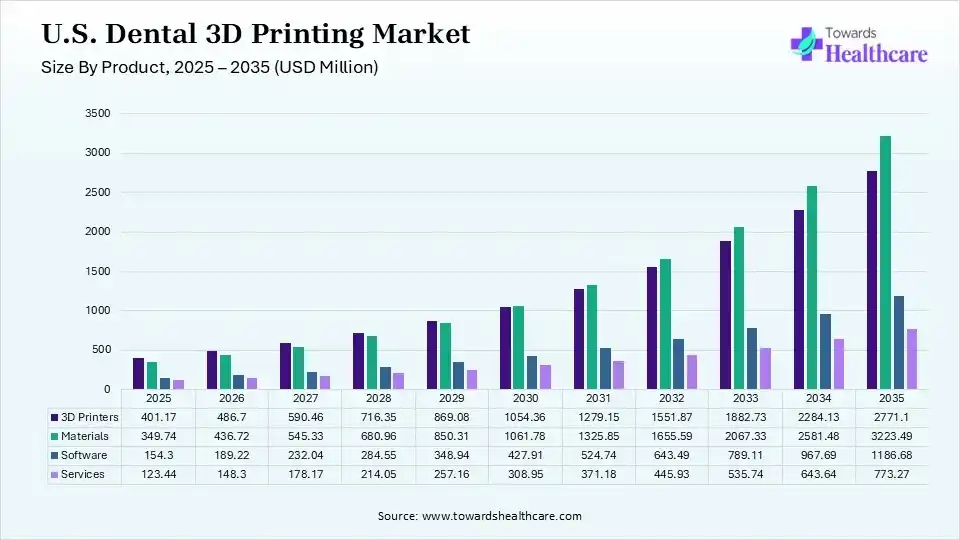
| Segment | Share 2025 (%) |
| 3D Printers | 39% |
| Materials | 34% |
| Software | 15% |
| Services | 12% |
The 3D Printers Segment Dominated the U.S. Dental 3D Printing Market in 2025
The 3D printers segment held a dominant share of 39% in 2025 because it enables rapid production of highly accurate dental models, crowns, bridges, surgical guides, and aligners. Dental clinics and laboratories increasingly prefer advanced 3D printers to reduce turnaround times, improve workflow efficiency, and support cost-effective in-house manufacturing. Continuous innovations in printing speed, precision, and material compatibility further strengthen the segment’s market leadership.
The materials segment held the second-largest share of 34% in 2025 and is expected to grow at the fastest CAGR in the market during the forecast period due to rising demand for high-performance biocompatible resins, ceramics, and hybrid materials. Continuous material innovations improve the strength, aesthetics, and durability of dental restorations while supporting a wider range of clinical applications, driving rapid adoption across dental laboratories and clinics.
The software segment held a 15% of the U.S. dental 3D printing market share due to the increasing adoption of AI-powered design platforms, CAD/CAM systems, and digital treatment planning solutions across dental clinics and laboratories. Advanced software enhances the accuracy of dental restorations, automates design workflows, and improves collaboration between clinicians and technicians. Rising integration with intraoral scanners and 3D printers is further accelerating software demand and market growth.
The services segment held a 12% market share as dental clinics and laboratories increasingly rely on external providers for design, printing, maintenance, training, and technical support. Outsourcing helps reduce equipment costs, improves operational efficiency, and provides access to advanced expertise and technologies. Growing adoption of digital dentistry and the need for faster, high-quality dental restorations are further driving demand for professional 3D printing services
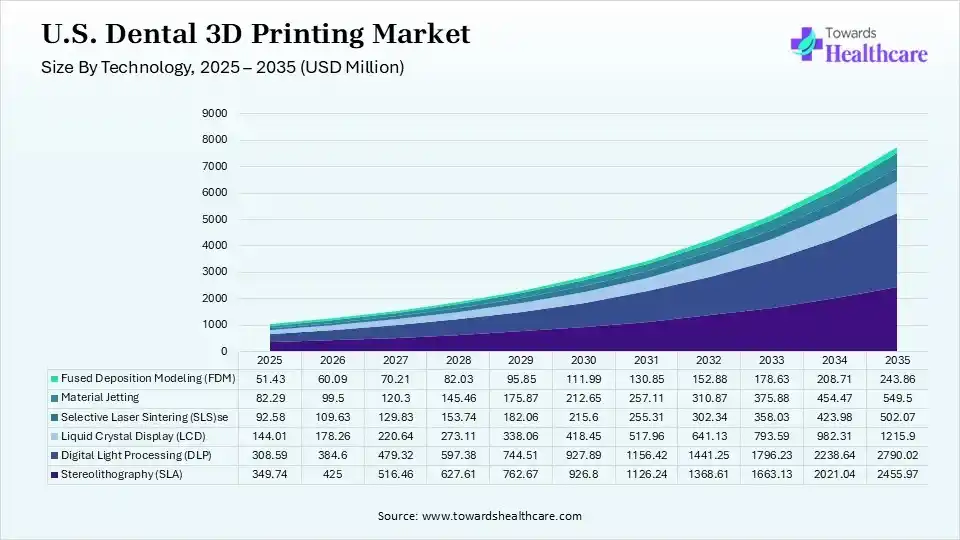
| Segment | Share 2025 (%) |
| Stereolithography (SLA) | 34% |
| Digital Light Processing (DLP) | 30% |
| Liquid Crystal Display (LCD) | 14% |
| Selective Laser Sintering (SLS)se | 9% |
| Material Jetting | 8% |
| Fused Deposition Modeling (FDM) | 5% |
The Stereolithography (SLA) Segment Led the U.S. Dental 3D Printing Market in 2025 with the Largest Share
The stereolithography (SLA) segment dominated the market with a share of 34% in 2025 because it delivers exceptional accuracy, smooth surface finishes, and high-resolution printing required for dental models, surgical guides, crowns, and aligners. SLA technology is widely adopted by dental laboratories and clinics due to its reliability, compatibility with biocompatible resins, fast production capabilities, and consistent quality for complex dental applications.
The digital light processing (DLP) segment held the second-largest share of 30% in 2025 and is expected to grow at the fastest CAGR in the market during the forecast period due to its high printing speed, excellent accuracy, and ability to produce multiple dental components simultaneously. DLP technology is widely used for temporary restorations, offering cost-effective production, reliable quality, and efficient workflows for dental laboratories and clinics.
The liquid crystal display (LCD) segment held a 14% of the U.S. dental 3D printing market share due to its affordability, high printing precision, and suitability for producing dental models, surgical guides, and aligners. LCD-based 3D printers offer lower operating costs and faster production, making them an attractive option for small and mid-sized dental clinics and laboratories. Continuous improvements in screen resolution and printing efficiency are further supporting segment growth.
The selective laser sintering (SLS) segment held a 9% market share due to its ability to produce durable, high-strength dental components with excellent dimensional accuracy. The technology supports complex geometries without requiring a support structure, reducing material waste and post-processing time. Increasing demand for advanced dental prosthetics, orthodontic appliances, and customized devices is driving the adoption of SLB across specialized dental laboratories.
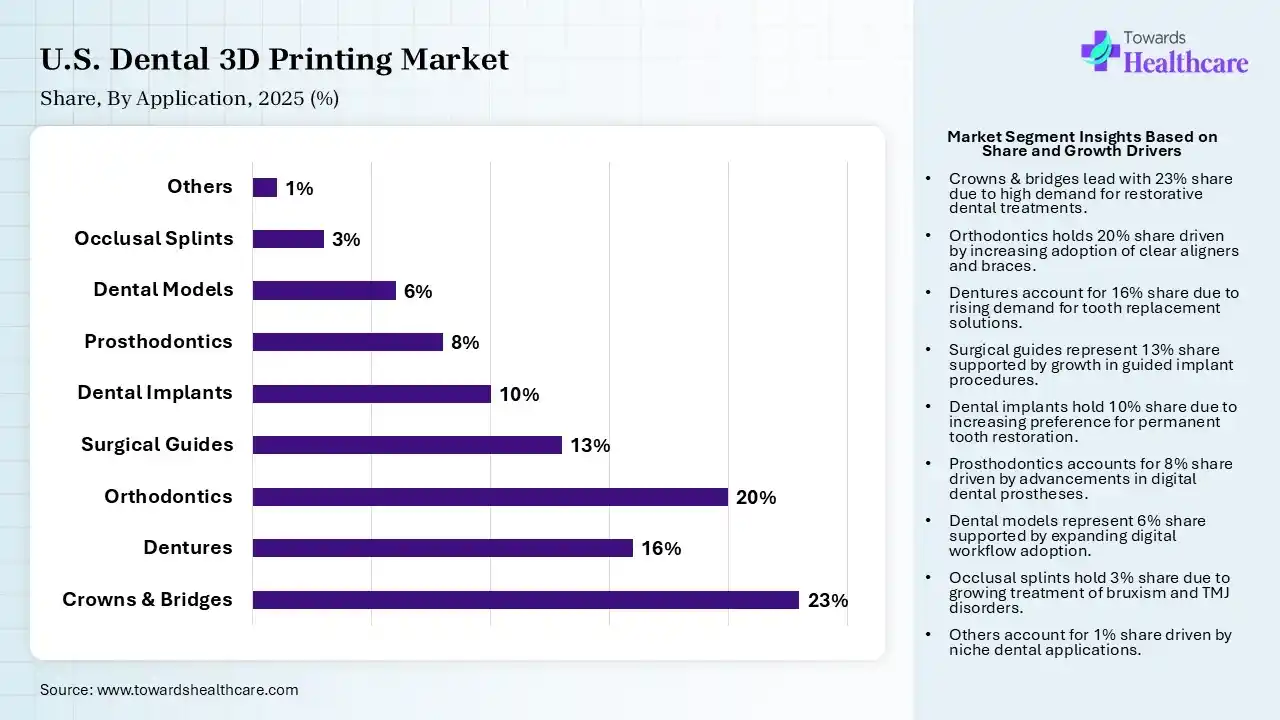
| Segment | Share 2025 (%) |
| Crowns & Bridges | 23% |
| Dentures | 16% |
| Orthodontics | 20% |
| Surgical Guides | 13% |
| Dental Implants | 10% |
| Prosthodontics | 8% |
| Dental Models | 6% |
| Occlusal Splints | 3% |
| Others | 1% |
The Crowns & Bridges Segment Dominated the U.S. Dental 3D Printing Market in 2025
The crowns & bridges segment led the market with a share of 23% in 2025, due to the high prevalence of tooth loss, dental decay, and restorative treatments. Dental 3D printing enables the rapid production of highly accurate, customized crowns and bridges with improved fit and aesthetics. Increasing adoption of digital dentistry and same-day restoration solutions is further strengthening the segment’s leading market position.
The orthodontics segment held the second-largest share of 20% in 2025 and is expected to grow at the fastest CAGR in the market during the forecast period due to the increasing demand for clear aligners and customized orthodontic appliances. Digital treatment planning and 3D printing enable faster production, improved precision, and personalized care. Growing patient preference for aesthetic orthodontic care treatments and expanding adoption of digital workflows continue to accelerate segment growth.
The dentures segment held a 16% of the U.S. dental 3D printing market share due to the rising aging population, increasingly prevalence of tooth loss, and growing demand for customized prosthetic solutions. Dental 3D printing enables the rapid production of accurately fitting dentures with improved comfort, aesthetics, and functionality. The technology also reduces manufacturing times, minimizes materials waste, and supports cost-effective, patient-specific denture fabrication across dental laboratories and clinics.
The surgical guides segment held a 13% market share due to the growing adoption of dental implant procedures and the increasing need for precise surgical planning. Three-dimensional printing enables the production of patient-specific surgical guides that improve implant placement accuracy, reduce procedural risks, and shorten treatment times. Rising use of digital workflows and image-guided dentistry is further supporting the segment’s growth across dental practices.
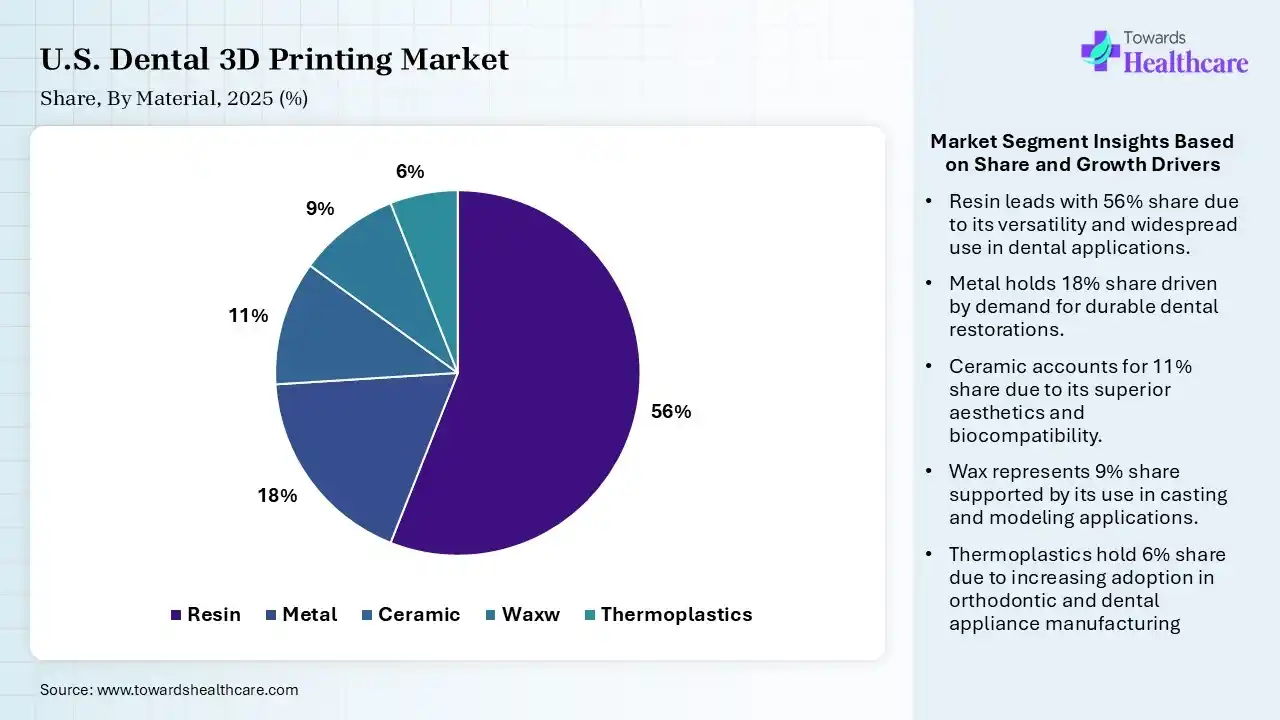
| Segment | Share 2025 (%) |
| Resin | 56% |
| Metal | 18% |
| Ceramic | 11% |
| Waxw | 9% |
| Thermoplastics | 6% |
The Resin Segment Led the U.S. Dental 3D Printing Market in 2025 with the Largest Share
The resin segment held a dominant share of 56% in 2025 and is expected to grow at the fastest CAGR in the market during the forecast period due to its excellent accuracy, smooth surface finish, and broad compatibility with dental applications. Biocompatible resins are widely used for dental models, surgical guides, aligners, dentures, and temporary restorations. Continuous innovations in resin formulations are further expanding clinical applications and driving market growth.
The metals segment held the second-largest share of 18% in 2025 due to the increasing demand for durable and high-strength dental restorations, implants, crowns, and bridges. Mental 3D printing provides excellent mechanical properties, long-term performance, and precise customization. Growing adoption of advanced metal additive manufacturing technologies and expanding restorative dentistry procedures continue to support the segment’s strong market position.
The ceramic segment held an 11% of the U.S. dental 3D printing market share due to the increasing demand for natural-looking, durable, and biocompatible dental restorations. Ceramic materials provide excellent aesthetics, wear resistance, and long-term performance, making them ideal for crowns, bridges, and veneers. Continuous advancements in ceramic 3D printing technologies and growing patient preference for metal-free dental solutions are further driving the segment’s growth.
The wax segment held a 9% market share due to its increasing use in investment casting for manufacturing crowns, bridges, and removable partial dentures. Wax-based 3D printing enables highly accurate patterns with smooth surface finishes, reducing production time and material waste. Rising demand for customized dental restorations and materials waste. Rising demand for customized dental restorations and improved laboratory efficiency is further driving the adoption of wax materials in dental applications.
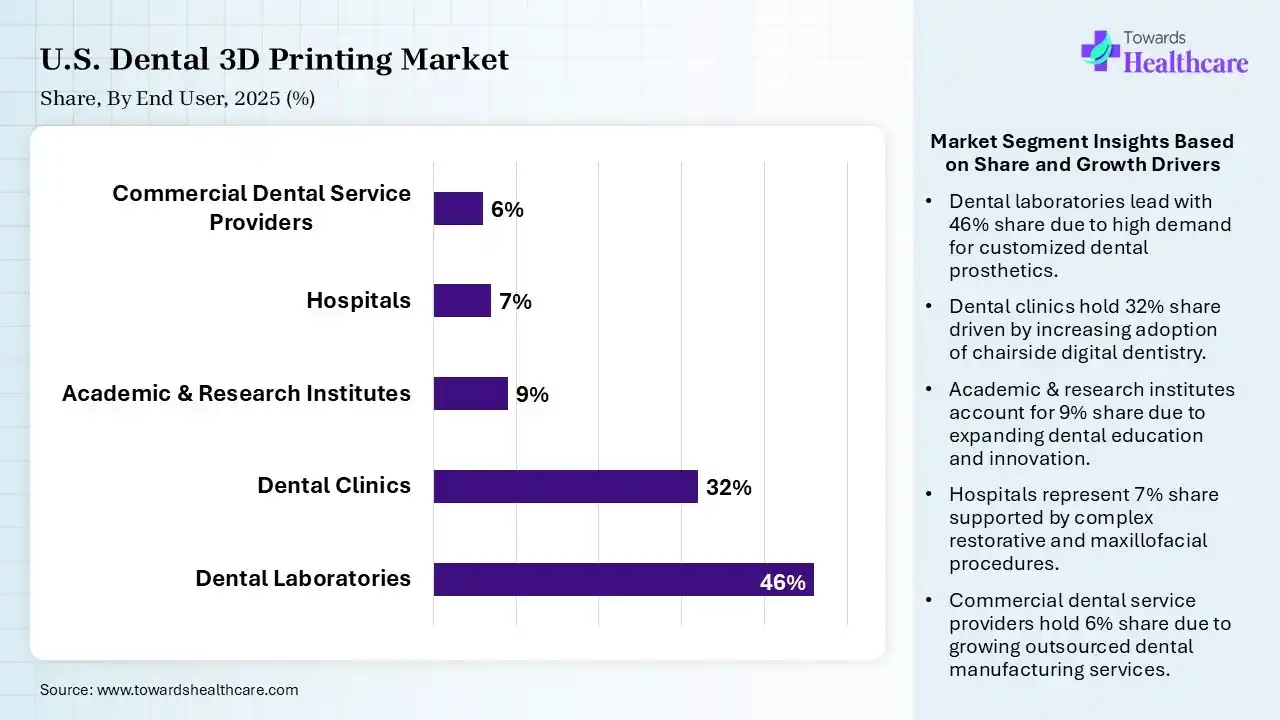
| Segment | Share 2025 (%) |
| Dental Laboratories | 46% |
| Dental Clinics | 32% |
| Academic & Research Institutes | 9% |
| Hospitals | 7% |
| Commercial Dental Service Providers | 6% |
The Dental Laboratories Segment Dominated the U.S. Dental 3D Printing Market in 2025
The dental laboratories segment dominated the market with a share of 46% in 2025 due to its extensive use of 3D printing for manufacturing crowns, bridges, dentures, surgical guides, aligners, and dental models. Laboratories benefit from high production volumes, improved precision, and faster turnaround times. Growing investments in digital workflows, advanced printing technologies, and customized dental restorations further strengthened the segment’s leading market position.
The dental clinics segment held the second-largest share of 32% in 2025 and is expected to grow at the fastest CAGR in the market during the forecast period due to the increasing adoption of chairside 3D printing for same-day crowns, surgical guides, aligners, and other customized restorations. Clinics are investing in digital workflows to improve treatment efficiency, reduce patient waiting times, and enhance clinical accuracy. Rising demand for personalized dental care is further supporting segment growth.
The academic & research institutes segment held a 9% of the U.S. dental 3D printing market share due to increasing investments in dental research, additive manufacturing technologies, and digital dentistry education. Universities and research centers are adopting 3D printing to develop innovative dental materials, improve clinical techniques, and train future dental professionals. Rising collaborations with industry players and growing funding for research projects are further accelerating the segment’s growth.
The hospitals segment held a 7% market share due to the growing integration of advanced dental services within multispecialty healthcare facilities. Hospitals are increasingly adopting 3D printing technologies for complex oral and maxillofacial surgeries, implant planning, and customized dental restorations. Rising patient volumes, improved access to digital dentistry, and investments in advanced healthcare infrastructure are further supporting the segment’s growth.
The U.S. dental 3D pricing market leads due to its strong digital dentistry ecosystem, widespread adoption of advanced 3D printing technologies, and the presence of leading manufacturers and dental laboratories. High healthcare spending, increasing demand for customized dental restorations, and continuous investments in research, innovation, and biocompatible materials are accelerating market growth. Supportive reimbursement trends and rapid integration of digital workflows further strengthen the country’s leadership.
Clinical Trials
Regulatory Approvals
Patient Support and Services
Strengths
Weaknesses
Opportunities
Threats
| Companies | Headquarters | Offerings |
| 3D Systems | South Carolina, U.S. | Dental 3D printers, software, biocompatible materials, digital dentistry solutions |
| Formlabs | Massachusetts, U.S . | SLA dental 3D printers, dental resins, workflow software |
| SprintRay | California, U.S. | Chairside dental 3D printers, resins, and AI-enabled dental workflows |
| Desktop Metal | Massachusetts, U.S. | Dental 3D printing systems, biomaterials, and digital manufacturing |
| Carbon | California, U.S. | Digital Light Synthesis (DLS) printers, dental production solutions |
| Dentsply Sirona | North Carolina, U.S. | CAD/CAM systems, digital dentistry, dental restorations |
| Envista Holdings | California, U.S | Dental implants, digital imaging, orthodontic, and restorative solutions. |
| Align Technology | Arizona, U.S. | Digital orthodontics, Invisalign workflows, and intraoral scanners |
In July 2025, “3D Systems is known as a pioneer in digital dentistry solutions. Our monolithic jetted denture solution is a truly unique market offering, fusing innovative materials, 3D printing technology, software, and applications expertise. This complete workflow is engineered for high-volume production, providing unparalleled accuracy and repeatability at a lower total cost of operation,” said Stijn Hanssen, director, dental solutions, 3D Systems.
By Product
By Technology
By Application
By Material
By End User









Principal Consultant
Payal Rabde is a Healthcare Market Research Analyst at Towards Healthcare Research & Consulting with 4+ years of experience in pharmaceuticals, biotechnology, medical devices, and life sciences.
Learn more about Payal Rabde

Reviewed By
Aditi Shivarkar is a seasoned professional with over 14 years of experience in healthcare market research. As a content reviewer, Aditi ensures the quality and accuracy of all market insights and data presented by the research team.
Learn more about Aditi Shivarkar









