
The market for U.S. equine artificial insemination is expected to increase from USD 284.00 million in 2025 to USD 508.60 million in 2035 because most major U.S. breed registries, except the Thoroughbred registry, have accepted artificial insemination as a breeding technique, with the use of cooled and frozen semen being used to access elite stallions in the country with reduced transportation and injury risks. The increased adoption of frozen semen and embryo transfer programs, along with rising demand for Western Performance and English Sport breeds, among other factors, is driving growth to USD 380.06 million in 2030 and a CAGR of 6.00% from 2026 to 2035.
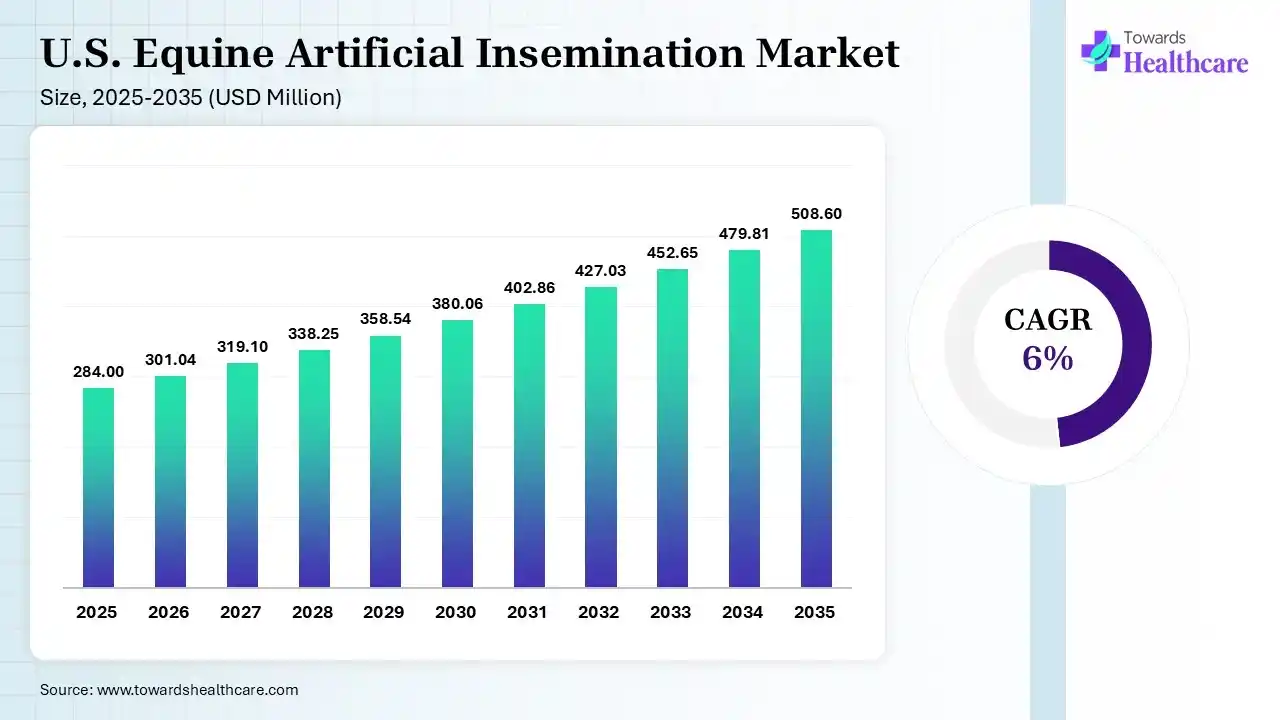
Analyst View: The forecast was created based on the number of mares bred through artificial insemination in the U.S. by breed and geographic region, adjusted for average costs per breeding for services, semen processing and transport, equipment and supplies, and reproductive drugs. The number of breedings depends on foal registrations by breed, proportion of artificial insemination breedings, and economic conditions within the horse industry. This was verified against the sales revenue of major breeding facilities, labs specializing in semen processing, and manufacturers of reproductive products, as well as other estimates, putting our base year somewhat higher than the largest comparable figure. Growth is based on steady demand for breeding of sport horses, limited somewhat by reduced foal crop in certain breeds and rising costs of horse ownership.
Driver: Most major horse breed registries allow for artificial insemination. Cooled and frozen semen allow access to some of the best stallions across the country. AI helps avoid injury and diseases associated with natural breeding. Equestrian sports drive up demand for good breeding. Programs that employ embryo transfers increase the number of AI programs.
Restraint: The Thoroughbred registry only allows for natural breeding. Some breeds are experiencing reduced foal production. Ownership of horses is very expensive. Frozen semen is less fertile per unit. The registry rules limit the use of frozen semen after death.
Opportunity: Frozen semen export/import is an area of opportunity. Freezing methods can be improved to increase fertility. Portable laboratories can reach remote locations. Genetic tests can assist in choosing stallions. More reproduction veterinarians could be trained.
| Segments | 2025 Share | 2025 Value (USD Million) | 2035 Value (USD Million) | CAGR 2026–2035 |
| Services | 51.40% | 145.98 | 250.90 | 5.57% |
| Semen | 28.60% | 81.22 | 156.31 | 6.77% |
| Equipment & Consumables | 20.00% | 56.80 | 101.39 | 5.97% |
Note: 2025 is the base year; 2035 values are forecasts.
Sources: Expert interviews, secondary sources, Towards Healthcare database, and Towards Healthcare analysts.
Services: This sub-segment had a share of 51.40% (USD 145.98 million) in the U.S. equine artificial insemination market in 2025 and is expected to grow to USD 250.90 million in 2035, growing at a CAGR of 5.57% between 2026 and 2035. The services are those involved in stallion semen collection, evaluation and processing, examination of the mare using ultrasound, timing of ovulation, insemination, pregnancy testing, and embryo transfer. This sub-segment makes up the highest share due to the need for accurate timing of the insemination process and skillful veterinary skills, which make the process to be performed several times in one breeding. Services are mostly provided by breeding centres such as affiliates of Select Breeders Services, university clinics and specialty reproduction clinics in Texas, Kentucky, Oklahoma, and Florida.
Semen: This segment constituted 28.60% (USD 81.22 million) of the overall U.S. equine artificial insemination market in 2025 and is forecast to attain USD 156.31 million by 2035, growing at a CAGR of 6.77% during 2026-2035. The semen category revenue includes the fees from studs and costs for collecting, processing, packaging, and transporting cooled/frozen/sexed semen (where applicable). It is the fastest-growing solution due to frozen semen, which enables breeders to utilize proven stallions post-retirement or death, provided registry regulations permit, along with importing/exporting genetics. High-end Quarter Horse, Paint, and sport horse stallions generate revenue through their semen sales throughout the nation.
Equipment & Consumables: This segment held a 20.00% share (USD 56.80 million) of the U.S. horse artificial insemination market in 2025 and is forecast to achieve USD 101.39 million by 2035, registering a CAGR of 5.97% between 2026 and 2035. Equipment & consumables comprise extenders for semen, artificial vaginas, insemination pipettes & catheters, transport equipment like Equitainers, liquid nitrogen dry shipper and straws and microscopes and ultrasound equipment. The market growth is dependent on breeding activities with consumables being used per collection and insemination. Some companies that provide these include IMV Technologies, Minitube, and Hoffman A.I. Breeders.
| Segments | 2025 Share | 2025 Value (USD Million) | 2035 Value (USD Million) | CAGR 2026–2035 |
| Sports & Racing | 56.20% | 159.61 | 285.83 | 6.00% |
| Recreation | 34.60% | 98.26 | 175.98 | 6.00% |
| Others | 9.20% | 26.13 | 46.79 | 6.00% |
Note: 2025 is the base year; 2035 values are forecasts.
Sources: Expert interviews, secondary sources, Towards Healthcare database, and Towards Healthcare analysts.
Sports & Racing: This segment represented 56.20% (USD 159.61 million) of the United States horse artificial insemination market in 2025 and is expected to grow to USD 285.83 million in 2035 at a CAGR of 6.00% from 2026 to 2035. This includes sports and racehorses like Quarter Horse racing and western performance horses, Standardbred harness racers, and warmbloods for show jumping, dressage, and eventing. This is the largest segment because the breeds have a wide acceptance of artificial insemination, high stud fees, and breeders invest in reproductive technologies to create superior progeny. Thoroughbred racing, on the other hand, needs natural cover and is thus not part of artificial insemination demand.
Recreation: This segment was responsible for 34.60% (USD 98.26 million) of the market size in the USA market for equine artificial insemination in 2025 and is estimated to be worth USD 175.98 million by 2035, with a CAGR of 6.00% from 2026 to 2035. Recreational horses comprise breeds of horses used for pleasure riding and recreational purposes, like Paints, Appaloosas, Arabians, Morgans, and gaited breeds. The number of U.S. horses for recreation is around 3.9 million, thus making the segment big in spite of comparatively low spending per breeding.
Others: This segment represented 9.20% (USD 26.13 million) of the market size in the USA market for equine artificial insemination in 2025 and is estimated to be worth USD 46.79 million by 2035, with a CAGR of 6.00% from 2026 to 2035. Others comprise breeds like ranch horses and working horses, ponies, draft horses, and miniature horses. This segment involves limited use of artificial insemination but more utilization of cooled semen services.
| Segments | 2025 Share | 2025 Value (USD Million) | 2035 Value (USD Million) | CAGR 2026–2035 |
| Cooled Semen | 58.60% | 166.42 | 281.26 | 5.39% |
| Frozen Semen | 27.80% | 78.95 | 159.54 | 7.29% |
| Fresh Semen | 13.60% | 38.62 | 67.80 | 5.79% |
Note: 2025 is the base year; 2035 values are forecasts.
Sources: Expert interviews, secondary sources, Towards Healthcare database, and Towards Healthcare analysts.
Cooled Semen: The cooled semen segment held a 58.60% (USD 166.42 million) share of the United States Equine Artificial Insemination market in 2025 and is expected to be worth of USD 281.26 million by 2035, growing at a CAGR of 5.39% from 2026 to 2035. The cooled semen is collected, diluted with extenders, then chilled and shipped overnight via insulated carriers to the location of the mare. It is the most commonly used procedure in the United States due to its fertility, absence of transportation of mare and stallion and suitability to registry regulations.
Frozen Semen: This market segment contributed 27.80% (USD 78.95 million) to the total U.S. equine artificial insemination market in 2025 and is expected to grow up to USD 159.54 million in 2035, registering a CAGR of 7.29% between 2026 and 2035. Frozen semen is kept in liquid nitrogen and can be used years after collection. It is the fastest-growing method because it enables international trading of genetics, use of stallions post-competition, and banking of genetics. The limitation includes lower fertility per dose, intensive mare management, and registry restrictions like the American Quarter Horse Association, which allows two-year usage of genetics after a stallion's death for horses foaled from 2015.
Fresh Semen: This market segment contributed 13.60% (USD 38.62 million) to the total U.S. equine artificial insemination market in 2025 and is expected to grow up to USD 67.80 million in 2035, registering a CAGR of 5.79% between 2026 and 2035. Fresh semen is used immediately after collection when the mare and stallion are on the same farm or breeding center. It provides the highest fertility rate and is prevalent in large breeding farms with stallions.
| Segments | 2025 Share | 2025 Value (USD Million) | 2035 Value (USD Million) | CAGR 2026–2035 |
| Private | 78.40% | 222.66 | 400.36 | 6.04% |
| Public | 21.60% | 61.34 | 108.24 | 5.84% |
Note: 2025 is the base year; 2035 values are forecasts.
Sources: Expert interviews, secondary sources, Towards Healthcare database, and Towards Healthcare analysts.
Private: The private channel held 78.40% (USD 222.66 million) of the total market share of U.S. equine artificial insemination in 2025 and is anticipated to grow to USD 400.36 million by 2035, recording a CAGR of 6.04% during 2026-2035. This channel includes private veterinary practices, breeding farms, and commercial breeding centers. The dominance is due to the fact that most horse breeding activities in the U.S. take place via private owners and are managed by specialized reproduction practices.
Public: This channel comprised 21.60% (USD 61.34 million) of the total U.S. equine artificial insemination market in 2025 and will grow to a value of USD 108.24 million by 2035, recording a CAGR of 5.84% between 2026 and 2035. The public channels include university veterinary teaching hospitals and public research institutes, like those in Texas A&M, Colorado State, and UC Davis.
Analyst View: Values were allocated for this segment based on matching the breeding volume and expenditure with solutions, horse breed, technique, and channels, based on breeding center data and registry statistics. Reproductive services, sport and race horses, cooled semen, and private channels are dominant due to existing practices in U.S. horse breeding. We anticipate growth in the shares of semen and frozen semen.
| Region | 2025 Share | 2025 Value (USD Million) | 2035 Value (USD Million) | CAGR 2026–2035 |
| South | 44.60% | 126.66 | 233.97 | 6.33% |
| West | 22.80% | 64.75 | 113.03 | 5.73% |
| Midwest | 18.40% | 52.26 | 91.21 | 5.73% |
| Northeast | 14.20% | 40.33 | 70.39 | 5.73% |
Note: 2025 is the base year; 2035 values are forecasts.
Sources: Expert interviews, secondary sources, Towards Healthcare database, and Towards Healthcare analysts.
South: In terms of revenue, this region held a 44.60% share of the U.S. equine artificial insemination market in 2025, which will grow from USD 126.66 million in 2025 to USD 233.97 million by 2035, growing at a CAGR of 6.33% between 2026 and 2035. Texas has the highest number of horses in the entire nation, and it is the heart of Quarter Horses and Paints' breeding operations, as there are many breeding operations and reproduction clinics in the areas of Weatherford, Pilot Point, and College Station. Oklahoma is yet another leading Quarter Horse and Racing state, and Kentucky, famous for its Thoroughbred breeding via natural covers, is home to Standardbred and sports horses' breeding via artificial insemination. The state of Florida, particularly the cities of Ocala and Wellington, has warmblood and show horses' breeding facilities.
West: This region held a 22.80% (USD 64.75 million) share of the U.S. equine artificial insemination market in 2025 and is estimated to reach USD 113.03 million by 2035, growing at a CAGR of 5.73% between 2026 and 2035. The West encompasses California, Colorado, Arizona, and the Pacific Northwest and breeds in reining, cutting, dressage, and Arabian horses. Programs like UC Davis and Colorado State provide sophisticated reproductive services, while ranch horse breeding is an integral part of the Mountain states.
Midwest: This region held an 18.40% (USD 52.26 million) share of the U.S. equine artificial insemination market in 2025 and is estimated to reach USD 91.21 million by 2035 growing at a CAGR of 5.73% between 2026 and 2035. The Midwest consists of Ohio, Indiana, Illinois, and Michigan, which have a significant contribution to breeding Standardbreds for harness racing, draft horses, and also Quarter Horses & Paints. Ohio and Indiana are key Standardbred states practicing artificial insemination extensively.
Northeast: This region held a 14.20% (USD 40.33 million) share of the U.S. equine artificial insemination market in 2025 and is estimated to grow to USD 70.39 million by 2035, registering a CAGR of 5.73% during 2026-2035. The Northeast consists of Pennsylvania, New York, and New Jersey, with Pennsylvania and New York having Standardbred breeding and sport horse/dressage breeding. Higher cost of land and smaller farms favor cooled shipped semen over keeping stallions.
Analyst View: Region-wise shares have been derived on the basis of breeding numbers and expenditures in each region. The South is dominant due to the presence of quarter horse/performance horses in abundance. We have given it the highest growth premium due to rapid expansion of breeding and reproduction activities in this region.
| Rank | Company Name | Market-Specific Revenue (USD Million) | 2025 Share | Key Products / Business | Headquarters |
| 1 | Select Breeders Services | 22.00 | 7.75% | Frozen semen processing and affiliate lab network | United States |
| 2 | IMV Technologies | 14.00 | 4.93% | Semen processing equipment and consumables | France |
| 3 | Zoetis | 14.00 | 4.93% | Equine reproductive hormones | United States |
| 4 | Merck Animal Health | 12.00 | 4.23% | Equine reproductive products | United States |
| 5 | Minitube | 12.00 | 4.23% | Semen extenders, containers and equipment | Germany |
| 6 | Hoffman A.I. Breeders | 8.00 | 2.82% | AI equipment and supplies | United States |
| 7 | Continental Genetics | 6.00 | 2.11% | Semen freezing and storage | United States |
| 8 | Neogen | 5.00 | 1.76% | Equine genetics and breeding diagnostics | United States |
| 9 | Equine Reproduction Concepts | 4.00 | 1.41% | Reproduction services and supplies | United States |
| 10 | Nasco | 3.00 | 1.06% | Breeding supplies | United States |
Note: Company revenues and shares are 2025 estimates.
Sources: Company press releases, expert interviews, secondary sources, Towards Healthcare database and Towards Healthcare analysts.
Select Breeders Services dominated the U.S. equine artificial insemination industry in terms of 7.75% (USD 22.00 million) of 2025 revenue share, followed by IMV Technologies with 4.93% (USD 14.00 million), and Zoetis with 4.93% (USD 14.00 million). The dominance of select breeder services is based on their ability to freeze semen and their several affiliate labs across America. IMV Technologies offers semen processing equipment, while Zoetis offers reproductive hormones for cycle management and ovulation. Merck Animal Health, Minitube, Hoffman A.I. Breeders, Continental Genetics, Neogen, Equine Reproduction Concepts, and Nasco are some of the competitive companies offering reproductive products, extenders, and AI supplies.
The leading 10 players constituted 35.21% (USD 100.00 million) of revenue in 2025, while the rest of the share constituting 64.79% (USD 184.00 million) was captured by private horse reproduction services, breeding centers, university clinics, and stallion stations. The U.S. equine artificial insemination market is highly fragmented and involves a large number of players such as private veterinarians and breeding facilities, and the competition is based on factors such as pregnancy rates, veterinary expertise, frozen semen quality, shipping, proximity, and pricing.
The U.S. equine artificial insemination ecosystem links product suppliers with stallion stations and semen laboratories, reproduction veterinarians, breed registries, shipping providers and mare owners.
| Ecosystem Stage | Role in the Market | Key Companies |
| Product Suppliers | Supply extenders, equipment, containers and hormones | IMV Technologies, Minitube, Hoffman A.I. Breeders, Zoetis, Merck |
| Stallion Stations & Labs | Collect, process, freeze and ship semen | Select Breeders Services affiliates, Continental Genetics, stallion farms |
| Reproduction Veterinarians | Manage mares and perform insemination | Private equine practices, university clinics |
| Breed Registries | Set rules for AI and frozen semen | AQHA, APHA, USTA, warmblood registries |
| Owners & Logistics | Breed mares and ship semen | Mare owners, breeders, overnight couriers |
Sources: Company press releases, expert interviews, secondary sources, Towards Healthcare database and Towards Healthcare analysts.
The U.S. equine artificial insemination market positioning by Towards Healthcare companies quadrant is based on the strength of each company in the U.S. equine artificial insemination market, measured in terms of size of the business and market shares, and also by innovation and growth strategies of each company, measured in terms of range of products and technological focus of the company.
Sources: Company press releases, expert interviews, secondary sources, Towards Healthcare database and Towards Healthcare analysts.
Leaders: Select Breeders Services, IMV Technologies, Zoetis, and Minitube combine significant U.S. equine reproduction revenue with strong technology, service networks, and broad distribution.
Challengers: Merck Animal Health has established reproductive products but less AI-specific innovation.
Innovators: Continental Genetics and Neogen bring semen storage, genetic testing, or equipment innovations used by breeders.
Niche Players: Hoffman A.I. Breeders, Equine Reproduction Concepts and Nasco serve specific supply and service segments.
By Solution
By Equine Type
By Technique
By Distribution Channel
By Region
The U.S. equine artificial insemination market is the provision of equine artificial insemination, including semen, equipment, consumable products, and reproductive hormones in the country. The 2025 base year was derived using a bottom-up approach, taking into account the number of mares bred using artificial insemination by breed and region and spending per breeding, and verified using a top-down approach against revenue of major breeding centers, semen labs, and suppliers of reproductive products. Allocation of segment, regional and company revenues was done based on solutions, types of equines, techniques, distribution channels and regional demand. Data inputs that could not be reconciled using third-party information, regulatory filings, and public estimates were not used. All segments, regions and companies were allocated against the same 2025 base, and 2026-2035 forecast using the constant CAGR was recomputed.
Analyst View: The U.S. equine artificial insemination market for horses in the U.S. is a mature industry based on services. It is driven by breeding of performance horses and usage of frozen semen. Our forecast depends on both the volume of breeding and the cost per breeding, which means that our forecast is connected with the number of foals registered and the requirements of the registries for breeding horses. The most positive factors include frozen semen and embryo transfer.