




 Request Consultation
A flexible, plastic tube inserted through the mouth or nose into the trachea to keep an open airway & convey oxygen, gases, or anesthesia to the lungs is termed an endotracheal tube. It has substantial applications during surgery, in emergencies, or for respiratory failure, often coupled with a ventilator.
Across the world, 2026 is considered an immersive year for development in the healthcare sector, where the endotracheal tube is broadened with the rising use of video-enabled tubes and advanced materials to lower infection risks. Industrial growth is facing challenges, including accelerating expenditures and supply chain bottlenecks for raw materials such as silicone.
Ensured Key Tube Placement Methods & More Common Complications
Gold Standard & Other Methods Supporting Surgeons
More specifically, the AHA & the European Resuscitation Council have recommended the Waveform capnography method as a gold standard across the globe, which assists in confirming proper endotracheal tube (ETT) placement. Besides this, the industry has executed other steps, like direct visualization of the tube passing through the vocal cords, chest auscultation for bilateral breath sounds, etc.
Studies Have Shown Diverse Complication Categories
- Early Complications- This primarily includes tooth damage, soft tissue injury, vocal cord trauma, & esophageal intubation.
- Late/Long-term Complications- Such as Ventilator-associated pneumonia (VAP), tracheal stenosis, vocal cord paralysis, & tracheal necrosis due to greater cuff pressure.
- Accidental Extubation- This is considered a significant issue, i.e. the premature removal of an endotracheal tube.
What is Rapid Sequence Intubation & Its 7 Ps?
Primarily, Rapid Sequence Intubation (RSI) is referred to as a particular, urgent procedure, which encompasses the instantaneous administration of an induction agent subsequently by a paralytic, to secure the airway in patients at high risk of aspiration. It prominently follows a systematic, mnemonic, substantial 7 Ps, such as Preparation, Preoxygenation, Pre-treatment, Paralysis and induction, Protection and positioning, Placement with proof, Post-intubation management.
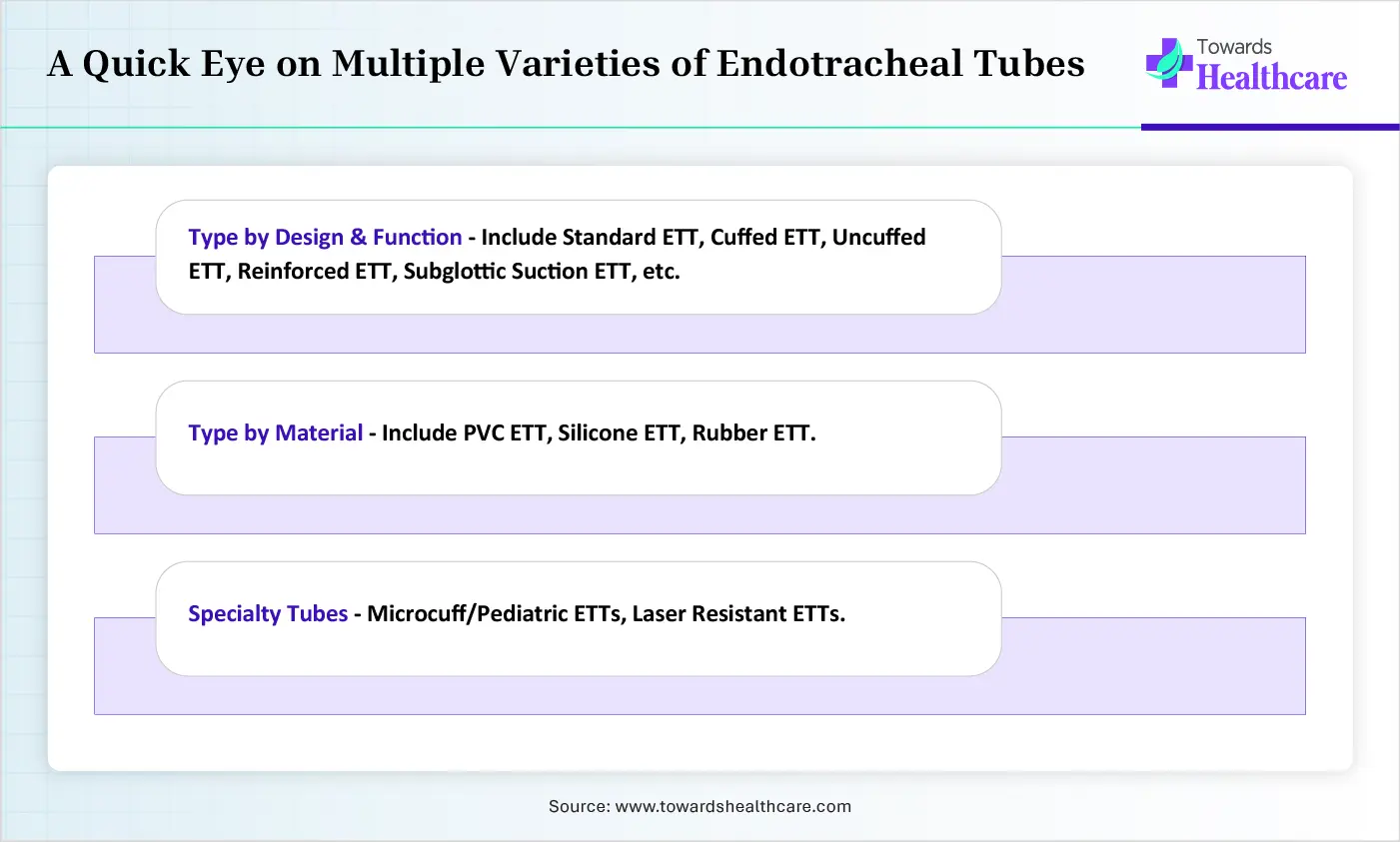
A Quick Eye on Multiple Varieties of Endotracheal Tubes
How do Emerging Technologies & Advanced Materials Impact the Endotracheal Tube?
Spurring Novel Tubes & Material Breakthroughs
Researchers are promoting newer tubes, like those coated with silver, silicone, or other antimicrobial agents, which lower bacterial adhesion and biofilm formation. Eventually, the population is moving toward polyurethane (PU) for thinner, more compliant cuffs that facilitate rigorous sealing at minimal pressure, thereby lowering tracheal harm.
Innovative Modern & Connected Devices with Robotic Support
Industry has been putting efforts into implementing new smart endotracheal tubes with integrated sensors, which will track cuff pressure & determine secretion levels in real-time. However, advances in AI-assisted robotic solutions, like KIS, RRAIS, and REALITI, offer expedited and more precise, continuous, and secure airway access.
Regional Spotlight
Which Innovations are Explored in North America in 2025?
In the last year, North America showed dominance in the endotracheal tube industry, with many strong efforts in novelty. This prominently comprises recently designed antimicrobial peptide coatings by researchers at the Children Hospitals of Philadelphia (CHOP), which focus on reducing upper-airway bacterial inflammation & mitigating subglottic stenosis.
The U.S. Aimed to Encourage Structural & Smart Groundbreakings
Endotracheal tube innovations in the U.S. have been demonstrated with consistent, robust trials, including the BREATHE trial. This is a multi-center randomized clinical trial conducted across 7 various U.S. sites, which shows a comparison of the efficacy of smaller vs. larger ETTs on long-term results.
Another innovation done at the University of North Carolina (UNC) is a versatile mouthguard prototype that secures ETTs without putting pressure on the skin, minimizing painful pressure injuries and the requirement for corrective plastic surgery.
How is the Asia Pacific Witnessing Rapid Growth in Endotracheal Tubes?
During 2026-2035, the Asia Pacific is anticipated to expand fastest, with arising AI-driven smart airway management solutions. Particular key engagement of Japan & South Korea is evolving smart airway devices to offer real-time data to clinicians. A prominent innovation involves AI-guided videolaryngoscopy, which leverages computer vision to find the glottis & support tube insertion through joystick control, and this finally lowers the human skill needed for complex intubations.
India Revolutionized Strategy & Strengthening Trauma Center
India is a major hub for upcoming healthcare developments, as in the recent era, the All India Difficult Airway Association (AIDAA) 2025 guidelines unveiled the SAFE strategy, i.e. Stratify Risk, Assemble, Facilitate, Evaluate, to regulate extubation procedures for at-risk airways. Coupled efforts have empowered government investment in trauma centers across India, which has led to a surging demand for reliable, specialized airway tools, specifically reinforced tubes for complex head & neck surgeries.
How will COPD & Asthma Cases Bolster the Development of the Endotracheal Tube?

In the coming era, the globe will have the above-mentioned number of cases of COPD & asthma, which highly supports the use of novel ETTs by leveraging specialized cuff materials, like soft polyurethane. This will eliminate tracheal damage (stenosis) and further facilitate a strong, low-pressure seal. The AnapnoGuard system shows automatic monitoring and adjusts cuff pressure while simultaneously controlling subglottic secretions.
Furthermore, the globe is pushing enhanced tip designs to couple with smoother, less traumatic intubation, primarily when utilizing fiberoptic bronchoscopy. This also incorporates actively established Sleeve-Type Endotracheal Tube (STET), which offers modular, dual-lumen architectures and optimized sealing & ease of use in patients with difficult, narrow, or compromised airways.
Briefing Ongoing Studies & Prospective Opportunity of Endotracheal Tube
Starting in late 2026, the VAPShield project has kept a goal to design next-generation infection-resistant biomaterials to further reduce VAP issues. Apart from this, research activities are continuing proprietary coatings, such as Bactiguard, which employs an alloy of silver, palladium, & gold to prevent biofilm formation.
Additionally, the University of Nottingham is performing human trials for iTraXS, the worlds first optical fiber sensor-equipped ETT, which will assist in monitoring pressure & oxygenation directly at the tracheal wall. Whereas, the Alexandria University Hospitals are demonstrating clinical trials to compare 4-hour versus 8-hour monitoring intervals for cuff pressure to find the most efficient protocol for lowering VAP prevalence in neuro-critically ill patients.
The Future Chances will Drive Pediatric Safety & Personalization
2026s scientific activities are aiming at the long-term impact of early-life intubation, with a connection between pediatric intubation and an expanded risk of mental health conditions, which fosters a lower emphasis on unnecessary intubation durations. Moreover, firms will experience significant opportunities in ergonomically designed, size-specific pediatric tubes with improved cuff technology to minimize mucosal injury in neonatal & pediatric surgeries.
Emergence of New Rules & Demand Will Give Rigorous Opportunities
From 2026, European sustainability rules are imposing manufacturers to transition toward bio-based or recyclable polymers, specifically thermoplastic polyurethanes. Besides this, a huge demand for reinforced tubes with embedded spiral wiring is also being explored by firms, which will mitigate kinking during complex surgeries, & specialized laser-proof tubes that are safe for use during airway surgeries using lasers.
Impactful Catalysts & Key Limitations: Pushes Steps in Players Breakthroughs
Many leading firms are putting efforts into developing novelty in endotracheal tubes, which have to emphasize the latest drivers of the respective industry, like:
- The worldwide growing surgical procedures, ageing populations, and the incidence of respiratory disorders, like COPD and asthma, raise demand for these tubes.
- Also, leaders are experiencing a huge expansion in the single-use/disposable airway device to mitigate nosocomial infections, which is supporting their vision.
- Alongside, especially in the Asia-Pacific region, companies are inclined towards alliances, acquisitions, and broadening production.
Peacocking Challenges in Manufacturing & Supply Chain
- Modifying regulations about single-use plastics is pressurizing a movement toward new materials, including bio-based polyurethanes.
- On a limited pediatric device, the FDA has looked at manufacturing risks, which require firms to reassess logistics.
- Certain production companies are facing product recalls because of safety concerns, which has developed opportunities for companies with outstanding quality control to achieve market share.
Offerings of Major Players in the Endotracheal Tube Industry
| Company Name | Key Offerings & Brands | Specialisations / Focus |
| Angiplast Pvt Ltd | Endotracheal tubes (ET tubes) | Anesthesia, emergency medicine, and airway management. |
| Advin Health Care | Medical-grade PVC tubes | Routine and specialized intubation. |
| Sterimed Group | Coated and structural tubes | Reducing patient trauma and preventing infections. |
| Ambu A/S | VivaSight 2 DLT, AuraGain, Aura-I | Innovative airway management technology. |
| Intersurgical | InTube range | Anesthesia, emergency medicine, and intensive care. |
| ICU Medical, Inc. | Portex and Blue Line brands | Comprehensive ETT portfolio |
| Medtronic (Covidien) | Shiley (TaperGuard & SealGuard) | Proprietary cuff technologies for improved sealing |
| Van Oostveen Medical | ETTs (MDR (EU) 2017/745) | Compliance with European and international quality standards. |
| Teleflex Inc. | Rusch and Sheridan brands | Advanced airway management solutions. |
| Convatec Inc. | Specialized intubation products | High-quality, sterile, and niche medical devices. |
Conclusion
Globally transforming endotracheal tubes is assisting in searching for novelty in materials, which has been explored through antimicrobial coating materials. Research activities have set a goal for smart & advanced airway management through the adoption of more sophisticated devices. Upcoming opportunities are inclined towards pediatric customization, safety, well-established trauma centers, and revolutionary guidelines.
Expert Insights
According to a Recent report on the Endotracheal Tube Market, published on Towards Healthcare, experts note that the market is growing steadily due to the rising prevalence of respiratory diseases and the increasing number of surgical and emergency procedures worldwide. Endotracheal tubes are essential for airway management and mechanical ventilation, particularly in intensive care units, operating rooms, and emergency settings. The growing aging population and the rising burden of conditions such as COPD and pneumonia are also contributing to higher demand for advanced airway management devices. Experts further highlight that innovations in materials, antimicrobial coatings, and disposable tube designs are improving patient safety, reducing infection risks, and supporting broader adoption across modern healthcare systems.