




 Request Consultation
Basically, the use of advanced meditation management apps is assisting users in practising mindfulness, lowering stress, enhancing sleep, & managing mental health through guided sessions, timers, and progress monitoring. Moreover, these kinds of apps often facilitate curated audio and specialised courses for beginners, with tools for developing lasting habits, available on mobile devices.
Day by day, numerous giant companies are inclining towards the wider adoption of AI & machine learning for the analysis of user behavior, emotional states, & feedback to bring precision meditation drives. Apart from this, a transformative development encompassing integrated smartwatches and fitness trackers to enable real-time monitoring of heart rate, sleep, and stress levels.
How do Various Drivers Impact the Progression of Meditation Management Apps?
Prominent catalysts include growing mental health awareness, technological breakthroughs, and immersive initiatives across diverse sectors.
Expanding Mental Health Awareness & Stress
Through the ongoing awareness activities, the globe is understanding the significance of mental wellness & decrease in stigma surrounding mental health conditions, which fuels demand for self-care measures. Alongside, the era is experiencing high-pressure lifestyles & accelerated anxiety levels, which support individuals to look for accessible stress management tools.
Extensive Technological Advances & Smartphone Adoption
The worldwide surge in digitalisation and greater smartphone penetration is further providing easy access to these digitalisation apps, especially in emerging areas. Moreover, the massive population is demanding the latest technology, like AI for customized content, and integration with wearable devices, which will finally boost user experience & involvement.
Robust Initiatives by Corporate & Government Sectors
To elevate employee productivity, the corporate world is fostering integrated mindfulness apps into its corporate wellness programs, which is also a key driver. Additionally, the government sector, specifically in Asia-Pacific countries, is actively promoting yoga & mental health, which surges adoption.
Regional Government Efforts to Spur Mental Health Wellness & Digital Approaches
| Region/Country | Program | Facilities |
| India� | National Tele Mental Health Programme (Tele MANAS) | This majorly offers universal, free 24/7 mental health care, which also includes a multi-lingual user interface that supports 20+ languages. |
| United Kingdom | NHS Mental Health Services | They have recommended different digital apps, called Wysa (AI-driven CBT chatbot), Be Mindful (Mindfulness-based cognitive therapy), Feeling Good (Positive mental training), & Sleepio (Clinically proven for insomnia), that are validated by ORCHA and DTAC.� |
| Gulf Cooperation Council (GCC) | Regional Wellness Strategies | This prominently focused on combining mental wellness into national development strategies, especially within Saudi Arabia's Vision 2030 & UAE�s National Strategy for Wellbeing 2031.� |
| Global Encouragement | WHO Special Initiative for Mental Health (SIMH)� | This initiative mainly operates in Bangladesh, Cambodia, Ghana, Jordan, Nepal, Ukraine, and Zimbabwe to revolutionize services & facilitate technical assistance to make them globally accessible at the community level. |
| Canada | Youth Mental Health Programs� | This emphasizes funds, tests, & scales groundbreaking mental health programs for youth (aged 10�24) in 12 priority countries.� |
What are the Specific Limitations of Meditation Management Apps?
- In certain regions, an increased dropout rate with nearly 94%-95% of users disconnecting after 2 weeks to 30 days.
- Often, users participate in shorter sessions, i.e., about 10-21 mins instead of traditional 30-45 mins programs, which are suggested with raised benefits.
- Sometimes, a lack of in-person, teacher-led sessions results in declined tailored support and detailed, comprehensive training.
- To roll out robust, high-quality guided meditations, there is a need to hire professional instructors and audio engineers, resulting in increased production expenditures.
- Another major hurdle is maintaining a balance between an enriched feature set and a non-frustrating user interface.
- Sometimes, firms are facing technical difficulties in conveying a seamless, lag-free experience across iOS, Android, & wearables.
Modern Trends: Reinforcing Individualization & Users' Belief
- Many leading firms have made a clear focus on utilizing AI algorithms, as well as wearable integrations, and more impressive advanced technology in the emerging mediation management apps to boost their respective well-being.
- In 2026, the broader population is heavily implementing apps by using artificial intelligence, which personalizes meditation sessions for particular user moods, preferences, and progress, which ultimately provides more customized content.
- Another notable trend comprises integrated wearables, such as smartwatches, that enable apps to monitor heart rate changes & stress levels, & also offer real-time feedback & data-driven insights into the effects of meditation on physical wellbeing.
- Most transformative steps in virtual reality & extended reality are developing engaging, calming environments, particularly Headspace XR, which focuses on younger audiences with interactive, nature-driven sessions.
- Globally popular apps are widely employing a freemium model, which provides free initial access to content, & also appeals to the widespread user base before facilitating paid subscriptions for specialized or premium content. 
Escalating Anxiety & Depressive Disorders Cases: Meditation Management Apps Support Declining These Issues
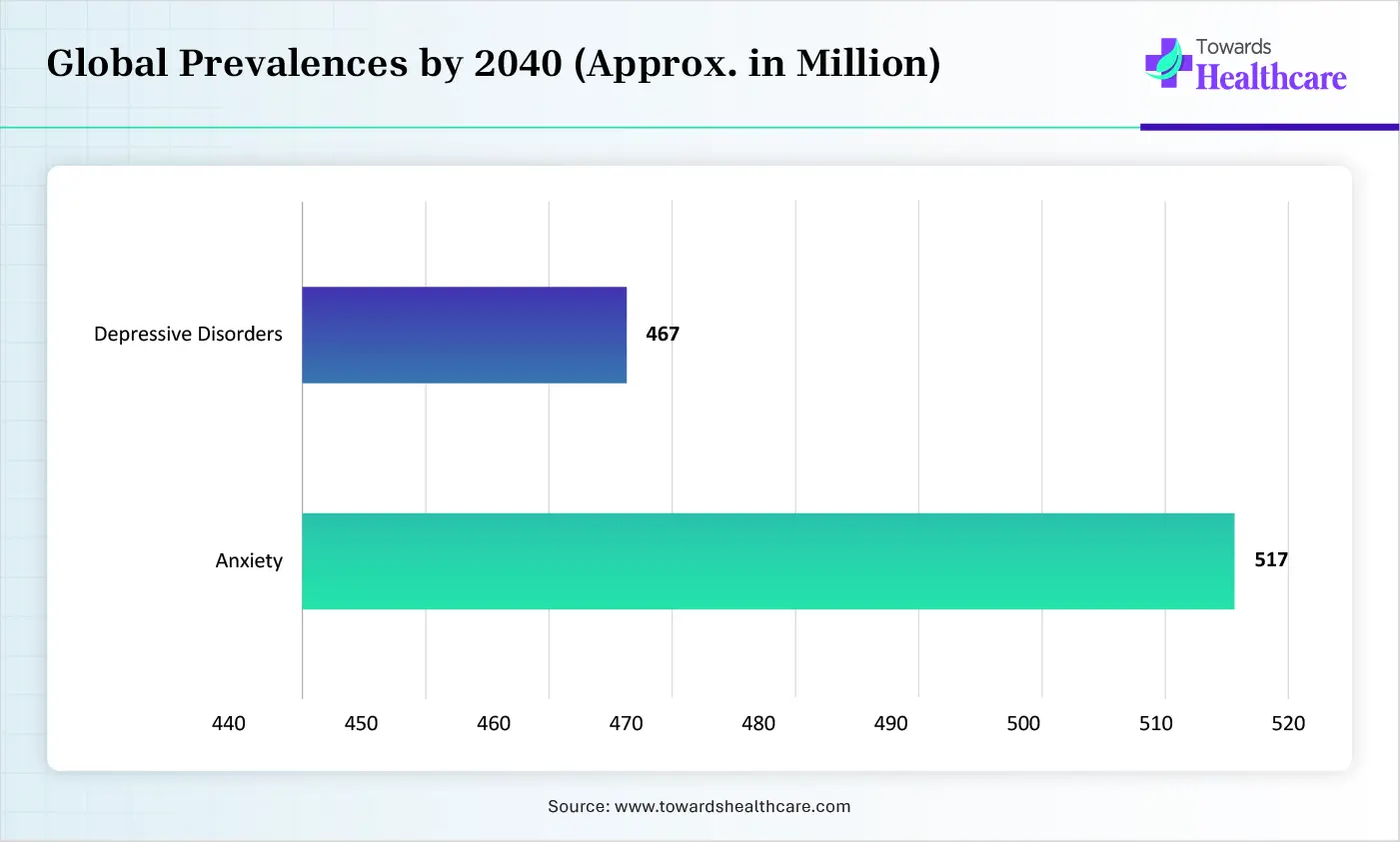
The worldwide rising burden of mental disorders, especially among women and middle-aged adults, with a projection of psychological distress will reach nearly 29% for men and 32% for women, pushing the prospective developments. These developments will actively empower in reducing the future cases.
- Lowering the repetitive negative thinking that leads to depression and anxiety, whereas guided practices will help users to refocus their attention on the present moment, instead of fixating on past failures or upcoming anxieties.
- Besides this, several meditation management apps are training users to aim their thoughts & emotions, ignoring judging or reacting to them, which develops emotional space, and finally decreases the intensity of anxious or depressive responses to each day's stressors.
- Eventually, sophisticated and user-friendly apps, including Headspace & Calm, will offer emergency SOS meditations & breathing exercises for moments of acute, intense anxiety or panic.
- However, certain structured programs & courses will also execute customized multi-day courses that fulfil specific mental health requirements, like Weathering the Storm or Managing Sadness.
Substantial Latest Alliances, Investments in Meditation Management Apps in 2025-2026
| Knoxville City Council (March 2026) | Approved more than $500,000 in funding to lower violence through youth programming, case management, & mental health services. |
| Somethings (February 2026)� | Raised $19.2M to bolster its mobile app that connects teens and young adults with trained peer mentors.� |
| Cigna Healthcare (November 2025)� | Joined with Headspace to provide over 7 million members access to Headspace�s digital mental health tools.� |
| Calm Health (October 2025) | Partnered with LifeStance Health to assist users in accessing high-quality mental health care.� |
| Infosys (June 2025) | Collaborated with Mental Health Foundation Australia (MHFA) to strengthen mental health awareness, with the evolution of a mobile app called 'Supportive Mind'. |
Country-Level �Eye on Present & Prospective Activities in Latest Meditation Management Apps
United States
U.S. efforts are aiming at clinical trials for specialized issues, like anxiety, PTSD, chronic pain, and rigorous alliance with significant health insurers.
India
Indian researchers are focusing on the efficiency of culturally specific content and Indian wisdom traditions, testing the progression of homegrown apps, specifically Idanim & Miracle of Mind.
United Kingdom
Researching AI solutions for personalized emotional support and their effect on workforce mental health.
Germany
This country has been taking steps towards the testing of preventive healthcare models, where these apps are offered for free by health insurance providers.
Japan
Japanese research activities are leveraging heart rate variability (HRV) and biometric data to eliminate extreme workplace stress.
South Korea
They are shifting towards points-based health platforms that unite meditation with nutrition and exercise.
France
Studies are assessing the long-term engagement of culturally customized breathing and relaxation programs.
Leading Players With Their Immersive & Advanced Offerings
| InnerExplorer� | Its offerings include audio-guided mindfulness programs primarily for education settings (PreK-12), teachers, & families to push social-emotional skills & decrease stress.� |
| Calm.� | A firm explored �Sleep Stories�, i.e., bedtime stories for adults, calming music, soundscapes, & gentle movement exercises. � |
| Headspace Inc. | This mainly facilitates over 1,000+ ad-free meditations, sleepcasts, mindful movement exercises, & tailored recommendations via an AI companion.  |
| MindApps. | Their platforms focus on guided, customizable sessions for stress reduction & sleep improvement. |
| Breathe | This specifically offers unique, on-demand AI-developed �Made4You� sessions, 24/7 AI coaching, and strong, exclusive hypnotherapy. |
| Meditation Moments. | It has unveiled 100+ hours of music (binaural beats, sound healing), daily affirmations, breathing exercises, & specialized content for kids.� |
| Simple Habit� | This provides over 2,000+ guided sessions of 5�30 minutes from prominent experts targeting stress, anxiety, & sleep.� |
| Ten Percent Happier� | This mainly executed nearly 500 guided meditations, expert-led courses on mindfulness and compassion, and specialized sleep content. � |
| Aura Health | An AI-enabled app offers daily 3-minute guided meditations, sleep stories, CBT, breathwork, and coaching.� |
Conclusion
A huge growth in mental health disorders, like anxiety, stress, and other depressive issues, especially among the young population and middle-aged adults, is fueling the need for the latest and impressive digital tools to raise meditation capacity and mental strength. Moreover, these cases are arising due to the expedited urbanization, digitalization, and worldwide competition, while these drivers are heavily encouraging corporate and government incentives for boosting mental health wellness among employees and the public, respectively. Most notable research efforts in different countries are pushing significant breakthroughs in these apps by utilizing AI-powered solutions and considering key mental health concerns.
Expert Insights
According to a recent report on the Meditation Management Apps Market, published on Towards Healthcare. Experts highlight that rising mental health awareness, increasing stress levels, and growing smartphone penetration are key drivers of market growth. The integration of artificial intelligence, cloud-based platforms, and personalized wellness features is enhancing user engagement and retention. Additionally, the popularity of freemium models and subscription-based services is supporting revenue expansion. However, concerns regarding data privacy, user retention challenges, and market saturation remain significant barriers. Overall, the market is expected to grow steadily, driven by digital wellness trends and increasing adoption of accessible mindfulness solutions globally.