The global dental regeneration market size accounted for USD 6.85 billion in 2025 and is predicted to increase from USD 7.52 billion in 2026 to approximately USD 17.45 billion by 2035, expanding at a CAGR of 9.8% from 2026 to 2035. The worldwide notable increase in tooth loss & periodontal diseases, with ongoing developments in bio-active materials, stem cell therapies, & AI solutions, is driving the market expansion.
rn
Market Glimpse
rn
A domain of dentistry that aims at restoration of damaged dental tissues, like dentin, pulp, & supporting bone, by leveraging stem cells, scaffolds, & signaling molecules is completely referred to as the dental regeneration market. It has major scopes in regenerating living pulp-dentin tissue in necrotic, immature permanent teeth, with the creation of biological tooth primordia using stem cells. A notable step includes research activities that use biomimetic materials to repair & regenerate enamel.
rn
Market Prospects
rn
In the coming era, the comprehensive progression will emphasize activation of dormant stem cells to new regrowth, functional teeth in adults, probably replacing dental implants & dentures. Eventually, research activities will step beyond cell-based to cell-free approaches, using mesenchymal stem cell (MSC)-secreted exosomes, to facilitate minimal immunogenicity & increased regenerative potential for pulpal & oral soft tissues.
rn
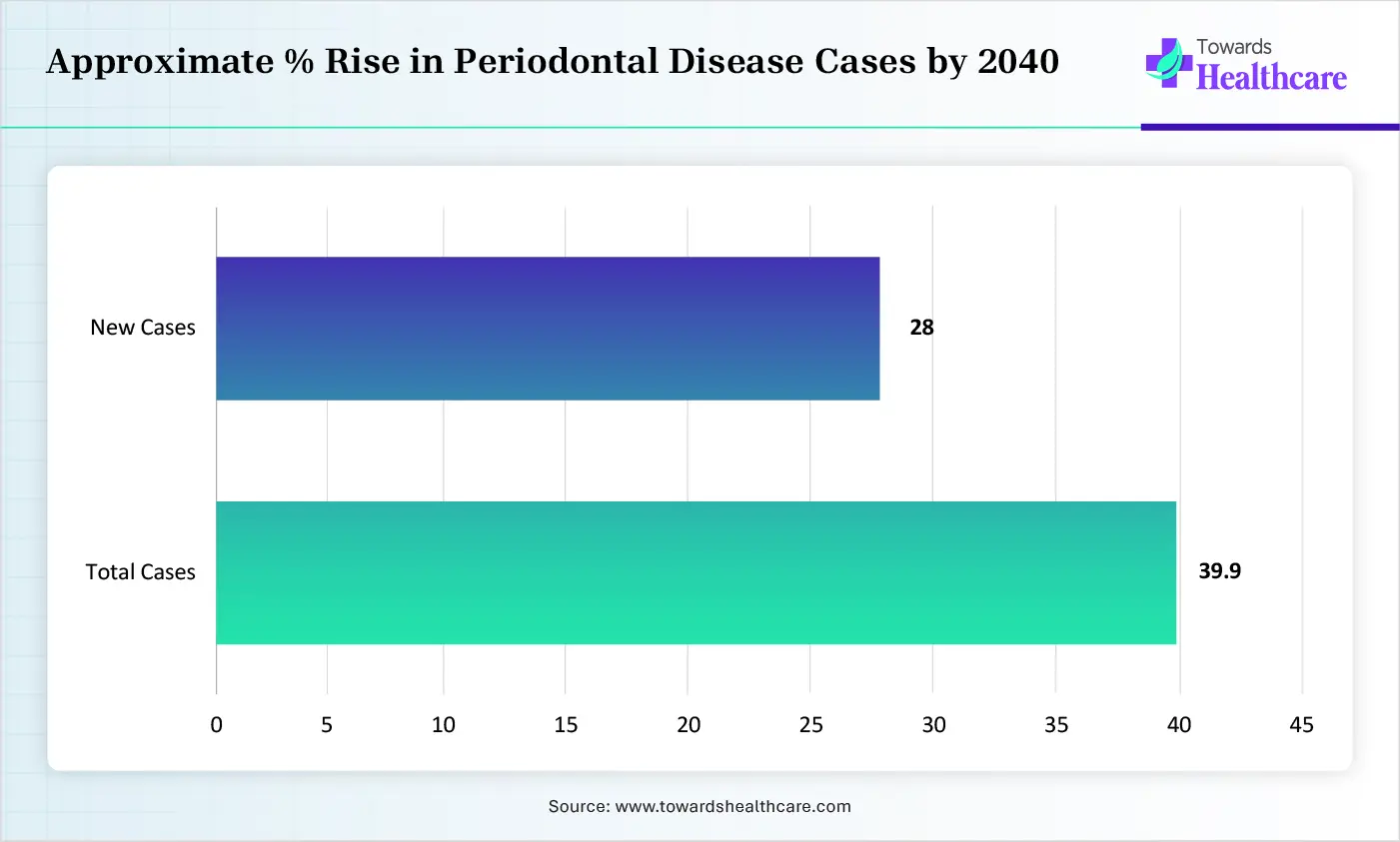
Approximate % Rise in Cases of Periodontal Disease by 2040
rn
rn
These statistics have shown a rise in both the number and age-standardized rates (ASR) of prevalence & instances are predicted to continue through 2040. This will foster the broader use of stem cell therapies, gene therapy to stimulate growth factors, 3D bioprinting of scaffolds, & fiber-guided scaffolding.
rn
Market Segmentation Overview
rn
rn- By product type, the bone grafts segment led with 42% share of the dental regeneration market in 2025. The occurrence of advanced gum disease, i.e., periodontitis, is the major reason for jawbone loss, which demands grafting for stabilization of teeth & prevention of tooth loss. However, tooth extraction results in substantial alveolar bone reduction, which requires bone grafting to keep the ridge structure for prospective prosthetic needs.
rn- By application, the periodontal regeneration segment held a major share of 34% of the market in 2025. Notably rising cases of periodontitis, gingival recession, and subsequent tooth loss, along with focus on growth factors, advanced biomaterial scaffolds, & stem/progenitor cell therapies, fuel the segmental growth & adoptions. In these instances, the market is fostering Platelet-rich fibrin (PRF), advanced PRF (A-PRF), & Injectable PRF (I-PRF) as autologous scaffolds.
rn- By material type, the natural materials segment dominated with 38% share of the dental regeneration market in 2025. This dominance is propelled by their biocompatibility, biodegradability, & ability to mimic the natural extracellular matrix (ECM) to repair or replace dental tissues. Also, several natural polymers are obtained from renewable, affordable, and abundant waste sources.
rn- By end user, the dental clinics segment captured 51% revenue share of the market in 2025. These clinics are considered a hub for bone grafting, guided tissue regeneration (GTR), & soft tissue regeneration to develop sites for implants. Expansion of patient awareness, aesthetic dentistry trends, & the demand for minimally invasive procedures drive the clinic-level adoption.
rn
rn
Regional Analysis
rn
North America Market Trends
rn
North America was dominant in the dental regeneration market, with 36% share in 2025. This is mainly fueled by consistent investments in dental R&D & the presence of advanced Dental Service Organizations (DSOs). Whereas, Canadian researchers are moving towards stem cell therapy, nanotechnology, and bioengineering to repair or replace tooth structures. Besides this, the U.S. researchers successfully employed induced stem cells to develop a thin layer of enamel-like material in vitro.
rn
Asia Pacific Market Trends
rn
Asia Pacific held 24% share of the dental regeneration market in 2025 & is expected to grow fastest at 11.2% CAGR in the coming era. Massive geriatric population in China, Japan & India, broadening awareness regarding dental aesthetics in APAC is fueling the adoption of innovative dental regeneration approaches. In India, many institutions and clinics are increasingly providing the harvesting of dental stem cells from deciduous teeth & wisdom teeth. Also, they are aiming at the transformation of remineralization and tissue regeneration, like Bioactive Glass, Calcium Silicate-based cements & casein phosphopeptide–amorphous calcium phosphate.
rn
Top Companies in the Dental Regeneration Market
rn
Institut Straumann AG, Dentsply Sirona, Geistlich Pharma, and Zimmer Biomet were the leading 4 companies in the market. From these, Institut Straumann AG is considered a dominant firm & others have rigorous product portfolios for soft & hard tissue regeneration, & R&D investments.
rn
Segments Covered in the Report
rn
By Product Type
rn
rn- Bone Graftsrn
rn- Autografts
rn- Allografts
rn- Xenografts
rn- Synthetic Bone Grafts
rn
rn rn- Barrier Membranesrn
rn- Resorbable Membranes
rn- Non-resorbable Membranes
rn
rn rn- Growth Factorsrn
rn- BMP (Bone Morphogenetic Proteins)
rn- PDGF (Platelet-Derived Growth Factor)
rn- PRF/PRP (Platelet-Rich Fibrin/Plasma)
rn
rn rn- Stem Cell-Based Productsrn
rn- Dental Pulp Stem Cells
rn- Periodontal Ligament Stem Cells
rn- Bone Marrow-Derived Stem Cells
rn
rn rn
rn
By Application
rn
rn- Periodontal Regenerationrn
rn- Soft Tissue Regeneration
rn- Hard Tissue Regeneration
rn
rn rn- Implant Bone Regenerationrn
rn- Ridge Augmentation
rn- Sinus Lift Procedures
rn
rn rn- Endodontic Regenerationrn
rn- Pulp Regeneration
rn- Apexification
rn
rn rn- Oral & Maxillofacial Surgeryrn
rn- Trauma Reconstruction
rn- Tumor Resection Repair
rn
rn rn
rn
By Material Type
rn
rn- Natural Materialsrn
rn- Collagen
rn- Chitosan
rn- Hyaluronic Acid
rn
rn rn- Synthetic Materialsrn
rn- Hydroxyapatite
rn- Tricalcium Phosphate
rn- Bioactive Glass
rn
rn rn- Hybrid Materialsrn
rn- Composite Biomaterials
rn- Nanostructured Materials
rn
rn rn
rn
By End User
rn
rn- Dental Clinicsrn
rn- Solo Practices
rn- Group Practices
rn
rn rn- Hospitalsrn
rn- Public Hospitals
rn- Private Hospitals
rn
rn rn- Academic & Research Institutes
rn
rn
By Region
rn
rn- North Americarn
rn- U.S.
rn- Canada
rn- Mexico
rn- Rest of North America
rn
rn rn- Latin Americarn
rn- Brazil
rn- Argentina
rn- Rest of Latin America
rn
rn rn- Europe rn
rn- Western Europe rn
rn- Germany
rn- Italy
rn- France
rn- Netherlands
rn- Spain
rn- Portugal
rn- Belgium
rn- Ireland
rn- UK
rn- Iceland
rn- Switzerland
rn- Poland
rn- Rest of Western Europe
rn
rn rn- Eastern Europe rn
rn- Austria
rn- Russia & Belarus
rn- Türkiye
rn- Albania
rn- Rest of Eastern Europe
rn
rn rn
rn rn- Asia Pacificrn
rn- China
rn- Taiwan
rn- India
rn- Japan
rn- Australia and New Zealand
rn- ASEAN Countries (Singapore, Malaysia)
rn- South Korea
rn- Rest of APAC
rn
rn rn- MEA rn
rn- GCC Countriesrn
rn- Saudi Arabia
rn- United Arab Emirates (UAE)
rn- Qatar
rn- Kuwait
rn- Oman
rn- Bahrain
rn
rn rn- South Africa
rn- Egypt
rn- Rest of MEA
rn
rn rn




