


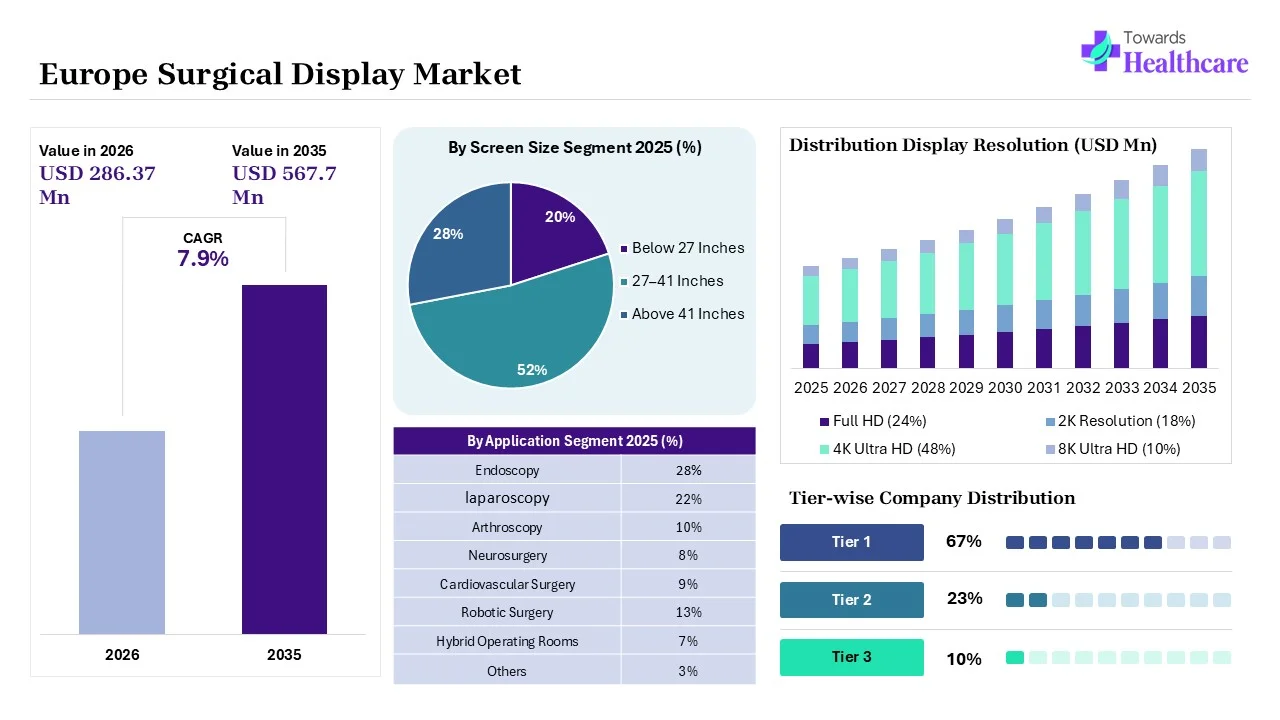
The Europe surgical display market size was reported at US$ 265.4 million in 2025 and is expected to rise to US$ 286.37 million in 2026 and to reach US$ 567.7 billion by 2035. It will grow at a CAGR of 7.9%. The market is experiencing steady growth driven by the increasing adoption of minimally invasive and robotic-assisted surgeries, along with rising demand for high-resolution visualization technologies in operating rooms. Continuous investments in healthcare modernization, digital operating rooms, and advanced imaging systems are further supporting market expansion across the region.
A surgical display is a medical-grade monitor designed to provide high-resolution, real-time visualization of surgical images and videos, helping surgeons perform procedures with greater accuracy and precision. The Europe surgical display market is growing due to the increasing adoption of minimally invasive and robotic-assisted surgeries, which require high-quality real-time imaging. Rising investments in healthcare infrastructure, digital operating rooms, and advanced visualization technologies such as 4K, 3D, and AI-enabled displays are further driving demand. Additionally, growing surgical volumes and the presence of leading medical technology companies support continued market expansion.
The Europe surgical display market is expected to witness strong growth driven by increasing adoption of AI-powered imaging, robotic-assisted surgeries, and digital operating rooms. Demand for 4K/8K, 3D, and fluorescence imaging displays will continue to rise as healthcare providers focus on improving surgical precision, workflow efficiency, and patient outcomes through advanced visualization technologies.
| Year | Surgical Volume Index | Digital OR Adoption Index | 4K/3D Display Adoption Index | AI Integration Index |
| 2023 | 100 | 100 | 100 | 100 |
| 2024 | 107 | 112 | 118 | 120 |
| 2025 | 115 | 125 | 135 | 140 |
The table highlights steady growth of the Europe surgical display market from 2023 to 2025, driven by increasing surgical volumes and rapid adoption of advanced visualization technologies. The rise in digital operating room installations and 4K/3D display usage reflects the shifts towards minimally invasive and precision-based surgeries. Additionally, growing AI integration in surgical imaging systems is enhancing real-time decision-making, improving surgical accuracy, and supporting overall healthcare modernization across Europe.
The 27-41 inches segment held a dominant share of 52% in 2025 due to its optimal balance of large-screen visibility and efficient operating room space utilization. These displays provide high-resolution imaging essential for minimally invasive and image-guided surgeries while maintaining ergonomic convenience for surgical teams. Their compatibility with advanced imaging systems, cost-effectiveness, and widespread adoption in hospitals further strengthened their leading market position.
The LED-backlit LCD segment led the Europe surgical display market with a share of 54% in 2025 due to a strong balance of high image quality, durability, and cost-effectiveness. These displays offer consistent brightness, wide viewing angles, and accurate color reproduction, making them suitable for various surgical procedures. Their long operational life, low power consumption, and easy integration with existing operating room systems have driven widespread adoption across hospitals and surgical centers in Europe.
The 2D surgical displays held a dominant share of 58% in 2025 due to their widespread use in routine and minimally invasive surgical procedures. These displays offer reliable high-resolution imaging, ease of use, and compatibility with most existing surgical imaging systems. Their lower cost compared to advanced 3D alternatives and strong integration in hospitals and surgical centers have made 2D displays the preferred and most widely adopted technologies.
The endoscopy segment dominated the Europe surgical display market with a share of 28% in 2025 due to the high adoption of minimally invasive diagnostic and surgical procedures across specialties such as gastroenterology, urology, and gynecology. Endoscopic surgeries require high-resolution, real-time visualization for accuracy and safety. Increasing prevalence of chronic diseases, growing patient preference for less invasive treatment, and advancements in endoscopic imaging technologies further strengthen segment dominance.
The hospitals segment held a dominant share of 68% in 2025 due to the high volume of complex surgical procedures performed in hospital settings. Hospitals are early adopters of advanced technologies such as 4K/3D displays, robotic-assisted systems, and integrated operating rooms. Strong healthcare infrastructure, higher patient inflow, and continuous investments in digital surgery and modernization initiatives further strengthen their dominant position in the surgical display market.
The Europe surgical display market is growing due to the rising adoption of minimally invasive and robotic-assisted surgeries that require high-quality real-time visualization. Increasing investments in advanced healthcare infrastructure, digital operating rooms, and imaging technologies such as 4K, 3D, and AI-enabled displays are further driving demand. Additionally, growing surgical volumes and the strong presence of leading medical device manufacturers are supporting steady market expansion across Europe.
Leading companies in the market include Barco, Karl Storz SE & Co. KG, Getinge AB, Brainlab AG, and Richard Wolf GmbH. These players are strengthening market growth through advanced surgical visualization systems, integrated operating room solutions, and high-resolution medical displays. Continuous investments in 4K/3D imaging, AI-enabled surgical platforms, and digital operating room technologies are further enhancing their leadership across the European surgical display landscape.
By Display Resolution
By Screen Size
By Display Type
By Technology
By Application
By End User
By Connectivity
By Region


