


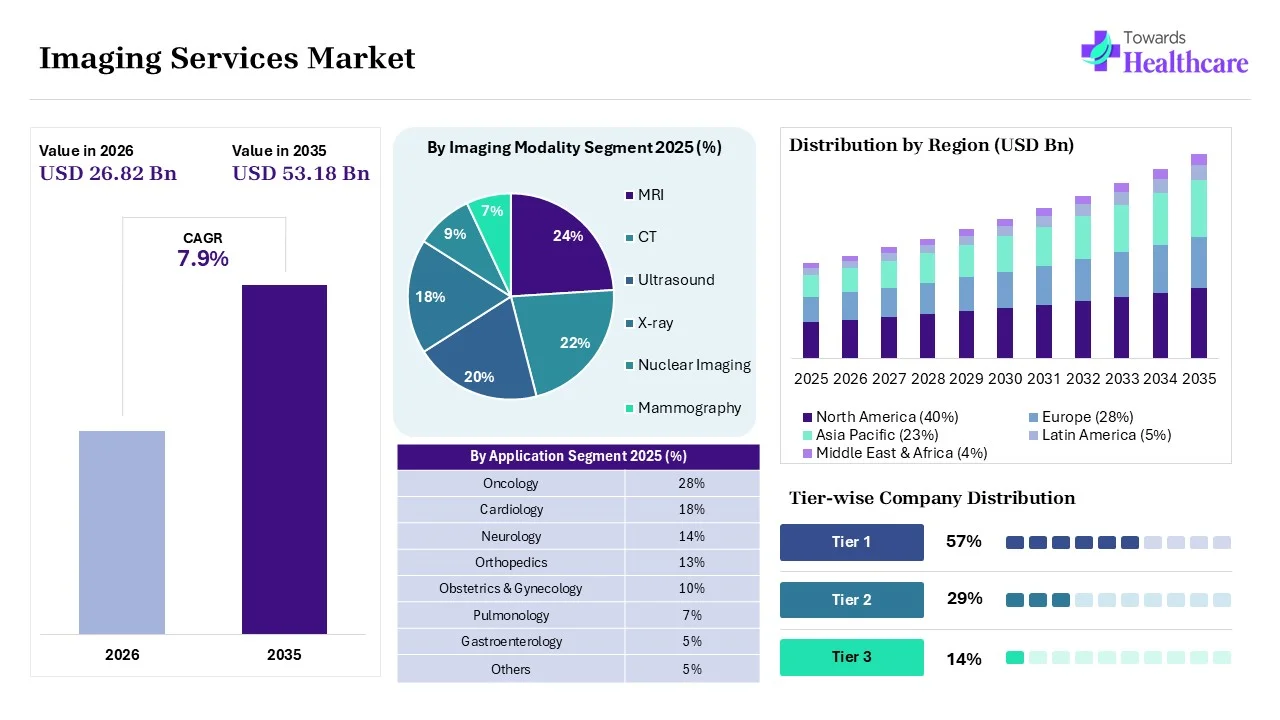
The global imaging services market size was estimated at USD 53.18 billion in 2025 and is predicted to increase from USD 26.82 billion in 2026 to approximately USD 53.18 billion by 2035, expanding at a CAGR of 7.9% from 2026 to 2035. A massive rise in chronic disease burden, an increasing geriatric population, rapid technological advancements, expanding applications, growing AI integration, increasing demand for precision medicine, and the rise of portable imaging services are promoting market growth.
The imaging services refer to the diagnostic healthcare services used across the U.S. for disease detection, monitoring, and treatment. This drives their use for visualization of internal organs, bones, and tissues. Furthermore, they are increasingly being utilized for cancer detection, neurological imaging, cardiovascular assessment, obstetric imaging, and orthopedic evaluation.

By service type, the diagnostic imaging services segment accounted for the highest revenue share of 58% of the U.S. imaging services market in 2025, as they were essential for disease diagnosis. Growth in chronic disease and the geriatric population has also increased their use. The presence of advanced technologies and non-invasive tools also increased their preference.
By imaging modality type, the MRI segment held a major revenue share of 24% of the market in 2025, driven by its high resolution and detailed images. No ionization radiation exposure and superior soft tissue contrast also increased their use. Their wide range of applications in oncology, neurology, musculoskeletal, and cardiology imaging has also increased their demand.
By application type, the oncology segment contributed the biggest revenue share of 28% of the imaging services market in 2025 and is expected to expand rapidly with a CAGR of 8.80% during the forecast period, due to growth in cancer cases. Growth in health awareness also increased the frequency of use of imaging services. The rise in the demand for treatment monitoring and personalized therapies has also increased their use.
By end user, the hospitals segment held the largest revenue share of 48% of the market in 2025, driven by high patient volumes. Comprehensive care settings and skilled healthcare professionals also increased their use. Advanced imaging equipment and reimbursement support also attracted the patients.
By delivery mode type, the onsite imaging services segment led the imaging services market with a 62% share in 2025, due to its immediate access and real-time disease diagnosis. High patient volumes and diagnosis interaction with healthcare providers are fostering their use. Advanced imaging solutions also encouraged their adoption.
The U.S. imaging services market held a significant share in 2025 and is expected to show lucrative growth during the predicted time, due to growing incidences of chronic disease. The presence of advanced healthcare infrastructure and industries is also accelerating the development of new imaging solutions. Alongside, surging investments and expanding outpatient imaging centers are spurring their innovations and adoption, which is enhancing the market growth.
Key Players: Top Companies Behind the U.S. Market Expansion
RadNet, Inc. dominated the market with its DeepHealth AI Diagnostics, where Radiology Partners, Inc. was its closest contender, which offered Matrix Cloud Reporting. RAYUS Radiology also sustained its position by providing Open-Bore 3T MRI Systems, where Akumin Inc. also contributed to the market growth with its Alliance Mobile Imaging Services and Alliance Oncology Services.
By Service Type
By Imaging Modalit
By Application
By End User
By Delivery Mode
By Ownership Model
By Region


