


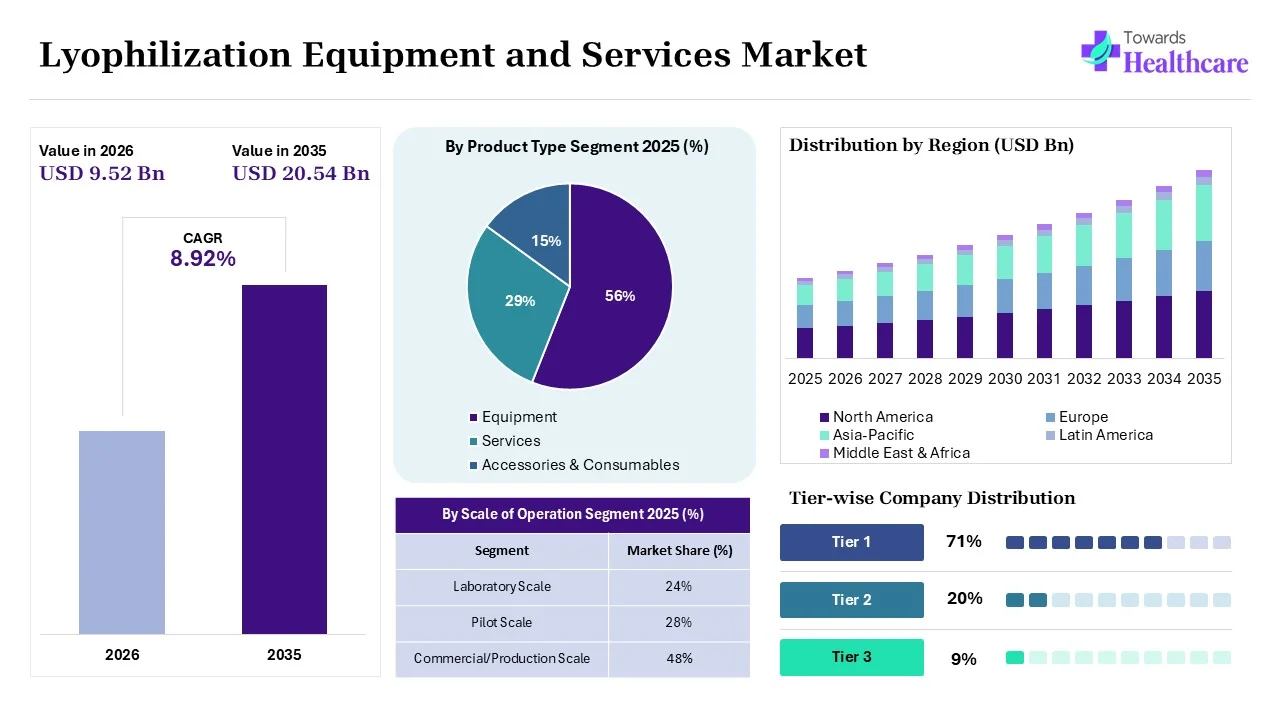
The lyophilization equipment and services market size accounted for USD 8.74 billion in 2025 and is predicted to increase from USD 9.52 billion in 2026 to approximately USD 20.54 billion by 2035, expanding at a CAGR of 8.92% from 2026 to 2035. Lyophilization is widely used in pharmaceutical manufacturing for its ability to preserve drug effectiveness, stabilize sensitive products, and extend shelf life, driving growth in the lyophilization equipment and services market.
The lyophilization equipment and services market is expanding due to equipment and services such as vacuum pumps, refrigeration systems, shelf fluid, and precise product temperature sensors, which are pivotal to achieving both the main and secondary drying phases. The goal is to preserve the integrity & shelf life of vaccines, injectable drugs, or other sensitive dosage forms like tablets, powders, wafers, injectables, and pellets produced by lyophilization. This service assists in lowering spoilage, which makes it more stable & convenient to transport. Pharmaceutical companies leverage lyophilization to produce lyophilized eye drops, injections, different sensitive medicines, and parenteral dosage forms to overcome traditional processes.
| Pharmaceutical Area | 2025 growth ($ bn) |
| Oncology | 34.3 |
| Immunology | 24.3 |
| Diabetea | 21.5 |
| Thrombosis | 2.0 |
| Obesity | 30.8 |
| Respiratory | 1.7 |
| HIV | 3.2 |
| Hypertension | 1.9 |
| Pain | 1.2 |
| Mental Health | 3.6 |
Modern lyophilizers now feature improved shelf temperature control, enhanced vacuum systems, and more efficient condenser designs. These upgrades promote more uniform drying and better energy efficiency. Recent innovations in continuous freeze-drying, like spin-freeze methods, have cut cycle times by a third, offering a clear pathway to overcoming cold chain challenges. They also address the stabilization of next-generation biologicals, CRISPR-based systems, and personalized medicines. New developments include automated loading and unloading to lower contamination risks, process analytical technology (PAT) for real-time cycle monitoring, controlled nucleation to standardize ice crystal formation, Quality by Design (QbD) principles to define critical process parameters, and data analytics to improve freeze-drying cycles.
By product type, the equipment segment contributed the largest lyophilization equipment and services market share of 56% in 2025, as this equipment's capability to maintain the stability and functionality of delicate materials, like proteins, enzymes, and other biomolecules. It is significantly used to preserve perishable materials, increasing shelf life, and preserving chemical or biological integrity.
By scale of operation, the commercial/production scale segment contributed the largest lyophilization equipment and services market share of 48%, as commercial-scale tools typically exhibit various cooling dynamics because of higher thermal masses and larger batch sizes. Modifications in cooling rates lead to non-uniform ice nucleation, resulting in variable crystal sizes in the batch. Commercial lyophilizers often exhibit a higher degree of supercooling because of the particle-free environment in the manufacturing setting.
By technology, the tray-style freeze-drying segment held a significant share of 55% in the market. Tray-style freeze dryer helps the advancement of long-term storage vaccines and labile therapeutics. It performs freeze drying in containers or in vials on huge quantities. This makes the tray-style freeze dryer the most common for emerging lyophilized products.
By application, the pharmaceuticals segment contributed the largest lyophilization equipment and services market share of 48%, as lyophilization is its capability to preserve the stability and functionality of subtle materials, such as enzymes, proteins, and different biomolecules. Lyophilization enables the manufacturing of stable and long-lasting drug formulations that withstand prolonged epochs of storage without remarkable degradation.
By end user, the pharmaceutical companies segment contributed the largest market share of 39%, as lyophilization in healthcare products improved stability, increasing shelf life, and reducing expenses. Lyophilization allows stable production of biologics and heat-sensitive injectables while lowering logistics and cold-chain constraints. Lyophilization helps store significant medicines, vaccines, and proteins without losing strength.
By region, the North America segment contributed the largest lyophilization equipment and services market share of 38%, as increasing concentration of U.S.-based healthcare giants and biotech organizations drives demand. Freeze-drying is significant for increasing the shelf life and maintaining the stability of challenging biologics, vaccines, and monoclonal antibodies. The significance of industry-leading, home-grown device manufacturers such as SP Scientific, Labconco, and Millrock Technology, which drives the growth of the lyophilization equipment and services market.
Leading companies in the North American animal health market include GEA Group, SP Scientific, Tofflon Science and Technology, and Azbil Telstar. Meanwhile, GEA Group has leading worldwide provider of large-scale manufacturing and sterile lyophilization technology for pharmaceuticals. SP Scientific, laboratory-scale to manufacturing-scale freeze dryers, predominantly their highly regarded Hull and VirTis brands. Tofflon Science and Technology, an important worldwide supplier dominating in both healthcare freeze dryers and food processing devices, and Azbil Telstar, significantly focus on high-tech vacuum tools and freeze-drying services for the biotechnology industry.
By Product Type
By Material
By Technology
By Application
By End User
By Region


