Growing technical complexity, increasing extreme capital requirements, growing cancer incidence rates, increasing R&D activities, expanding outsourcing trends, growing funding, increasing technological advancements, and expanding collaborations are promoting the market growth.
The ADC Breakthroughs: The Rise of the U.S. ADC Contract Manufacturing Market
The ADC contract manufacturing refers to the outsourcing of the antibody-drug conjugates for their development and production to specialized third-party manufacturing organizations. A wide range of services, including commercial manufacturing, small and large scale production, technical expertise, quality testing, fill finish services, and clinical trial support, is provided by them. This drives their use for the development of new ADC molecules, high-potency drugs, cancer treatments, next-generation biologics, and tailored ADC products.
Global Market Growth
The global ADC contract manufacturing market size was estimated at USD 6.8 billion in 2025 and is predicted to increase from USD 7.68 billion in 2026 to approximately USD 22.88 billion by 2035, expanding at a CAGR of 12.9% from 2026 to 2035.
Emerging Opportunities: Forecasting The Market Growth Trends
Increasing R&D activities focused on oncology are driving the development of ADC-targeted therapies, increasing the demand for ADC contract manufacturing services across the U.S.
- Growing outsourcing trends among companies are promoting the use of these services for complex ADC development.
- Expanding ADC approvals are also boosting the demand for large-scale production, driving the adoption of these services.
- A rise in the use of biologics and precision medicine is also increasing the use of ADC contract manufacturing services.
- Growing collaboration supported by the investments is also promoting the use of these services for faster ADC product development.
- Increasing technological innovations are driving demand for end-to-end services, which are also increasing their adoption rates.
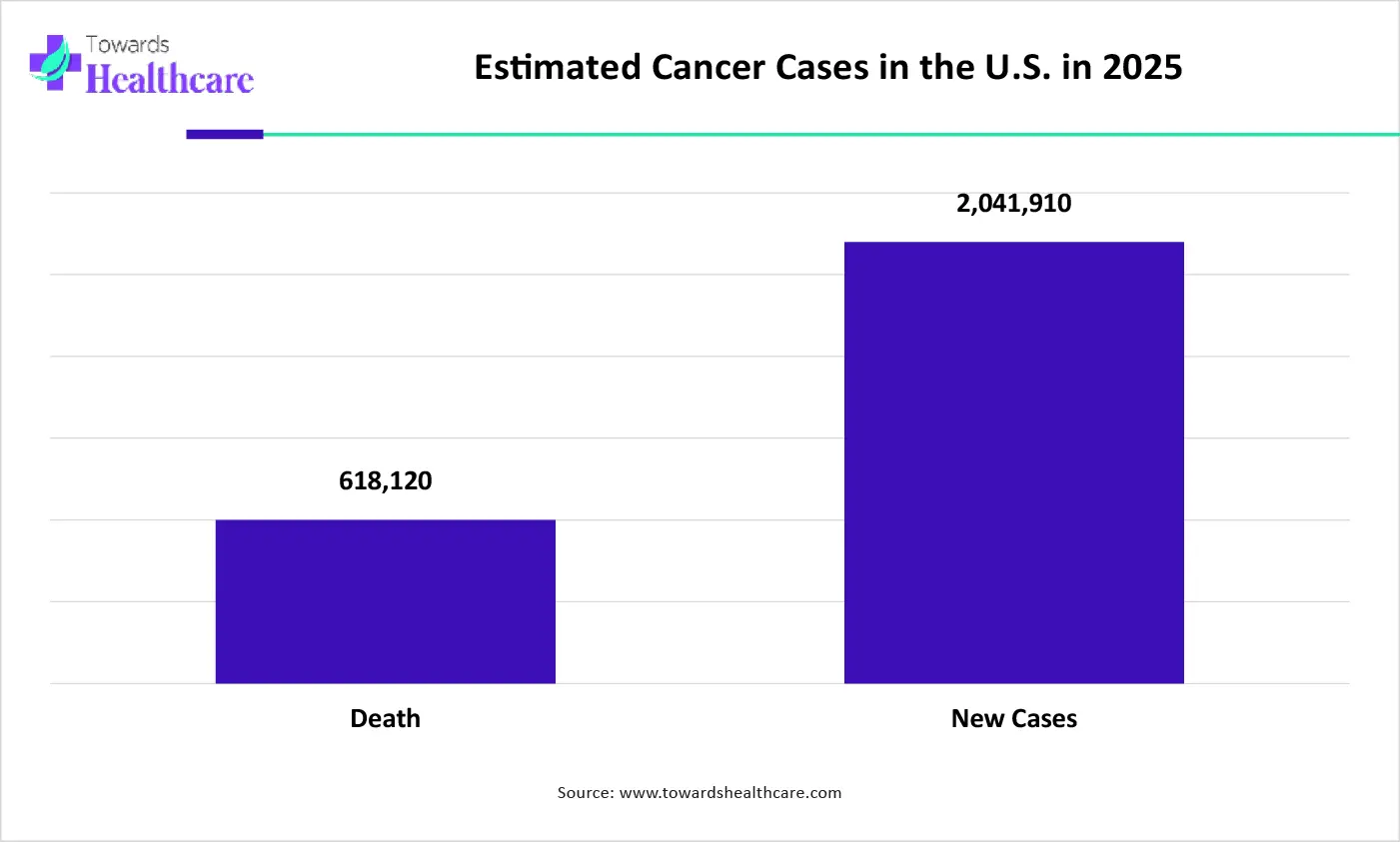
The graph represents the estimated number of U.S. cancer deaths and new cases in the year 2026. It indicates that there will be a growth in the cancer burden in the U.S., which will increase the demand for effective treatment options. This, in turn, will drive the adoption of ADC contract manufacturing for the development of new targeted treatment options for multiple cancer types, which will ultimately promote market growth.
Market Segmentation Overview
- By service type, the cGMP manufacturing segment held a major revenue share of 32% of the U.S. ADC contract manufacturing market in 2025, due to stringent regulations, which increased the demand for high-safety ADC drugs. To maintain the product's purity, potency, and quality, the demand for cGMP manufacturing services increased. Complex process control and large-scale production needs have also increased their use.
- By payload type, the cytotoxic payloads segment held the largest revenue share of 46% of the U.S. ADC contract manufacturing market in 2025, driven by their higher cancer-killing potency. Proven clinical success and targeted delivery also increased their adoption rates. Their low-dose effectiveness and versatile mechanisms also increased their usage across multiple cancer types.
- By linker type, the cleavable linkers segment contributed the biggest revenue share of 62% of the U.S. ADC contract manufacturing market in 2025 and is expected to grow with the fastest CAGR during the forecast period, due to their high therapeutic potency. They also offered enhanced effectiveness and tumor selectivity, which promoted target-specific action. Their clinical success rates and low systemic toxicity also contributed to their increased usage.
- By conjugation technology type, the chemical conjugation segment accounted for the highest revenue share of 48% of the U.S. ADC contract manufacturing market in 2025, driven by its simple and well-established processes. Their affordability, flexibility, and enhanced scalability also increased their adoption rates. Their lower technical complexity, widespread availability, and faster development timelines also promoted their adoption.
Regional Analysis
The U.S. ADC contract manufacturing market held 34% share in 2025 and is expected to show lucrative growth during the forecast period, due to the presence of a robust pharmaceutical and biotechnology industry. The presence of advanced CDMO infrastructure and high R&D investments also increased the outsourcing trends, driving the use of ADC contract manufacturing services. Expansion of the ADC pipeline, growth in the cancer burden, funding, and early technology adoption also contributed to the market growth.
The Power Players: the Spotlight on the Top U.S. CDMOs
Catalent, Inc. held a dominant position in the market with its SMARTag technology, where Thermo Fisher Scientific (Patheon) was its closest competitor, which offered integrated end-to-end models. AbbVie Contract Manufacturing also held its position by providing commercial-grade facilities and high-quality services, where Abzena also contributed to the market growth with its ThioBridge conjugation technology.
Segments Covered in the Report
By Service Type
- Process Development
- Cell Line Development
- Upstream Process Development
- Downstream Process Development
- Analytical & Quality Control Services
- Bioanalytical Testing
- Stability Testing
- Method Development & Validation
- cGMP Manufacturing
- Clinical Manufacturing
- Commercial Manufacturing
- Fill-Finish Services
- Aseptic Filling
- Lyophilization
- Packaging & Labeling
By Payload Type
- Cytotoxic Payloads
- Auristatins (MMAE, MMAF)
- Maytansinoids (DM1, DM4)
- DNA Damaging Agents
- Calicheamicin
- Duocarmycin
- PBD Dimers
- Topoisomerase Inhibitors
- Others
By Linker Type
- Cleavable Linkers
- Acid-cleavable
- Protease-cleavable
- Glutathione-sensitive
- Non-cleavable Linkers
By Conjugation Technology
- Chemical Conjugation
- Site-specific Conjugation
- Enzymatic Conjugation
- Engineered Cysteine Conjugation
- Others
By Scale of Operation
- Preclinical Scale
- Clinical Scale
- Commercial Scale
By End User
- Pharmaceutical Companies
- Biotechnology Companies
- Academic & Research Institutes




