


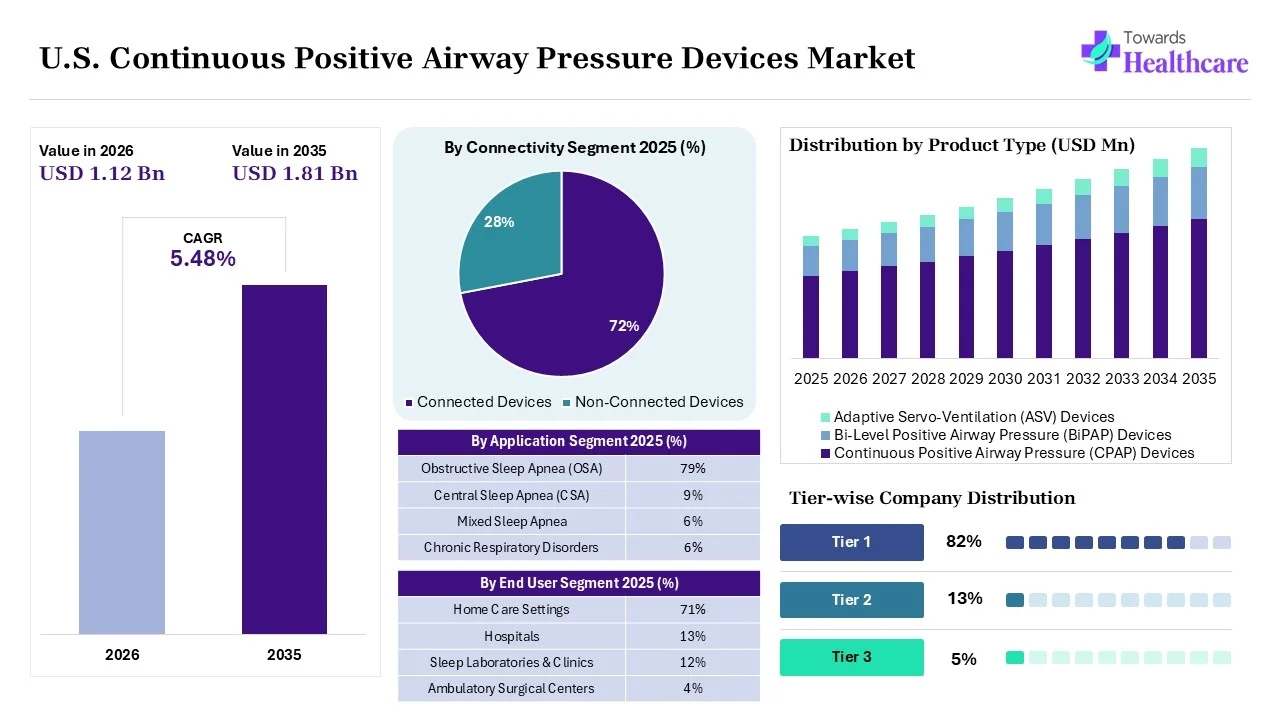
The U.S. continuous positive airway pressure devices market size was estimated at USD 1.06 billion in 2025 and is predicted to increase from USD 1.12 billion in 2026 to approximately USD 1.81 billion by 2035, expanding at a CAGR of 5.48% from 2026 to 2035. Accelerating prevalence of OSA, an ageing population & continuous technological innovations are driving the market expansion.
The U.S. continuous positive airway pressure devices market explores diverse medical machines that deliver a steady, consistent stream of pressurized room air to keep the throat open while sleeping. The market expansion is fueled by a rise in the geriatric population, increasing obesity rates, & ongoing technological advances, such as AI-enabled remote monitoring & more comfortable masks to boost patient compliance. Advanced CPAP devices have a major scope in treating Obstructive Sleep Apnea (OSA) to mitigate airway collapse & lower loud snoring.
In this era, the U.S. leaders are focusing on AI-enabled personalisation, cloud-connected remote patient monitoring, & comfortable, travel-friendly designs. Alongside, manufacturers are fostering the resolution of historical adherence issues through predictive analytics and subscription-based service models. The U.S. continuous positive airway pressure devices market will have a prominent opportunity in the development of 3D-printed interfaces contoured especially for users having unique facial geometry.
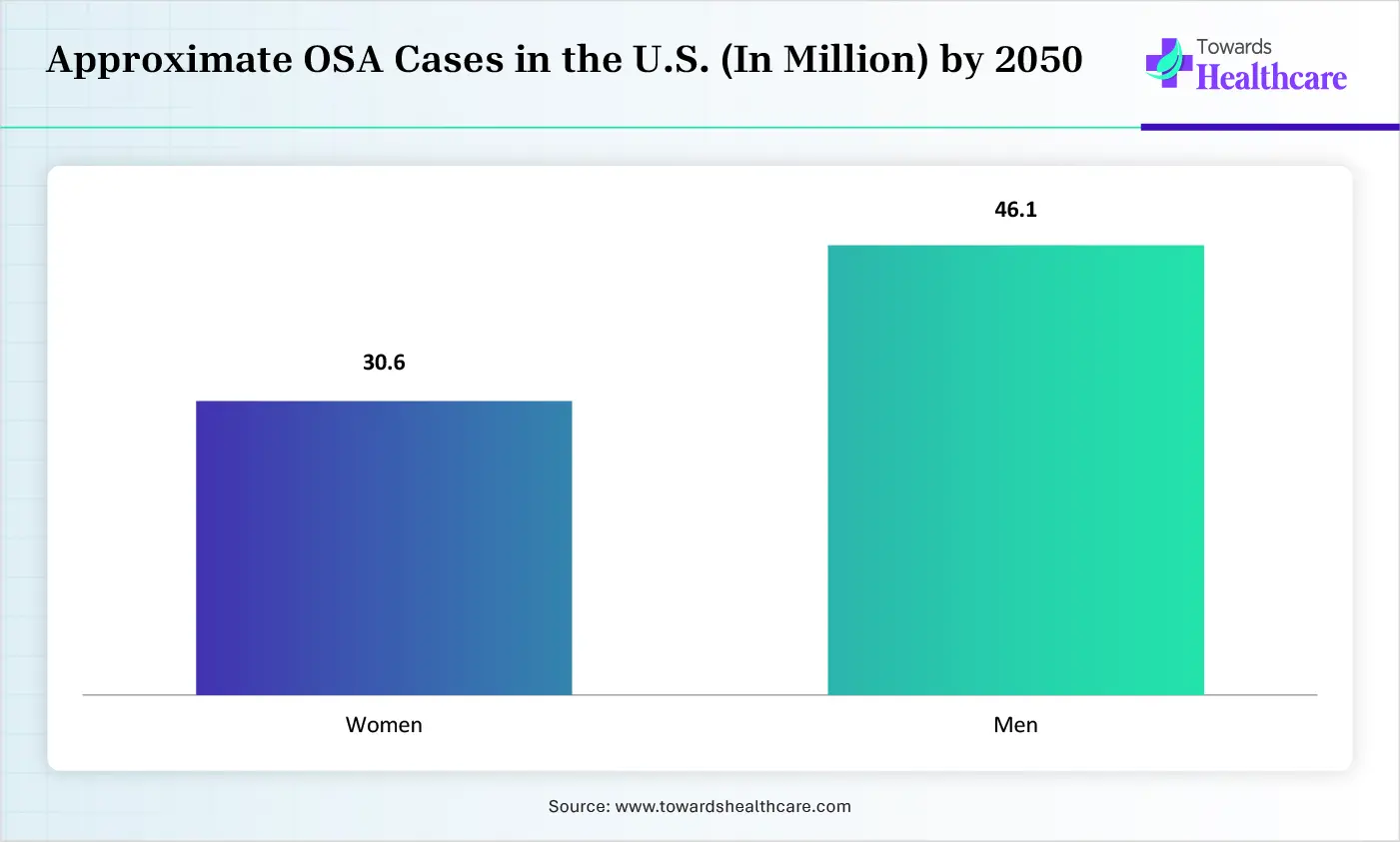
By 2050, the U.S. will have millions of OSA cases, which will accelerate the importance of CPAP devices. These devices will be the most prescribed, clinically proven first-line therapy for moderate to severe OSA. Alongside, consistent use of CPAP supports the elimination of breathing interruptions, provider relief in daytime fatigue, & highly lowers the risks of cardiovascular disease, diabetes, hypertension, & stroke.
By product type, the continuous positive airway pressure (CPAP) devices segment dominated with a 68.00% share of the U.S. continuous positive airway pressure devices market in 2025. These devices are considered a first-line therapy for sleep apnea. The widespread strong physicians are preferring CPAP devices, which pushes the overall adoption. Alongside, surging diagnosis cases are sustaining demand for these devices.
By connectivity, the connected devices segment held a major share of 72.00% of the market in 2025. Their dominance is fueled by a wider adoption of remote monitoring that enhances compliance tracking. Many U.S. providers are highly using telehealth integration, which raises demand for these devices. Connected devices offer data-driven care & this further boosts patient outcomes.
By end user, the home care settings segment led with a 71.00% share of the U.S. continuous positive airway pressure devices market in 2025. The segmental growth is fueled by the use of home-based therapy that enhances convenience. Day by day, the U.S. population is increasingly preferring self-managed care, which supports the overall adoption. Besides this, advanced portable devices are strengthening the utilization.
By application, the obstructive sleep apnea (OSA) segment captured a dominant share of 79.00% of the market in 2025. Escalating prevalence of obesity-related sleep apnea fuels the demand for advanced devices. The U.S. is expanding screening programs, which ultimately improve the diagnosis of OSA. These cases are raising the adoption of long-term therapy, & further sustain sales.
By distribution channel, the durable medical equipment (DME) providers segment dominated with a 40.00% share of the U.S. continuous positive airway pressure devices market in 2025. These providers are managing setup & compliance services. Alongside, insurance relationships are widely facilitating device access. DME providers are developing recurring revenue from the continuous replacement cycles of disposable accessories, like filters, tubing, and masks.
The U.S. continuous positive airway pressure devices market has been focusing on the elimination of mask claustrophobia, and manufacturers are promoting minimalist, lightweight designs. This further covers smaller nasal pillows, soft silicone cushions, and magnetic clips that lower face irritation & pressure points. Moreover, the FDA finalized novel guidance for Clinical Decision Support (CDS) software and wearable monitors, that developing clearer landscapes for Home Sleep Apnea Testing (HSAT) devices.
ResMed, Philips Respironics, Fisher & Paykel Healthcare, and React Health (formerly 3B Medical) are the four leading players in the market. Whereas, ResMed is expanding as a dominant firm in the U.S., which has unveiled its Cloud-Based Digital Health Ecosystem. On the other hand, remaining players are also bolstering with the progression of connected care, ultra-compact designs, & patient-centric comfort.
By Product Type
By Connectivity
By End User
By Application
By Distribution Channel


