


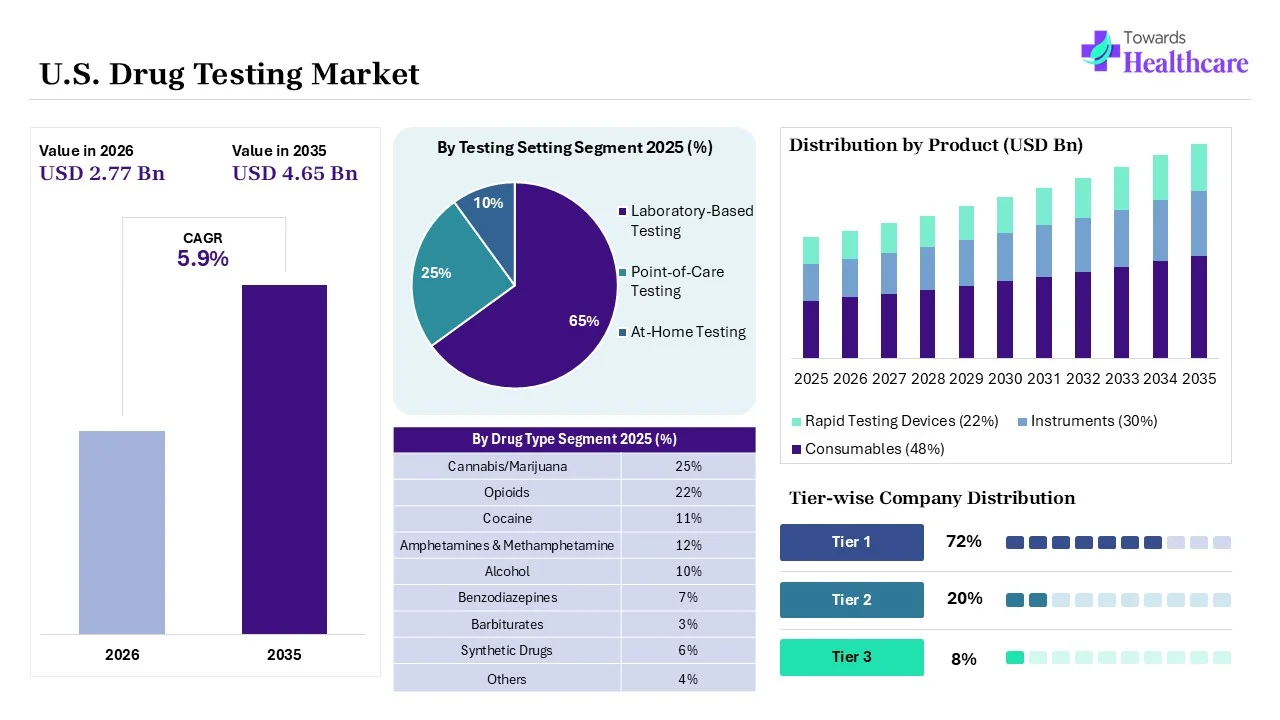
The U.S. drug testing market size was valued at US$ 2.62 billion in 2025 and is projected to grow to 2.77 billion in 2026. Forecasts suggest it will reach approximately US$ 4.65 billion by 2035, registering a CAGR of 5.9% during the period. Drug testing offers various values based on the context, mainly serving as a tool for public safety, workplace risk mitigation, and individual health, which drives the growth of markets
A drug test includes testing a biological sample, like hair or urine, for the presence of a legal or illegal drug. There are numerous possible applications for a drug test, the most general of which is for pre-employment screening. The most commonly tested drugs include amphetamines, cocaine, marijuana, opioids, and PCP. Drug tests are ordered and performed in a variety of settings with a variety of processes. The most significant applications of drug testing are in the workplace. Employers need drug screening for different reasons. Drug testing is also used for the diagnosis, treatment, and monitoring of alcohol use disorder and substance use disorder. Drug testing may be required for legal purposes, including collecting potential evidence of a crime, investigating cases of child abuse or endangerment, and determining if a patient is under the effects of alcohol or other substances while driving.
In January 2025, Northlane Capital Partners announced that it had invested in United States Drug Testing Laboratories Inc., a forensic toxicology laboratory testing for alcohol and substance use. NCP capitalised alongside USDTL’s management team and its founders, Veronica and Doug Lewis.
Wearable sensors have gained significant interest for numerous applications, but there is a lack of robust and accurate systems for reliable drug monitoring. These devices come in various form factors and can monitor different physiological parameters. Their compact size makes them adaptable to diverse computer and accessibility needs across many use cases. Recent advancements focus on wearable sensors capable of non-invasively detecting drugs, especially substances of abuse. The development of continuous drug monitoring wearables is progressing. In healthcare, wearable devices are transforming patient care by enabling real-time monitoring and more proactive health management.
By product type, the consumables segment contributed the largest U.S. drug testing market share of 48% in 2025, as significant consumables include collection cups and vials, swabs and saliva collectors, tamper-evident seals and barcodes, and test strips and dip cards. A variety of instruments and tools are used to assess how a therapeutic dose in a given medium simulates conditions in the individual's body. High-quality consumables are significant for obtaining precise and reliable outputs, supporting optimized drug therapy, and lowering side effects.
By sample type, the urine segment contributed the largest market share of 57%, as a urine sample offers a profile of both current and recent past substance usage. Urine provides a somewhat longer window of identification for substances, typically varying from one day after consumption. Urine is the most commonly used specimen for drug testing due to its simplicity of collection.
By drug type, the cannabis/marijuana segment held the major share of 25% in the U.S. drug testing market, as testing for marijuana, particularly in urine, identifies evidence of use, not current intoxication or addiction. Marijuana is detected for a period of days, weeks, or months after application. Drug testing for marijuana events cannabinoids or cannabinoid metabolites in a sample of saliva, hair, blood, or urine.
By testing method, the immunoassay segment contributed the largest U.S. drug testing market share of 45%, as immunoassay tests identify not only the parent therapeutics but also their metabolites or byproducts, which the body produces. The simplicity, effortlessness of use, affordability, and quick output have made immunoassays the significant popular initial screening test.
By end user, the drug testing laboratories segment contributed the largest market share of 44%, as it improves workplace safety, optimizes healthcare, and ensures rigorous legal compliance via scientifically validated testing technology. It endorses workplace safety and health. Labs utilize advanced equipment such as gas chromatography-mass spectrometry (GC-MS) and liquid chromatography-mass spectrometry (LC-MS).
By testing setting, the laboratory-based testing segment held the largest U.S. drug testing market share of 65% in 2025, driven by its high accuracy, regulatory compliance, comprehensive screening capabilities, and widespread adoption across workplaces, healthcare facilities, and legal institutions. Advanced analytical technologies, confirmatory testing requirements, and growing demand for reliable substance detection further strengthened the segment’s dominance, supporting consistent utilization nationwide.
The U.S. drug testing market is growing due to increasing workplace safety requirements, rising substance abuse concerns, and stringent federal and state regulations supporting routine screening. Expanding drug testing programs across healthcare, transportation, law enforcement, and corporate sectors are driving demand. Technological advancements in rapid and accurate testing methods, coupled with growing awareness of public health risks and the need for compliance, further contribute to sustained market expansion.
Leading organizations in the U.S. drug testing market are Labcorp, Quest Diagnostics, Clinical Reference Laboratory, and Abbott Laboratories. Meanwhile, Labcorp offers a comprehensive suite of clinical workplace forensic solutions and drug testing. Quest Diagnostics, a provider of criminal drug testing and workplace solutions, works with certified testing labs. Clinical Reference Laboratory it apprehended laboratory specializing in employer, transportation (DOT), and healthcare drug screening solutions. Abbott Laboratories leader in medical care technology, industrial medical devices, and toxicology technology.
By Product Type
By Sample Type
By Drug Type
By Testing Method
By End User
By Testing Setting


