


The U.S. medical billing outsourcing market size was estimated at USD 6.42 billion in 2025 and is predicted to increase from USD 7.24 billion in 2026 to approximately USD 21.41 billion by 2035, expanding at a CAGR of 12.8% from 2026 to 2035. The market is expanding steadily due to rising healthcare claim volumes, increasing reimbursement complexities, and growing demand for efficient revenue cycle management, and the need to reduce administrative costs continues to support long-term market growth.
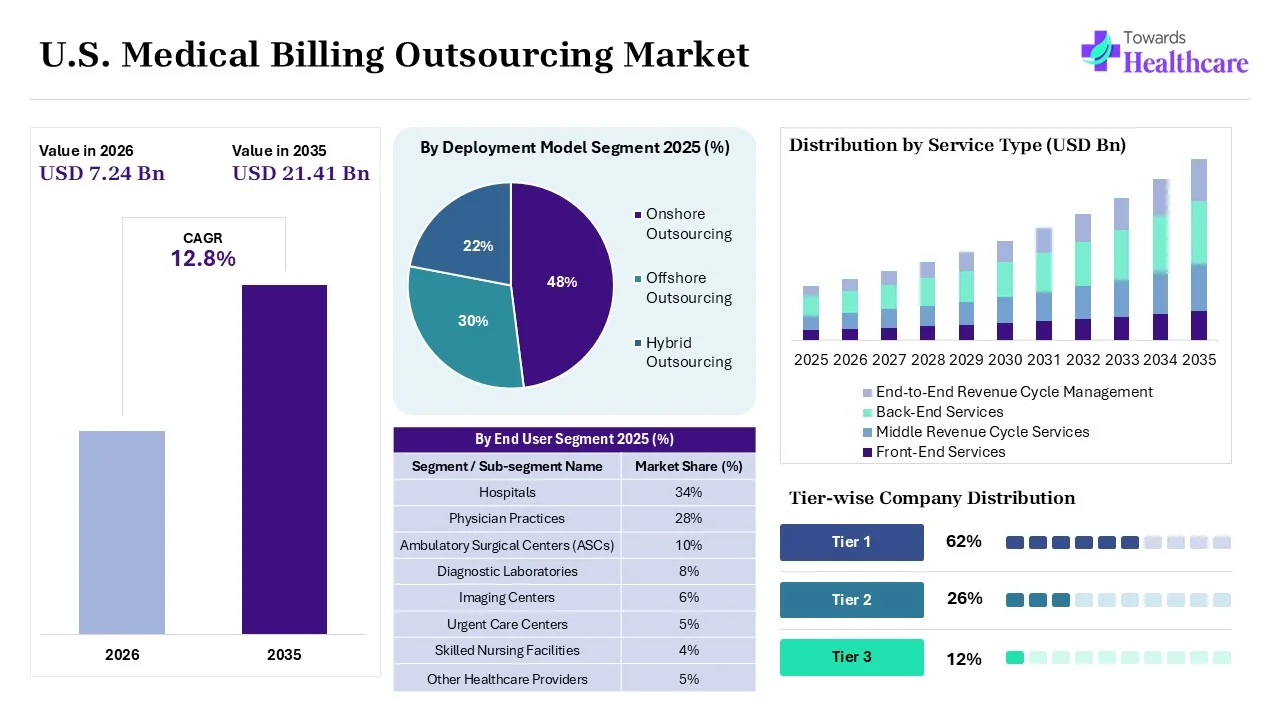
Medical billing outsourcing is the practice of hiring a third-party service provider to manage medical billing, coding, claims processing, and reimbursement activities for healthcare organizations. The U.S. medical billing outsourcing market is growing due to increasing healthcare claims volumes, evolving reimbursement regulations, and the need to reduce administrative costs. Healthcare providers are increasingly outsourcing billing operations to improve coding accuracy, accelerate reimbursements, and minimize claim denials. Rising adoption of AI-powered automation, cloud-based revenue cycle management solutions, and value-based care models is further driving sustained market growth.
The U.S. billing outsourcing market is expected to witness steady growth as healthcare providers increasingly adopt AI-powered automation, predictive analytics, and cloud-based revenue cycle management solutions. Greater emphasis on value-based care, regulatory compliance, and operational efficiency will continue to accelerate outsourcing demand while improving reimbursement accuracy and financial performance.
| Parameter | 2025 |
| Medical Claims processed annually in the U.S | Over 4.8 billion claims |
| Average clean rate | 95-98% |
| Average claim denial rate | 5-10% |
| Healthcare provides using electronic claims. | More than 95% |
The table highlights key operational metrics influencing the U.S. medical billing outsourcing market. Rising claim volumes, widespread electronic claims adoption, and the need to improve claims accuracy and reduce denials are driving healthcare providers to increasingly outsource medical billing and revenue cycle management services.
The back-end services segment held a dominant share of 35% in 2025 due to its critical role in claims submission, payment posting, denial management, and accounts receivable follow-up. Healthcare provides increasingly outsourcing these functions to improve reimbursement accuracy, reduce claims denials, and accelerate cash flow. Growing billing complexities, strict payer requirements, and the need for efficient revenue cycle management further strengthened the segment’s market leadership.
The hospitals segment dominated the U.S. medical billing outsourcing market with a share of 34% in 2025 due to high patient volumes, complex reimbursement processes, and increasing administrative workloads. Hospitals rely on outsourcing partners to improve coding accuracy, reduce claim denials, accelerate reimbursements, and strengthen revenue cycle performance. Growing regulatory compliance requirements, multi-specialty services offerings, and the adoption of advanced billing technologies further reinforced the segment’s market leadership.
The general practices & family medicine segment led the U.S. medical billing outsourcing market with a share of 18% in 2025 due to its large patient base, frequent outpatient visits, and continuous billing requirements. These practices increasingly outsource billing and ensure timely reimbursements. Rising prevention care visits, chronic disease management, and growing insurance documentation requirements further supported the segment’s leading position.
The large healthcare organization segment dominated the U.S. medical billing outsourcing market with a share of 40% in 2025 due to high patient volumes, extensive multi-specialty operations, and complex reimbursement workflows. These organizations increasingly outsourced billing to improve revenue cycle efficiency, minimize claims denials, and maintain regulatory compliance. Their greater investment capacity, need for scalable billing solutions, and focus on operational efficiency further strengthened the segment’s market leadership.
The transaction-based segment held a dominant share of 38% in 2025 because it offers a flexible pricing structure where healthcare provider pay based in the number of claims or transactions providers pay based on the number of claims or transactions processed. This model helps reduce fixed operational costs, support fluctuating claims volumes, and improve cost efficiency. Its affordability, scalability, and suitability for providers of different sizes contributed to its leading market position.
Leading companies in the U.S. medical billing outsourcing market include R1 RCM Inc., GeBBS Healthcare Solutions, CorroHealth, CareCloud, eClinicalWorks, Ventra Health, and Omega Healthcare. These companies are driving market growth through comprehensive revenue cycle management, medical coding, claims processing, denial management, and payment collection services. Continuous investments in AI-powered automation, cloud-based billing platforms, predictive analytics, and regulatory compliance solutions are further strengthening their position in the U.S. medical billing outsourcing market.
By Service Type
By End User
By Specialty
By Deployment Model
By Organization Size
By Technology Integration
By Contract Model


