


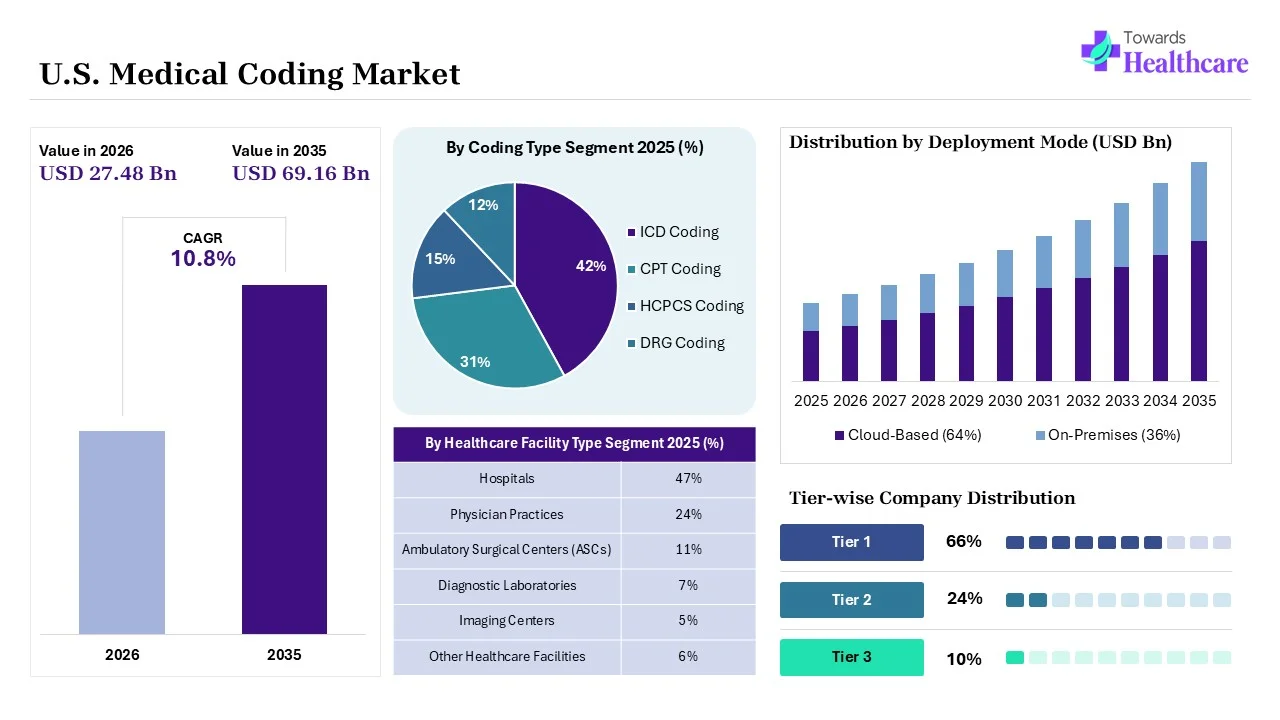
The U.S. medical coding market size was valued at US$ 24.8 billion in 2025 and is projected to grow to 27.48 billion in 2026. Forecasts suggest it will reach approximately US$ 69.16 billion by 2035, registering a CAGR of 10.8% during the period. The market is experiencing steady growth, driven by increasing healthcare service volumes, complex reimbursement requirements, and stringent regulatory compliance standards. Rising adoption of digital healthcare systems, revenue cycle optimization initiatives, and demand for accurate clinical documentation are further supporting market expansion.
Medical coding is the process of converting healthcare diagnoses, procedures, and services into standardized alphanumeric codes used for billing, reimbursement, documentation, and healthcare data management. The U.S. medical coding market is growing due to increasing patient volumes, evolving reimbursement models, and stricter regulatory compliance requirements. Healthcare providers are investing in accurate coding solutions to minimize claim denials, optimize revenue cycle performance, and ensure proper reimbursement. Additionally, the expansion of electronic health records (EHRs), rising healthcare expenditures, and the growing focus on documentation accuracy are further accelerating market growth.
The U.S. medical coding market is poised for significant growth opportunities driven by the increasing adoption of automated coding technologies, expansion of value-based care models, and rising demand for automated coding services. A healthcare organization is focusing on improving reimbursement accuracy, reducing administrative burdens, and enhancing clinical documentation quality. Additionally, the growing integration on coding platforms with the EHR and revenue cycle management system is expected to create new opportunities for innovation and operational efficiency across the healthcare sector.
| Indicator | Value |
| Total ICD-10-PCS procedures codes | 78,948 |
| New ICD-10 PCS codes added | 50 |
| Medicare Beneficiaries | 68 million |
| Medicaid & & CHIP Enrollment | 79 million |
| Active U.S. Physician | 1.1 million |
| U.S. community hospital | 34 million |
The table highlights key healthcare utilization and coding-related statistics that support the growth of the U.S. medical coding market. The large number of Medicare and Medicaid beneficiaries, high healthcare expenditure, and ICD-10 coding standards are driving demand for accurate medical coding services. Additionally, the vast network of hospitals and physician generates substancial coding network of hospitals and physicians generates substantial coding volumes, reinforcing the need for efficient coding solutions and compliance-focused healthcare documentation.
The services segment held a dominant share of 68% in 2025 due to the increasing demand for accurate coding, compliance management, auditing, and revenue cycle optimization. Healthcare provider and payers increasingly rely on outsourced coding services to manage complex reimbursement requirements and reduce claim denials. Additionally, the shortage of certified coding professionals and the need for continuous coding updates and training further strengthened demand for specialized medical coding services.
The ICD coding segment dominated the U.S. medical coding market with 42% in 2025 due to its essential role in documenting diagnoses, disease classification, reimbursement processing, and regulatory reporting. ICD codes are required across all healthcare settings for insurance claims and patient record management. The growing prevalence of chronic diseases, increasing patient encounters, and ongoing updates to ICD coding standards further contribute to the segment’s leading market position.
The cloud-based segment led the U.S. medical coding market with a share of 64% in 2025 and is expected to grow at the fastest CAGR of 13.10% in the market during the forecast period due to its ability to provide remote access, seamless data integration, and cost-effective deployment. Healthcare organizations increasingly prefer cloud platforms for their scalability, real-time updates, and compatibility with EHR and revenue cycle management systems. Additionally, cloud-based solutions support operational flexibility, improved collaboration, and streamlined coding workflows, making them the preferred deployment model across healthcare settings.
The healthcare provider segment dominated the U.S. medical coding market with a share of 56% in 2025 due to the large volume of patient encounters, diagnostic procedures, and treatment services generated by hospitals, clinics, and physician practices. These organizations rely heavily on accurate coding for reimbursement, compliance, and clinic documents. Growing healthcare utilization, increasing administrative requirements, and the need to optimize revenue cycle performance further strengthened the segment’s market leadership.
The diagnostic coding segment held a dominant share of 29% in 2025 due to its critical role in recording patient diagnoses, supporting treatment decisions, and facilitating insurance reimbursement. Every healthcare encounter requires accurate diagnosis coding for claims processing, compliance, and medical record management. The rising prevalence of chronic diseases, increasing patient visits, and growing emphasis on documentation accuracy further contributed to the segment’s dominant position.
Leading companies in the market include Optum, CorroHealth, Aviacode, Dolbey Systems, and GeBBS Healthcare Solutions. These organizations are supporting market growth through comprehensive medical coding services, coding audits, clinical documentation improvement, computer-assisted coding solutions, and revenue cycle management offerings. Ongoing investments in coding automation, advanced analytics, cloud-based technologies, and compliance-focused solutions are enhancing operational efficiency and strengthening their competitive position in the U.S. medical coding industry.
By Component
By Coding Type
By Deployment Mode
By Healthcare Facility Type
By End User
By Application
By Technology


