


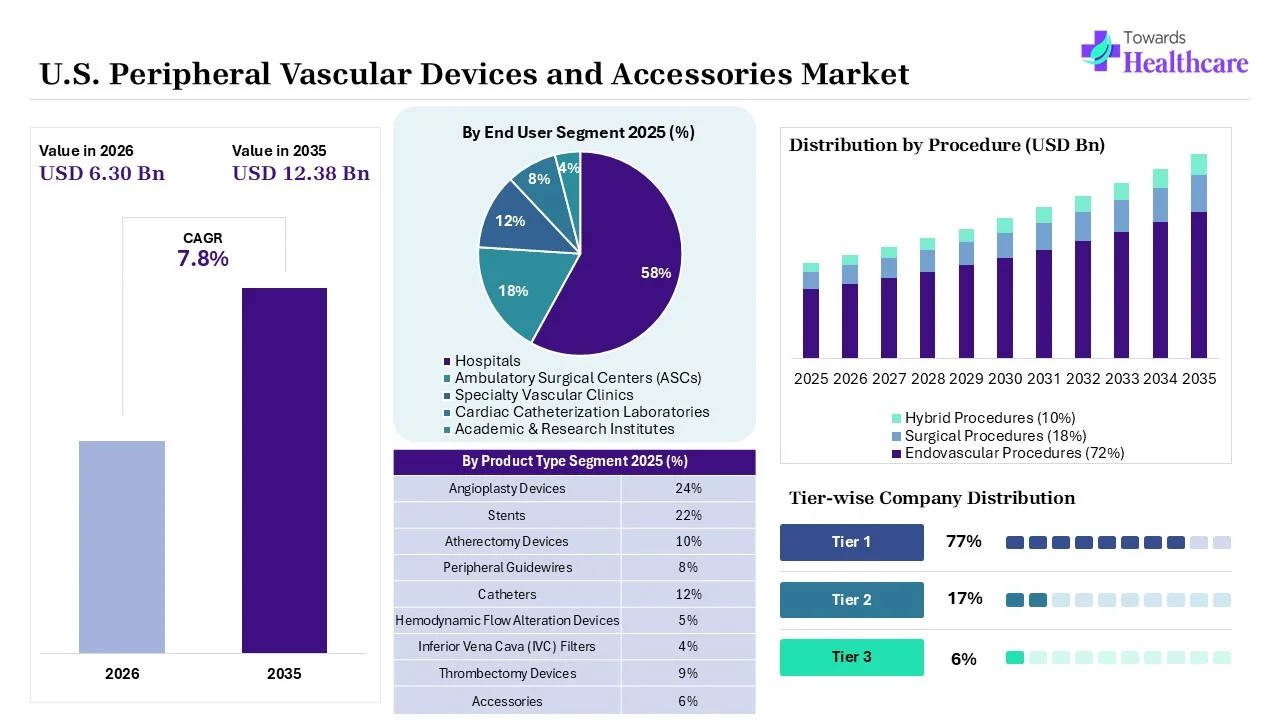
The U.S. peripheral vascular devices and accessories market size was valued at US$ 5.84 billion in 2025 and is projected to grow to 6.3 billion in 2026. Forecasts suggest it will reach approximately US$ 12.38 billion by 2035, registering a CAGR of 7.8% during the period. A growing geriatric population, increasing diabetes cases, a shift towards outpatient labs, increasing demand for endovascular procedures, growing R&D activities, increasing advances in navigation systems, and expanding technological advancements are enhancing the market growth
The U.S. peripheral vascular devices and accessories refer to the medical devices and supporting accessories used in the U.S. for the diagnosis, treatment, and management of diseases affecting peripheral blood vessels. They also help in the diagnosis of vascular conditions, reopen blocked vessels, improve blood circulation, prevent limb loss, and reduce the risk of other complications. This drives their use for the treatment and management of peripheral artery disease (PAD), critical limb ischemia, peripheral vascular occlusion, deep vein thrombosis, arterial stenosis, and vascular abnormalities.
The graph represents a comparison between the diabetes cases in the U.S. for the years 2024 and 2050. It indicates that there will be a rise in diabetes cases, which will drive the demand for advanced diagnostic and treatment options. This, in turn, will increase the adoption of peripheral vascular devices and accessories for the effective management and treatment of diabetes, which will ultimately promote the market growth.
By product type, the angioplasty devices segment accounted for the highest revenue share of 24% of the U.S. peripheral vascular devices and accessories market in 2025, due to their increased use in the treatment of blocked blood vessels and PAD. Being a minimally invasive procedure, their adoption rates increased. Their high success rates and low procedural risk also increased their use.
By procedure type, the endovascular procedures segment held a major revenue share of 72% of the U.S. peripheral vascular devices and accessories market in 2025, as it is a minimally invasive procedure, which increased its demand. Their high effectiveness and lower risk of complications also increased their use. Strong clinical evidence and faster recovery also encouraged their use.
By application type, the peripheral artery disease (PAD) segment contributed the biggest revenue share of 45% of the U.S. peripheral vascular devices and accessories market in 2025, due to growth in diabetes and hypertension cases, which increased PAD cases. Growth in the geriatric population and high-risk complications also increased the demand for their devices and accessories. High health awareness also increased their use.
By end user, the hospitals segment held the largest revenue share of 58% of the U.S. peripheral vascular devices and accessories market in 2025, driven by the high volume of peripheral vascular procedures. Advanced catheterization labs, imaging systems, and operating rooms also increased their use. Specialized surgeons, reimbursement support, and emergency services also increased their use.
The U.S. peripheral vascular devices and accessories market held a significant share in 2025 and is expected to show considerable growth during the predicted time, due to growing peripheral artery disease incidences. The growing shift towards minimally invasive procedures is also increasing the demand for peripheral vascular devices and accessories. Increasing outpatient care centres and reimbursement coverage are also enhancing their accessibility, promoting market growth.
Medtronic plc dominated the market with its IN.PACT Admiral, SpiderFX, and EverFlex, where Boston Scientific Corporation was its closest competitor, which provided Eluvia, Jetstream, and Ranger products. Abbott Laboratories also sustained its position by offering Supera, ProGlide, and Armada, where Becton, Dickinson and Company (BD) also contributed to the market growth with its Lutonix 035, Rotarex S, and LifeStent.
By Product Type
By Procedure
By Application
By End User


