


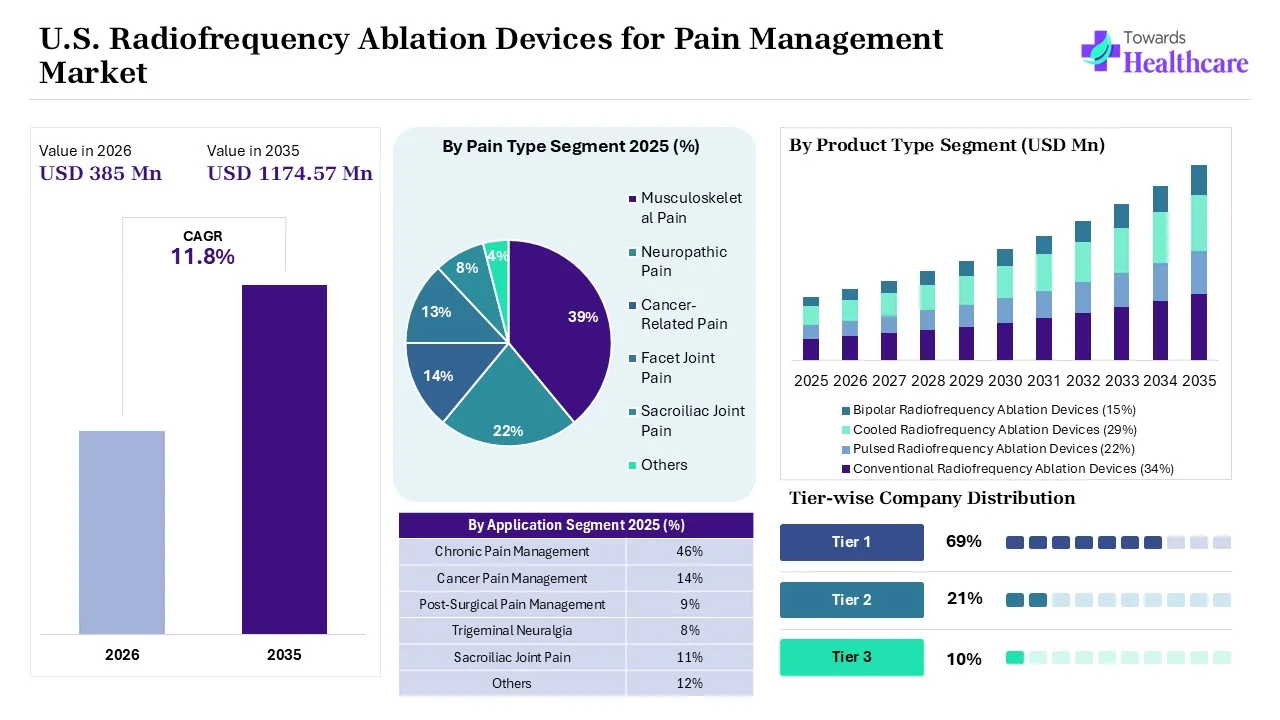
The U.S. radiofrequency ablation devices for pain management market size was estimated at USD 385 million in 2025 and is predicted to increase from USD 430.43 billion in 2026 to approximately USD 1174.57 million by 2035, expanding at a CAGR of 11.8% from 2026 to 2035 Radiofrequency ablation is a minimally invasive technology that influences the power of radio waves to create a current that smoothly heats up a small region of the nerve, which drives the growth of the market.
The application of radiofrequency ablation for intractable pain is built on the premise that the transmission of radiofrequency currents near nociceptive pathways interrupts pain impulses. The thermal energy related to radiofrequency ablation leads to tissue destruction, affecting the nerves responsible for transmitting and moderating the sense of pain. Radiofrequency ablation is the use of radio waves to make a thermal isotherm or lesion. This technology is used to manage various chronic pain conditions like facet joint pain, knee and shoulder pain, and trigeminal neuralgia by directing the accountable sensory nerve and disrupting pain transmission. Radiofrequency ablation uses specific heat to stop nerves from transmitting pain signals to the brain.
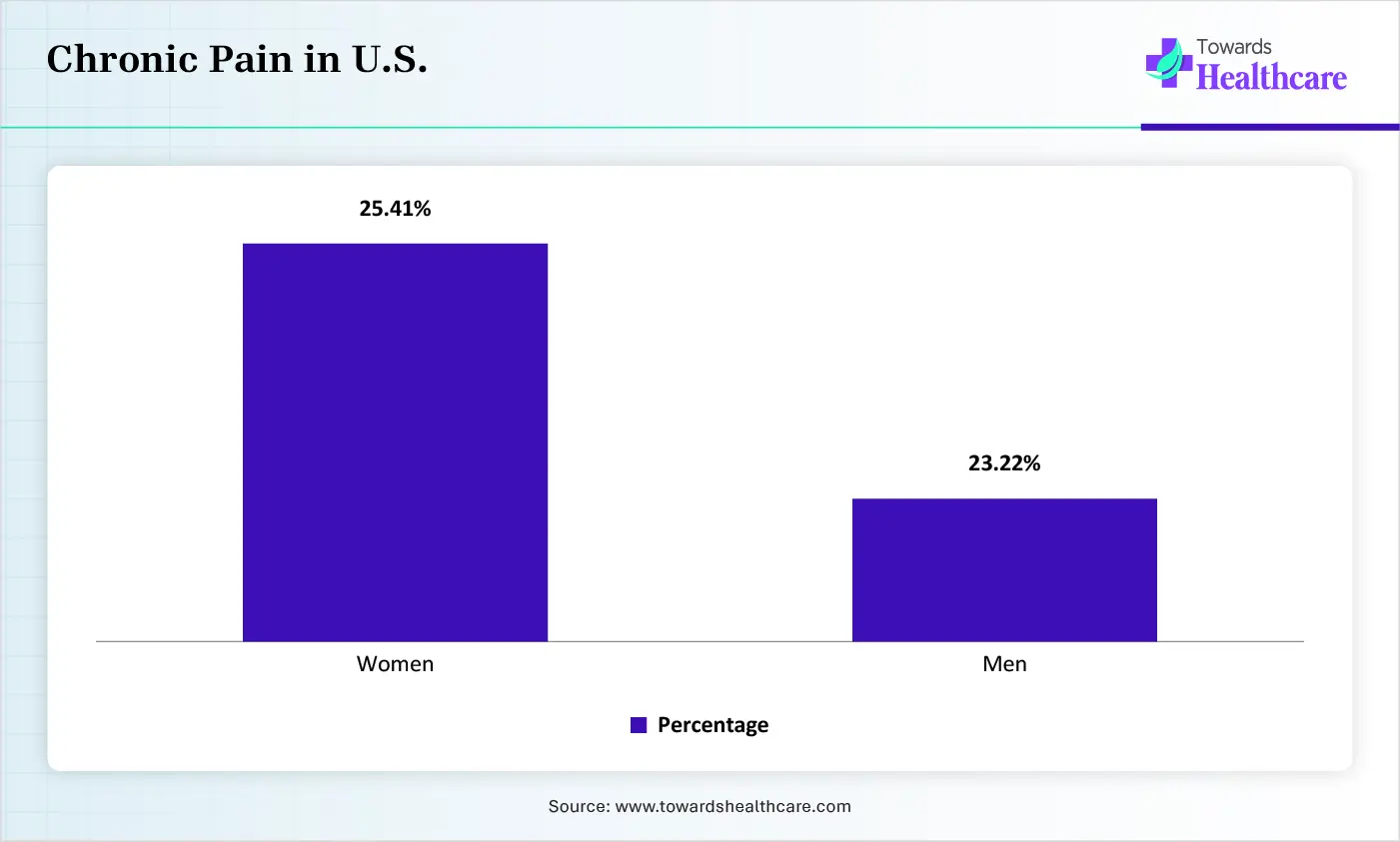
In the United States, data from the Centers for Disease Control and Prevention (CDC) indicate that nearly 50 million adults experience chronic pain.
| Gender | Percentage |
| Women | 25.4% |
| Men | 23.2% |
Recent advancements in cooled radiofrequency are intended to manage challenges and variable nerves via large volume and spherical lesions. Water is circulated through the tools while nervous tissue is heated, creating a treatment area larger than with traditional RF treatments. Using radiofrequency energy, the sensory nerves causing pain are targeted, sparing extreme heating or damage to together tissue. The cooled radiofrequency technology, although medical, is simple. It is often performed using only a local anesthetic. A cooled-tip electrode is intended with a small, water-cooled tip, which lowers the challenges of tissue damage and provides more specific control over the ablation technology. This procedure is specifically valuable for procedures that need higher temperatures or lengthier ablation times.
By product, the conventional radiofrequency ablation devices segment contributed the largest U.S. radiofrequency ablation devices for pain management market share of 34% in 2025, as it offers benefits such as precise tissue targeting, minimal invasiveness, lower complications, and rapid recovery compared to outdated surgical interventions. Technological development in RFA has led to enhanced treatment results. Multi-electrode systems enable larger ablation zones.
By application, the chronic pain management segment contributed the largest market share of 46%, as RFA offers lasting relief for patients with chronic pain, particularly in the lower back, neck, and arthritic joints. Radiofrequency ablation reduces or eliminates the requirement for long-term use of opioid pain medication, providing supportive, safer pain management approaches.
By pain type, the musculoskeletal pain segment held the major share of 39% in the U.S. radiofrequency ablation devices for pain management market, as radiofrequency (RF) is a minimally invasive technology applied to interrupt or alter nociceptive pathways for managing musculoskeletal pain. It appears to be a valuable tool to relieve chronic pain syndromes, and it also increases the effectiveness of this therapy.
By end user, the hospitals segment contributed the largest market share of 41%, as radiofrequency ablation is applied to manage several cancers, like breast. Radiofrequency nerve ablation offers longer-lasting nerve pain relief as compared to conventional treatments.
By technology, the thermal radiofrequency ablation segment contributed the largest U.S. radiofrequency ablation devices for pain management market share of 43%, as thermal ablation potentially lessens patient pain, scarring, and rapid recovery time. Pain management approaches are also allowed to supports lessen discomfort.
By procedure type, the minimally invasive procedures segment contributed the largest market share of 44%, as minimally invasive surgery refers to technologies performed via small incisions, and in some cases, without external incisions. Minimally invasive surgeries are longer to perform because of the difficulty of the tools and navigation, but the long-term advantages are often noteworthy.
Leading companies in the U.S. radiofrequency ablation devices for pain management market include Boston Scientific Corporation, Medtronic, Abbott Laboratories, and Stryker Corporation. Meanwhile, Boston Scientific Corporation, a significant leader offering broadly used RF generators, pain-targeting probes, and the unified RF injection electrode. Medtronic provides a wide portfolio of surgical energy stages, unipolar technology, and AI-based navigation. Abbott Laboratories, a significant innovator in electrophysiology and long-term diseases, provides movable hybrid RF ablation devices. Stryker Corporation produces customizable energy sectors for extremely specific tissue ablation.
By Product Type
By Therapeutic Application
By Pain Type
By End User
By Technology
By Procedure User


