The emergence of mandatory regulations, advances in robotic-assisted procedures, with emphasis on AI-enhanced solutions, fuels the market expansion.
Market At a Glance
The U.S. surgical simulation market comprises a technologically advanced, risk-free training solution employed in medical education to teach & evaluate technical skills before performing on patients. The Accreditation Council for Graduate Medical Education (ACGME) necessitates simulation training. These simulation approaches are highly applicable in minimally invasive surgery (MIS), robotic-assisted procedures, endoscopy, & endovascular procedures.
Market Prospects
A pivotal opportunity will foster an integration of preoperative imaging with 3D printing, & VR will enable surgeons to rehearse on a patient's accurate anatomy, which greatly raises safety for complex or rare instances. The U.S. surgical simulation market will transform robot-assisted and laparoscopic procedures, while simulators are emphasizing training complex hand-eye coordination & device-specific skills.
Global Market Trends
The global surgical simulation market size was estimated at USD 3.85 billion in 2025 and is predicted to increase from USD 4.42 billion in 2026 to approximately USD 15.31 billion by 2035, expanding at a CAGR of 14.8% from 2026 to 2035. The worldwide rising demand for minimally invasive procedures, an emphasis on reducing errors, & impelling advances in robotic surgeries propel the global market development. Many leading institutions and hospitals are promoting AR, VR, XR, and other AI-driven solutions in the different surgical domains.
Approximate Numbers of Surgeries in 2025 & Annually in the U.S.
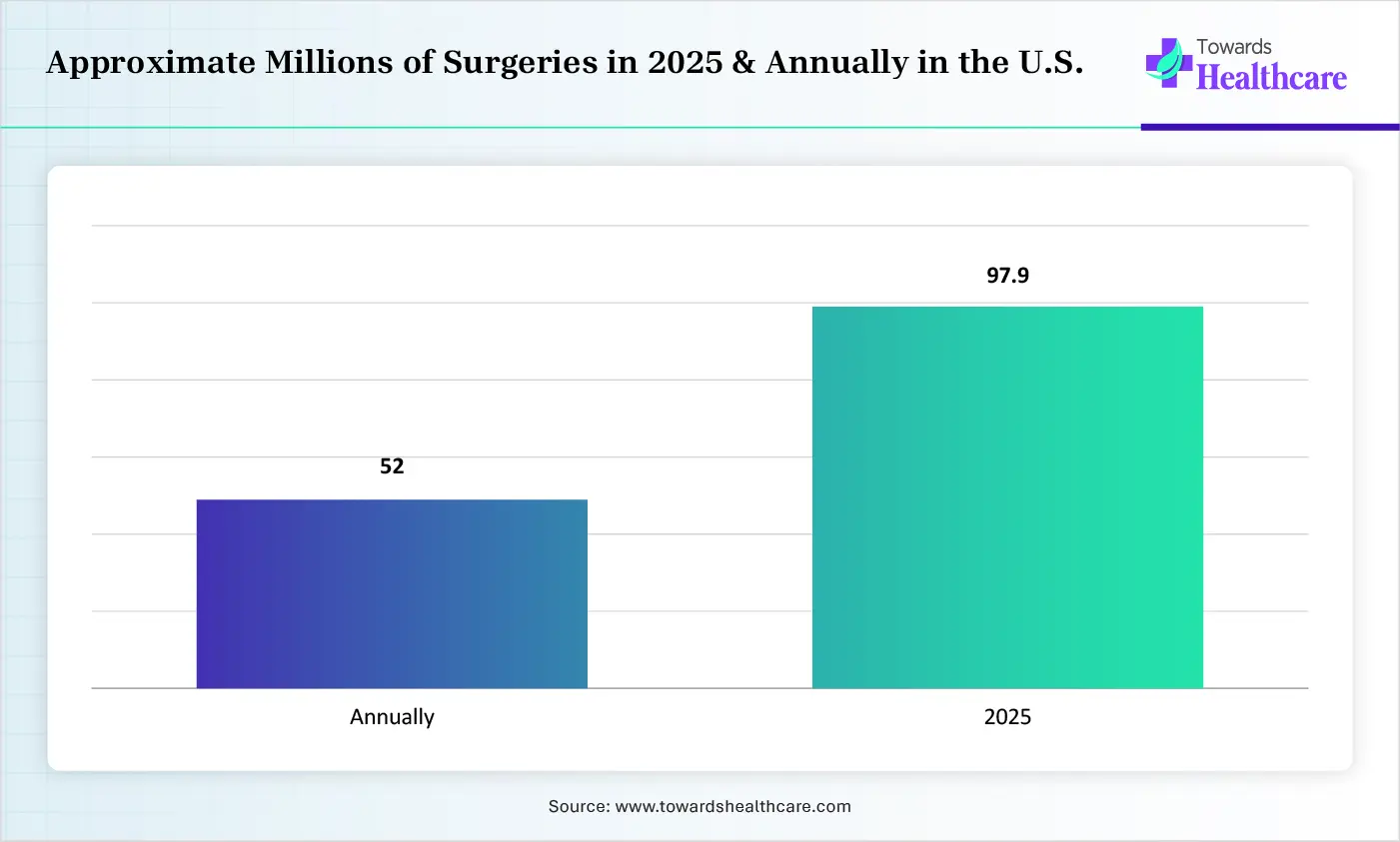
These surging surgical cases are highly demanding advanced surgical simulation to highlight issues over patient safety, surgical resident training, & operating room expenditures. Simulators will increasingly assist in different surgeries, including suturing, knot-tying, & device handling, in a risk-free setting, eliminating the early learning curve from real patients.
Market Segmentation Overview
- By product type, the software segment dominated with 52% share of the U.S. surgical simulation market in 2025. Key drivers include broadened scalability through cloud-based simulation tools, along with integration of these techniques with AI for real-time feedback. These software are fostering portable training & conversion of preoperative patient imaging (CT/MRI) into 3D VR environments.
- By technology, the virtual reality (VR) segment held a major share of 38% of the market in 2025, due to the execution of immersive surgical environments for realistic training. This technology enhances procedural accuracy, with substantial cost-effectiveness. Many U.S. firms are demonstrating comprehensive, validated VR curricula for orthopedic residents, especially emphasizing enhancement in procedural knowledge & implant placement accuracy.
- By application, the training & education segment dominated the market with 46% share in 2025 because surgical simulation plays a crucial role in understanding various procedures and critical points in surgeries. It helps in analysing body anatomy for better results without risking patients’ lives. Students are able to understand more efficiently with the help of simulation using various advanced technologies.
- By end user, the hospitals segment captured a dominant share of 48% of the U.S. surgical simulation market in 2025. They are widely integrating these advanced simulations into their surgical workflows, which further bolsters patient safety results. The projected shortage of surgeons is fueling the need to speed up the proficiency & throughput of surgical residency programs through simulation.
- By surgical specialty, the general surgery segment led with 26% share of the market in 2025, due to the coverage of a broad range of procedures. Mainly, the market is promoting a combination of virtual reality with physical, tangible materials to bolster haptic feedback. The U.S. is experiencing a massive need to raise patient safety, lower working hrs, and merge the technological breakthroughs in simulation, which supports the overall segmental progression.
Top Companies in the U.S. Surgical Simulation Market
3D Systems, CAE Healthcare, Intuitive Surgical, and Medtronic are four leading firms in the respective market, which specialise in AI-enabled, high-fidelity VR platforms. From these players, 3D Systems is perceived as a dominant one, with its advanced digital twin simulation technology, enabling the development of patient-specific, 3D-printed anatomy models integrated with VR for pre-operative rehearsal.
Segments Covered in the Report
By Product Type
- Anatomical Models
- Physical Models
- Virtual 3D Models
- Software
- Procedure Simulation Software
- Performance Assessment Software
- VR/AR Simulation Software
- Services
- Training Services
- Maintenance & Support
By Technology
- Virtual Reality (VR)
- Immersive VR
- Non-Immersive VR
- Augmented Reality (AR)
- Marker-based AR
- Markerless AR
- Mixed Reality (MR)
- 3D Printing Simulatio
- AI-based Simulation
- Predictive Simulation
- Adaptive Learning Systems
By Application
- Training & Education
- Medical Schools
- Residency Training
- Preoperative Planning
- Surgical Rehearsal
- Skill Assessment & Certification
By End User
- Hospitals
- Large Hospitals
- Specialty Clinics
- Academic Institutions
- Military & Defense
- Research Organizations
By Surgical Specialty
- General Surgery
- Orthopedic Surgery
- Cardiovascular Surgery
- Neurological Surgery
- Gynecological Surgery
- Urological Surgery
- Others




