The U.S. wireless cardiac monitoring systems market size accounted for USD 3.85 billion in 2025 and is predicted to increase from USD 4.34 billion in 2026 to approximately USD 12.84 billion by 2035, expanding at a CAGR of 12.8% from 2026 to 2035. The U.S. is experiencing a substantial rise in AFib, HF, and other CVD cases, which fosters the demand for advanced wearables, RPM solutions, & AI applications for continuous monitoring.
Market Briefing
The use of advanced, wearable or implantable, & FDA-approved devices for consistent monitoring of heart electrical activity & transmitting data to healthcare providers remotely is referred to as the U.S. wireless cardiac monitoring systems market. This market encompasses diverse wearables, like patches to offer constant monitoring, with advanced mobile cardiac telemetry (MCT) for continuous ECG analysis.
Market Forecast
During 2026-2035, the U.S. firms will enforce AI-assisted insertable cardiac monitors (ICMs) to lower non-actionable alerts & finally reduce the burden on clinical staff. Along with this, the U.S. wireless cardiac monitoring systems market will have a rigorous chance in integrating smartwatches, and also novel patches, those uniting multi-parameter tracking, & further enable a complete study of patient health.
Number of CVD Cases by 2050 in the U.S. (Approx. in Million)
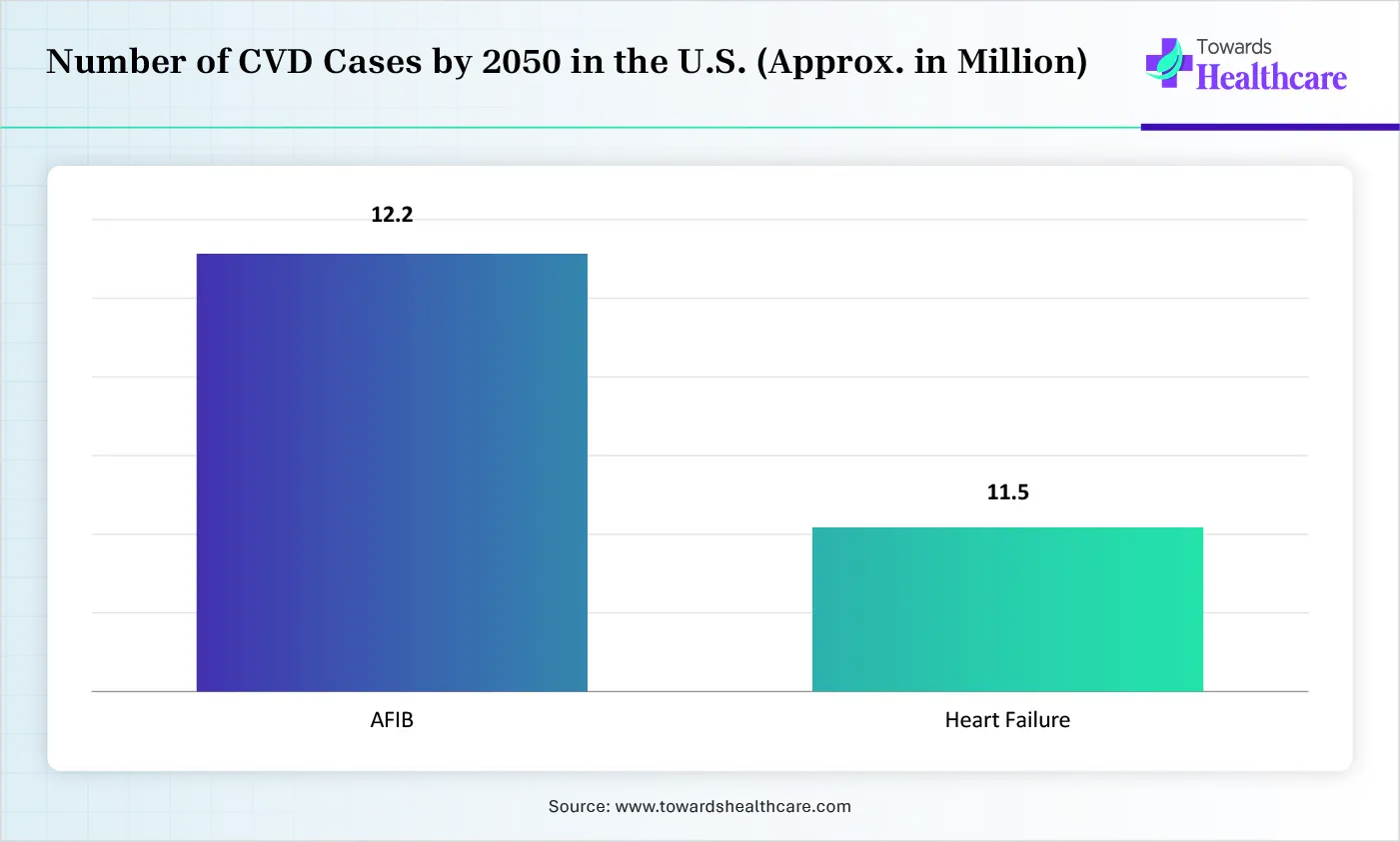
In the coming era, the U.S. wireless cardiac monitoring systems market will bolster, with the rising prevalence of atrial fibrillation & heart failure cases, which need advanced & continuous monitoring devices. Whereas, in the case of AFib, continuous ECG patches and photoplethysmography (PPG) smartwatches have a pivotal role in detecting irregular heart rhythms. However, the U.S. is fostering the use of implantable, battery-free sensors to monitor pulmonary artery (PA) pressure in the surging heart failure cases.
Market Segmentation Overview
- By product type, the Holter monitors segment led with 28% share of the market in 2025. Dominance is driven by a rise in adoption for constant ECG monitoring across hospitals & clinics. Alongside, the presence of robust reimbursement support is propelling its use. This non-invasive product assists in detecting arrhythmias & transient symptoms that standard ECGs miss.
- By technology, the cloud-based monitoring platforms segment dominated with 30% share of the U.S. wireless cardiac monitoring systems market. Key catalysts include its centralized data storage & analytics, & also allows physician access anytime, with enhanced decision-making. These platforms enable integration with AI to assess data trends &find clear heart rhythm changes to anticipate possible adverse cardiac events earlier.
- By application, the arrhythmia monitoring segment captured a major share of 40% of the market in 2025 and is expected to be the fastest growing during the forecast period, due to the massive increase in atrial fibrillation cases. The widespread adoption of 24-hour Holter monitoring, wireless patches & mobile cardiac outpatient telemetry (MCOT) support recording for 14–30 days.
- By end user, the hospitals segment registered dominance with 38% share of the U.S. wireless cardiac monitoring systems market in 2025. The presence of extensive infrastructure, rigorous reimbursement guidelines & higher patient inflow is fueling the need for advanced cardiac monitoring. These solutions elevate mobility, lower hospital-acquired infection risks, & enable rapid, data-driven interventions, leading to minimal hospitalizations.
- By distribution channel, the direct sales segment captured a dominant share of 52% in 2025. This has been driven by strong relationships among manufacturers manufacturers & hospitals, coupled with tailored solutions & service contracts, which give excellent margins & control. This type of sales enables subtle unification between the cardiac device & the manufacturer’s cloud server, which provides secure, real-time data to physicians.
Top Companies in the U.S. Wireless Cardiac Monitoring Systems Market
The market perceives Medtronic, iRhythm Technologies, Abbott Laboratories, & Boston Scientific as leading companies, which spurs the adoption of AI-enhanced & long-term remote monitoring solutions to spotlight the increasing cases of arrhythmias. While iRhythm Technologies is generally considered the largest shareholder in the wearable, AI-enabled patch monitoring with its Zio suite.
Segments Covered in the Report
By Product Type
- Holter Monitors
- Wired Holter Monitors
- Wireless Holter Monitors
- Event Monitors
- Symptom Event Monitors
- Looping Event Recorders
- Mobile Cardiac Telemetry (MCT)
- Real-time MCT Systems
- Patch-based MCT Systems
- Implantable Cardiac Monitors (ICM)
- Traditional ICM
- Miniaturized ICM
- Smart Wearable Monitors
- Smartwatches with ECG
- Chest Strap Monitors
- Patch-based Wearables
By Technology
- Bluetooth-enabled Monitoring
- Cellular-based Monitoring
- Cloud-based Monitoring Platforms
- AI-integrated Monitoring Systems
By Application
- Arrhythmia Monitoring
- Atrial Fibrillation
- Bradycardia
- Tachycardia
- Heart Failure Monitoring
- Post-surgical Monitoring
- Remote Patient Monitoring (RPM)
By End User
- Hospitals
- Ambulatory Surgical Centers (ASCs)
- Cardiac Clinics
- Home Care Settings
By Distribution Channel
- Direct Sales
- Online Sales
- Third-party Distributors




