

Pipeline Programs

CGT Companies Tracked

Manufacturing Facilities


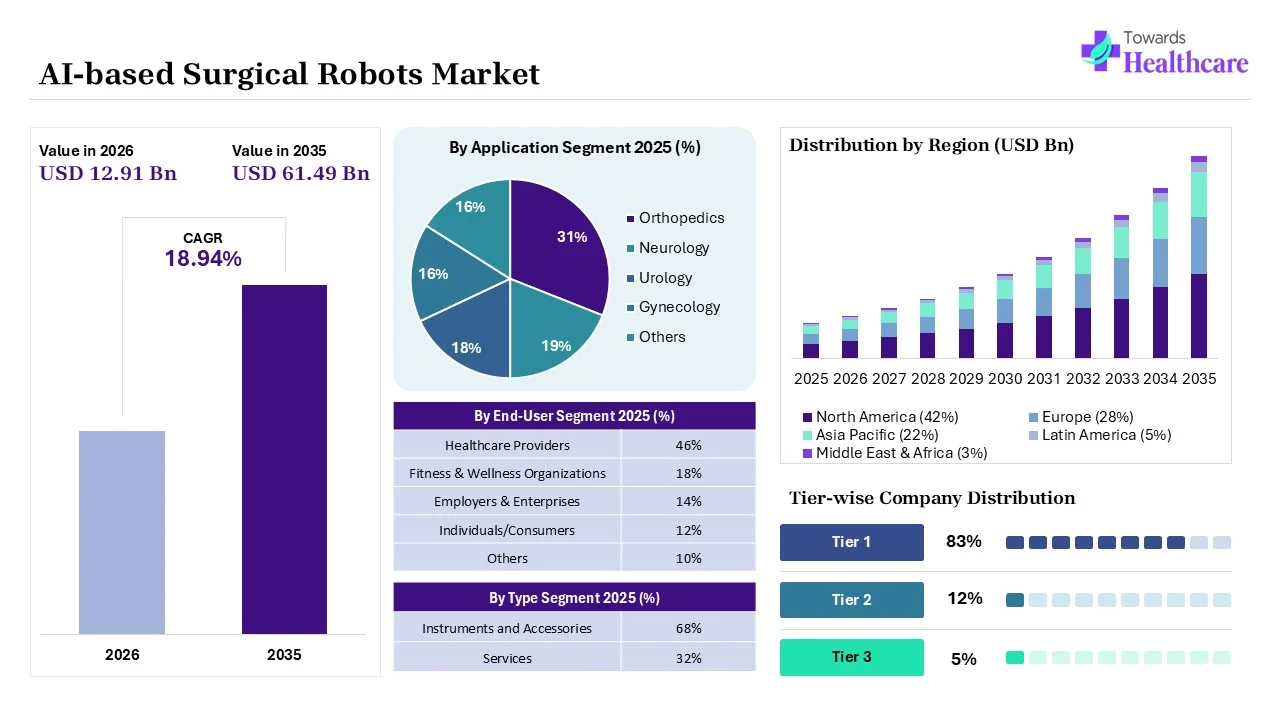
The global AI-based surgical robots market size was estimated at USD 10.85 billion in 2025 and is predicted to increase from USD 12.91 billion in 2026 to approximately USD 61.49 billion by 2035, expanding at a CAGR of 18.94% from 2026 to 2035.
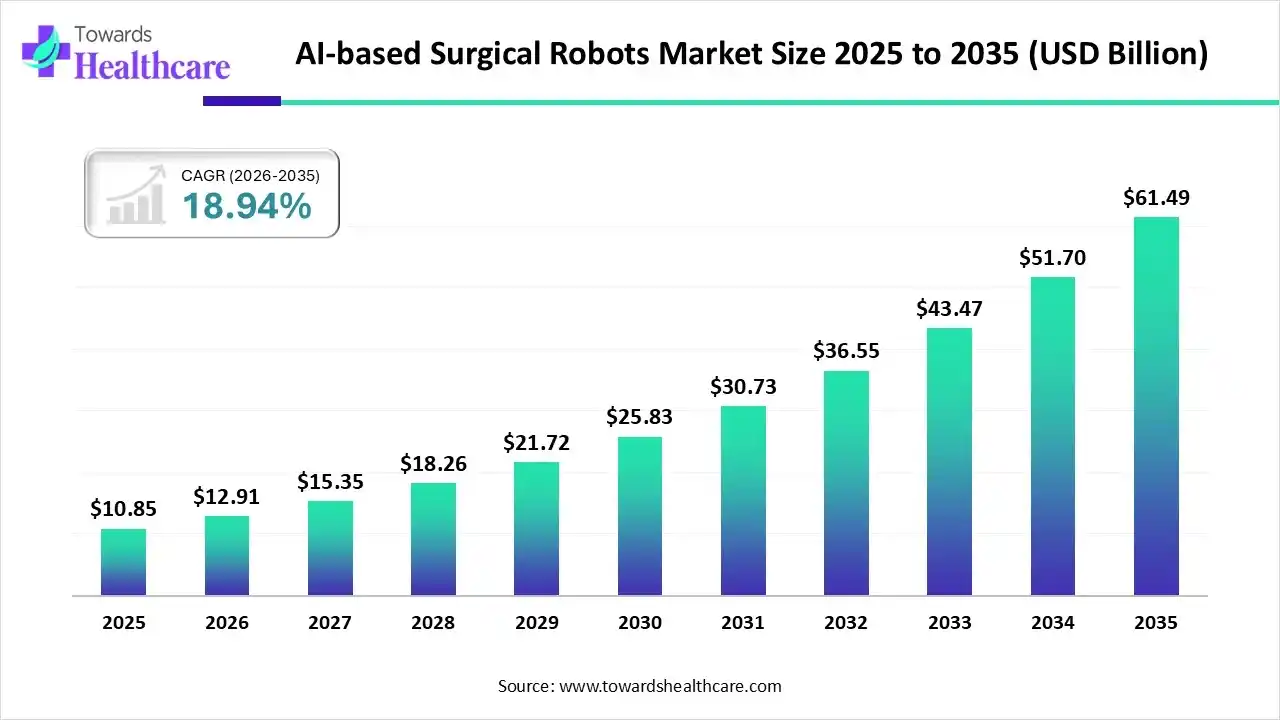
The AI-based surgical robots’ market is growing, as AI-based robotic surgeries are 40% more accurate. This means patients recover rapidly and face fewer complications. AI-driven systems provide real-time predictive analytics, supporting surgeons in anticipating and lessening potential challenges.
The AI-based surgical robots market is growing because healthcare robots make surgeries possible, with the support of robots reducing errors. In medical care facilities, robots are used in a variety of settings. They have an indirect or direct influence on the patients’ lives. They take care of ageing and disabled patients and engage them in conversation so that they do not suffer from pain or boredom. Along with that, there are frequent benefits of healthcare robots. The incorporation of robotics in medical care has transformed the way medical services are delivered. Surgical Robots are capable of performing sophisticated surgical procedures via small incisions with negligible scarring. These robots are equipped with high-definition 3-D cameras, mechanical arms, and numerous other small tools.
The AI-based surgical robots market is expanding as healthcare providers adopt intelligent robotic systems to improve surgical precision, reduce complications, and enhance patient outcomes. Artificial intelligence enables these robots to support surgeons with real-time image analysis, motion guidance, and data-driven decision-making during complex procedures. The increasing preference for minimally invasive surgeries, combined with the rising number of chronic diseases requiring surgical intervention, is driving demand for advanced robotic platforms. Continuous improvements in computer vision, machine learning, and robotic navigation are making these systems more accurate and efficient. Growing investments from healthcare institutions and medical technology companies, along with expanding surgeon training programs, are further accelerating market development.
| Table | Scope |
| Market Size in 2026 | USD 12.91 Billion |
| Projected Market Size in 2035 | USD 61.49 Billion |
| CAGR (2026 - 2035) | 18.94% |
| Leading Region | North America by 42% |
| Key Applications | Robotic-assisted surgery, minimally invasive surgery, orthopedic procedures, urology, gynecology, general surgery, cardiac surgery, neurosurgery, surgical planning, intraoperative navigation |
| Primary End Users | Hospitals, academic medical centers, ambulatory surgical centers, specialty clinics, surgeons, healthcare systems |
| Key Growth Drivers | Increasing adoption of minimally invasive surgery, AI-assisted precision, aging population, demand for faster recovery, surgeon skill enhancement, healthcare automation |
| Measurable Values | USD Millions/Units/Volume |
| Market Segmentation | By Type, By Application, By End-User, By Region |
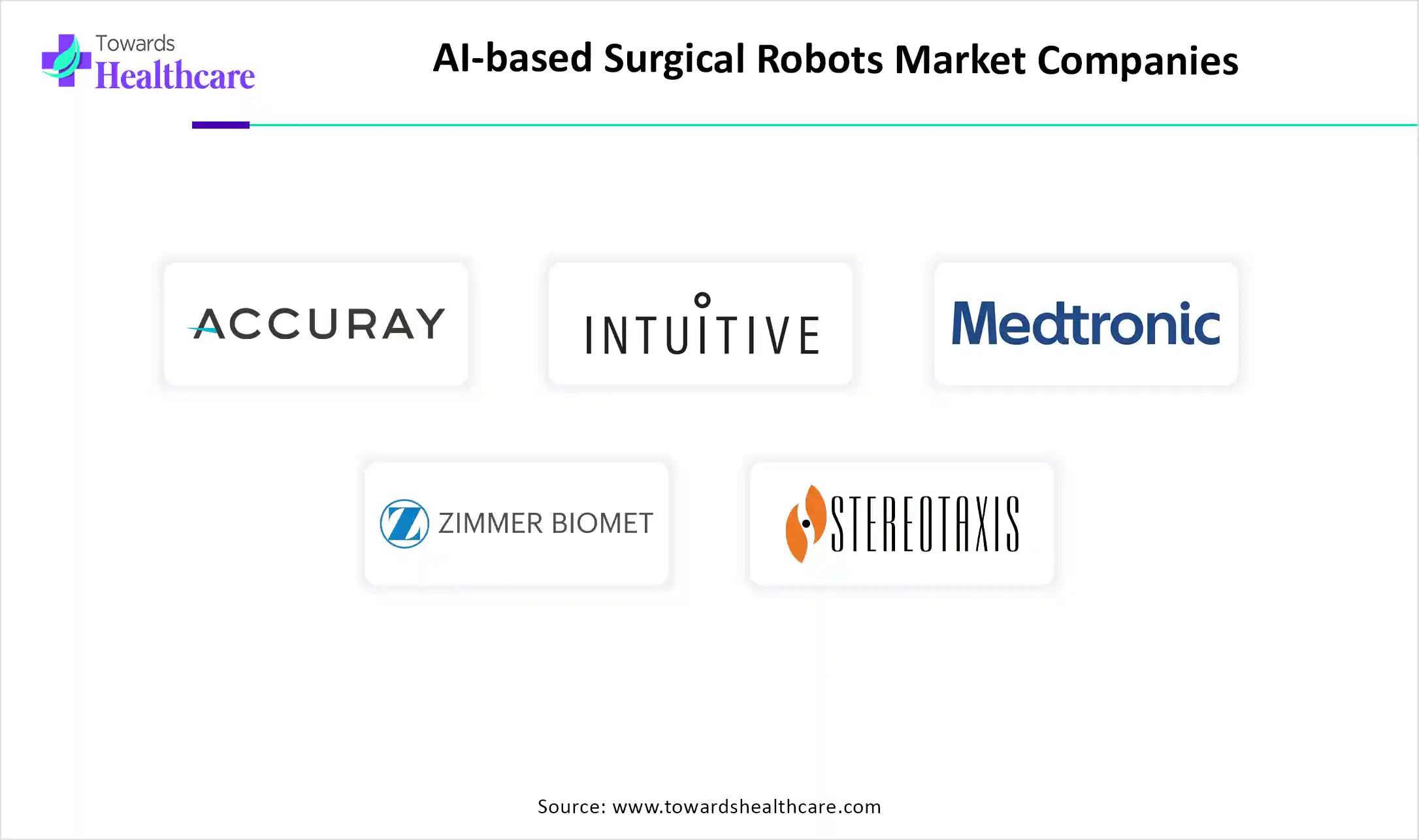
| Top Key Players | Accuray Incorporated, Intuitive Surgical, Inc., Medtronic, plc, Medrobotics Corporation, Zimmer Biomet, Stereotaxis, Inc. |
| Segments | Shares % |
| Instruments and Accessories | 68% |
| Services | 32% |
Which Type Led the AI-based Surgical Robots Market in 2025?
In 2025, the instruments and accessories segment held the dominant share of 68% of the AI-driven surgical robots market 2025, as AI-based technology has improved the precision of robotic surgery by supporting decision-making via real-time imaging, sensors, algorithms, and monitors. AI-driven technology enables automating and streamlining surgical-instrument identification. It's affordable, and cloud-driven accessibility democratizes the process, making it feasible in remote or resource-limited settings. AI-based technology tools offer a more cost-effective and scalable substitute to traditional hardware-based or custom-developed services.
Services
The services segment is estimated to achieve significant growth during the forecast period. AI-driven surgical robot services enhance precision through real-time data analysis, haptic feedback, and image recognition. Key offerings include preoperative 3D planning, intraoperative navigation, and remote surgical support. These services automate tasks like suturing and tissue dissection, reducing human error, lowering complication rates, and improving recovery times.
| Segments | Shares % |
| Orthopedics | 31% |
| Neurology | 19% |
| Urology | 18% |
| Gynecology | 16% |
| Others | 16% |
Which Application Held a Significant Share of the Market in 2025?
The orthopedics segment held a notable share of 31% of the AI-based surgical robots market in 2025 because of the surge in joint replacements among an aging population, requiring extreme precision. AI-powered, 3D pre-operative planning and real-time guidance improved implant alignment, reducing revision rates. Major players like Stryker (Mako) and Zimmer Biomet (ROSA) saw widespread adoption to enhance surgical accuracy. Furthermore, these systems offer faster recovery, and the recurring use of specialized instruments and accessories solidified the segment’s dominant revenue share in the market.
Neurology
Whereas the neurology segment is the fastest-growing in the market, AI-based technology is allowing physicians to have progressive intraoperative metrics like force and tactile measurements, improved discovery of positive medical margins, and allowing for the complete automation of certain steps in surgical measures. Robotic systems are used in neurosurgery for procedures with limited operative spaces. AI-driven intraoperative applications for robotic surgery provide opportunities to enhance the efficacy, safety, and efficiency of technology.
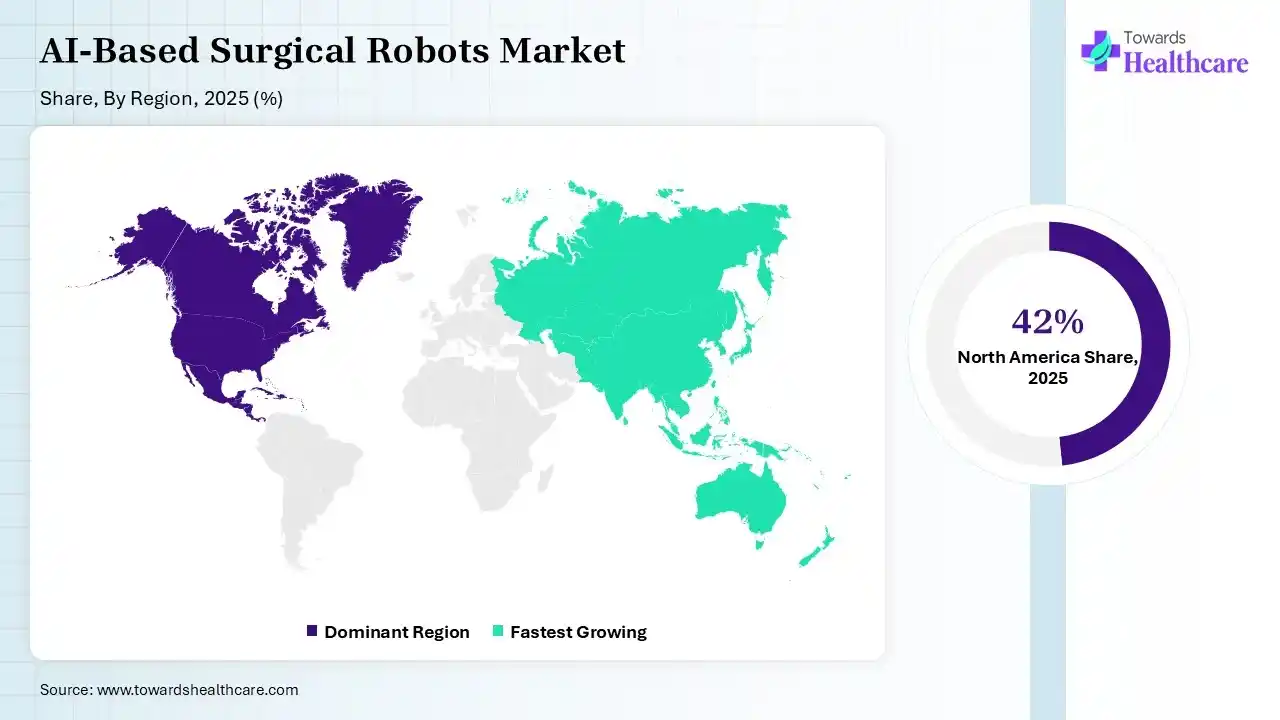
In 2025, North America dominated the AI-based surgical robots market by 42% share, as advanced digital health technology is driving healthcare spending by allowing novelty, attracting worldwide funding, and shifting investor priorities toward emergent and scalable services. The FDA inspires the advancement of innovative, safe, and efficient medical tools, including devices that incorporate artificial intelligence (AI), which drives the growth of the market.
For Instance,
U.S. Market Trends
In the U.S., AI-based technology improves diagnostics and revolutionizes remote monitoring and telemedicine, enabling incessant care beyond traditional settings. Robots are applied for complex surgeries, healthcare training, medicine dispensing, private care, and many other responsibilities in this region.
Canada Market Trends
The AI-based surgical robots market in Canada is experiencing robust expansion driven by increasing adoption of minimally invasive procedures and the integration of artificial intelligence for enhanced precision. Growth is supported by government investment in healthcare technology, a focus on improving patient outcomes, and rising utilization in urban teaching hospitals.
Mexico Market Trends
Mexico is witnessing steady growth in the AI-based surgical robots market as hospitals continue adopting advanced technologies to improve surgical outcomes. Rising demand for minimally invasive procedures is encouraging healthcare providers to invest in robotic systems with AI capabilities. Public and private hospitals are expanding access to modern surgical equipment. Growing medical tourism, increasing healthcare spending, and partnerships between hospitals and technology companies are also supporting the wider use of AI-powered surgical robots across the country.
Asia Pacific is expected to see rapid growth in the AI-based surgical robots market by 22% share, as rising demand for minimally invasive events, rising health care spending, and supportive regulatory policies encourage the acceptance of robotic systems. It aims to enhance safety, efficiency, and lower errors, creating the way for autonomous clinical robotics. There is an increasing prevalence of chronic diseases such as cancer, necessitating precise, challenging surgical interventions, which drives the growth of the market.
India Market Trends
Robotic surgery in India has developed as a transformative force, providing precision and effectiveness in different healthcare procedures. As patients progressively turn to these advanced strategies, ensuring safety measures and safety protocols becomes vital. Indian companies are developing high-tech, inexpensive robotic healthcare systems.
China Market Trends
China is experiencing rapid growth in the AI-based surgical robots market due to strong investments in healthcare technology and digital innovation. Hospitals are adopting AI-powered robotic systems to improve surgical accuracy and reduce recovery time. Rising cases of chronic diseases and an aging population are increasing the demand for advanced surgical procedures. Government support for medical technology, expanding local manufacturing, and continuous research in artificial intelligence are helping the market grow across major healthcare facilities nationwide.
Europe is significantly growing in the AI-based surgical robots market by 28% share, as the incorporation of robotics and AI-based technology in the medical practice is fundamentally revolutionising patient care. Robots intended for medical care organisations embrace robotic services to enable the organisation of medical care. European healthcare systems are under unprecedented pressure from significant demographic variations, with the ageing of the population, workforce lacks and increasing health inequalities, which increases the demand for AI-based surgical robots.
Germany Market Trends
Germany is experiencing strong growth in the AI-based surgical robots market because of its advanced healthcare system and well-established medical technology industry. Hospitals are investing in AI-enabled robotic platforms to improve surgical precision, efficiency, and patient recovery. Increasing demand for minimally invasive procedures and complex surgeries is supporting market expansion. Strong research capabilities, continuous technological innovation, and collaborations between medical device manufacturers, healthcare providers, and research institutions are further accelerating the adoption of surgical robots.
UK Market Trends
The UK is seeing steady growth in the AI-based surgical robots market as healthcare providers focus on improving patient care and surgical precision. Hospitals are increasing the use of robotic systems supported by artificial intelligence for complex procedures. Rising demand for minimally invasive surgeries and better clinical outcomes is encouraging further adoption. Government funding for healthcare innovation, strong research activities, and collaborations between universities, hospitals, and technology companies are driving continued market expansion.
| Category | Market Role |
| Technology Providers | AI algorithms, computer vision, machine learning, imaging technologies, surgical navigation systems, sensor technologies enabling intelligent robotic assistance |
| Product Manufacturers | Companies developing robotic surgical platforms, robotic instruments, surgical systems, and AI-enabled operating room technologies |
| Service Providers | Installation, maintenance, training, clinical support, robotic surgery programs, and hospital integration services |
| Platform Providers | Digital surgery platforms combining robotics, AI analytics, imaging, and surgical workflow optimization |
| CROs/CDMOs | Limited direct relevance; some support medical device development, validation, and manufacturing |
| Software Vendors | AI-based surgical planning software, visualization platforms, workflow analytics, surgical data platforms |
| Research Institutions | Universities and medical research centers developing surgical robotics, AI models, and autonomous surgery technologies |
| End-User Industries | Healthcare providers, hospitals, surgical centers, specialty care networks |
| Tier 1 | Tier 2 | Tier 3 | |
| Typical Market Influence | 83% | 12% | 5% |
| Tier 1 | ||||
| Company Name | Headquarters | Country | Why Relevant to This Market | Key Products/Services Related to Keyword |
| Intuitive Surgical | Sunnyvale, California, USA | USA | Global leader in robotic-assisted surgery with the largest installed base and strong AI-driven digital surgery ecosystem | da Vinci Surgical System, Ion robotic platform, digital surgery analytics |
| Medtronic | Minneapolis, Minnesota, USA | USA | Major medical device company investing heavily in robotic surgery and AI-enabled surgical platforms | Hugo Robotic-Assisted Surgery System, Touch Surgery Enterprise |
| Johnson & Johnson MedTech | New Brunswick, New Jersey, USA | USA | Strong presence in surgical robotics through advanced robotic platforms and digital surgery investments | OTTAVA Surgical Robotic System, VELYS robotic technologies |
| Tier 2 | ||||
| Company Name | Headquarters | Country | Why Relevant to This Market | Key Products/Services |
| Zimmer Biomet | Warsaw, Indiana, USA | USA | Strong orthopedic robotics player using AI-driven planning and surgical assistance | ROSA Robotics, ROSA Knee, ROSA Hip |
| Smith+Nephew | Watford, England | UK | Active in robotic-assisted surgery with orthopedic digital technologies | CORI Surgical System |
| Asensus Surgical | Research Triangle Park, North Carolina, USA | USA | Specialized company focused on AI-driven digital surgery and robotic platforms | Senhance Surgical System, LUNA Surgical System |
| Tier 3 | ||||
| Company Name | Headquarters | Country | Why Relevant to This Market | Key Products/Services |
| Rob Surgical | Barcelona, Spain | Spain | Emerging surgical robotics company focused on affordable robotic-assisted surgery | Bitrack Surgical Robot |
| Distalmotion | Epalinges, Switzerland | Switzerland | Developing next-generation robotic surgery platforms with flexible operating models | Dexter Surgical Robot |
| Moon Surgical | Paris, France | France | AI-enabled surgical robotics startup focused on collaborative robotic assistance | Maestro Surgical Robot |
Strengths
Weaknesses
Opportunities
Threats
In May 2026, “With AI’s promise comes profound implications for clinical practice and the continued safe function of surgical teams. These warrant multistakeholder discussion to ensure clarity of liability, minimisation of bias, integration of autonomous robotic systems within surgical teams, global equity, and robust product regulation,” said Professor Prokar Dasgupta OBE FRCS HonFREng, former Director of the Centre of Academic Surgery, King’s College London.
By Type
By Application
By End-User
By Region





Principal Consultant
Rohan Patil is a seasoned market research professional with over 5+ years of focused experience in the healthcare sector, bringing deep domain expertise, strategic foresight, and analytical precision to every project he undertakes.
Learn more about Rohan Patil

Reviewed By
Aditi Shivarkar is a seasoned professional with over 14 years of experience in healthcare market research. As a content reviewer, Aditi ensures the quality and accuracy of all market insights and data presented by the research team.
Learn more about Aditi Shivarkar









