
The AI-enabled clinical laboratory analyzer market is projected to increase from USD 3.40 billion in 2025 to USD 12.39 billion by 2035, supported by the requirement for intelligent diagnostic systems across hospital laboratories, reference laboratories, and specialized testing facilities. Clinical laboratories are under pressure to enhance testing volumes while ensuring accuracy and reducing costs and turnaround times. AI-enabled analyzers support these objectives by automating selected analytical and operational tasks and improving laboratory workflow efficiency. Factors such as workforce shortages, increased testing demand, and investment in digital infrastructure are driving market growth.
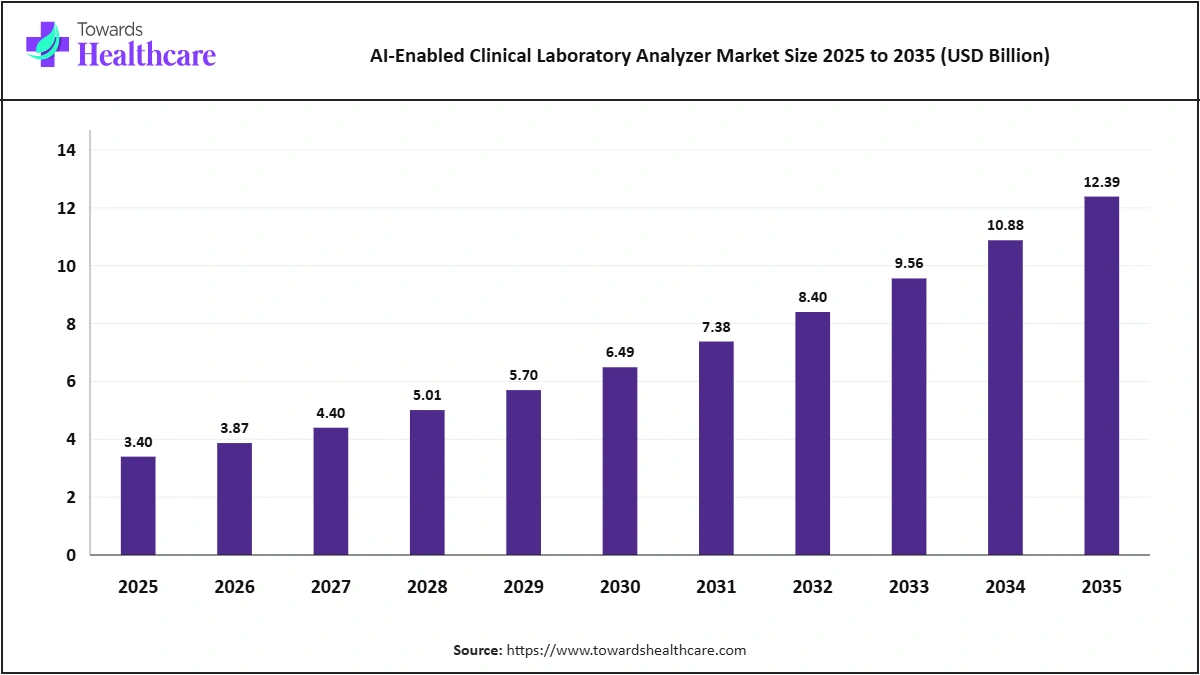
Next-gen diagnostic systems emphasize capabilities like AI-based morphology classification and automated result verification. Additionally, laboratories are integrating software platforms for streamlined operations, supported by robotic sample handling and intelligent automation. These developments are expected to increase market revenue to USD 6.49 billion by 2030 and sustain a CAGR of 13.8% from 2026 to 2035. AI-enabled analyzers are becoming part of connected diagnostic ecosystems that combine laboratory instruments, imaging technologies, software, and automated material handling.
Analyst View: We estimated the market using installed and newly deployed AI-enabled analyzer systems, software modules, service revenues, and average system prices across regions and end-user categories. Our assessment includes AI-enabled hematology, digital morphology, clinical chemistry, immunoassay, microbiology, urinalysis, and molecular analyzer technologies. The estimate was cross-checked against the IVD portfolios, analyzer installations, and digital laboratory activities of leading suppliers. Published estimates for this specific market definition are limited, making a clearly defined scope and bottom-up assessment particularly important.
| Driver | Impact | ≈ CAGR Contribution | Time Horizon | Key Regions |
| Laboratory staff shortages | High | +5.39 pp | Short to long term | Global, strongest in North America |
| Rising test volumes | Medium | +4.55 pp | Medium to long term | Global, fastest uptake in Asia Pacific |
| Need for faster results | Medium | +3.87 pp | Short to medium term | Global |
| AI improves accuracy | Low | +3.03 pp | Long term | Developed and emerging markets |
Note: Contributions are indicative estimates of each factor's effect on annual growth.
Sources: Expert interviews, secondary sources, Towards Healthcare database and Towards Healthcare analysts.
The identified growth drivers collectively contribute an estimated 16.84 percentage points to the forecast CAGR, with laboratory staff shortages representing the largest individual contribution. Increasing diagnostic testing volumes are driving demand for automated analytical platforms, especially in high-throughput labs. The need for quicker results is promoting the use of automated verification and AI-based image interpretation, with improved algorithm performance enhancing clinical acceptance. These trends are notably influential in North America, while Asia Pacific is expected to see quicker adoption as healthcare infrastructure improves.
| Restraint | Impact | ≈ Negative CAGR Contribution | Time Horizon | Key Regions |
| High system costs | High | -1.37 pp | Short to medium term | Global |
| Regulatory validation of AI | High | -1.00 pp | Medium term | Price-sensitive and emerging markets |
| Data privacy and cybersecurity | Medium | -0.67 pp | Short term | North America and other mature markets |
Note: Contributions are indicative estimates of each factor's effect on annual growth.
Sources: Expert interviews, secondary sources, Towards Healthcare database and Towards Healthcare analysts.
High system costs, regulatory validation requirements and data privacy concerns are estimated to constrain the forecast CAGR by an estimated 3.04 percentage points. The primary constraint is high acquisition and implementation costs, especially affecting smaller healthcare facilities with limited budgets. Additionally, regulatory and cybersecurity requirements complicate the adoption of AI-enabled diagnostic platforms.
However, these barriers may gradually ease as AI technologies become more standardized, suppliers expand their validated product portfolios, and laboratories gain experience with digital integration. The market is consequently projected to maintain a net CAGR of 13.8% from 2026 to 2035.
The advancement of integrated reference laboratory automation, digital morphology platforms, and AI middleware presents substantial opportunities for market players. Reference laboratories are appealing due to their high testing volumes and need for optimized workflows. Additionally, AI software modules compatible with existing analyzer systems can enable suppliers to earn recurring revenue, reducing reliance on new equipment sales.
Asia Pacific offers significant opportunities due to expanding hospital infrastructure, increased diagnostic testing volumes, and investments in advanced healthcare facilities in China, India, and Japan. Manufacturers can enhance their market presence through collaborations with hospital networks, lab automation providers, and AI software developers, while innovations such as robotic sample handling, cloud-based lab dashboards, and predictive maintenance technologies present commercial prospects during the forecast period.
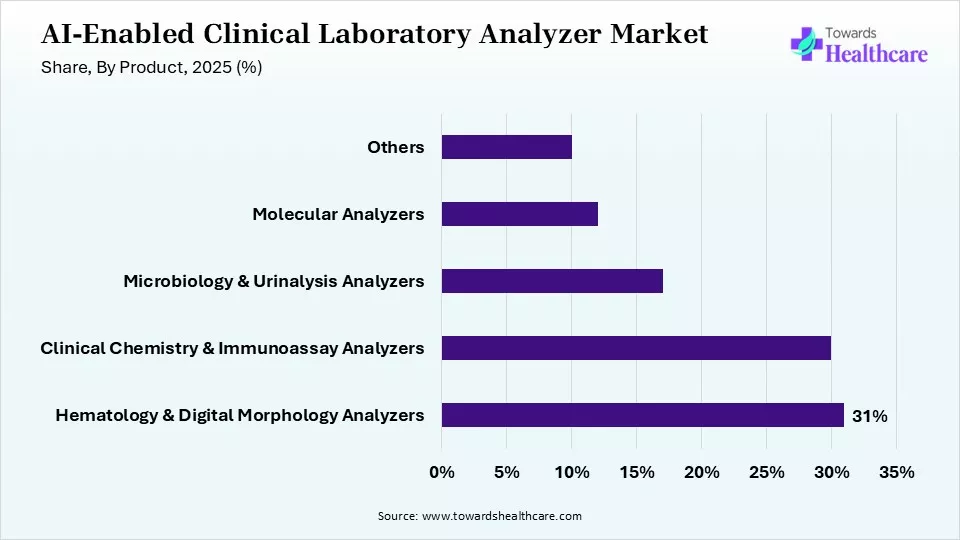
Note: 2025 is the base year; 2035 shares and CAGRs are forecasts.
Sources: Expert interviews, secondary sources, Towards Healthcare database, and Towards Healthcare analysts.
Hematology and digital morphology analyzers held 31% of the market in 2025, with a projected CAGR of 13.16% from 2026 to 2035. These analyzers lead the product category by utilizing AI for blood cell classification and abnormal population identification, aiding in reducing manual workloads. Integration with automated systems boosts adoption, although growth is anticipated to be slower compared to microbiology and emerging applications.
These analyzers increasingly utilize AI for quality control, result verification, predictive maintenance, and optimization, facilitating high-volume testing in hospitals and laboratories. Their integration into routine diagnostics is anticipated to sustain demand, aligning with overall market growth.
AI-powered microbiology image analysis is expected to support the fastest growth among the product segments. This growth is driven by demand for quicker microbiological testing and laboratory automation, as these technologies enhance consistency and reduce the need for manual observation in high-volume labs.
Molecular analyzers are leveraging AI for result interpretation, quality assessment, and data analysis. The rising significance of molecular diagnostics in fields like infectious disease testing and oncology presents opportunities for intelligent diagnostic platforms, with integration into laboratory information systems and advanced analytical software likely to facilitate segment growth.
Other products include AI-enabled coagulation analyzers, blood gas analyzers, and specialized clinical diagnostic systems. These technologies support additional laboratory applications and benefit from automated quality control, digital connectivity, and predictive maintenance capabilities.
However, microbiology and urinalysis analyzers are projected to register the highest CAGR of 15.56%, supported by growing demand for image-based microbiology interpretation and automated urine analysis. Clinical chemistry and immunoassay analyzers will continue to represent a substantial revenue category, while molecular analyzers and others will support the expansion of specialized AI-enabled diagnostic applications.
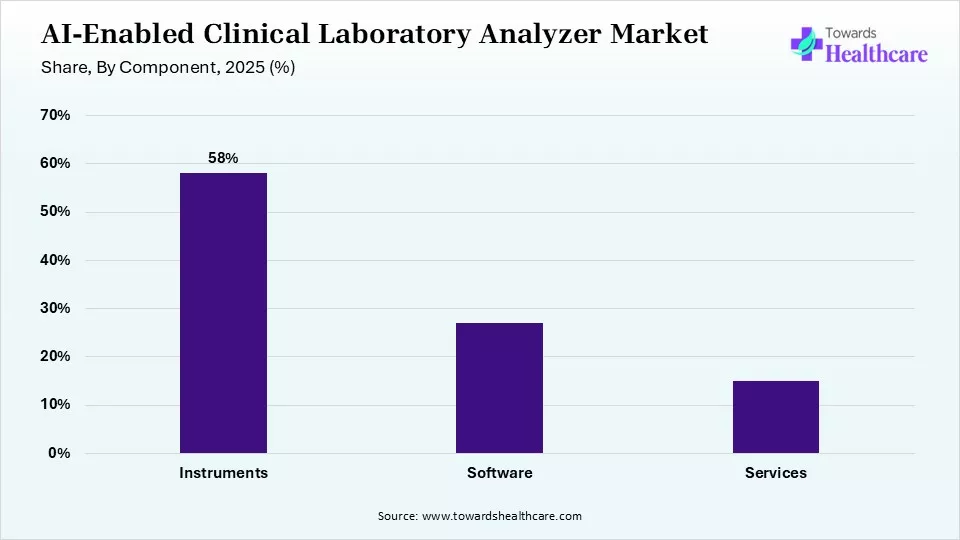
Note: 2025 is the base year; 2035 shares and CAGRs are forecasts.
Sources: Expert interviews, secondary sources, Towards Healthcare database and Towards Healthcare analysts.
Instruments accounted for 58% of the market in 2025, with a projected CAGR of 12.89% through 2035. This segment remains dominant due to the integration of AI-enabled analytical capabilities in various diagnostic platforms. Hospitals and reference laboratories are investing in advanced analyzers to enhance testing capacity and workflow efficiency. However, growth in this segment is expected to be slower than the overall market as software-based AI upgrades become significant during the forecast period.
It is anticipated to be the fastest-growing segment, allowing upgrades to existing infrastructure without total replacements. The demand for integrated laboratory data management and workflow optimization will further bolster the growth.
This segment includes installation, configuration, integration, validation support, maintenance, training, and technical assistance. Demand for specialized services is driven by the deployment of advanced analyzer platforms and interconnected lab systems, although growth is anticipated to be slightly slower than the overall market.
However, software is projected to register the highest CAGR of 15.79%, supported by the increasing adoption of AI modules, digital morphology applications, and laboratory middleware. Services will remain essential for implementation, maintenance, validation, and technical support across expanding AI-enabled laboratory networks.
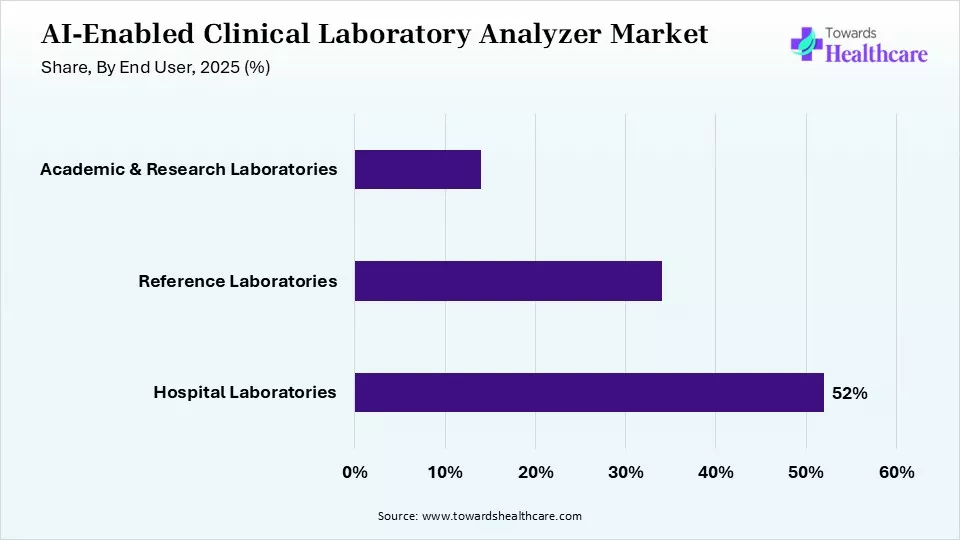
Note: 2025 is the base year; 2035 shares and CAGRs are forecasts.
Sources: Expert interviews, secondary sources, Towards Healthcare database and Towards Healthcare analysts.
Hospital laboratories held 52% of the market in 2025 and are expected to register a CAGR of 13.18% from 2026 to 2035. They are the largest end-user due to their role in routine and specialized diagnostic testing. Factors such as staff shortages, increased testing volumes, and the need for quicker turnaround times are driving the adoption of AI-enabled analyzers and automated verification systems. Integration with hospital and laboratory information systems is also facilitating this adoption, although growth is anticipated to be slower than the overall market.
Their growth is driven by processing numerous diagnostic samples and leveraging centralized automation. AI-enabled analyzers enhance result interpretation, abnormality detection, quality control, and workflow efficiency. Increased investments in high-throughput analyzers and digital infrastructure are anticipated to boost adoption in both independent and integrated reference laboratory networks.
These labs utilize AI-enabled diagnostic systems for novel analytical techniques and advanced methodologies. Increased research in digital pathology and automated workflows will support growth, complemented by collaborations among academic institutions, technology developers, and diagnostic manufacturers.
Reference laboratories are projected to register the highest CAGR of 14.78%, supported by their increasing requirement for high-throughput automation, operational efficiency, and centralized diagnostic processing. Academic and research laboratories will continue to contribute to the market through AI validation, technology development, and specialized research applications.
Analyst View: In our analysis, segment shares were allocated using diagnostic demand, product portfolios, analyzer installations, testing volumes, and average system prices across each category. Hematology and digital morphology analyzers, instruments, and hospital laboratories lead their respective categories because they address the core requirements of established diagnostic workflows. However, microbiology and urinalysis analyzers, software, and reference laboratories are expected to gain market share as newer technologies, automation applications, and high-volume laboratory operations expand during the forecast period.
Note: 2025 is the base year; 2035 shares and CAGRs are forecasts.
Sources: Expert interviews, secondary sources, Towards Healthcare database, and Towards Healthcare analysts.
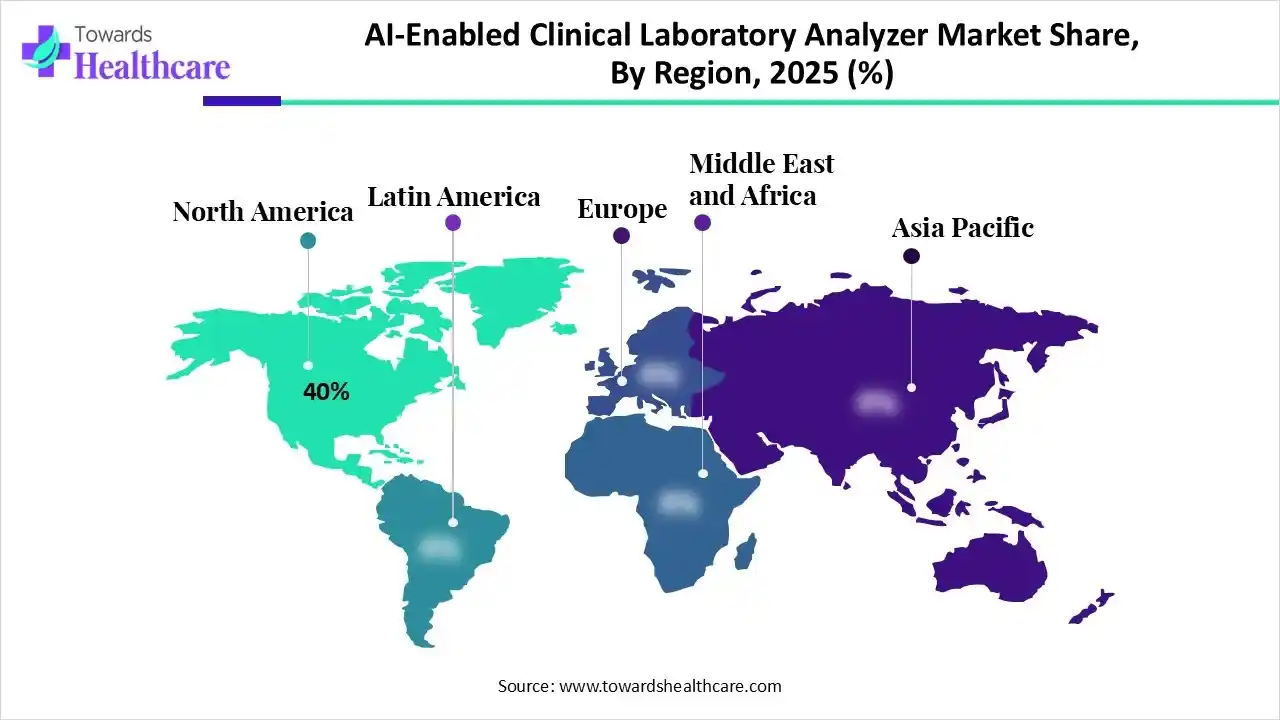
North America held a 40% share of the market in 2025, with a projected CAGR of 13.26% from 2026 to 2035. The growth in North America is driven by its robust clinical laboratory infrastructure, high diagnostic testing volumes, and the presence of leading IVD manufacturers. The U.S. is a key market for AI-enabled technologies owing to workforce shortages and demand for efficiency. Established laboratory networks and regulatory pathways enhance market development, although North America's growth is expected to be slightly slower than the overall market during the forecast period.
Europe markets include Germany, the UK, France, and Italy due to their robust healthcare systems and diagnostic manufacturing. The rise of CE-marked diagnostic technologies and integrated analyzer platforms will further support growth, aligning with overall market projections.
Asia Pacific is projected to experience rapid growth due to enhanced hospital infrastructure, increased diagnostic testing, and investments in smart healthcare facilities, with China, Japan, and India being key markets. Factors such as a large patient population, expanding laboratory networks, rising healthcare spending, and the adoption of automated analyzers are anticipated to drive market expansion.
Latin America demand is supported by expanding diagnostic laboratory infrastructure, healthcare investments, and the modernization of hospital testing facilities. Brazil, Argentina, and Mexico represent important markets because of their established healthcare networks and growing requirements for automated diagnostic systems. However, high acquisition costs, budget limitations, and unequal access to advanced healthcare technologies may restrict adoption in some countries.
Middle East and Africa driven by investments in smart hospitals, expanded diagnostic capacities, and increased healthcare spending. Key markets include GCC countries and South Africa, where advancements in laboratory automation and digital diagnostics are notable. Rising hospital construction, healthcare modernization, and demand for efficient diagnostics will facilitate the adoption of AI-enabled clinical laboratory analyzers.
Analyst View: According to our analysis, the regional market shares were developed by evaluating diagnostic demand, installed analyzer bases, laboratory infrastructure, healthcare spending, and supplier presence across geographical markets. North America maintains its leading position because of its mature diagnostic market, established healthcare infrastructure, and strong supplier ecosystem. Asia Pacific is expected to receive the highest growth premium because laboratory investments, hospital capacity, and adoption of intelligent automation are expanding rapidly. Europe will maintain a substantial market position, while Latin America and the Middle East and Africa will benefit from gradual improvements in diagnostic infrastructure and healthcare access.
| Rank | Company Name | 2025 Share (%) | Key Products / Business | Headquarters |
| 1 | Roche Diagnostics | 529.41% | cobas analyzers with digital lab and AI solutions | Switzerland |
| 2 | Siemens Healthineers | 382.35% | Atellica systems with AI-driven operations | Germany |
| 3 | Abbott | 352.94% | Alinity systems and AlinIQ software | United States |
| 4 | Beckman Coulter (Danaher) | 294.12% | DxH and DxI systems with DxA automation | United States |
| 5 | Sysmex | 294.12% | Haematology analyzers and CellaVision-linked morphology | Japan |
| 6 | Mindray | 176.47% | Haematology and chemistry analyzers with AI morphology | China |
| 7 | CellaVision | 117.65% | AI digital cell morphology | Sweden |
| 8 | bioMérieux | 117.65% | Microbiology automation and AI reading | France |
| 9 | BD | 88.24% | Kiestra microbiology automation | United States |
| 10 | Scopio Labs | 58.82% | Full-field digital morphology | Israel |
Note: Company shares are 2025 estimates.
Sources: Company press releases, expert interviews, secondary sources, Towards Healthcare database and Towards Healthcare analysts.
Roche Diagnostics, Siemens Healthineers, and Abbott dominate the AI-enabled clinical laboratory analyzer market, leveraging their established IVD businesses and extensive global networks. Roche Diagnostics competes through cobas analyzer platforms and digital laboratory solutions, while Siemens Healthineers offers Atellica systems with integrated laboratory workflow capabilities. Abbott participates through its Alinity analyzer platforms and AlinIQ informatics solutions.
Other key market players include Beckman Coulter, Sysmex, Mindray, CellaVision, bioMérieux, BD, and Scopio Labs, which compete in hematology automation, digital cell morphology, clinical chemistry, immunoassay testing, microbiology automation, and AI-enabled image analysis.
The competitive landscape features large IVD manufacturers with extensive diagnostic portfolios and specialized AI technology firms concentrating on morphology and laboratory imaging. Established suppliers leverage installed equipment, strong laboratory ties, global distribution, and steady service revenues. Specialized AI developers differentiate by algorithm performance, image classification accuracy, regulatory compliance, software integration, and collaborations with leading diagnostic manufacturers.
Competition now focuses on integrating AI into laboratory workflows rather than standalone algorithms. Key purchasing considerations include product reliability, analytical performance, interoperability, cybersecurity, regulatory compliance, and total cost per test. The rise of robotics and intelligent automation is fostering strategic partnerships between diagnostic manufacturers and industrial automation providers.
Roche Diagnostics: Roche Diagnostics, a subsidiary of F. Hoffmann-La Roche Ltd based in Switzerland, specializes in cobas analyzer platforms, digital laboratory solutions, and AI-enabled diagnostic technologies. The company's extensive IVD portfolio, strong laboratory connections, and global network enhance its competitive edge, further bolstered by investments in intelligent laboratory automation. It is classified as a Leader in the Towards Healthcare Companies Quadrant.
Siemens Healthineers: Siemens Healthineers, headquartered in Germany, provides Atellica analyzer systems and integrated laboratory solutions for efficient diagnostics. The company leverages its extensive diagnostic technology portfolio, strong healthcare partnerships, and digital laboratory infrastructure investments, positioning it as a Leader in the Towards Healthcare Companies Quadrant.
Abbott: Abbott, based in the United States, features an AI-enabled laboratory ecosystem with Alinity diagnostic systems and AlinIQ software. The company has a robust diagnostic product portfolio and a solid global presence, focusing on connected diagnostic platforms and workflow optimization. It is recognized as a Leader in the Towards Healthcare Companies Quadrant.
Beckman Coulter (Danaher): Beckman Coulter, a subsidiary of Danaher based in the U.S., offers hematology analyzers, immunoassay systems, and laboratory automation solutions. The company leverages its established installations and automation capabilities to enhance diagnostic throughput and workflow efficiency, solidifying its competitive edge. It is recognized as a Leader in the Towards Healthcare Companies Quadrant.
Sysmex: Sysmex, based in Japan, specializes in hematology analyzers, laboratory automation, and digital morphology technologies, integrating with CellaVision solutions. The company holds a strong position in hematology diagnostics and boasts a global customer network, being classified as a Leader in the Towards Healthcare Companies Quadrant.
Mindray: Mindray, a subsidiary of Shenzhen Mindray Bio-Medical Electronics Co., Ltd. based in China, offers advanced hematology and clinical chemistry analyzers enhanced by digital and AI technologies. The company boasts a comprehensive diagnostic portfolio and is expanding internationally, with a competitive strategy centered on technology development, product integration, and increasing access to automated diagnostic solutions. It is classified as a Leader in the Towards Healthcare Companies Quadrant.
CellaVision: CellaVision, based in Sweden, focuses on digital cell morphology and automated blood cell image analysis, enhancing microscopy workflows, cell classification, and remote blood sample reviews. Its collaborations with leading hematology analyzer manufacturers boost its market presence. In the Towards Healthcare Companies Quadrant, it is positioned as an Innovator.
bioMérieux: bioMérieux, headquartered in France, specializes in microbiology automation and diagnostic technologies for automated sample processing and image interpretation. The company leverages its robust diagnostics portfolio and global laboratory connections, enhancing its position in intelligent microbiology workflows. In the Towards Healthcare Companies Quadrant, it is placed as an Innovator.
BD: BD, part of Becton, Dickinson and Company, is a U.S.-based company specializing in microbiology automation technologies like Kiestra, which enhance laboratory operations and microbiological sample processing. Its diagnostic presence and automation strengths contribute to its market position as an Innovator, as noted in the Towards Healthcare Companies Quadrant.
Scopio Labs: Scopio Labs, based in Israel, specializes in full-field digital morphology technologies for high-resolution imaging and AI-supported blood cell analysis. Its offerings include automated image acquisition, digital microscopy, and remote laboratory review, positioning the company within the emerging AI-enabled diagnostics sector. In the Towards Healthcare Companies Quadrant, it is recognized as an Innovator.
The AI-enabled clinical laboratory analyzer ecosystem links AI and software developers, analyzer makers, automation and robotics partners, laboratories, and regulators, with each stage adding value before products reach end users.
| Ecosystem Stage | Role in the Market | Key Companies |
| AI & Software Developers | Build algorithms and middleware | CellaVision, Scopio Labs, IVD software teams |
| Analyzer Makers | Build AI-enabled instruments | Roche, Siemens Healthineers, Abbott, Beckman Coulter, Sysmex |
| Automation & Robotics Partners | Move samples and materials | ABB Robotics, lab automation integrators |
| Laboratories | Run tests | Hospital, reference and academic labs |
| Regulators | Clear AI devices | FDA, EU IVDR |
Sources: Company press releases, expert interviews, secondary sources, Towards Healthcare database and Towards Healthcare analysts.
AI and Software Developers: AI and software developers create algorithms, digital imaging applications, morphology classification technologies, and laboratory middleware. Key participants include CellaVision, Scopio Labs, and specialized IVD software development teams. These companies contribute to automated interpretation, digital microscopy, and intelligent diagnostic workflows.
Analyzer Makers: Analyzer manufacturers develop and commercialize diagnostic instruments that incorporate AI-supported analytical capabilities. Major participants include Roche Diagnostics, Siemens Healthineers, Abbott, Beckman Coulter, Sysmex, and Mindray. Their platforms support hematology, chemistry, immunoassay, microbiology, urinalysis, and molecular testing applications.
Automation and Robotics Partners: Automation and robotics providers create technologies for sample transportation, slide handling, and laboratory material movement, enhancing repetitive operational tasks. Companies like ABB Robotics and specialized integrators play a crucial role in developing intelligent laboratory environments.
Laboratories: Hospital laboratories, reference laboratories, and academic and research laboratories utilize AI-enabled analyzers to enhance analytical efficiency, lessen manual workloads, and facilitate high-volume diagnostic testing.
Regulators: Regulatory bodies set safety and performance standards for diagnostic instruments, including software verification and AI applications. The FDA and European authorities significantly influence the commercialization and acceptance of diagnostic technologies.
The value chain in the global AI-enabled clinical laboratory analyzer market begins with AI algorithm development and diagnostic technology integration, followed by analyzer manufacturing, software deployment, laboratory installation, and ongoing technical services. Automation and robotics partners add value by connecting individual instruments into integrated laboratory environments. Companies that combine advanced analyzer portfolios, validated AI software, automation capabilities, and established laboratory relationships are better positioned to capture value across the ecosystem.
The Towards Healthcare Companies Quadrant positions key participants in the AI-enabled clinical laboratory analyzer market by market strength, reflecting revenue scale, market share, and geographic reach, and by innovation and growth strategy, reflecting product portfolio breadth, R&D intensity, and partnerships. Positions reflect each company's estimated 2025 share of the AI-enabled clinical laboratory analyzer market and our assessment of its product innovation, portfolio breadth, and partnerships.
Sources: Company press releases, expert interviews, secondary sources, Towards Healthcare database and Towards Healthcare analysts.
Leaders: Roche Diagnostics, Siemens Healthineers, Abbott, Beckman Coulter (Danaher), Sysmex, and Mindray combine high market share with broad portfolios and strong innovation.
Innovators: CellaVision, bioMérieux, BD, and Scopio Labs bring newer technologies and specialised products.
By Product
By Component
By End User
By Region
The AI-enabled clinical laboratory analyzer market includes analyzers that utilize artificial intelligence for various functions, such as result interpretation and workflow optimization. It focuses on hematology, chemistry, immunoassays, microbiology, molecular analyzers, and more. The market encompasses instruments, software, and services for hospital, reference, and research laboratories. The 2025 base-year estimate was derived from a bottom-up analysis of installed systems, new deployments, software adoption, and service revenues, differentiating instrument revenues from software licensing and technical services for accurate pricing assessment.
The market estimate was validated through a top-down assessment of IVD activities, including diagnostic product portfolios, analyzer installations, and digital laboratory businesses of major suppliers. Competitive positions were analyzed using information on diagnostic offerings, AI applications, partnerships, product commercialization, and geographical presence. Estimates were refined based on product demand, revenue components, end-user purchasing patterns, and regional diagnostics infrastructure. Validation relied on company disclosures, regulatory data, industry statistics, expert interviews, and third-party estimates, with unresolvable inputs excluded from final calculations.
All market estimates are standardized to a 2025 base year, with forecasts through 2035 based on expected changes in analyzer adoption, laboratory automation investment, AI software penetration, diagnostic testing volumes and average selling prices. Company market shares are calculated using verified revenue attributable to qualifying AI-enabled clinical laboratory analyzers, software modules and associated services. Total corporate or broad IVD revenues are excluded unless the relevant portion can be directly attributed to the defined market. Competitive rankings are assessed using market-specific revenue, product commercialization, installed base, technology capabilities and geographical presence.
Analyst View: The AI-enabled clinical laboratory analyzer market is poised for significant growth as labs focus on automation, efficiency, and faster diagnostics. Rising testing volumes and workforce shortages drive the demand for AI technologies, with traditional manufacturers integrating AI into various diagnostic platforms. North America will lead the market due to its established infrastructure, while the Asia Pacific region is set for rapid expansion. Key growth areas include microbiology and urinalysis systems, digital morphology, and robotic sample handling, though challenges like high costs and regulatory requirements may hinder progress. The shift toward intelligent diagnostic laboratories is expected to support market expansion through 2035.