
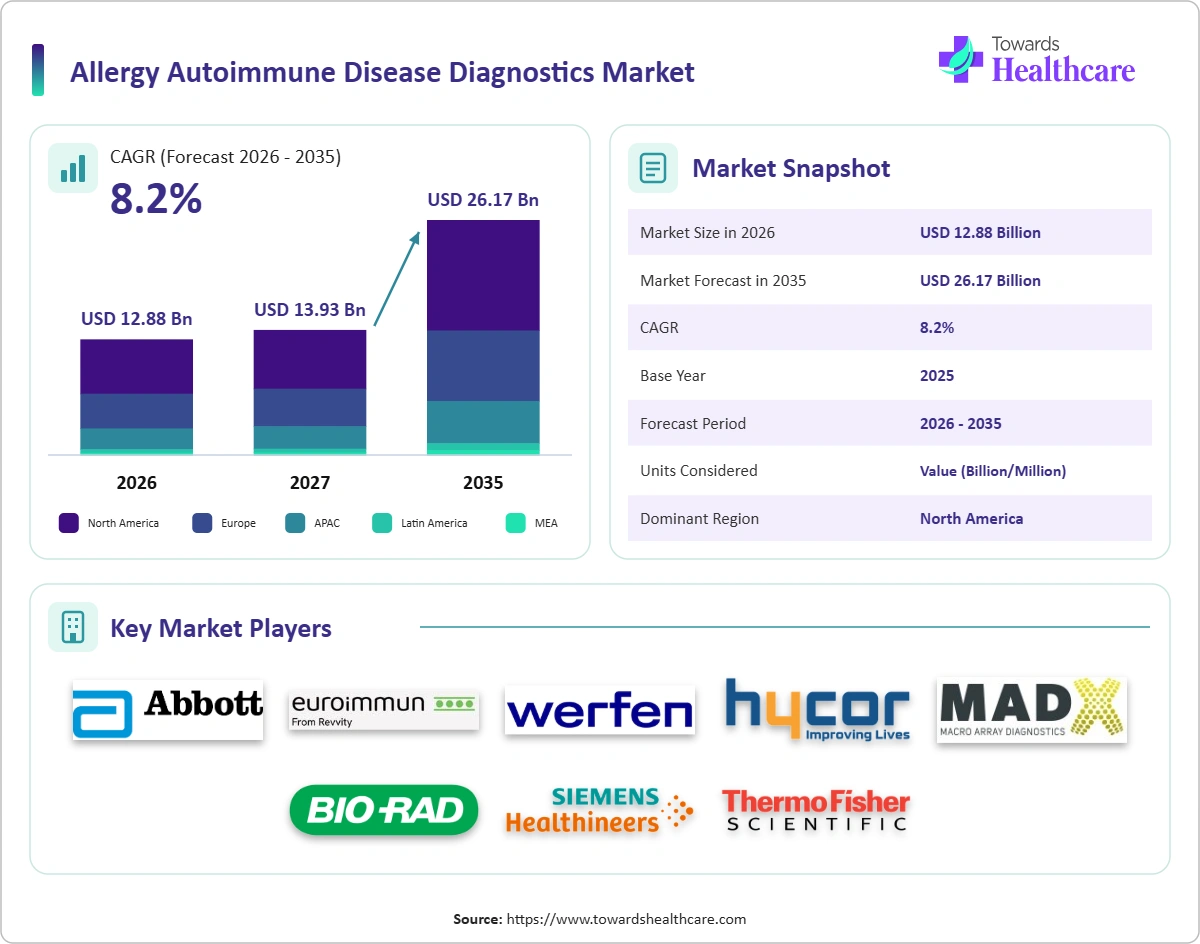
The allergy autoimmune disease diagnostics market is projected to grow from USD 11.90 billion in 2025 to USD 26.17 billion by 2035 because allergies and autoimmune diseases affect hundreds of millions of people, and accurate antibody testing guides diagnosis and biologic treatment. Rising allergy prevalence, autoimmune recognition, biologic therapies, and multiplex testing support strong growth, lifting the market to USD 17.65 billion by 2030 and sustaining a CAGR of 8.20% from 2026 to 2035. Allergy and autoimmune testing supports precision medicine, and research links many conditions to the human microbiome.
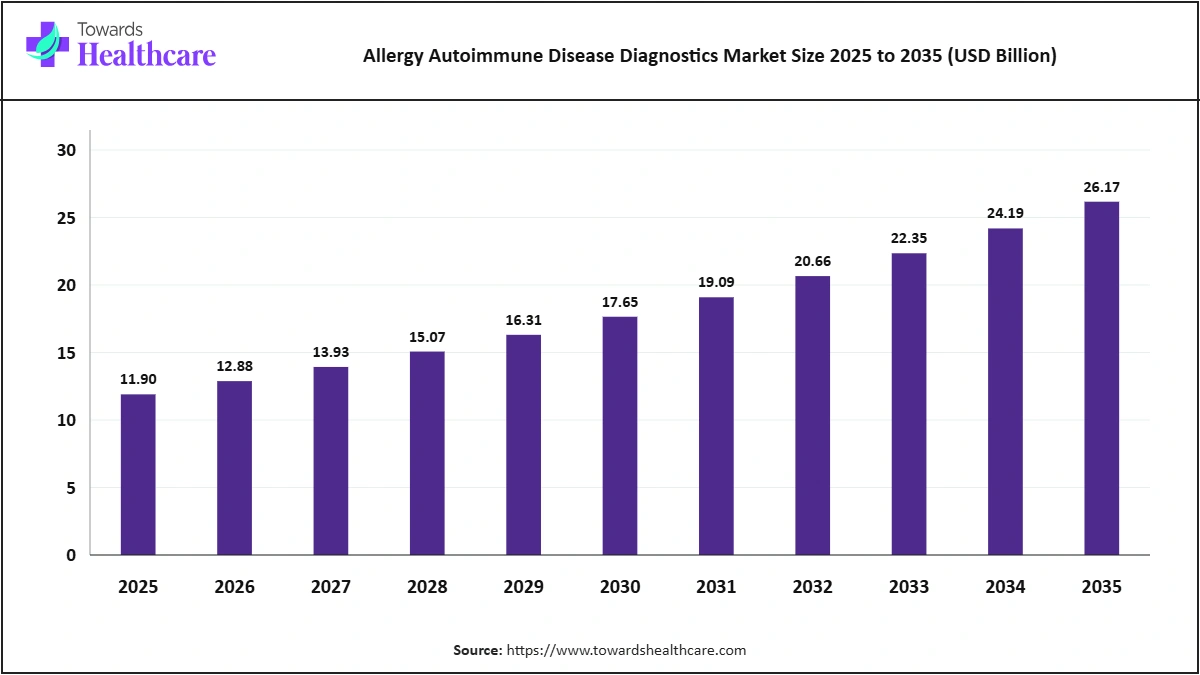
Analyst View: We built the estimate from allergy and autoimmune test volumes and average prices by technology and region, cross-checked against specialty diagnostics revenues of leading suppliers. Our value sits above published comparable estimates because it combines allergy and autoimmune testing.
| Driver | Impact | ≈ CAGR Contribution | Time Horizon | Key Regions |
| Allergy prevalence rises | High | +3.20 pp | Short to long term | Global, strongest in North America |
| Autoimmune diseases are better recognised | Medium | +2.70 pp | Medium to long term | Global, fastest uptake in Asia Pacific |
| Biologic therapies need diagnosis | Medium | +2.30 pp | Short to medium term | Global |
| Multiplex testing saves time | Low | +1.80 pp | Long term | Developed and emerging markets |
Note: Contributions are indicative estimates of each factor's effect on annual growth.
Sources: Expert interviews, secondary sources, Towards Healthcare database and Towards Healthcare analysts.
Taken together, these drivers add about 10.00 percentage points to the annual growth of the allergy autoimmune disease diagnostics market, with allergy prevalence rises having the largest effect. Their influence is strongest in North America, while uptake grows fastest in Asia Pacific.
| Restraint | Impact | ≈ Negative CAGR Contribution | Time Horizon | Key Regions |
| Reimbursement limits | High | -0.81 pp | Short to medium term | Global |
| Variation between assays | High | -0.60 pp | Medium term | Price-sensitive and emerging markets |
| Overtesting concerns | Medium | -0.40 pp | Short term | North America and other mature markets |
Note: Contributions are indicative estimates of each factor's effect on annual growth.
Sources: Expert interviews, secondary sources, Towards Healthcare database and Towards Healthcare analysts.
These restraints are expected to reduce annual growth of the allergy autoimmune disease diagnostics market by about 1.80 percentage points, led by reimbursement limits. Their effect eases over the forecast period as suppliers, buyers, and regulators adapt, leaving a net CAGR of 8.20% from 2026 to 2035.
Growing demand for component-resolved allergy testing and the expansion of diagnostic laboratories across Asia are creating new market opportunities. The increasing adoption of multiplex autoimmune panels is also supporting demand for more comprehensive testing solutions. Additionally, AI-based interpretation of indirect immunofluorescence (IIF) results is improving diagnostic efficiency, while rising demand for paediatric food allergy testing is opening further avenues for market growth.
Note: 2025 is the base year; 2035 shares and CAGRs are forecasts.
Sources: Expert interviews, secondary sources, Towards Healthcare database, and Towards Healthcare analysts.
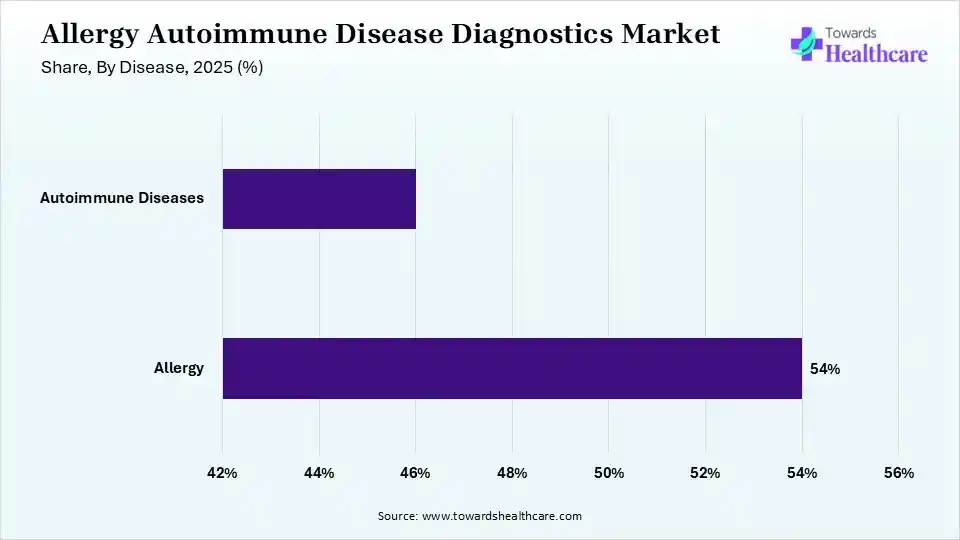
Allergy: This segment accounted for 54.00% of the allergy autoimmune disease diagnostics market in 2025 and is projected to expand at a CAGR of 7.63% from 2026 to 2035. Allergy leads because food, inhalant, and drug allergies affect a very large population and need specific IgE testing. The allergy segment is expected to grow slower than the overall market over the forecast period.
Autoimmune Diseases: grow faster as ANA and multiplex autoantibody testing expands. The autoimmune diseases segment is expected to grow faster than the overall market over the forecast period.
Segment Outlook: Allergy remains the largest disease segment through 2035, holding about 51.24% of the market in 2035, while Autoimmune Diseases records the highest CAGR of 8.83% from 2026 to 2035. Although Autoimmune Diseases starts from the smallest base, its faster growth shows how demand is shifting within the allergy autoimmune disease diagnostics market.
Note: 2025 is the base year; 2035 shares and CAGRs are forecasts.
Sources: Expert interviews, secondary sources, Towards Healthcare database, and Towards Healthcare analysts.
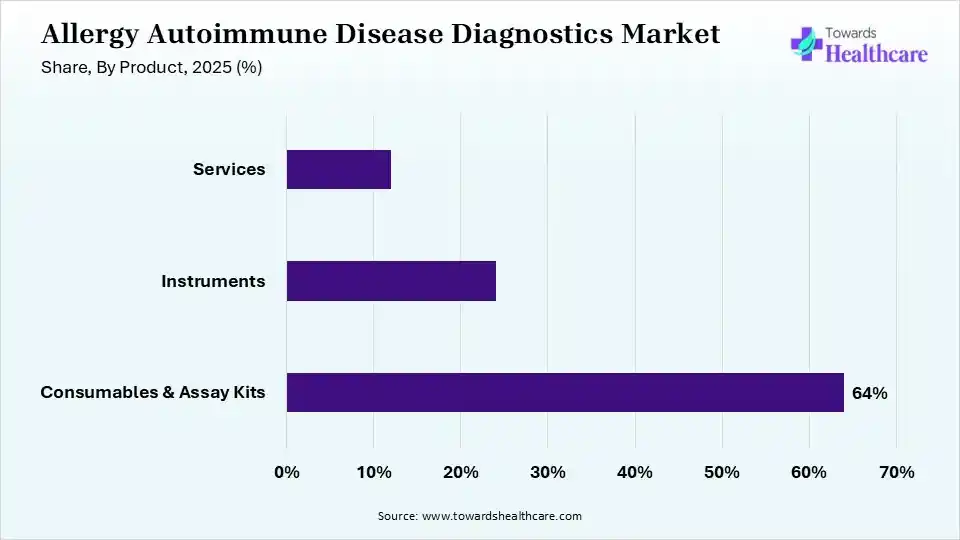
Consumables & Assay Kits: This segment accounted for 64.00% of the allergy autoimmune disease diagnostics market in 2025 and is projected to expand at a CAGR of 8.34% from 2026 to 2035. Consumables and assay kits lead because every test uses reagents. The consumables & assay kits segment is expected to grow broadly in line with the overall market over the forecast period.
Instruments: include immunoassay and multiplex analyzers. The instruments segment is expected to grow broadly in line with the overall market over the forecast period.
Services: include reference lab testing. The services segment is expected to grow broadly in line with the overall market over the forecast period.
Segment Outlook: Consumables & Assay Kits remains the largest product segment through 2035, holding about 64.85% of the market in 2035, and also records the highest CAGR of 8.34% from 2026 to 2035, strengthening its lead in the allergy autoimmune disease diagnostics market.
Note: 2025 is the base year; 2035 shares and CAGRs are forecasts.
Sources: Expert interviews, secondary sources, Towards Healthcare database, and Towards Healthcare analysts.
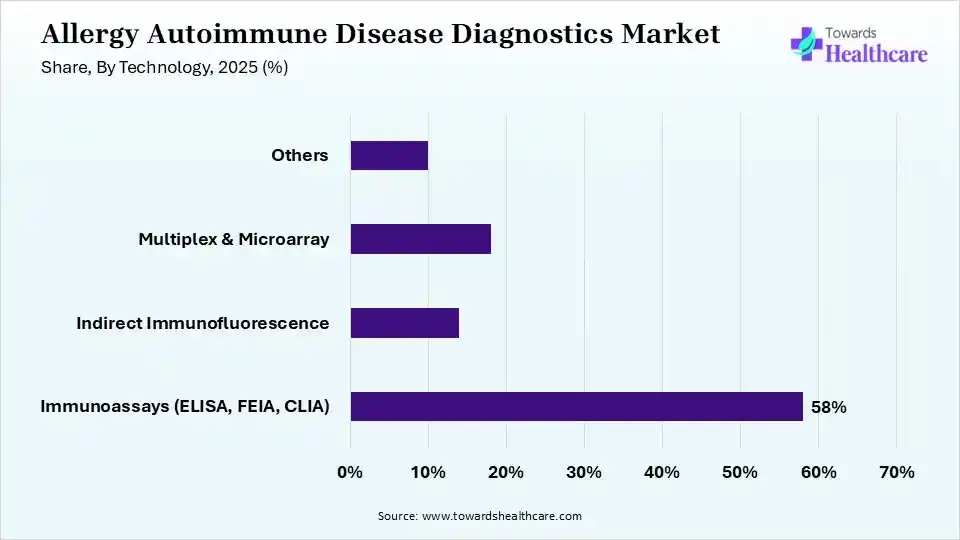
Immunoassays (ELISA, FEIA, CLIA): This segment accounted for 58.00% of the allergy autoimmune disease diagnostics market in 2025 and is projected to expand at a CAGR of 7.64% from 2026 to 2035. Immunoassays lead because they are standard for IgE and autoantibody tests. The immunoassays (ELISA, FEIA, CLIA) segment is expected to grow slower than the overall market over the forecast period.
Indirect Immunofluorescence: remains the reference for ANA screening. The indirect immunofluorescence segment is expected to grow broadly in line with the overall market over the forecast period.
Multiplex & Microarray: tests grow fastest as they test many allergens or autoantibodies at once. The multiplex & microarray segment is expected to grow faster than the overall market over the forecast period.
Others: methods include skin tests and line blots. The other segment is expected to grow broadly in line with the overall market over the forecast period.
Segment Outlook: Immunoassays (ELISA, FEIA, CLIA) remain the largest technology segment through 2035, holding about 55.06% of the market in 2035, while Multiplex & Microarray records the highest CAGR of 10.04% from 2026 to 2035. Others hold the smallest share today and serve more specialised needs within the allergy autoimmune disease diagnostics market.
Note: 2025 is the base year; 2035 shares and CAGRs are forecasts.
Sources: Expert interviews, secondary sources, Towards Healthcare database, and Towards Healthcare analysts.
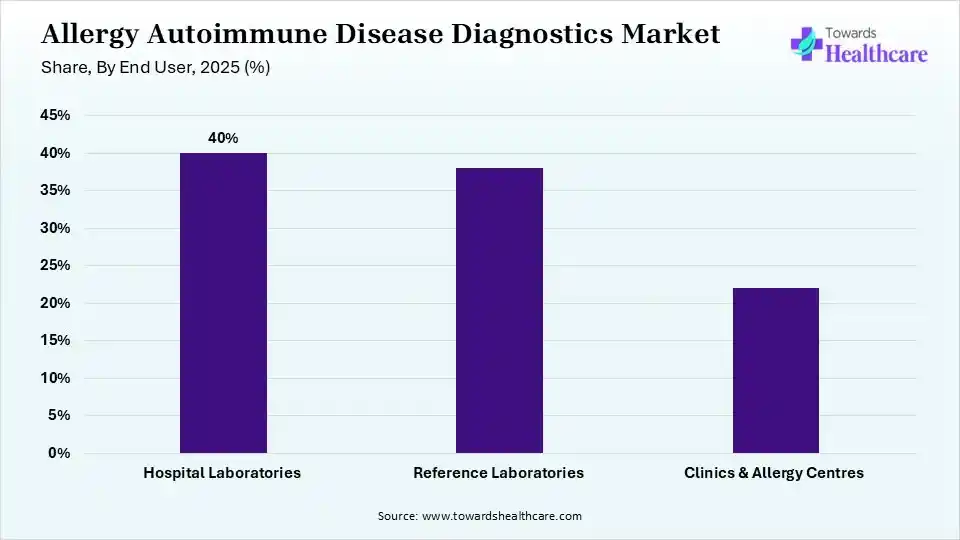
Hospital Laboratories: This segment accounted for 40.00% of the allergy autoimmune disease diagnostics market in 2025 and is projected to expand at a CAGR of 7.68% from 2026 to 2035. Hospital laboratories lead because they serve rheumatology and allergy clinics. The hospital laboratories segment is expected to grow slower than the overall market over the forecast period.
Reference Laboratories: run specialised panels at scale. The reference laboratories segment is expected to grow broadly in line with the overall market over the forecast period.
Clinics & Allergy Centres: grow fastest with point-of-care allergy tests. The clinics & allergy centres segment is expected to grow faster than the overall market over the forecast period.
Segment Outlook: Hospital Laboratories remains the largest end user segment through 2035, holding about 38.10% of the market in 2035, while Clinics & Allergy Centres records the highest CAGR of 9.28% from 2026 to 2035. Although Clinics & Allergy Centres starts from the smallest base, its faster growth shows how demand is shifting within the allergy autoimmune disease diagnostics market.
Analyst View: Segment shares were allocated from demand, product portfolios and pricing in each category. Allergy, Consumables & Assay Kits, Immunoassays (ELISA, FEIA, CLIA) and Hospital Laboratories lead their categories because they meet the core needs of today's buyers. We expect Autoimmune Diseases, Multiplex & Microarray and Clinics & Allergy Centres to gain share as newer technologies, users and applications grow faster.
Note: 2025 is the base year; 2035 shares and CAGRs are forecasts.
Sources: Expert interviews, secondary sources, Towards Healthcare database, and Towards Healthcare analysts.
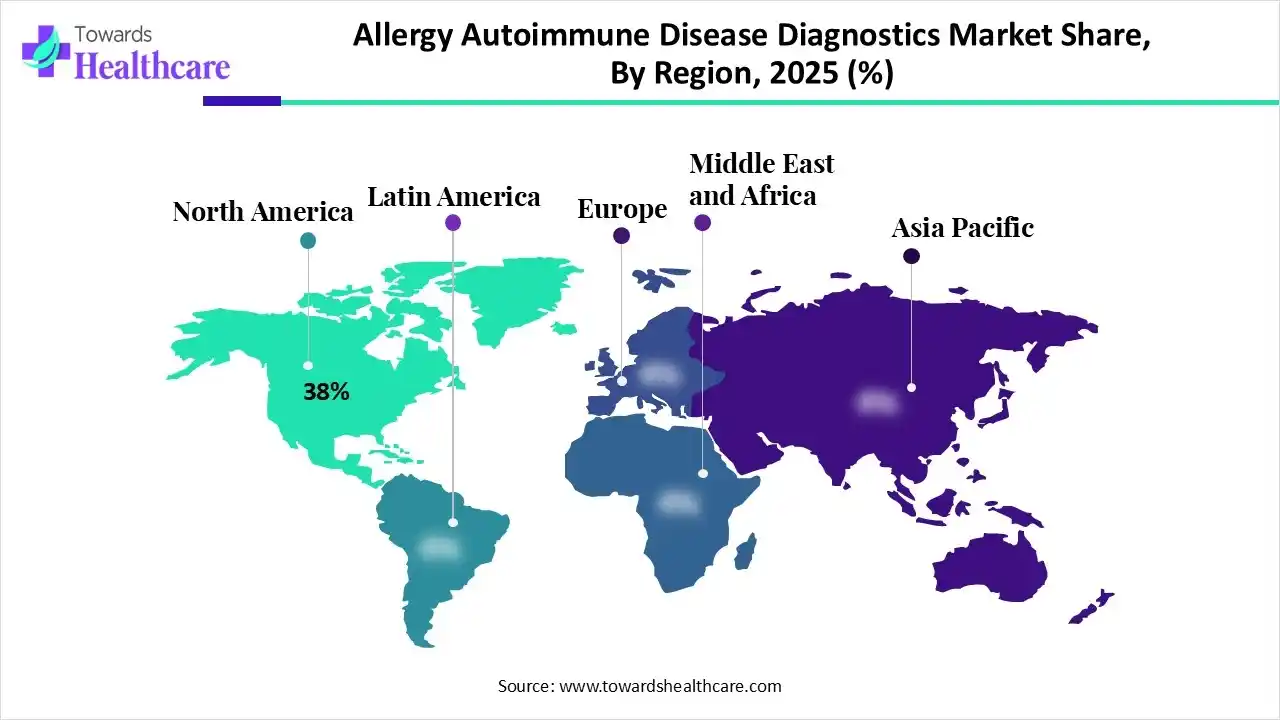
North America valued at 38.00% of the allergy autoimmune disease diagnostics market in 2025 and is projected to expand at a CAGR of 7.66% from 2026 to 2035. North America leads because of high allergy prevalence, wide specialty testing, and reimbursement for component allergy and autoantibody tests. North America is expected to grow slower than the overall market between 2026 and 2035.
Europe has strong autoimmune testing traditions and large allergy diagnostic users. Europe is expected to grow broadly in line with the overall market between 2026 and 2035.
Asia Pacific grows fastest as allergy awareness and laboratory capacity rise in China, Japan, and India. Asia Pacific is expected to grow faster than the overall market between 2026 and 2035.
Latin America has growing allergy testing. Latin America is expected to grow broadly in line with the overall market between 2026 and 2035.
Middle East & Africa expand specialty labs. Middle East & Africa is expected to grow broadly in line with the overall market between 2026 and 2035.
Analyst View: Regional shares were built from demand, installed base, spending and supplier presence in each region. North America leads because of its mature demand base and strong suppliers. We assign Asia Pacific the highest growth premium because investment, adoption, and capacity are expanding fastest there.
| Rank | Company Name | 2025 Share (%) | Key Products / Business | Headquarters |
| 1 | Thermo Fisher Scientific | 184.87% | ImmunoCAP allergy and EliA autoimmune tests on Phadia systems | United States |
| 2 | Werfen | 92.44% | Aptiva, BIO-FLASH and QUANTA autoimmune tests | Spain |
| 3 | EUROIMMUN (Revvity) | 84.03% | Autoimmune and allergy immunoassays and IIFT | Germany |
| 4 | Siemens Healthineers | 58.82% | IMMULITE allergy tests | Germany |
| 5 | Bio-Rad Laboratories | 58.82% | BioPlex 2200 autoimmune multiplex | United States |
| 6 | Roche Diagnostics | 33.61% | Anti-CCP and thyroid autoimmune assays | Switzerland |
| 7 | Abbott | 25.21% | Autoimmune immunoassays | United States |
| 8 | HYCOR Biomedical | 25.21% | NOVEOS allergy system | United States |
| 9 | Trinity Biotech | 16.81% | Autoimmune ELISA and IFA | Ireland |
| 10 | MacroArray Diagnostics | 16.81% | ALEX multiplex allergy array | Austria |
Note: Company shares are 2025 estimates.
Sources: Company press releases, expert interviews, secondary sources, Towards Healthcare database and Towards Healthcare analysts.
Thermo Fisher Scientific led the allergy autoimmune disease diagnostics market with an estimated 184.87% share of 2025 revenue, followed by Werfen at 92.44% share and EUROIMMUN (Revvity) at 84.03% share. Thermo Fisher Scientific leads with immunoCAP allergy and EliA autoimmune tests on Phadia systems, Werfen competes with aptiva, BIO-FLASH, and QUANTA autoimmune tests, and EUROIMMUN (Revvity) offers autoimmune and allergy immunoassays and IIFT. Siemens Healthineers, Bio-Rad Laboratories, Roche Diagnostics, Abbott, HYCOR Biomedical, Trinity Biotech and MacroArray Diagnostics compete through IMMULITE allergy tests, bioPlex 2200 autoimmune multiplex, anti-CCP and thyroid autoimmune assays, autoimmune immunoassays, NOVEOS allergy system, autoimmune ELISA and IFA and ALEX multiplex allergy array.
The top 10 companies accounted for an estimated 596.64% of 2025 revenue, while the remaining -496.64% was shared among many regional reagent makers and labs. The allergy autoimmune disease diagnostics market is concentrated around a few specialist platforms, and competition centres on test menu breadth, component allergens, automation, multiplex capability, clinical evidence and price per test.
Thermo Fisher Scientific: Thermo Fisher Scientific is headquartered in the United States. It held an estimated 184.87% share of the allergy autoimmune disease diagnostics market in 2025. Its offering centres on ImmunoCAP allergy and EliA autoimmune tests on Phadia systems. In the Towards Healthcare Companies Quadrant, it is positioned as a Leader.
Werfen: Werfen is headquartered in Spain. It held an estimated 92.44% share of the allergy autoimmune disease diagnostics market in 2025. Its offering centres on Aptiva, BIO-FLASH and QUANTA autoimmune tests. In the Towards Healthcare Companies Quadrant it is positioned as a Leader.
EUROIMMUN (Revvity): EUROIMMUN (Revvity) is headquartered in Germany. It held an estimated 84.03% share of the allergy autoimmune disease diagnostics market in 2025. Its offering centres on Autoimmune and allergy immunoassays and IIFT. In the Towards Healthcare Companies Quadrant it is classified as a Leader.
Siemens Healthineers: Siemens Healthineers is headquartered in Germany. It held an estimated 58.82% share of the allergy autoimmune disease diagnostics market in 2025. Its offering centres on IMMULITE allergy tests. In the Towards Healthcare Companies Quadrant it is positioned as a Leader.
Bio-Rad Laboratories: Bio-Rad Laboratories is headquartered in the United States. It held an estimated 58.82% share of the allergy autoimmune disease diagnostics market in 2025. Its offering centres on BioPlex 2200 autoimmune multiplex. In the Towards Healthcare Companies Quadrant it is classified as a Leader.
Roche Diagnostics: Roche Diagnostics, part of F. Hoffmann-La Roche Ltd, is headquartered in Switzerland. It held an estimated 33.61% share of the allergy autoimmune disease diagnostics market in 2025. Its offering centres on Anti-CCP and thyroid autoimmune assays. In the Towards Healthcare Companies Quadrant, it is positioned as a Leader.
Abbott: Abbott is headquartered in the United States. It held an estimated 25.21% share of the allergy autoimmune disease diagnostics market in 2025. Its offering centres on Autoimmune immunoassays. In the Towards Healthcare Companies Quadrant, it is positioned as an Innovator.
HYCOR Biomedical: HYCOR Biomedical is headquartered in the United States. It held an estimated 25.21% share of the allergy autoimmune disease diagnostics market in 2025. Its offering centres on NOVEOS allergy system. In the Towards Healthcare Companies Quadrant, it is classified as an Innovator.
Trinity Biotech: Trinity Biotech is headquartered in Ireland. It held an estimated 16.81% share of the allergy autoimmune disease diagnostics market in 2025. Its offering centres on Autoimmune ELISA and IFA. In the Towards Healthcare Companies Quadrant, it is positioned as an Innovator.
MacroArray Diagnostics: MacroArray Diagnostics is headquartered in Austria. It held an estimated 16.81% share of the allergy autoimmune disease diagnostics market in 2025. Its offering centres on the ALEX multiplex allergy array. In the Towards Healthcare Companies Quadrant, it is positioned as an Innovator.
The allergy autoimmune disease diagnostics ecosystem links antigen & reagent suppliers, diagnostic makers, laboratories, clinicians and regulators, with each stage adding value before products reach end users.
| Ecosystem Stage | Role in the Market | Key Companies |
| Antigen & Reagent Suppliers | Supply recombinant allergens and antigens | Reagent makers |
| Diagnostic Makers | Make assays and analyzers | Thermo Fisher, Werfen, EUROIMMUN, Bio-Rad |
| Laboratories | Run tests | Hospital and reference labs |
| Clinicians | Order and interpret | Allergists, rheumatologists, primary care |
| Regulators | Clear tests | FDA, EU IVDR |
Sources: Company press releases, expert interviews, secondary sources, Towards Healthcare database, and Towards Healthcare analysts.
Antigen & Reagent Suppliers: Supply recombinant allergens and antigens. Key participants include Reagent makers.
Diagnostic Makers: Make assays and analyzers. Key participants include Thermo Fisher, Werfen, EUROIMMUN, Bio-Rad.
Laboratories: Run tests. Key participants include hospitals and reference labs.
Clinicians: Order and interpret. Key participants include Allergists, rheumatologists, and primary care.
Regulators: Clear tests. Key participants include FDA, EU IVDR.
Value in the allergy autoimmune disease diagnostics market flows from upstream material and technology suppliers to manufacturers and service providers, then through distribution partners to end users. Companies that integrate several stages or build long-term relationships with end users capture a larger share of this value.
The Towards Healthcare Companies Quadrant positions key participants in the allergy autoimmune disease diagnostics market by market strength, reflecting revenue scale, market share, and geographic reach, and by innovation and growth strategy, reflecting product portfolio breadth, R&D intensity, and partnerships. Positions reflect each company's estimated 2025 share of the allergy autoimmune disease diagnostics market and our assessment of its product innovation, portfolio breadth, and partnerships.
Sources: Company press releases, expert interviews, secondary sources,Towards Healthcare database and Towards Healthcare analysts.
Leaders: Thermo Fisher Scientific, Werfen, EUROIMMUN (Revvity), Siemens Healthineers, Bio-Rad Laboratories and Roche Diagnostics combine high market share with broad portfolios and strong innovation.
Innovators: Abbott, HYCOR Biomedical, Trinity Biotech and MacroArray Diagnostics bring newer technologies and specialised products.
By Disease
By Product
By Technology
By End User
By Region
The allergy autoimmune disease diagnostics market was defined as in-vitro diagnostic tests, instruments and services used to diagnose allergies and autoimmune diseases, including specific IgE and component-resolved allergy tests, skin and challenge test supplies, antinuclear antibody (ANA) and autoantibody assays, and multiplex and immunofluorescence systems, covering food, inhalant and drug allergies, rheumatoid arthritis, lupus, coeliac disease, thyroid and other autoimmune disorders, used by hospital and reference laboratories, clinics and allergy centres.
The 2025 base year was built bottom-up from demand volumes and average prices by disease, product, technology and end user and region, and checked top-down against the market-specific revenues of leading companies and published estimates. Segment, regional and company values were allocated from disease, product, technology and end user and region demand.
Key estimates were verified by cross-checking company disclosures, regulatory and industry data, and published third-party estimates, and inputs that could not be reconciled were excluded. All segment, regional and company figures were reconciled to the same 2025 base year, and the 2026-2035 forecast, which applies a constant CAGR from the 2025 base, was recalculated and validated.
Analyst View: The allergy autoimmune disease diagnostics market is set for steady expansion as rising allergy prevalence and related demand keep growing. Our estimate links value to underlying demand, installed base and pricing, so the forecast follows real adoption rather than headline hype. The main upside comes from component allergy tests and multiplex panels, while the main risks are reimbursement limits and assay variation.