
The market is projected to grow from USD 780.00 million in 2025 to USD 1,464.17 million by 2035 because pet populations are growing and ageing, veterinary practices are increasingly focusing on humane end-of-life care, and disease outbreaks in poultry and livestock need large-scale humane depopulation. Welfare regulations for livestock, laboratory animals and shelters, together with the significant frequency of avian influenza and swine fever outbreaks, support demand for compliant drugs and equipment, propelling the market to USD 1,068.67 million by 2030 and maintaining a CAGR of 6.50% during the forecast period.
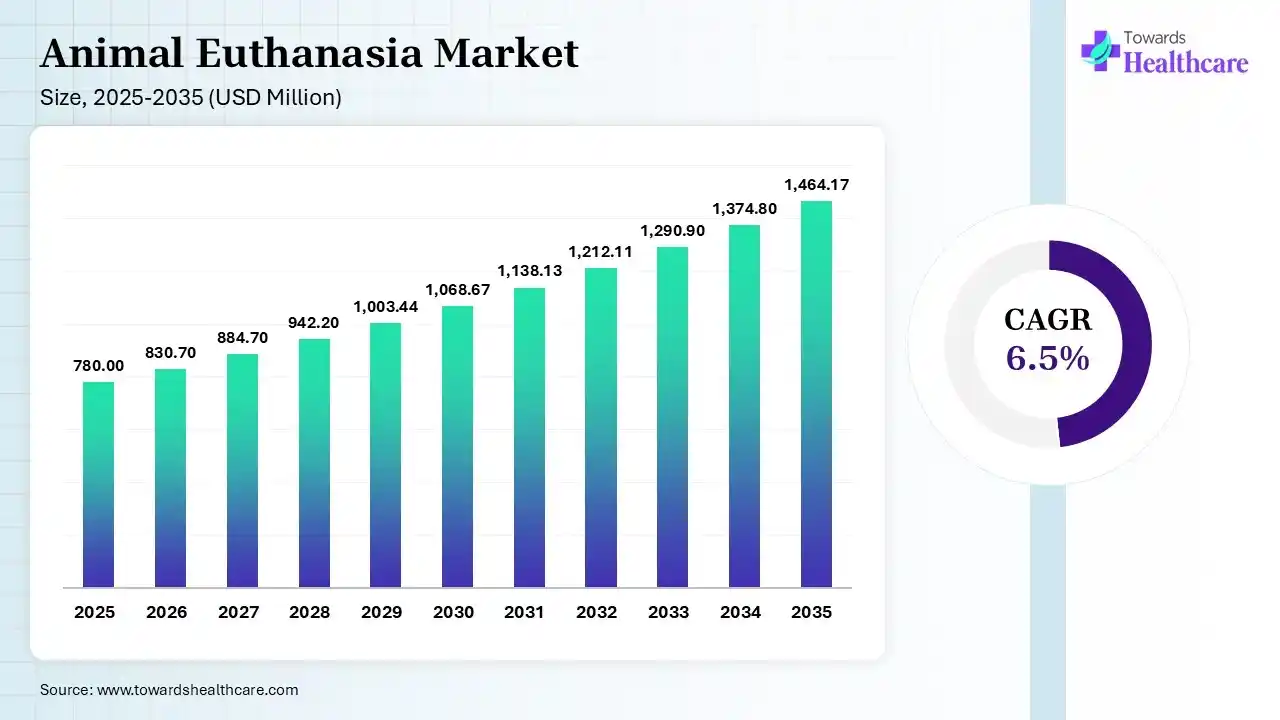
Analyst View: We built the estimate from the number of euthanasia procedures for companion animals, livestock, poultry and laboratory animals by region, multiplied by drug, inhalant and equipment usage and prices, plus equipment sales to farms, slaughter facilities, agencies and laboratories. Procedure numbers highlight pet populations and life expectancy, shelter intake, disease outbreaks and research animal use. The total was cross-checked against the euthanasia product revenue of prominent animal health and equipment companies. Published estimates vary widely, and some appear to include services beyond just products and equipment, so we used an evidence-based value. The growth rate reflects growth in pet population and disease control needs. The demand for animal euthanasia is being negatively influenced by efforts to reduce shelter euthanasia.
Driver: The growing and ageing pet populations are an important demand driver. Veterinary practices are giving more and more importance to humane end-of-life care. Avian influenza and African swine fever outbreaks require depopulation. Welfare regulations state strict rules regarding livestock and laboratory animal killing. Research institutions need euthanasia methods that comply with the latest regulations.
Restraint: Controlled-substance rules restrict the supply of pentobarbital. Shelter programs aim to reduce the rates of animal euthanasia. Ethical concerns limit the use of certain methods. Supply shortages can cause disruptions in drug availability, and price pressure on generic solutions limits revenue.
Opportunity: Combination solutions and better sedation improve humane practices. The demand for depopulation equipment for poultry and swine is increasing. Pet ownership growth in Asia benefits the veterinary segment. Training and certification services add value, and rising laboratory welfare standards drive the modernization of equipment.
| Segments | 2025 Share | 2025 Market Value |
| Pharmaceuticals | 58.40% | USD 455.52 million |
| Inhalants | 17.60% | USD 137.28 million |
| Physical & Mechanical Equipment | 24.00% | USD 187.20 million |
Note: 2025 is the base year.
Sources: Expert interviews, secondary sources, Towards Healthcare database and Towards Healthcare analysts.
Pharmaceuticals accounted for 58.40% (USD 455.52 million) of revenue in 2025 because pentobarbital and combination solutions are the default method in veterinary practice and shelters, typically performed after sedation. The physical and mechanical equipment segment held a market share of 24.00% (USD 187.20 million), and it involves captive bolt devices and depopulation systems for livestock and poultry. Inhalants accounted for 17.60% (USD 137.28 million) of the market and are used for poultry, swine, and laboratory rodents.
| Segments | 2025 Share | 2025 Market Value |
| Companion Animals | 54.20% | USD 422.76 million |
| Livestock & Poultry | 33.60% | USD 262.08 million |
| Laboratory & Other Animals | 12.20% | USD 95.16 million |
Note: 2025 is the base year.
Sources: Expert interviews, secondary sources, Towards Healthcare database and Towards Healthcare analysts.
Companion animals accounted for a market share of 54.20% (USD 422.76 million) in 2025 because dogs and cats are euthanized in veterinary clinics, at home, and in shelters at the end of life or for welfare reasons. Livestock and poultry held 33.60% (USD 262.08 million) of revenue and are growing at the fastest rate because of disease outbreaks and welfare rules. Laboratory and other animals accounted for a 12.20% (USD 95.16 million) share.
| Segments | 2025 Share | 2025 Market Value |
| Injectable | 61.80% | USD 482.04 million |
| Inhalation | 17.40% | USD 135.72 million |
| Physical Methods | 20.80% | USD 162.24 million |
Note: 2025 is the base year.
Sources: Expert interviews, secondary sources, Towards Healthcare database and Towards Healthcare analysts.
Injectable administration accounted for 61.80% (USD 482.04 million) of the market in 2025 due to the fact that intravenous barbiturates provide rapid and peaceful death in companion animals. Physical methods held a market share of 20.80% (USD 162.24 million), and inhalation held 17.40% (USD 135.72 million).
| Segments | 2025 Share | 2025 Market Value |
| Veterinary Hospitals & Clinics | 46.20% | USD 360.36 million |
| Farms, Slaughter & Disease Control | 28.40% | USD 221.52 million |
| Animal Shelters & Rescue Centers | 13.60% | USD 106.08 million |
| Research Laboratories & Universities | 11.80% | USD 92.04 million |
Note: 2025 is the base year.
Sources: Expert interviews, secondary sources, Towards Healthcare database and Towards Healthcare analysts.
Veterinary hospitals and clinics accounted for 46.20% (USD 360.36 million) of revenue in 2025 because a major proportion of companion animal euthanasia is performed by veterinarians, including home euthanasia services. Farms, slaughter, and disease control held a market share of 28.40% (USD 221.52 million), animal shelters and rescue centers held 13.60% (USD 106.08 million), and research laboratories and universities held 11.80% (USD 92.04 million).
Analyst View: Segment values were allocated by matching procedures, usage, and prices to products, animals, routes, and end uses, using company disclosures and veterinary data. Pharmaceuticals, companion animals, injectables, and veterinary clinics dominate because of significant demand from companion animal end-of-life care. We expect livestock and poultry depopulation equipment to gain share.
| Region | 2025 Share | 2025 Market Value |
| North America | 41.60% | USD 324.48 million |
| Europe | 28.80% | USD 224.64 million |
| Asia Pacific | 20.40% | USD 159.12 million |
| Latin America | 5.40% | USD 42.12 million |
| Middle East & Africa | 3.80% | USD 29.64 million |
Note: 2025 is the base year.
Sources: Expert interviews, secondary sources, Towards Healthcare database and Towards Healthcare analysts.
North America accounted for 41.60% (USD 324.48 million) of revenue in 2025. Highly pathogenic avian influenza outbreaks in early 2025 led to the depopulation of tens of millions of egg-laying hens in the U.S.
Europe held a 28.80% (USD 224.64 million) share in 2025. EU regulations regarding the protection of animals at the time of killing set standards for methods and equipment, and avian influenza and African swine fever require culling.
Asia Pacific accounted for 20.40% (USD 159.12 million) of the market in 2025 and is the fastest-growing region. Pet ownership rates in China and Japan are increasing, and disease outbreaks in livestock fuel the demand for depopulation.
Latin America held a market share of 5.40% (USD 42.12 million) in 2025. Large poultry and swine sectors in Brazil require disease control capabilities.
The Middle East and Africa accounted for 3.80% (USD 29.64 million) of revenue in 2025. Veterinary services and livestock disease control drive regional market demand.
Analyst View: Regional shares were built from procedures, usage, and prices in each region. The leadership of North America can be attributed to pet ownership and disease control spending. We assign Asia Pacific the highest growth premium because pet ownership and livestock disease control are expanding at the fastest rate in this region.
| Rank | Company Name | Market-Specific Revenue (USD Million) | 2025 Share | Key Products / Business | Headquarters |
| 1 | Virbac | 62.00 | 7.95% | Euthasol and Lethabarb euthanasia solutions | France |
| 2 | Boehringer Ingelheim | 48.00 | 6.15% | Euthatal and euthanasia products | Germany |
| 3 | Jarvis Products | 40.00 | 5.13% | Captive bolt stunning and euthanasia devices | United States |
| 4 | Vetoquinol | 34.00 | 4.36% | Dolethal euthanasia solution | France |
| 5 | Vortech Pharmaceuticals | 30.00 | 3.85% | Fatal-Plus euthanasia solution | United States |
| 6 | Merck Animal Health | 28.00 | 3.59% | Euthanasia and sedation products | United States |
| 7 | Dechra | 26.00 | 3.33% | Euthanasia and anaesthesia products | United Kingdom |
| 8 | Accles & Shelvoke | 22.00 | 2.82% | Captive bolt devices | United Kingdom |
| 9 | Bimeda | 18.00 | 2.31% | Euthanyl euthanasia solution | Ireland |
| 10 | Parnell | 8.00 | 1.03% | Pentobarbital and phenytoin euthanasia solution | Australia |
Note: Company revenues and shares are 2025 estimates.
Sources: Company press releases, expert interviews, secondary sources, Towards Healthcare database and Towards Healthcare analysts.
Virbac led the market with an estimated 7.95% (USD 62.00 million) of revenue in 2025, followed by Boehringer Ingelheim at 6.15% (USD 48.00 million) and Jarvis Products at 5.13% (USD 40.00 million). The leadership of Virbac can be attributed to Euthasol in the United States and Lethabarb in Australia, which are widely adopted pentobarbital-based solutions. Boehringer Ingelheim is an important supplier of Euthatal and related products in Europe and other markets, and Jarvis Products is a leading manufacturer of captive bolt devices used for livestock stunning and euthanasia. Vetoquinol, Vortech Pharmaceuticals, Merck Animal Health, Dechra, Accles & Shelvoke, Bimeda and Parnell compete through euthanasia solutions, sedation products, captive bolt equipment and regional portfolios. The top 10 companies held 40.51% (USD 316.00 million) of net market revenue in 2025, while the remaining 59.49% (USD 464.00 million) was held by compounding pharmacies, regional drug manufacturers, inhalant and depopulation system suppliers and laboratory equipment makers. The market exhibits significant fragmentation in terms of product type and region, and competition revolves around regulatory approval and controlled-substance compliance, reliability and humaneness, supply consistency, training support, and price. Controlled-substance regulations limit the number of approved pentobarbital suppliers in various countries.
The animal euthanasia ecosystem links active ingredient and equipment component suppliers with drug and equipment manufacturers, distributors, regulators, and veterinary, agricultural, and research users.
| Ecosystem Stage | Role in the Market | Key Companies |
| Active Ingredients & Components | Supply pentobarbital, sedatives, gases and device parts | API manufacturers, industrial gas suppliers |
| Drug Makers | Produce euthanasia and sedation solutions | Virbac, Boehringer Ingelheim, Vetoquinol, Vortech, Bimeda, Dechra |
| Equipment Makers | Build captive bolt, inhalant and depopulation systems | Jarvis Products, Accles & Shelvoke, CO2 and foam system makers |
| Distributors & Regulators | Distribute controlled products and set standards | Veterinary distributors, drug enforcement and veterinary authorities |
| End Users | Perform humane euthanasia | Veterinary clinics, shelters, farms, disease control agencies, research labs |
Sources: Company press releases, expert interviews, secondary sources, Towards Healthcare database and Towards Healthcare analysts.
The Towards Healthcare Companies Quadrant positions key participants in the market by market strength, reflecting revenue scale, market share, and geographic reach, and by innovation and growth strategy, reflecting product portfolio breadth, research and development intensity, and collaborations. Positions highlight each company's 2025 euthanasia product revenue and our evaluation of its portfolio, regulatory approvals, and distribution.
Sources: Company press releases, expert interviews, secondary sources, Towards Healthcare database and Towards Healthcare analysts.
Leaders: Virbac, Boehringer Ingelheim, and Jarvis Products bring together significant euthanasia revenue and certified products, broad distribution, and veterinary relationships.
Challengers: Vetoquinol and Vortech Pharmaceuticals have established euthanasia products but do not have a broad range of portfolios or regional reach.
Innovators: Merck Animal Health, Dechra and Parnell provide combination solutions, sedation protocols and new euthanasia formulations.
Niche Players: Accles & Shelvoke and Bimeda serve specific regional or equipment segments.
By Product
By Animal
By Route of Administration
By End Use
By Region
The market is defined as euthanasia pharmaceuticals, inhalant agents, and physical and mechanical euthanasia and depopulation equipment for companion animals, livestock, poultry, and laboratory animals. The 2025 base year was built bottom-up from euthanasia procedures by animal type and region and drug, inhalant, and equipment usage and prices, and checked top-down against the euthanasia product revenue of prominent animal health and equipment companies. Segment, regional and company values were allocated from products, animals, routes of administration, end uses and regional demand. Key estimates were verified by cross-checking company disclosures, regulatory and industry data and published third-party estimates, and inputs that could not be reconciled were excluded. All segment, regional and company figures were reconciled to the same 2025 base year, and the 2026–2035 forecast, which applies a constant CAGR from the 2025 base, was recalculated and validated.
Analyst View: The animal euthanasia market is a relatively stable and well-established segment of animal health that grows with pet populations and disease control requirements. Our estimate connects demand to procedures, usage, and prices, so the forecast follows companion animal care, livestock disease outbreaks, and welfare regulation. The main upside comes from depopulation needs and pet population growth, while the main risks are supply restrictions and shelter euthanasia reduction.