
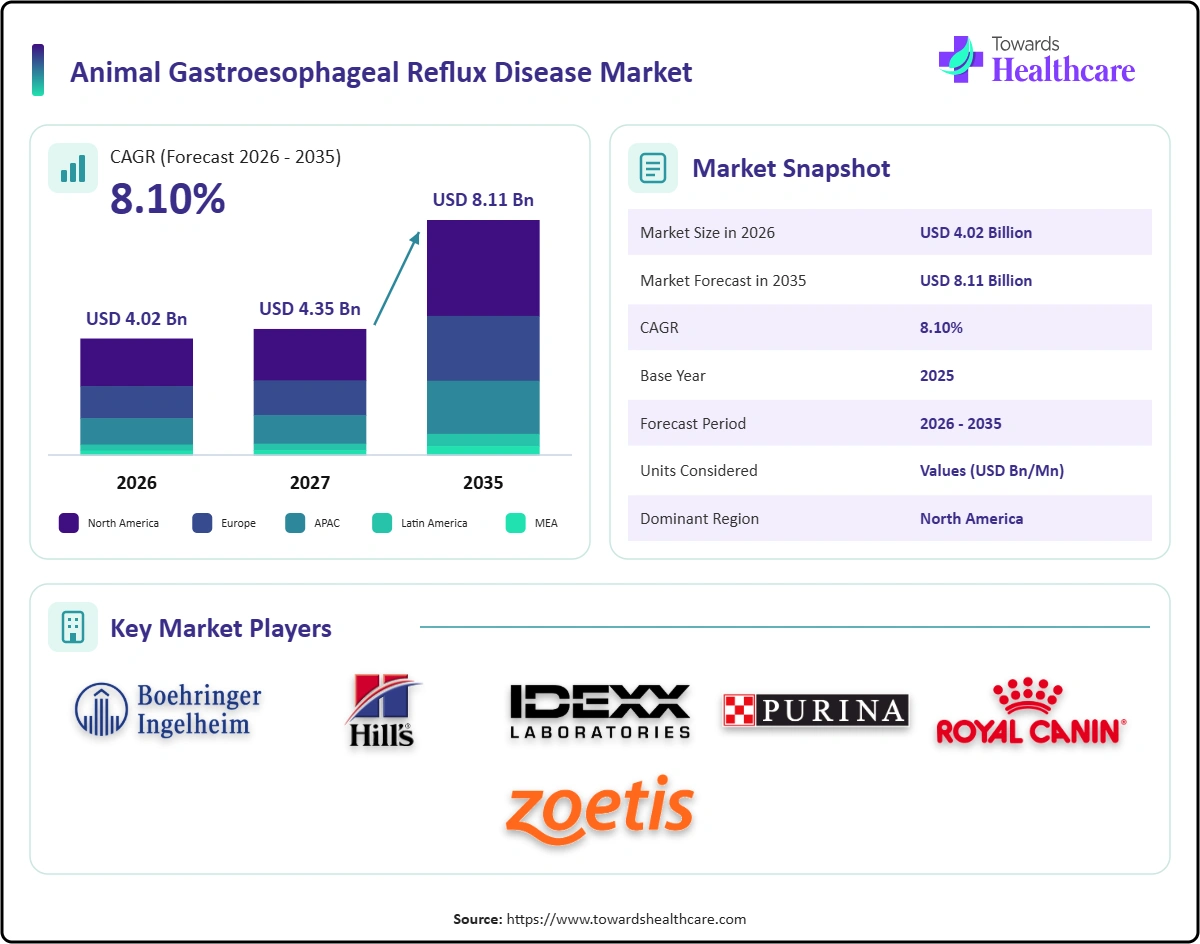
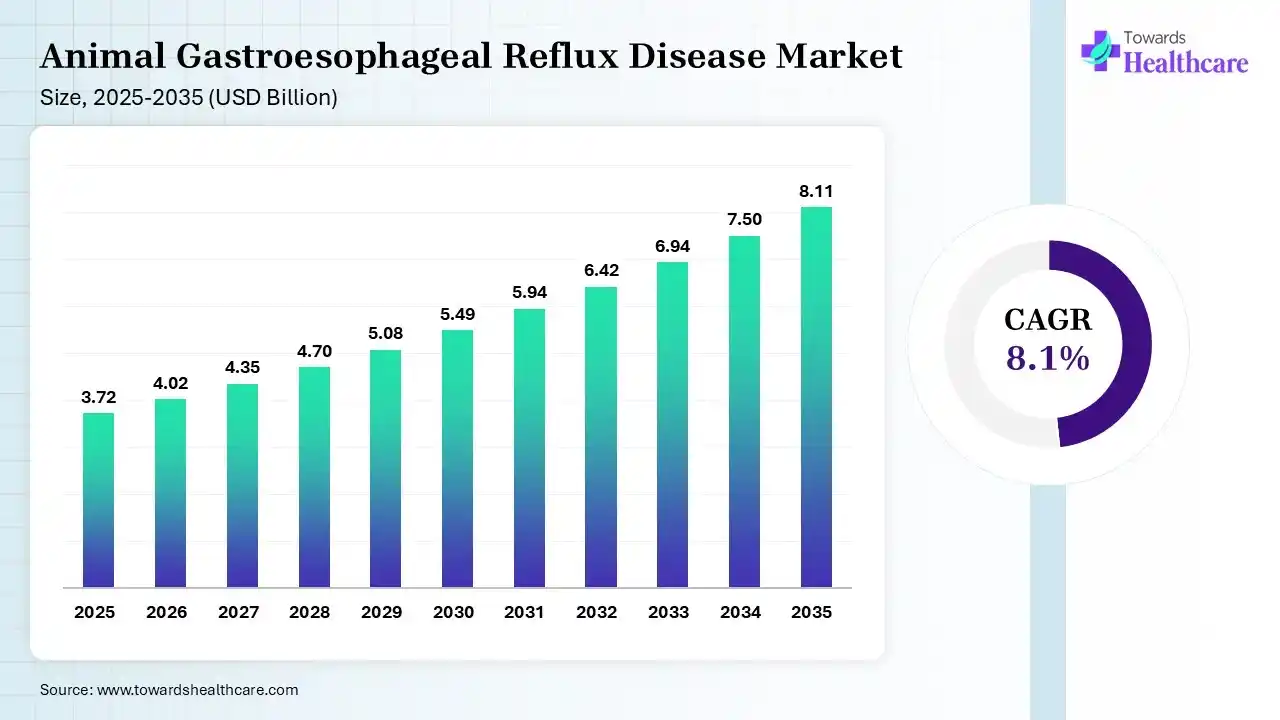
The market is projected to expand from USD 3.72 billion in 2025 to USD 8.11 billion by 2035 because more and more pets are being diagnosed and treated for reflux and related digestive disorders as owners are spending more on veterinary care, and therapeutic diets and acid-suppressing drugs are used long term. Advancements in veterinary endoscopy and imaging, pet insurance coverage, and new microbiome-based gastrointestinal diets drive consistent growth, propelling the market to USD 5.49 billion by 2030 and maintaining a CAGR of 8.10% during the forecast period.
Analyst View: We built the estimate from the number of animals diagnosed with reflux and related upper gastrointestinal disorders by species and region, multiplied by spending on drugs, therapeutic diets and diagnostic procedures per case, together with livestock treatment volumes. Case numbers highlight pet populations, veterinary visit rates, diagnostic adoption and equine and livestock management practices. The total was cross-checked against the gastrointestinal product revenue of prominent animal health, pet nutrition and veterinary diagnostics companies and against published estimates, which places our base year slightly above the highest comparable figure. The growth rate reflects growing veterinary care spending. The market demand is being negatively influenced by generic drug pricing and limited approved veterinary-specific GERD drugs.
Driver: Pet ownership and humanization are rising. Increasing population of ageing pets drives demand as they develop relatively more digestive disorders. Owners are spending more on veterinary diagnostics and treatment, and pet insurance improves treatment accessibility. Therapeutic nutrition is widely recommended.
Restraint: Few drugs have been approved specifically for veterinary GERD. Diagnosis can be pricey and involve significant intricacies. Generic human drugs limit pricing power, and there is significant variation in owner compliance with long-term diets. Economic pressure can reduce discretionary veterinary spending.
Opportunity: Veterinary-specific prokinetics and formulations have the ability to cater to unmet needs. Microbiome diagnostics can be used to provide personalized treatment. Pet market expansion in Asia offers rapid growth opportunity. Telehealth and online pharmacies improve access, and equine performance markets fuel demand for premium products.
| Segments | 2025 Share | 2025 Market Value |
| Treatment | 54.60% | USD 2.03 billion |
| Diagnostics | 45.40% | USD 1.69 billion |
Note: 2025 is the base year.
Sources: Expert interviews, secondary sources, Towards Healthcare database and Towards Healthcare analysts.
Treatment accounted for 54.60% (USD 2.03 billion) of revenue in 2025 because reflux and oesophagitis need ongoing acid suppression, prokinetic therapy, and dietary management. The diagnostics segment held a market share of 45.40% (USD 1.69 billion), and its coverage spans laboratory tests, endoscopy, radiography, and ultrasound used to confirm reflux and rule out any possibility of other conditions.
| Segments | 2025 Share | 2025 Market Value |
| Proton Pump Inhibitors | 31.40% | USD 1.17 billion |
| Therapeutic Diets & Others | 23.40% | USD 0.87 billion |
| H2 Receptor Blockers | 18.60% | USD 0.69 billion |
| Prokinetic Agents | 14.40% | USD 0.54 billion |
| Antacids | 12.20% | USD 0.45 billion |
Note: 2025 is the base year.
Sources: Expert interviews, secondary sources, Towards Healthcare database and Towards Healthcare analysts.
Proton pump inhibitors accounted for a 31.40% (USD 1.17 billion) share in 2025 because omeprazole and similar drugs are acid suppressants with the highest effectiveness for dogs, cats, and horses, including approved equine omeprazole products for gastric ulcers. Therapeutic diets and others held a market share of 23.40% (USD 0.87 billion), and are growing at the highest rate in the treatment-type segment owing to new prescription gastrointestinal diets. H2 receptor blockers account for 18.60% (USD 0.69 billion) of revenue, prokinetic agents for 14.40% (USD 0.54 billion), and antacids for 12.20% (USD 0.45 billion).
| Segments | 2025 Share | 2025 Market Value |
| Companion Animals | 71.20% | USD 2.65 billion |
| Livestock | 28.80% | USD 1.07 billion |
Note: 2025 is the base year.
Sources: Expert interviews, secondary sources, Towards Healthcare database and Towards Healthcare analysts.
Companion animals accounted for 71.20% (USD 2.65 billion) share in 2025 because dogs, cats and horses account for a major proportion of diagnostic work-ups and long-term treatment. Livestock held 28.80% (USD 1.07 billion) of net market revenue, covering digestive health management in cattle, swine and poultry.
| Segments | 2025 Share | 2025 Market Value |
| Veterinary Hospitals & Clinics | 62.40% | USD 2.32 billion |
| Retail Pharmacies | 21.20% | USD 0.79 billion |
| E-commerce | 16.40% | USD 0.61 billion |
Note: 2025 is the base year.
Sources: Expert interviews, secondary sources, Towards Healthcare database and Towards Healthcare analysts.
Veterinary hospitals and clinics accounted for a 62.40% (USD 2.32 billion) share in 2025 because diagnosis, prescription drugs, and therapeutic diets are provided through veterinarians. Retail pharmacies held a market share of 21.20% (USD 0.79 billion), and e-commerce held 16.40% (USD 0.61 billion) and is the fastest-growing channel due to the expansion of online veterinary pharmacies.
Analyst View: Segment values were allocated by matching cases, treatment patterns, and spending to products, treatment types, animals, and channels, using company revenue mixes and veterinary data. Treatment, PPIs, companion animals and veterinary clinics hold a leading position because of well-established care pathways. We expect the shares of therapeutic diets and e-commerce to increase.
| Region | 2025 Share | 2025 Market Value |
| North America | 40.80% | USD 1.52 billion |
| Europe | 27.60% | USD 1.03 billion |
| Asia Pacific | 22.60% | USD 0.84 billion |
| Latin America | 5.20% | USD 0.19 billion |
| Middle East & Africa | 3.80% | USD 0.14 billion |
Note: 2025 is the base year.
Sources: Expert interviews, secondary sources, Towards Healthcare database and Towards Healthcare analysts.
North America held 40.80% (USD 1.52 billion) of revenue in 2025. In July 2026, Royal Canin launched fresh therapeutic diets, including a low-fat gastrointestinal formula, in the United States, which caters to the high-demand regional market as it facilitates GI transit.
Europe accounted for a market share of 27.60% (USD 1.03 billion) in 2025. Equine gastric ulcer and reflux management is significant, and the veterinary diagnostics ecosystem is well-developed.
Asia Pacific held 22.60% (USD 0.84 billion) of revenue in 2025 and is growing at the highest rate. China's pet population and veterinary hospital chains are experiencing rapid expansion.
Latin America accounted for a 5.20% (USD 0.19 billion) share in 2025. Brazil has a large pet population and livestock sector.
The Middle East and Africa held 3.80% (USD 0.14 billion) of the market in 2025. Equine care in the Gulf and rising pet ownership drive regional market demand.
Analyst View: Regional shares were built from cases and spending in each region. North America dominates because of veterinary spending and insurance. We assign Asia Pacific the highest growth premium because pet ownership and veterinary services are expanding at the fastest rate in this region.
| Rank | Company Name | Market-Specific Revenue (USD Billion) | 2025 Share | Key Products / Business | Headquarters |
| 1 | Hill's Pet Nutrition | 0.42 | 11.29% | Prescription Diet i/d gastrointestinal diets | United States |
| 2 | Royal Canin | 0.40 | 10.75% | Gastrointestinal veterinary diets | France |
| 3 | Zoetis | 0.22 | 5.91% | Gastrointestinal therapeutics and diagnostics | United States |
| 4 | Purina | 0.20 | 5.38% | Pro Plan Veterinary Diets EN Gastroenteric | United States |
| 5 | IDEXX Laboratories | 0.18 | 4.84% | Veterinary diagnostics and imaging | United States |
| 6 | Boehringer Ingelheim | 0.16 | 4.30% | GastroGard equine omeprazole | Germany |
| 7 | Elanco | 0.14 | 3.76% | Digestive health products | United States |
| 8 | Merck Animal Health | 0.12 | 3.23% | Animal health therapeutics | United States |
| 9 | Virbac | 0.08 | 2.15% | Digestive support products | France |
| 10 | Vetoquinol | 0.06 | 1.61% | Gastrointestinal care products | France |
Note: Company revenues and shares are 2025 estimates.
Sources: Company press releases, expert interviews, secondary sources, Towards Healthcare database and Towards Healthcare analysts.
Hill's Pet Nutrition led the market with 11.29% (USD 0.42 billion) of revenue in 2025, followed by Royal Canin at 10.75% (USD 0.40 billion) and Zoetis at 5.91% (USD 0.22 billion). The dominance of Hill's Pet Nutrition can be attributed to its Prescription Diet gastrointestinal range, including i/d, widely recommended by veterinarians for digestive disorders. Royal Canin offers a broad portfolio of gastrointestinal veterinary diets, recently extended with fresh therapeutic diets, and Zoetis is an important supplier of gastrointestinal therapeutics and diagnostics to veterinary practices. Purina, IDEXX Laboratories, Boehringer Ingelheim, Elanco, Merck Animal Health, Virbac and Vetoquinol compete through therapeutic diets, diagnostics and imaging, equine omeprazole, digestive health products and regional portfolios. The top 10 companies accounted for 53.23% (USD 1.98 billion) of share in 2025, while the remaining 46.77% (USD 1.74 billion) was shared among generic drug suppliers, compounding pharmacies, imaging and endoscopy manufacturers and regional pet food brands. The market is moderately concentrated, and competition revolves around clinical evidence, veterinarian recommendation, palatability and compliance for diets, drug formulation and approvals, diagnostic accuracy, and distribution through clinics and online pharmacies. Many acid-suppressing drugs are human generics used off-label, limiting differentiation for drug manufacturers.
The animal GERD ecosystem links ingredient and active pharmaceutical suppliers with animal health and pet nutrition companies, diagnostic and imaging providers, distributors, and veterinary practices.
| Ecosystem Stage | Role in the Market | Key Companies |
| Ingredients & APIs | Supply drug actives and nutrition ingredients | API manufacturers, fibre and probiotic suppliers |
| Drug & Nutrition Companies | Develop drugs and therapeutic diets | Hill's, Royal Canin, Purina, Zoetis, Boehringer Ingelheim, Elanco |
| Diagnostics & Imaging | Provide tests, endoscopes and imaging | IDEXX, Antech, endoscopy and ultrasound makers |
| Distributors & Pharmacies | Distribute products to clinics and owners | Veterinary distributors, online pet pharmacies |
| Veterinary Practices & Owners | Diagnose and treat animals | Veterinary hospitals, equine practices, pet owners, farmers |
Sources: Company press releases, expert interviews, secondary sources, Towards Healthcare database and Towards Healthcare analysts.
The Towards Healthcare Companies Quadrant positions key participants in the market by market strength, reflecting revenue scale, market share, and geographic reach, and by innovation and growth strategy, reflecting product portfolio breadth, intensity of research and development, and collaborations. Positions reflect each company's 2025 animal GERD revenue and our evaluation of its product innovation, clinical evidence, and distribution.
Leaders: Hill's Pet Nutrition, Royal Canin, Zoetis, Purina, and IDEXX Laboratories bring together significant gastrointestinal revenue and strong veterinary recommendation, new product launches, and broad distribution.
Innovators: Elanco brings digestive health and microbiome-focused products that are being increasingly used in the veterinary segment.
Niche Players: Boehringer Ingelheim, Merck Animal Health, Virbac, and Vetoquinol serve specific therapeutic or regional segments.
Sources: Company press releases, expert interviews, secondary sources, Towards Healthcare database and Towards Healthcare analysts.
By Product
By Treatment Type
By Animal
By Distribution Channel
By Region
The market is defined as drugs, therapeutic diets, and diagnostic products and procedures for gastroesophageal reflux and related upper gastrointestinal disorders in companion and production animals. The 2025 base year was built bottom-up from animals diagnosed with reflux and related disorders by species and region and spending on drugs, diets, and diagnostics per case, and checked top-down against the gastrointestinal product revenue of prominent animal health, pet nutrition, and veterinary diagnostics players. Segment, regional and company values were allocated from products, treatment types, animals, distribution channels and regional demand. Key estimates were verified by cross-checking company disclosures, regulatory and industry data and published third-party estimates, and inputs that could not be reconciled were excluded. All segment, regional and company figures were reconciled to the same 2025 base year, and the 2026–2035 forecast, which applies a constant CAGR from the 2025 base, was recalculated and validated.
Analyst View: The market growth can be attributed to veterinary care spending, combining therapeutic diets, acid-suppressing drugs, and diagnostics. Our estimate links demand to cases, treatment patterns, and spending, so the forecast follows pet ownership, veterinary visits, and nutrition innovation. The main upside comes from therapeutic diets and Asian pet markets, while the main risks are generic pricing and limited veterinary-specific drugs.