
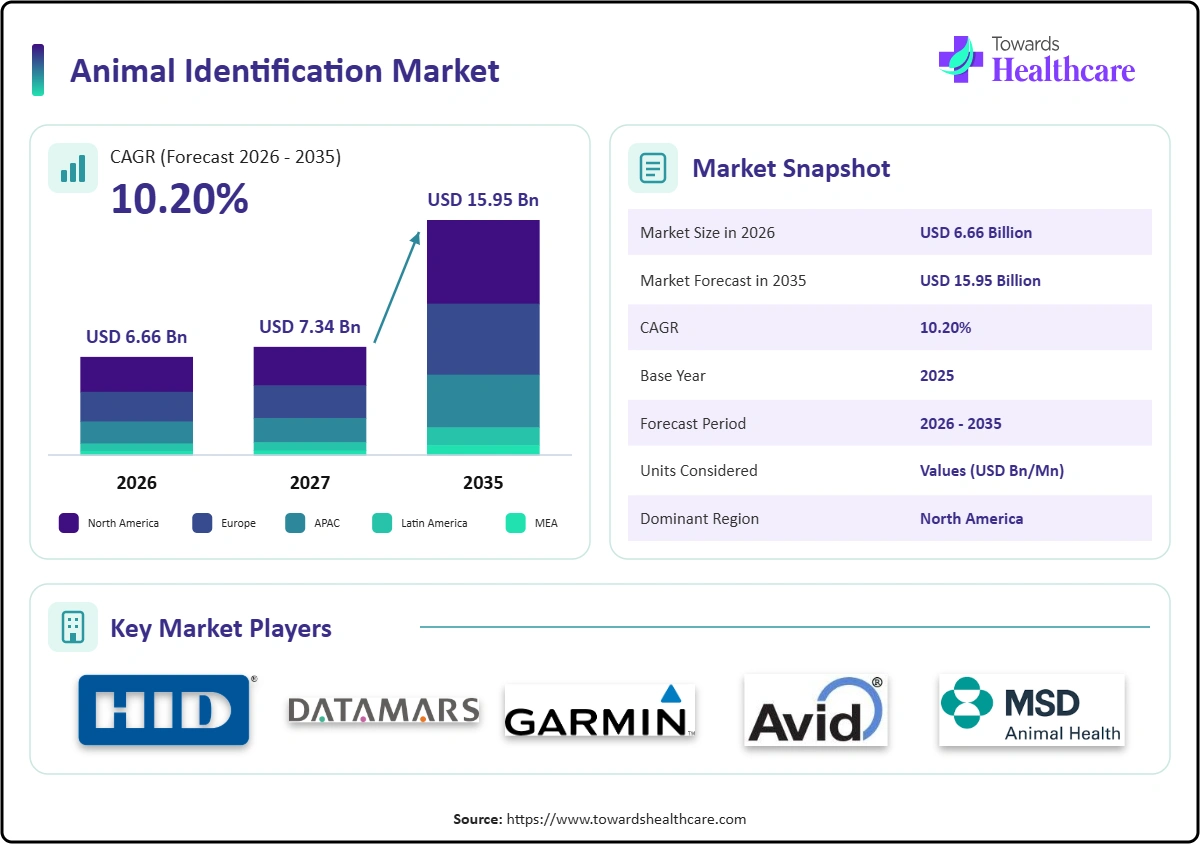
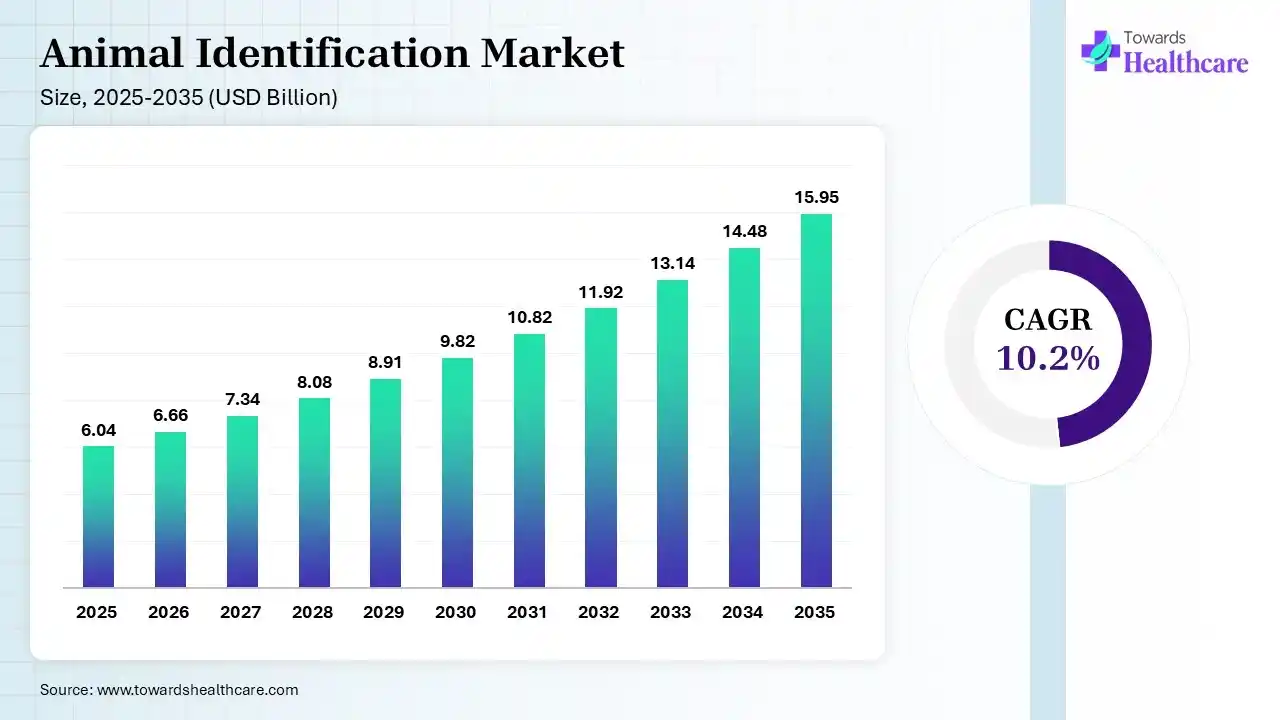
The animal identification market reached USD 6.04 billion in 2025 and is projected to grow to USD 15.95 billion by 2035. Market expansion is driven by mandatory livestock identification for disease surveillance, traceability, and trade, alongside rising pet ownership and microchip adoption. Increasing use of connected identification tags and smart wearables among livestock farms and pet owners further supports demand, particularly devices that combine animal identification with location tracking and health monitoring. Mandatory electronic cattle identification, EU-wide microchipping and registration requirements for dogs and cats, and the integration of identification technologies with farm and pet management software further contribute to market growth. The market is projected to reach USD 9.82 billion by 2030, registering a CAGR of 10.20% during 2026-2035.
Analyst View: The animal identification market is gaining momentum due to strict government regulations, growing demand for livestock traceability, and rising pet microchipping. The adoption of electronic tags, smart wearables, and digital tracking systems is also creating new growth opportunities by improving animal monitoring, disease control, and farm management. The growth rate reflects tightening traceability and microchipping rules and rising adoption of electronic and connected identification, moderated by cost sensitivity among small farmers.
Government traceability regulations are driving demand for livestock identification, while meat export markets increasingly require proof of animal origin. Expanding pet microchipping mandates and the adoption of precision livestock farming are further supporting the market growth.
Implementation costs make small farmers more cautious about adopting animal identification systems. Tag loss and reading failures increase operating expenses, while data privacy concerns and limited database interoperability create challenges. Varying enforcement of identification regulations across countries also slows market adoption.
Opportunity: Integrating animal identification with health monitoring technologies offers opportunities to deliver greater value to farmers and pet owners. Growing demand from EU pet registration rules and livestock traceability programs across Asia is creating new avenues for expansion. Furthermore, biometric and DNA-based identification can serve premium supply chains, while subscription-based software offers opportunities for recurring revenue.
| Segments | 2025 Share | 2025 Value (USD Billion) | 2035 Value (USD Billion) | CAGR 2026-2035 |
| Livestock Animals | 58.40% | 3.53 | 8.80 | 9.58% |
| Companion Animals | 36.20% | 2.19 | 6.31 | 11.18% |
| Other Animals | 5.40% | 0.33 | 0.84 | 9.98% |
Note: 2025 is the base year; 2035 values are forecasts.
Sources: Expert interviews, secondary sources, Towards Healthcare database, and Towards Healthcare analysts.
Livestock animals accounted for a 58.40% share and reached USD 3.53 billion in 2025; companion animals held a 36.20% share, reaching USD 2.19 billion; and other animals accounted for a 5.40% market share and valued at USD 0.33 billion in 2025. Livestock leads in volume because of mandatory traceability, while companion animals are the fastest-growing segment because of microchipping mandates and pet wearables.
Livestock Animals: This segment dominated with a 58.40% share and valued at USD 3.53 billion in 2025 and is projected to reach USD 8.80 billion by 2035, expanding at a CAGR of 9.58% from 2026 to 2035. Livestock identification is driven by law rather than choice: the U.S. requires electronic ear tags for adult cattle and bison moving across state lines, and the EU requires individual identification of cattle, sheep, and goats. And countries such as Brazil, Australia, and New Zealand operate national traceability systems that support beef and dairy exports. Each year, newborn calves, lambs, and kids must be tagged, creating steady recurring demand. Electronic tags are replacing visual-only tags because they allow faster, more accurate recording at saleyards, abattoirs and border checks. Precision dairy and beef farms also use RFID tags and boluses to link each animal to feeding, milking, breeding and health records.
Companion Animals: This segment reached USD 2.19 billion in 2025 and is estimated to reach USD 6.31 billion by 2035, growing at a CAGR of 11.18% from 2026 to 2035. Companion animal identification consists mainly of microchips implanted by veterinarians and registered in pet recovery databases, together with GPS trackers and smart collars bought by owners. Microchipping is mandatory for dogs in the UK and many EU countries, and the EU has adopted rules requiring all dogs and cats to be microchipped and registered in interoperable databases after transition periods. Rising pet ownership, higher spending per pet, and the emotional value placed on lost-pet recovery support demand. Connected collars that combine identification with location, activity, and health tracking add higher-value recurring subscription revenue.
Other Animals: This segment generated USD 0.33 billion in 2025 and is expected to reach USD 0.84 billion by 2035, expanding at a CAGR of 9.98% from 2026 to 2035. Other animals include horses, laboratory animals, zoo and wildlife populations, and aquaculture. Horses are microchipped for passports, competition, and movement controls in Europe and other regions. Research facilities use RFID tags and microchips to track laboratory rodents and other animals for study integrity, and wildlife agencies tag fish and wild animals for conservation monitoring.
| Segments | 2025 Share | 2025 Value (USD Billion) | 2035 Value (USD Billion) | CAGR 2026-2035 |
| Hardware | 72.60% | 4.39 | 11.06 | 9.70% |
| Software | 16.20% | 0.98 | 3.12 | 12.30% |
| Services | 11.20% | 0.68 | 1.77 | 10.10% |
Note: 2025 is the base year; 2035 values are forecasts.
Sources: Expert interviews, secondary sources, Towards Healthcare database, and Towards Healthcare analysts.
Hardware accounted for a 72.60% share and reached USD 4.39 billion in 2025, software held a 16.20% share at USD 0.98 billion, and services held an 11.20% share (USD 0.68 billion) in 2025. Tags, microchips, readers, and wearables make up most spending, while software is growing fastest as identification data is linked to herd, veterinary, and pet management platforms.
Hardware: This segment reached USD 4.39 billion in 2025 and is projected to reach USD 11.06 billion by 2035, expanding at a CAGR of 9.70% from 2026 to 2035. Hardware includes visual and electronic ear tags, rumen boluses, leg bands, implantable microchips, handheld and panel readers, applicators and consumables, GPS and smart collars. It accounts for most revenue because every animal identified needs at least one physical device, and electronic tags and readers carry higher prices than visual tags. Replacement of lost tags, tagging of each new generation of livestock, and new pet microchips create recurring hardware demand.
Software: This segment was valued at USD 0.98 billion in 2025 and is projected to reach USD 3.12 billion by 2035, registering a CAGR of 12.30% during the forecast period from 2026 to 2035. Software includes herd management platforms, traceability databases, pet registration and recovery databases, and apps linked to smart collars. It is the fastest-growing solution because identification data is most valuable when connected to animal health, movement, breeding, and productivity records. Governments are digitizing national traceability databases, and farms use cloud software to manage RFID data from readers and sensors.
Services: This segment captured USD 0.68 billion in 2025 and is expected to reach USD 1.77 billion by 2035, at a CAGR of 10.10% from 2026 to 2035. Services include tagging and chipping procedures, database registration, installation of reading systems at farms and saleyards, data management and support. Veterinary microchipping procedures and registration fees form a significant part of companion animal spending, while traceability services support government programs and meat supply chains.
| Segments | 2025 Share | 2025 Value (USD Billion) | 2035 Value (USD Billion) | CAGR 2026-2035 |
| Wearables (Ear Tags, Collars, Boluses) | 54.80% | 3.31 | 8.35 | 9.71% |
| Microchipping | 29.60% | 1.79 | 5.13 | 11.11% |
| Ear Notching & Tattooing | 7.40% | 0.45 | 1.17 | 10.11% |
| Other Methods | 8.20% | 0.50 | 1.30 | 10.11% |
Note: 2025 is the base year; 2035 values are forecasts.
Sources: Expert interviews, secondary sources, Towards Healthcare database, and Towards Healthcare analysts.
Wearables held the largest share of 54.80%, generating USD 3.31 billion in 2025; microchipping accounted for a 29.60% share and valued at USD 1.79 billion; ear notching & tattooing captured a 7.40% share (USD 0.45 billion); and other methods accounted for an 8.20% share (USD 0.50 billion) in 2025. Ear tags dominate livestock identification, while microchipping is the standard for pets and horses.
Wearables (Ear Tags, Collars, Boluses): This segment generated USD 3.31 billion in 2025 and is projected to reach USD 8.35 billion by 2035, expanding at a CAGR of 9.71% from 2026 to 2035. Wearables include visual and RFID ear tags, rumen boluses and smart collars. Ear tags are the dominant method for cattle, sheep, goats and pigs because they are inexpensive, quick to apply and meet official identification rules. Smart collars and neck tags are used in dairy herds and increasingly for pets, combining identification with monitoring of activity, rumination, heat detection, or location.
Microchipping: This segment was valued at USD 1.79 billion in 2025 and is expected to reach USD 5.13 billion by 2035, at a CAGR of 11.11% from 2026 to 2035. Microchipping involves implanting a small RFID transponder under the skin, usually by a veterinarian, and registering the number in a database. It is the standard permanent identification method for dogs, cats, and horses and is required for pet travel and in many national laws. It is the fastest-growing procedure because microchipping mandates are expanding, including the new EU-wide requirement for dogs and cats.
Ear Notching & Tattooing: This segment reached USD 0.45 billion in 2025 and is projected to reach USD 1.17 billion by 2035, growing at a CAGR of 10.11% from 2026 to 2035. Ear notching is used mainly in pig herds, and tattooing in pigs, rabbits, laboratory animals, and some pedigree animals. These low-cost, permanent methods remain common in specific production systems but are gradually being supplemented by electronic identification.
Other Methods: This segment generated USD 0.50 billion in 2025 and is expected to reach USD 1.30 billion by 2035, expanding at a CAGR of 10.11% from 2026 to 2035. Other methods include freeze and hot branding, DNA-based identification, biometric approaches such as muzzle-print and facial recognition, and leg bands for poultry. DNA and biometric identification are emerging for high-value animals and supply chain verification.
| Segments | 2025 Share | 2025 Value (USD Billion) | 2035 Value (USD Billion) | CAGR 2026-2035 |
| Livestock Farms & Ranches | 52.60% | 3.18 | 8.06 | 9.76% |
| Veterinary Hospitals & Clinics | 27.40% | 1.65 | 4.36 | 10.16% |
| Pet Owners | 14.20% | 0.86 | 2.61 | 11.76% |
| Others | 5.80% | 0.35 | 0.92 | 10.16% |
Note: 2025 is the base year; 2035 values are forecasts.
Sources: Expert interviews, secondary sources, Towards Healthcare database, and Towards Healthcare analysts.
Livestock farms & ranches accounted for a 52.60% share and were valued at USD 3.18 billion in 2025; veterinary hospitals & clinics held a 27.40% share (USD 1.65 billion); pet owners captured a 14.20% share (USD 0.86 billion); and others accounted for a 5.80% share (USD 0.35 billion) in 2025. Farms buy most tags and readers, clinics implant most microchips, and pet owners buy smart collars and trackers directly.
Livestock Farms & Ranches: This segment accounted for USD 3.18 billion in 2025 and is projected to reach USD 8.06 billion by 2035, expanding at a CAGR of 9.76% from 2026 to 2035. Livestock farms and ranches buy ear tags, boluses, readers, and herd software to comply with traceability rules and manage their animals. Large dairy and beef operations increasingly invest in electronic identification integrated with automated feeding, milking, and weighing systems.
Veterinary Hospitals & Clinics: This segment was valued at USD 1.65 billion in 2025 and is estimated to reach USD 4.36 billion by 2035, a CAGR of 10.16% from 2026 to 2035. Veterinary hospitals & clinics implant microchips, scan lost animals, apply official tags in some countries, and register animals in databases. They are the main channel for pet and horse identification and often bundle microchipping with vaccination and neutering.
Pet Owners: This segment held USD 0.86 billion in 2025 and is projected to reach USD 2.61 billion by 2035, growing at a CAGR of 11.76% from 2026 to 2035. Pet owners buy GPS trackers, smart collars, and identification tags directly, often with monthly subscriptions. This is the fastest-growing end use as connected pet technology becomes more affordable and owners seek real-time location and health information.
Others: This segment generates USD 0.35 billion in 2025 and is projected to reach USD 0.92 billion by 2035, expanding at a CAGR of 10.16% from 2026 to 2035. Others include government agencies, saleyards and abattoirs, shelters, research institutions, zoos and wildlife organizations that use identification systems for disease control, rehoming, research and conservation.
Analyst View: The market is primarily driven by livestock traceability requirements, rising pet ownership, and the growing need for reliable animal monitoring. Livestock remains the largest segment, supported by mandatory tagging and export regulations, while companion animals are gaining momentum through microchipping mandates and smart pet wearables. Hardware continues to lead as physical identification devices remain essential. Wearable identification remains widely used, while microchipping is gaining ground, particularly in pet care. Overall, demand is shifting from normal identification toward connected solutions that combine tracking, health monitoring, and data management.
| Region | 2025 Share | 2025 Value (USD Billion) | 2035 Value (USD Billion) | CAGR 2026-2035 |
| North America | 35.60% | 2.15 | 5.30 | 9.46% |
| Europe | 30.20% | 1.82 | 4.67 | 9.86% |
| Asia Pacific | 22.40% | 1.35 | 4.15 | 11.86% |
| Latin America | 7.60% | 0.46 | 1.18 | 9.86% |
| Middle East & Africa | 4.20% | 0.25 | 0.65 | 9.86% |
Note: 2025 is the base year; 2035 values are forecasts.
Sources: Expert interviews, secondary sources, Towards Healthcare database, and Towards Healthcare analysts.
North America dominates the market with 35.60% share and reached USD 2.15 billion in 2025, Europe held 30.20% share, reaching USD 1.82 billion; Asia Pacific accounted for 22.40% share, generating USD 1.35 billion; Latin America captured 7.60% share, with a valuation of USD 0.46 billion; and the Middle East & Africa accounted for 4.20% share (USD 0.25 billion) in 2025. North America and Europe lead because of mature traceability systems and high pet microchipping rates, while Asia Pacific is the fastest-growing region as China, India, and Southeast Asia build livestock traceability and pet ownership rises.
North America: This region accounted for a market size of USD 2.15 billion in 2025 and is projected to reach USD 5.30 billion by 2035, at a CAGR of 9.46% from 2026 to 2035. The U.S. requires electronic, visually readable ear tags for adult cattle and bison moving interstate. The region has a large beef cattle herd, an advanced dairy sector, and high pet ownership, with microchipping widely recommended by veterinarians and shelters. Canada operates a mandatory national cattle identification program using RFID tags. Pet wearables and GPS trackers are also widely adopted, adding software and subscription revenue.
Europe: This region was valued at USD 1.82 billion in 2025 and is expected to reach USD 4.67 billion by 2035, growing at a CAGR of 9.86% from 2026 to 2035. Europe has long-established mandatory identification for cattle, sheep, goats, pigs and horses under EU animal health rules, with electronic identification required for sheep and goats. Dog microchipping is mandatory in the UK and many EU countries. Germany, France, the UK, Ireland and Spain are the largest markets.
Asia Pacific: This region was reaching a value of USD 1.35 billion in 2025 and is projected to reach USD 4.15 billion by 2035, at a CAGR of 11.86% from 2026 to 2035. Asia Pacific is estimated to be the fastest-growing region. China is developing livestock traceability for pigs and cattle after African swine fever outbreaks, and India runs a large livestock identification program linked to vaccination campaigns. Australia operates the National Livestock Identification System with electronic tags for cattle and, increasingly, sheep and goats. Pet ownership and microchipping are rising quickly in China, Japan, South Korea, and Australia.
Latin America: This region secured USD 0.46 billion in 2025 and is expected to reach USD 1.18 billion by 2035, growing at a CAGR of 9.86% from 2026 to 2035. Latin America is driven by beef exports from Brazil, Argentina, Uruguay, and Paraguay, where buyers in Europe and Asia require traceability. Uruguay has mandatory electronic identification of all cattle, and Brazil is expanding its national traceability program. Pet microchipping is growing in urban areas of Brazil.
Middle East & Africa: This region accounted for 4.20% (USD 0.25 billion) of the animal identification market in 2025 and is projected to reach USD 0.65 billion by 2035, expanding at a CAGR of 9.86% from 2026 to 2035. The Middle East and Africa are supported by livestock disease control programs, camel and sheep identification in the Gulf, and traceability for beef exports from countries such as Botswana and Namibia. Pet microchipping is growing in the UAE and Saudi Arabia, while donor-funded livestock identification projects support adoption in parts of Africa.
Analyst View: Regional shares were built from tagged and chipped animal volumes and prices in each region. North America leads because of electronic cattle tagging and pet microchipping. We project Asia Pacific to have the highest growth premium because livestock traceability and pet ownership are expanding fastest there.
| Rank | Company Name | Market-Specific Revenue (USD Billion) | 2025 Share | Key Products / Business | Headquarters |
| 1 | MSD Animal Health (Allflex) | 0.85 | 14.07% | Allflex ear tags, readers and monitoring | United States |
| 2 | Datamars | 0.42 | 6.95% | Livestock tags, microchips and readers | Switzerland |
| 3 | Tractive | 0.14 | 2.32% | GPS pet trackers | Austria |
| 4 | Garmin | 0.12 | 1.99% | Dog tracking collars | United States |
| 5 | HID Global | 0.06 | 0.99% | Animal RFID transponders | United States |
| 6 | Avid Identification Systems | 0.06 | 0.99% | Pet microchips and scanners | United States |
| 7 | Shearwell Data | 0.05 | 0.83% | Livestock tags and software | United Kingdom |
| 8 | Caisley International | 0.04 | 0.66% | Ear tags and RFID tags | Germany |
| 9 | Ritchey | 0.03 | 0.50% | Livestock identification tags | United Kingdom |
| 10 | Luoyang Laipson | 0.03 | 0.50% | RFID animal tags | China |
Note: Company revenues and shares are 2025 estimates.
Sources: Company press releases, expert interviews, secondary sources, Towards Healthcare database, and Towards Healthcare analysts.
MSD Animal Health led the animal identification market with 14.07% share and was valued at USD 0.85 billion in 2025 revenue, followed by Datamars at 6.95% (USD 0.42 billion) and Tractive at 2.32% (USD 0.14 billion). MSD Animal Health leads through Allflex, the largest manufacturer of livestock ear tags and readers, combined with animal monitoring solutions. Datamars supplies livestock tags, pet and horse microchips and readers worldwide, and Tractive is a leading maker of GPS trackers for dogs and cats. Garmin, HID Global, Avid Identification Systems, Shearwell Data, Caisley International, Ritchey, and Luoyang Laipson compete through dog tracking collars, RFID transponders, pet microchips, livestock tag software, and regional supply.
The top 10 companies accounted for 29.80% share and reached USD 1.80 billion in 2025 revenue, while the remaining 70.20% (USD 4.24 billion) was shared among regional tag makers, microchip brands, pet wearable start-ups and software providers. The animal identification market is moderately concentrated in livestock tags and fragmented in pet wearables, and competition centers on tag retention and read performance, regulatory approval, price, reader and software integration, distribution and subscription services. Government tender programs and approved-manufacturer lists shape competition in livestock tags.
The animal identification ecosystem links chip and polymer suppliers with tag, microchip and wearable makers, software and database providers, distributors and veterinarians, and farmers, pet owners and regulators.
| Ecosystem Stage | Role in the Market | Key Companies |
| Components | Supply RFID chips, antennas and polymers | NXP, HID Global, polymer suppliers |
| Device Makers | Produce tags, microchips, readers and wearables | MSD Animal Health (Allflex), Datamars, Avid, Tractive, Garmin |
| Software & Databases | Run traceability, herd and pet recovery databases | National traceability systems, herd software, pet registries |
| Distribution | Sell and apply devices | Farm supply stores, veterinary distributors, veterinarians, retailers |
| End Users & Regulators | Use and mandate identification | Farmers, ranchers, pet owners, shelters, agriculture ministries |
Sources: Company press releases, expert interviews, secondary sources, Towards Healthcare database, and Towards Healthcare analysts.
The Towards Healthcare Companies Quadrant positions key participants in the animal identification market by market strength, reflecting revenue scale, market share and geographic reach, and by innovation and growth strategy, reflecting product portfolio breadth, R&D intensity and partnerships. Positions reflect each company's estimated 2025 animal identification revenue and our assessment of its product range, technology and distribution.
Sources: Company press releases, expert interviews, secondary sources, Towards Healthcare database, and Towards Healthcare analysts.
Leaders: MSD Animal Health (Allflex), Datamars, Tractive, and Garmin combine large identification revenue with broad tag, microchip, or wearable portfolios, connected software, and global distribution.
Challengers: HID Global has established identification products but slower innovation.
Innovators: Shearwell Data and Luoyang Laipson bring integrated tag and herd software or low-cost RFID tags that are gaining customers.
Niche Players: Avid Identification Systems, Caisley International, and Ritchey serve regional livestock tag segments.
By Animal
By Solution
By Procedure
By End Use
By Region
The animal identification market was defined as ear tags, boluses, microchips, readers, wearables, applicators, software, and services for identifying and tracing livestock, companion, and other animals worldwide.
The 2025 base year was built bottom-up from animals tagged, chipped, or fitted with wearables by animal type, procedure, and region, and average device, software, and service prices, and checked top-down against the animal identification revenue of leading suppliers. Segment, regional, and company values were allocated from animal types, solutions, procedures, end uses, and regional demand. Key estimates were verified by cross-checking company disclosures, regulatory and industry data, and published third-party estimates, and inputs that could not be reconciled were excluded. All segment, regional, and company figures were reconciled to the same 2025 base year, and the 2026-2035 forecast, which applies a constant CAGR from the 2025 base, was recalculated and validated.
Analyst View: The animal identification market is growing steadily as regulation, trade, and technology push both livestock and pets toward electronic, connected identification. Our estimate links demand to tagged and chipped animals and prices, so the forecast follows traceability rules, pet ownership, and wearable adoption. The main opportunities come from microchipping mandates and connected wearables, while the main risks are farmer cost sensitivity and uneven enforcement.