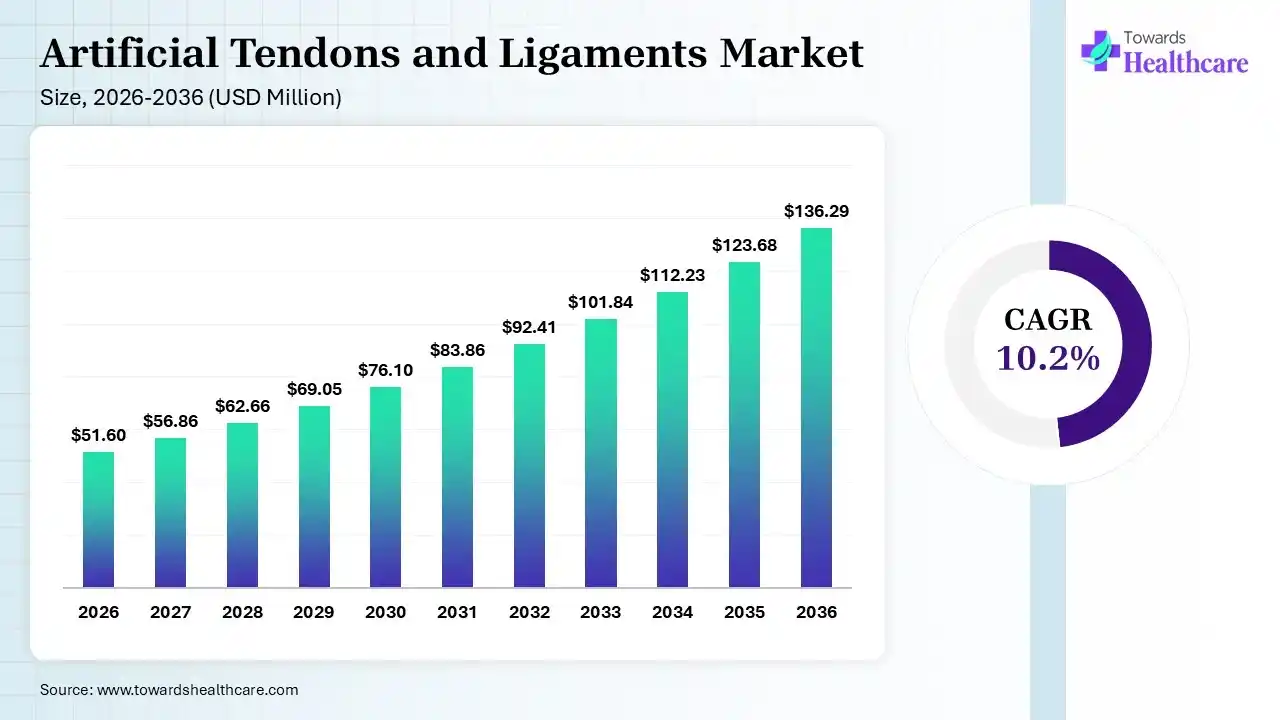
The artificial tendons and ligaments market is expected to reach US$ 51.6 billion in 2026 and grow to approximately US$ 136.29 billion by 2036, registering a CAGR of 10.2% during 2026-2035. The market includes artificial ligament implants, tendon repair systems, ligament reinforcement devices, and biosynthetic scaffolds used to repair or reinforce damaged soft tissues. Demand is driven by sports injuries, anterior cruciate ligament (ACL) tears, Achilles tendon injuries, shoulder instability, and reconstructive procedures requiring alternatives or supplements to autografts and donor tissue.
Market estimates vary based on the products and applications covered, particularly the inclusion of biosynthetic implants and reinforcement systems. Artificial ligaments are used in selected knee reconstruction procedures, while tendon repair and reinforcement products serve shoulder, foot and ankle, and other orthopedic applications. North America and Europe benefit from established surgical infrastructure, specialist expertise, and access to advanced sports medicine. Asia-Pacific offers growth opportunities as orthopedic services and sports medicine capabilities expand.
Through 2035, market growth will depend on clinical outcomes, implant durability, regulatory approvals, surgeon adoption, and cost-effectiveness compared with conventional reconstruction techniques. Established synthetic implants compete on mechanical performance and clinical experience, while newer biosynthetic solutions aim to improve tissue compatibility without compromising structural support. Manufacturers that demonstrate reliable performance, acceptable safety, and clear clinical benefits will be better positioned to increase adoption and market share. Long-term commercial success will depend on both procedure volumes and evidence that these technologies offer meaningful advantages over existing treatment options.
Market segmentation is based on implant type, material, anatomical application, procedure, end user, and geography. Knee reconstruction is a major demand area, driven by ACL injuries and other ligament damage requiring surgical repair. Shoulder reconstruction and foot and ankle procedures extend market opportunities, particularly for products designed to repair or reinforce tendons.
By implant type, the market includes synthetic ligaments, synthetic tendon implants, ligament augmentation systems, and hybrid or biosynthetic scaffolds. Polyester, particularly polyethylene terephthalate (PET), is an established material for synthetic ligament systems. Bioresorbable polymers and tissue-engineered materials offer alternative approaches, but their commercial adoption depends on clinical performance, regulatory approval, and long-term safety.
Hospitals and specialist orthopedic centers are key buyers because they perform complex reconstruction procedures and rely on surgeon-led implant selection. Ambulatory surgical centers may offer additional growth opportunities for suitable procedures, depending on patient selection, reimbursement coverage, and available surgical infrastructure.
The segmentation analysis distinguishes established revenue-generating categories from faster-growing segments. Established implants may account for a larger share of current revenue, while emerging materials and biosynthetic technologies may offer higher growth potential as clinical evidence and regulatory approvals advance.
Market growth is driven by sports participation, traumatic ligament injuries, tendon ruptures, and joint instability requiring reconstruction. Artificial grafts provide immediate mechanical support and eliminate the need to harvest a patient’s own tissue or source donor grafts. These benefits influence graft selection, surgical complexity, and recovery planning.
However, artificial implants do not outperform biological grafts in every application. Durability, wear, tissue reactions, infection, implant failure, and revision surgery remain key concerns. Clinical outcomes and surgeon experience strongly influence adoption, regardless of the implant’s mechanical strength.
Market potential depends on injury rates and the proportion of eligible patients treated with artificial implants. Greater access to sports medicine and orthopedic surgery may increase procedure volumes, while stronger clinical evidence and standardized surgical techniques could support wider adoption.
High treatment costs, uncertain reimbursement, and regulatory requirements may limit uptake. Manufacturers must demonstrate clear clinical and economic benefits to justify the cost of their products and any changes to established surgical practices.
Pricing in the artificial tendons and ligaments market depends on the specific device and its clinical application. Comparisons account for implant design, material, fixation method, surgical application, instrumentation, regulatory requirements, and technical support. Comparing implant prices alone may not reflect the full cost of the procedure.
Established devices compete on mechanical reliability, clinical experience, and product availability. Advanced biosynthetic and tissue-integrating implants may command premium prices if they demonstrate meaningful clinical benefits. However, hospital budgets and reimbursement constraints can limit pricing flexibility.
The most relevant commercial benchmark is the total cost of treatment. Key cost factors include operating room time, additional fixation devices, rehabilitation, complications, revision surgery, and recovery-related resource use. Higher-priced implants should only be considered cost-saving when supported by clinical and economic evidence.
Global average selling prices are not consistently available for all products. A comprehensive pricing analysis should therefore distinguish verified product quotations, estimated transaction prices, and broader economic benchmarks. Pricing should be assessed by anatomical application, implant configuration, geography, and purchasing channel.
Artificial tendons and ligaments represent a niche market for specialized devices, where the supply relies on proper manufacturing of the devices, material quality, sterilization, regulatory compliance, and delivery to orthopedic hospitals. Unlike commodities in the medical industry, the availability of implants is not only about production capacity but also involves proper certification for the devices to operate in the targeted market.
Factors that drive demand include surgery scheduling, buying cycles in hospitals, distributors' inventories, surgeons' preferences, and the availability of products in various sizes and designs. There might be some difficulties with business operations among suppliers due to regulatory differences in various countries or because of the limited range of high-volume surgeries.
There is no sufficient publicly available data for determining the exact numbers for the total production capacity of this market, its utilization, or the supply-demand gap. Such information can be validated only through analysis at the company and distribution level rather than through extrapolation from the total market revenues.
The report assesses the supply resilience using manufacturing capacity, product availability, qualifications required, lead times (if known), geographical reach, and dependence on material suppliers. The potential areas for expanding the market are also identified.
The value chain for artificial tendons and ligaments includes development of biomaterials, sourcing of components, development of implants, manufacturing, quality control, sterilization, regulatory approval, and distribution to hospitals and surgery centers. Value creation involves manufacturing of devices, gathering clinical evidence, surgeon training, and post-marketing surveillance. While component providers play an important role as providers of inputs into the production process, manufacturers can achieve additional strategic value in terms of innovative engineering of the implant, its mechanical properties, intellectual property protection, manufacturing processes, and clinical evidence.
From our analysis, we can conclude that technical differentiation and clinical acceptance are more sustainable sources of competitive advantage than manufacturing capacity alone. While devices might conform to all specifications of the materials used, their adoption might still be hindered by a lack of experience in handling them during surgery. In our opinion, this means that qualification of products, gathering of clinical evidence, and clinical expertise become important factors in the commercialization process.
These strategic ramifications cover procurement, production, and channels. Availability of materials, quality control, sterilization, and packaging determine production cost and reliability of the supply chain, while connections with distributors and the sales network for orthopedics define market access and commercialization effectiveness. Our recommendation in this context is that supplier diversification, standardization of processes, and selective vertical integration can contribute to overcoming supply risk and gaining better control over key value chain functions. The comprehensive report analyzes cost factors if they are disclosed, supplier concentration, supplier qualification requirements, distribution economics, channel connections, and options for enhancing value generation along the device life cycle.
The knowledge about this industry can also be organized in the form of a value chain database containing data on suppliers, biomaterials, implant manufacturers, production locations, production capabilities, sterilization requirements, regulatory situation, distributors, geographical presence, and cost factors disclosed. Users of this database will be able to filter and benchmark companies by value chain segment, geography, technology, and capabilities.
Technology development in the artificial tendons and ligaments market focuses on mechanical strength, durability, fatigue resistance, biocompatibility, and functional performance. PET-based synthetic ligament systems provide established benchmarks for evaluating new materials and implant designs. Research into bioresorbable scaffolds, hybrid implants, tissue engineering, and advanced manufacturing aims to improve tissue healing while maintaining adequate structural support.
Innovation follows three main paths. First, improvements to existing synthetic implants aim to extend durability and reduce complications. Second, biosynthetic reinforcement systems seek to combine mechanical support with tissue integration. Third, regenerative technologies use scaffolds to support biological healing rather than simply replace damaged tissue.
The maturity of these technologies varies. Commercially available implants with established clinical use cannot be compared directly with experimental tissue-engineered products. Development stages range from patent filings and laboratory testing to clinical trials, regulatory approval, and commercial distribution.
Manufacturers demonstrate that technological advances deliver meaningful clinical benefits and justify their cost. The report benchmarks product platforms, material science, manufacturing processes, intellectual property, clinical evidence, and commercialization progress to assess competitive positioning and adoption potential.
Hospitals, specialist orthopedic centers, and other surgical facilities are the main buyers of artificial tendons and ligaments, while surgeons largely influence product selection. Purchasing decisions depend on clinical suitability, implant reliability, ease of use, product availability, cost, and the strength of supporting clinical evidence.
Knee reconstruction, particularly ACL and other ligament reconstruction procedures, represents a key application. Shoulder surgery and foot and ankle reconstruction offer additional opportunities for tendon reinforcement and ligament support.
Revision procedures require alternative reconstruction approaches when an initial graft fails or tissue damage limits available options. In these cases, implant performance and the risk of further complications are important considerations.
Adoption depends on whether synthetic implants offer clear advantages over biological grafts. Surgeons may value immediate mechanical support and the ability to avoid harvesting autologous tissue or sourcing donor grafts. These benefits must be weighed against implant durability, complication risks, and the potential need for revision surgery.
The report compares purchasing priorities across hospital systems, specialist orthopedic centers, and outpatient surgical facilities, highlighting differences in clinical requirements, budgets, and decision-making criteria.
| Company | Headquarters | Market position and core strength | Relevant applications or segments |
| Xiros Ltd. / Neoligaments | United Kingdom | Specialist synthetic ligament and tendon technologies | Ligament reconstruction and tendon repair |
| Cousin Biotech | France | Specialist implant manufacturer | Synthetic ligaments and soft-tissue reconstruction |
| Orthomed | France | Artificial ligament portfolio | Knee, ankle, shoulder, and tendon reinforcement |
| FX Solutions | France | Specialist orthopedic reconstruction products | Ligament reconstruction and reinforcement |
| Shanghai PINE & POWER Biotech | China | Regional artificial ligament technology supplier | Synthetic ligament applications |
| Arthrex | United States | Sports medicine and orthopedic surgery platform | Ligament reconstruction and tendon repair |
| Stryker | United States | Diversified orthopedic and sports medicine platform | Sports medicine and soft-tissue repair |
| Smith+Nephew | United Kingdom | Sports medicine and orthopedic devices | Ligament reconstruction and tendon repair |
| Zimmer Biomet | United States | Diversified musculoskeletal technologies | Orthopedic and sports medicine procedures |
| Integra LifeSciences | United States | Soft-tissue and reconstructive medical technologies | Relevant reconstructive applications |
| Corin Group | United Kingdom | Orthopedic reconstruction and distribution capabilities | Relevant orthopedic implant technologies |
| Medline | United States | Medical-device and surgical product platform | Relevant synthetic ligament and reinforcement products |
| CONMED | United States | Sports medicine and surgical technologies | Ligament augmentation and soft-tissue repair |
| Miach Orthopaedics | United States | ACL repair and bioengineering specialist | Bio-enhanced ACL repair |
| Bioretec | Finland | Bioresorbable orthopedic implant technologies | Adjacent biomaterial and fixation capabilities |
| MTF Biologics | United States | Human tissue and biologic graft ecosystem | Allograft alternatives and competitive context |
Accurate competitive assessment is essential in the artificial tendons and ligaments market because many specialist companies generate limited revenue from these products and do not report it separately. Public estimates vary, and company-wide orthopedic or sports medicine revenue may not reflect sales from artificial tendon and ligament products.
A reliable competitive ranking must distinguish reported company revenue from estimated product-level revenue. Where verifiable figures are unavailable, companies should be classified by their market role, such as specialist manufacturer, technology developer, platform provider, or regional competitor. Market share should be reported only when product-level revenue and total market estimates use consistent definitions.
The assessment evaluates the top five and top ten market participants, other competitors, estimated market concentration, and changes in competitive positioning where reliable data are available. It also identifies companies with a strong presence in specific products, technologies, or clinical applications.
Companies are evaluated relative to their performance in various market-related parameters such as implant product portfolio, material platform, anatomic coverage, regulatory clearance, clinical data, manufacturing ability, surgeon experience, distribution, and innovation. Financial measures are used where relevant for the market context.
Specialized implant makers may excel in dedicated product development and specific disease-state knowledge, whereas diversifying orthopedics firms may be able to exploit hospital relationships, wider distribution channels, and additional surgery products. No guarantee is offered by either strategy, and success will depend on a company’s ability to convert technical benefits into clinically proven products available regularly.
The benchmarking system is based on qualitative measures such as Leader, Strong, Moderate, and Emerging, supplemented with relevant numeric parameters where known. It does not construct a composite competitive score and assumes no deficiency of performance from lack of data.
The differentiation within portfolios relates to the product’s role in either replacing a damaged ligament, reinforcing a damaged area, helping with tendon healing, or serving as a scaffold for biological integration.
The existing synthetic technologies are different from each other in terms of mechanical properties, their familiarity among surgeons, and availability across indications. The reinforcement technologies are compared against the ability of the product to reinforce natural tissue healing, while bio-synthetic products have to demonstrate how they can combine the features of both types of products. A wide portfolio could help suppliers to cover multiple procedures; however, it is necessary to have indication-specific clinical evidence for the technology.
The assessment provides information about the products offered by every company in terms of its function and the indication for which it is designed.
Innovation benchmarking involves comparing different firms in the fields of synthetic polymer systems, tissue-integrated implants, bioresorbable materials, and regenerative technologies. Such metrics may include innovations in product launches, patents, clinical trials, partnering, regulatory approval, and commercialization.
An expanding portfolio of patents may be seen as an indicator of innovations but does not mean that such innovations provide any clinical superiority or commercial success. Thus, a positive preclinical performance is not enough either. That is why these categories are clearly distinguished.
The competitive positioning of products is based on an anatomical indication and geography. Companies with robust knee reconstruction product lines may lack a similarly robust offering of products for tendon repairs and shoulder reconstruction. Application-level benchmarking would then look at how well the product fits the need, evidence supporting the product, physician adoption, and the effectiveness of any existing distribution channels.
North America has excellent orthopedics infrastructure and sports medicine expertise. Europe has many specialists dealing with orthopedics devices, and the Asia-Pacific region has potential because of orthopedic procedure access and manufacturing capabilities. However, regional attributes don’t define one standard adoption rate: the authorization, reimbursement, practices, and purchasing power vary by country.
The buying of artificial tendons and ligaments is a highly specialized b2b transaction. Hospitals and surgical facilities consider cost and availability, while doctors analyze the clinical appropriateness, implantation, and results. Manufacturers could stand out through technical assistance, training, and good distribution systems. An existing connection to hospitals could be an economic advantage; however, it will depend on the clinical relevance of the product to that particular operation.
Examples of strategic activity in the market include new artificial tendon and ligament product launches, new product design developments, distribution deals, research collaborations, regulatory approvals, and the entry into new anatomical indications. Such activity may increase a company's commercial presence in the market without necessarily involving the purchase of another manufacturer.
M&A analysis covers those deals which have significant impact on artificial tendon and ligament products, product lines, manufacturing capacity, or orthopedic customer access. M&A deals with wider sports medicine companies should not be seen as proof of artificial tendon and ligament consolidation.
The artificial tendons and ligaments market offers growth opportunities for specialized manufacturers, but commercial success will depend on product economics, clinical acceptance, and clear differentiation from existing treatment options.
The base-case forecast assumes continued demand for orthopedic reconstruction and gradual growth in synthetic implant adoption. The upside scenario considers stronger clinical evidence, successful commercialization of differentiated biosynthetic materials, and wider access to orthopedic procedures. The downside scenario accounts for slow adoption, unfavorable clinical outcomes, reimbursement constraints, and continued preference for conventional grafts.
Through 2035, key priorities for manufacturers will include strengthening clinical evidence, expanding approved indications, improving material properties and mechanical performance, building relationships with surgeons, and expanding distribution in high-potential markets. Revenue forecasts must use consistent market definitions, particularly when comparing established synthetic implants with emerging biosynthetic technologies.
The artificial tendons and ligaments market is driven by demand for effective solutions for ligament reconstruction and tendon repair, particularly for sports-related injuries and knee injuries. Synthetic implants made from materials such as polyethylene terephthalate (PET) remain established options due to their mechanical strength and reliability. However, biosynthetic and hybrid implants are attracting interest for their potential to support tissue integration and healing.
The primary market research process was carried out by Payal Rabde, Senior Research Associate, who also designed the methodology and did market segmentation, regional trend analysis, buyer intelligence, competitive analysis, and forecasts, laying the foundation for the analytical part of the report.
Aman Singh, Head of Research, has gathered and checked regulatory policies, company financial information, production information, commodity price information, and various other quantitative information sources, which were obtained independently, thereby increasing the quality of evidence supporting the calculations of the market values.
Aditi Shivarkar, VP Research, has validated and refined the research material, verified facts, corrected inconsistencies, and completed the research document, making it accurate and to the point.
By Product Type
By Material Type
By Technology
By Application
By End User
By Distribution Channel
By Region


Principal Consultant
Payal Rabde is a Healthcare Market Research Analyst at Towards Healthcare Research & Consulting with 4+ years of experience in pharmaceuticals, biotechnology, medical devices, and life sciences.
Learn more about Payal Rabde

Reviewed By
Aditi Shivarkar is a seasoned professional with over 14 years of experience in healthcare market research. As a content reviewer, Aditi ensures the quality and accuracy of all market insights and data presented by the research team.
Learn more about Aditi Shivarkar