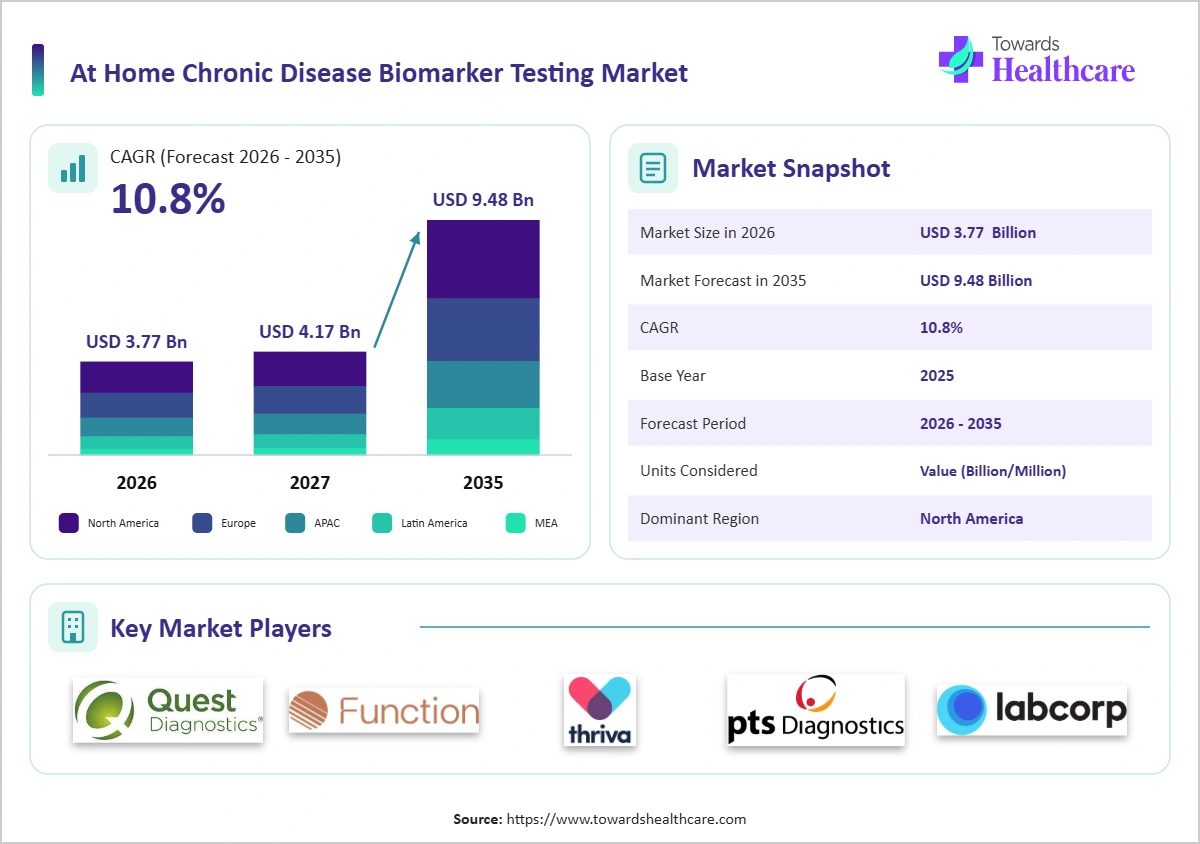
The at-home chronic disease biomarker testing market is expected to expand from USD 3.40 billion in 2025 to USD 9.48 billion by 2035, driven by the growing burden of chronic diseases and rising demand for convenient at-home health monitoring. Increasing consumer interest in preventive healthcare is expected to accelerate market growth, taking its value to USD 5.68 billion by 2030 and registering a CAGR of 10.80% from 2026 to 2035.
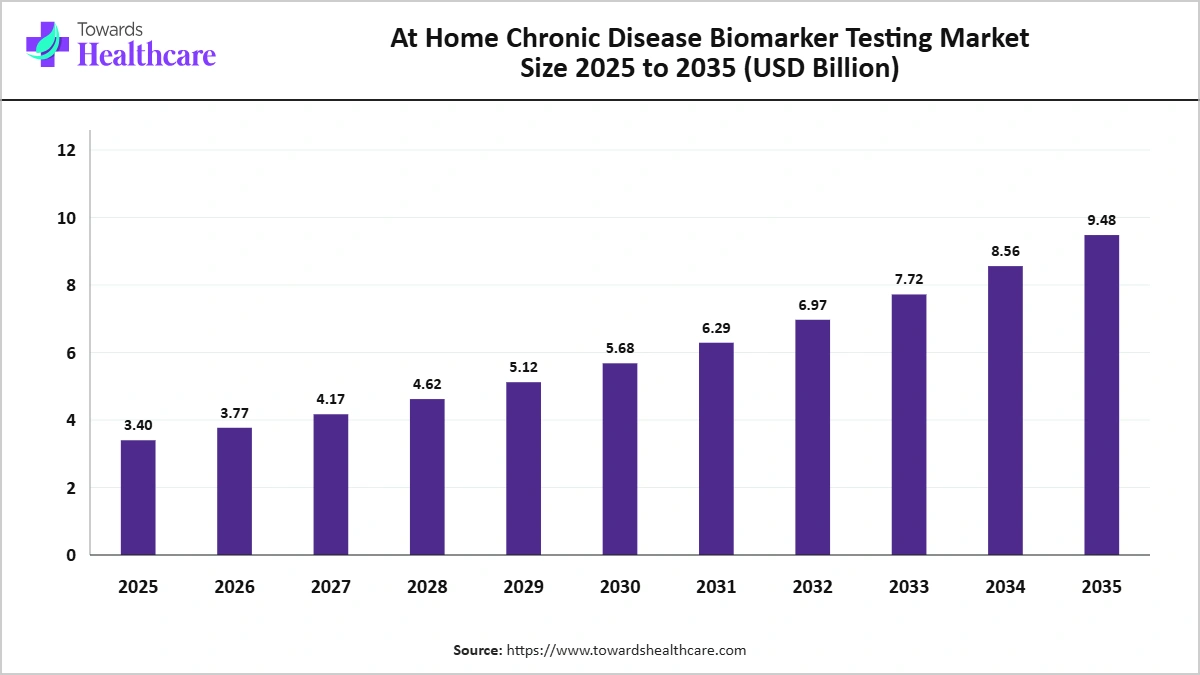
Analyst View: The market estimate is based on at-home test kit volumes across different conditions and distribution channels, average kit prices, and company revenues. These estimates were cross-validated using health plan data and company disclosures.
The at-home chronic disease biomarker testing market is growing as health plans and consumer apps use home kits to track chronic conditions.
Chronic Disease
The growing prevalence of diabetes and cardiovascular diseases is increasing the need for regular biomarker testing. At-home kits provide a convenient way to monitor key health indicators and manage chronic conditions.
Convenience
At-home testing eliminates the need for frequent clinic visits and simplifies sample collection. This convenience encourages consumers to monitor their health more regularly.
Payer Programs
Health insurance plans are increasingly supporting at-home testing kits to improve screening participation and close care gaps. These programs also encourage timely monitoring of chronic conditions.
Prevention Interest
Growing consumer awareness of preventive healthcare is driving interest in regular health tracking. At-home biomarker tests allow individuals to monitor health indicators and identify potential concerns earlier.
Market Drivers - Impact & CAGR Contribution (2026-2035)
| Driver | Impact | ≈ CAGR Contribution | Time Horizon | Key Regions |
| Chronic disease | High | +4.22 pp | Short to long term | Global, strongest in North America |
| Convenience | Medium | +3.56 pp | Medium to long term | Global, fastest uptake in Asia Pacific |
| Payer programs | Medium | +3.03 pp | Short to medium term | Global |
| Prevention interest | Low | +2.37 pp | Long term | Developed and emerging markets |
Note: Contributions are indicative estimates of each factor's effect on annual growth.
Sources: Expert interviews, secondary sources, Towards Healthcare database and Towards Healthcare analysts.
Chronic disease, convenience and payer programs drive most growth in the at home chronic disease biomarker testing market.
Accuracy
Variations in sample collection and handling can affect test accuracy and result reliability. Improper collection techniques may lead to inconsistent readings and limit consumer confidence.
Reimbursement
Limited insurance coverage and reimbursement options can increase out-of-pocket expenses for consumers. This may restrict the adoption of at-home chronic disease testing.
Follow-up
At-home test results often require professional interpretation and medical guidance. Limited connections with healthcare providers can delay follow-up consultations and necessary treatment.
Market Restraints - Impact & Negative CAGR Contribution (2026-2035)
| Restraint | Impact | ≈ Negative CAGR Contribution | Time Horizon | Key Regions |
| Accuracy | High | -1.07 pp | Short to medium term | Global |
| Reimbursement | High | -0.78 pp | Medium term | Price-sensitive and emerging markets |
| Follow-up | Medium | -0.52 pp | Short term | North America and other mature markets |
Note: Contributions are indicative estimates of each factor's effect on annual growth.
Sources: Expert interviews, secondary sources, Towards Healthcare database and Towards Healthcare analysts.
Accuracy is the main restraint, followed by reimbursement limits and follow-up gaps.
Emerging Markets
Rising diabetes prevalence and limited access to conventional diagnostic facilities are creating opportunities for at-home biomarker testing in emerging markets. Affordable screening kits can improve access to routine health monitoring.
Telehealth Links
Integration with telehealth platforms enables consumers to discuss test results with healthcare professionals remotely. Virtual consultations can support timely follow-ups and improve continuity of care.
Employer Wellness
Growing corporate interest in employee health is creating opportunities for at-home testing through workplace wellness programs. Employers can offer biomarker screening to encourage preventive care and routine health monitoring.
Note: 2025 is the base year; 2035 shares and CAGRs are forecasts.
Sources: Expert interviews, secondary sources, Towards Healthcare database, and Towards Healthcare analysts.
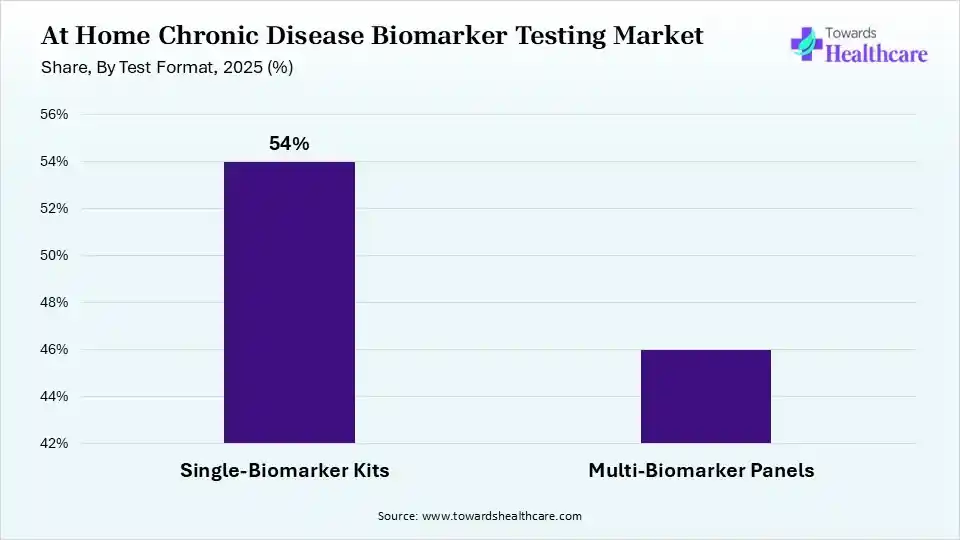
Single-biomarker kits dominated the market with a 54.00% share in 2025, driven by demand for routine at-home testing, including HbA1c and urine albumin tests. Their focused approach makes them suitable for monitoring specific chronic disease indicators.
Multi-biomarker panels is growing demand for comprehensive health monitoring is supporting adoption. In May 2026, Noom introduced a USD 125 at-home testing kit covering 17 biomarkers, including HbA1c, ApoB, and Lp(a), while Function Health offers a subscription covering 160 biomarkers.
Diabetes testing led the market with a 34.00% share in 2025, supported by the growing need for regular blood glucose and HbA1c monitoring.
Cardiovascular testing driven by increasing demand for monitoring cholesterol, ApoB, and other heart health indicators.
Kidney disease testing: Everly Health offers an at-home eGFR and UACR testing kit designed to support the KED HEDIS measure.
Thyroid and hormone testing supported by demand for convenient monitoring of thyroid function and hormonal health.
Others, such as liver function, vitamin levels, and other biomarkers, collectively account for 16.00% of the market, reflecting growing interest in broader preventive health screening.
Online direct-to-consumer channels led the market with a 46.00% share in 2025 and are projected to grow at a CAGR of 11.64%. Easy access to testing kits, home sample collection, and digital result tracking are supporting channel growth.
Health plans and employers driven by initiatives to improve preventive screening and chronic disease management. Employer wellness programs and payer-funded testing kits further support adoption.
Retail pharmacies benefiting from their established consumer reach and convenient access to diagnostic products. Their physical presence also helps consumers purchase at-home testing kits more easily.
Analyst View: Multi-biomarker panels and kidney disease testing are expected to gain market share at a faster pace, supported by demand for comprehensive health monitoring and preventive screening. However, single-biomarker kits, diabetes testing, and online direct-to-consumer channels are likely to retain their leading positions throughout the forecast period.
Note: 2025 is the base year; 2035 shares and CAGRs are forecasts.
Sources: Expert interviews, secondary sources, Towards Healthcare database, and Towards Healthcare analysts.
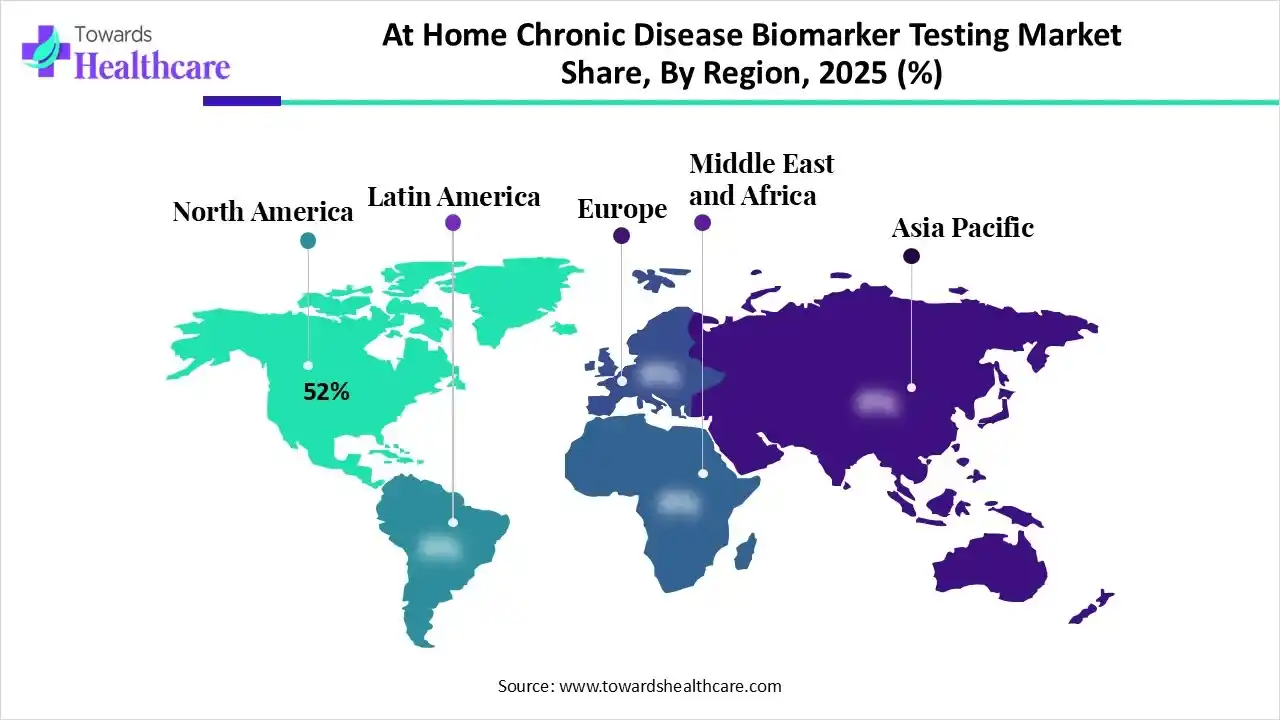
North America leads because health plans and consumer platforms use home kits, while Asia Pacific grows fastest with rising diabetes.
North America dominated the market with a 52.00% revenue share in 2025, supported by the growing adoption of at-home chronic disease testing. U.S. health plans increasingly use home testing kits to support HEDIS quality measures and close screening gaps. Consumer health platforms such as Everlywell, Function Health, and Noom are expanding direct-to-consumer access to biomarker testing. Strong digital health infrastructure and rising preventive healthcare awareness further strengthen regional growth.
Europe is growing consumer interest in preventive healthcare and convenient diagnostic services is supporting demand for home blood testing. Companies such as Thriva and online diagnostic laboratories are making biomarker testing more accessible through direct-to-consumer platforms. Increasing adoption of digital healthcare services is also supporting regional market expansion.
Asia Pacific is rising diabetes prevalence in China and India is increasing the need for accessible and routine biomarker monitoring. Growing healthcare awareness, expanding digital health services, and wider smartphone adoption are creating opportunities for at-home testing providers. Improving access to preventive screening is expected to further accelerate regional demand.
Latin America is growing awareness of chronic disease management and the need for accessible diagnostic solutions are supporting demand for at-home testing. Expanding digital healthcare services and online distribution channels may create further opportunities for market participants.
The Middle East and Africa is increasing healthcare investments and rising awareness of diabetes and cardiovascular disease are creating opportunities for home-based biomarker testing. Gradual improvements in healthcare access and digital health infrastructure are expected to support future market development.
Analyst View: North America is expected to maintain its market leadership, supported by established health plan programs, consumer testing platforms, and strong digital healthcare infrastructure. Meanwhile, Asia Pacific is projected to experience the fastest growth, driven by rising chronic disease prevalence, expanding healthcare access, and increasing demand for convenient preventive testing.
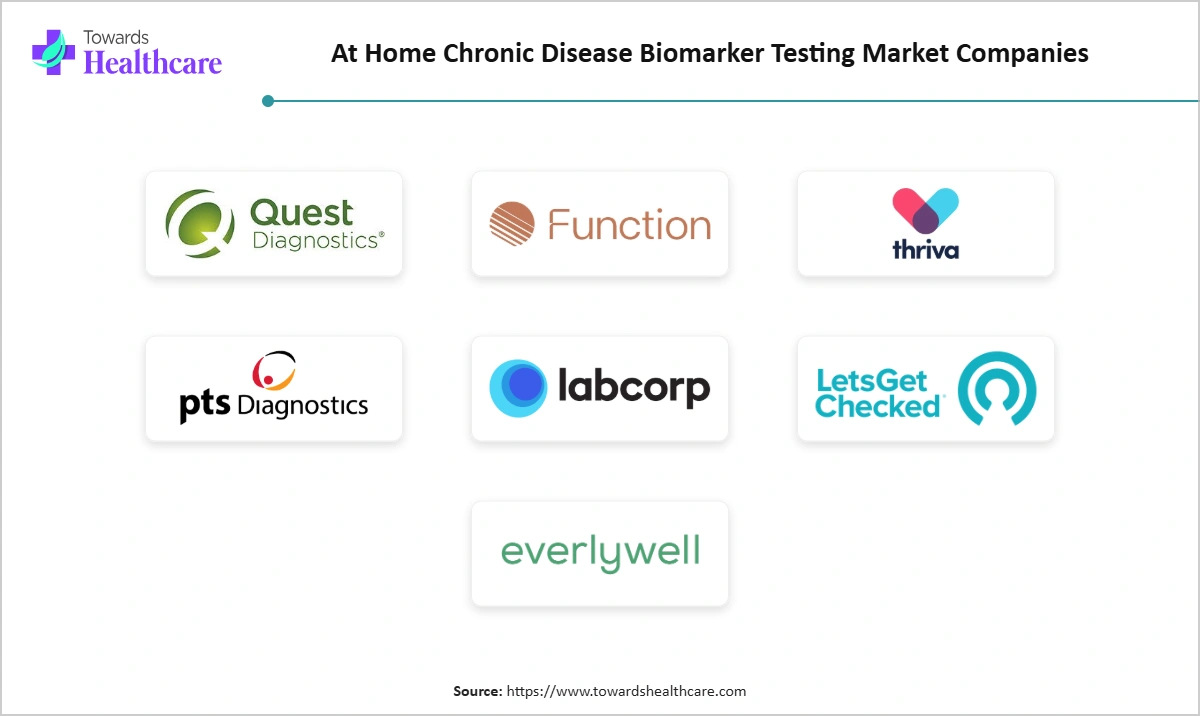
| Rank | Company Name | 2025 Share (%) | Key Products / Business | Headquarters |
| 1 | Everlywell | 10.00% | home collection kits and health plan programs | United States |
| 2 | LetsGetChecked | 8.00% | home lab tests | Ireland |
| 3 | Quest Diagnostics | 8.00% | questhealth.com consumer tests | United States |
| 4 | Labcorp | 7.00% | Labcorp OnDemand kits | United States |
| 5 | Function Health | 5.00% | multi-biomarker subscriptions | United States |
| 6 | PTS Diagnostics | 4.00% | A1CNow and CardioChek | United States |
| 7 | Healthy.io | 3.00% | smartphone kidney tests | Israel |
| 8 | Thriva | 2.00% | home blood tests | United Kingdom |
| 9 | imaware | 2.00% | home test kits | United States |
| 10 | Noom | 1.00% | biomarker kits for members | United States |
Note: Company shares are 2025 estimates.
Sources: Company press releases, expert interviews, secondary sources, Towards Healthcare database and Towards Healthcare analysts.
Everlywell led the at-home chronic disease biomarker testing market with an estimated 10.00% share of 2025 revenue, followed by LetsGetChecked at 8.00% share and Quest Diagnostics at 8.00% share. Everlywell leads with home collection kits and health plan programs, LetsGetChecked competes with home lab tests, and Quest Diagnostics offers questhealth.com consumer tests. Labcorp, Function Health, PTS Diagnostics, Healthy.io, Thriva, imaware, and Noom compete through labcorp OnDemand kits, multi-biomarker subscriptions, a1CNow and CardioChek, smartphone kidney tests, home blood tests, home test kits, and biomarker kits for members.
The top companies accounted for an estimated 50.00% of 2025 revenue, while the remaining 50.00% was shared among many digital health firms and labs. The at home chronic disease biomarker testing market is fragmented. Everlywell, LetsGetChecked, and the large U.S. labs lead, while subscription platforms compete on panel size and app insights.
Everlywell, headquartered in the United States, accounted for an estimated 10.00% of the at-home chronic disease biomarker testing market in 2025. Its market presence is supported by a broad portfolio of home sample-collection kits and partnerships with health plans. The company is positioned as a Leader in the Towards Healthcare Companies Quadrant.
LetsGetChecked based in Ireland, LetsGetChecked held an estimated 8.00% revenue share in 2025, primarily through its range of at-home laboratory testing solutions. Its direct-to-consumer model and convenient home testing services strengthen its market presence.
Quest Diagnostics captured approximately 8.00% of the market in 2025, leveraging its consumer-focused testing portfolio through questhealth.com. Headquartered in the United States, the company combines its established diagnostic capabilities with direct access to at-home testing services.
Labcorp held an estimated 7.00% market share in 2025, supported by its Labcorp OnDemand platform and range of at-home testing kits. The U.S.-based company benefits from its established laboratory network and expanding consumer testing services.
Function Health accounted for an estimated 5.00% of the market in 2025, driven by its subscription-based approach to multi-biomarker testing. Headquartered in the United States, the company focuses on providing consumers with access to comprehensive health insights through its extensive biomarker panels.
PTS Diagnostics held an estimated 4.00% market share in 2025, supported by its A1CNow and CardioChek product lines. Based in the United States, the company offers testing solutions focused on diabetes and cardiovascular health monitoring. It is positioned as a Leader in the Towards Healthcare Companies Quadrant.
Healthy.io maintained an estimated 3.00% revenue share, with its market presence largely driven by smartphone-enabled kidney testing solutions. Headquartered in Israel, the company combines mobile technology with at-home diagnostic testing to simplify kidney health monitoring.
Thriva, based in the United Kingdom, held an estimated 2.00% market share in 2025, supported by its portfolio of at-home blood testing services. The company focuses on making biomarker monitoring more accessible through convenient home sample collection and digital health insights.
imaware, headquartered in the United States, accounted for approximately 2.00% of the market through its range of at-home diagnostic testing kits. Its consumer-focused testing solutions provide convenient access to biomarker information without requiring routine laboratory visits. The company is classified as an Innovator in the Towards Healthcare Companies Quadrant.
Noom captured an estimated 1.00% of the at-home chronic disease biomarker testing market in 2025, with its presence supported by biomarker testing kits offered to its members. Headquartered in the United States, the company is extending its digital health and wellness ecosystem into at-home testing. It is positioned as an Innovator.
The at-home chronic disease biomarker testing ecosystem links device & kit makers, laboratories, digital platforms, payers & employers, and regulators, with each stage adding value before products reach end users. Results feed telehealth visits and precision medicine programs, and some platforms add human microbiome and probiotics tests to their panels.
| Ecosystem Stage | Role in the Market | Key Companies |
| Device & Kit Makers | Make collection kits | PTS Diagnostics, kit suppliers |
| Laboratories | Run tests | Quest, Labcorp, partner labs |
| Digital Platforms | Sell and report | Everlywell, Function Health, Noom |
| Payers & Employers | Fund tests | health plans, employers |
| Regulators | Set rules | FDA, CMS (CLIA) |
Sources: Company press releases, expert interviews, secondary sources, Towards Healthcare database and Towards Healthcare analysts.
Device & Kit Makers: Develop at-home testing kits that collect finger-prick blood or urine samples for chronic disease biomarker monitoring.
Laboratories: Process and analyse collected samples to generate reliable test results for consumers and healthcare providers.
Digital Platforms: Provide online access to test results, biomarker tracking, and personalized health insights or recommendations.
Payers & Employers: Purchase or subsidize testing kits to improve preventive screening, support chronic disease management, and close healthcare gaps.
Regulators: Establish safety, quality, and performance standards to ensure the reliability of at-home diagnostic tests.
Value in the at home chronic disease biomarker testing market flows from upstream material and technology suppliers to manufacturers and service providers, then through distribution partners to end users. Companies that integrate several stages or build long-term relationships with end users capture a larger share of this value.
The Towards Healthcare Companies Quadrant positions key participants in the at home chronic disease biomarker testing market by market strength, reflecting revenue scale, market share, and geographic reach, and by innovation and growth strategy, reflecting product portfolio breadth, R&D intensity, and partnerships. Positions reflect each company's estimated 2025 share of the at home chronic disease biomarker testing market and our assessment of its product innovation, portfolio breadth, and partnerships.
Sources: Company press releases, expert interviews, secondary sources, Towards Healthcare database and Towards Healthcare analysts.
Leaders: Everlywell, LetsGetChecked, Quest Diagnostics, Labcorp, Function Health and PTS Diagnostics combine high market share with broad portfolios and strong innovation.
Innovators: Healthy.io, Thriva, imaware and Noom bring newer technologies and specialised products.
By Test Format
By Condition
By Channel
By Region
The at-home chronic disease biomarker testing market encompasses home-based testing solutions and sample-collection kits used to monitor biomarkers associated with chronic health conditions worldwide. The market includes single-biomarker kits and multi-biomarker panels covering diabetes (HbA1c), cardiovascular health (lipids, ApoB, and Lp(a)), kidney function (eGFR and UACR), thyroid and hormonal health, and other conditions. These products are distributed through online direct-to-consumer platforms, health plans, employer-sponsored programs, and retail pharmacies.
The 2025 market valuation was developed using a bottom-up approach based on testing volumes and average selling prices across test formats, conditions, distribution channels, and geographic regions. The estimates were cross-validated through a top-down assessment of market-specific revenues reported by leading companies and publicly available industry data. Segment, regional, and company-level valuations were allocated according to the respective demand patterns across these categories.
Key assumptions were further assessed against company disclosures, regulatory information, industry databases, and published third-party estimates. Inputs that could not be independently reconciled were excluded from the analysis. All segment, regional, and company estimates were aligned with the same 2025 base year, while the 2026-2035 projections were recalculated using a consistent CAGR methodology and validated for overall market consistency.
Analyst View: We expect the at home chronic disease biomarker testing market to grow fast. Accuracy concerns and limited reimbursement are the main risks.