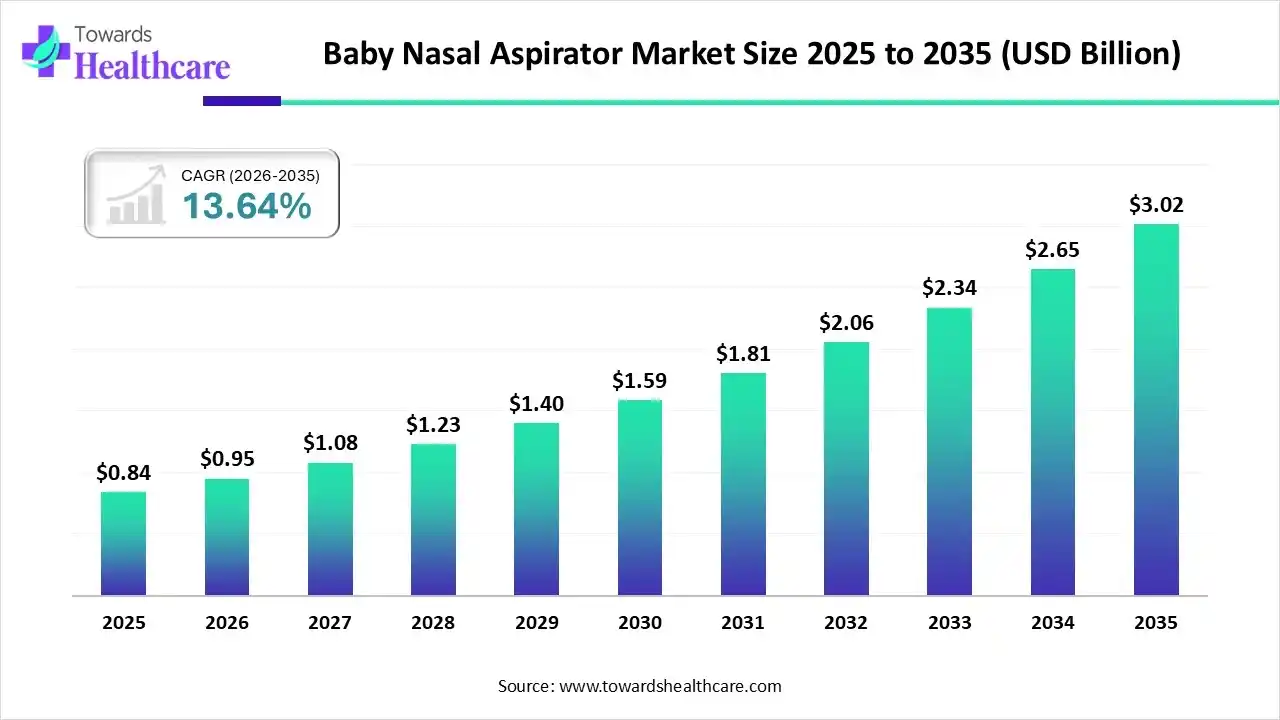
The global baby nasal aspirator market size was estimated at USD 0.84 billion in 2025 and is predicted to increase from USD 0.95 billion in 2026 to approximately USD 3.02 billion by 2035, expanding at a CAGR of 13.64% from 2026 to 2035.
The baby nasal aspirator market is growing, as it offers relief from nasal congestion with a nasal aspirator. These healthcare tools help prevent mucus from getting into the baby's throat.
The baby nasal aspirator market is growing because of rising health awareness among parents and the development of baby care products. Nasal aspirators are a product favoured by parents. These snot-sucking devices moderately remove mucus in a child's nasal passageways. It is intended to safely and efficiently remove mucus or nasal secretions from a baby's nasal passages, supporting them breathe more effortlessly. Nasal congestion is a challenge in infants, particularly since they are unable to blow their noses. There are different types of nasal aspirators available in the healthcare sector. The common types include bulb syringe aspirators, physical suction aspirators, and electric aspirators.
Integration of AI-driven technology in baby nasal aspirators drives market growth, as neonatology involves devices for significant signs monitoring, disease prediction, and challenges stratification, neurological diagnostic and predictive support, and new image recognition technologies, which are specifically useful for prompt recognition of infections. AI-based incorporation in paediatric nasal aspirators is facilitating smarter tools capable of adapting to individual patient circumstances. AI-driven technology demonstrated promising accuracy in identifying respiratory conditions, creating the way for real-time, smartphone-based breathing monitoring.
| Table | Scope |
| Market Size in 2026 | USD 0.95 Billion |
| Projected Market Size in 2035 | USD 3.02 Billion |
| CAGR (2026 - 2035) | 13.64% |
| Leading Region | North America by 39% |
| Key Applications | Infant nasal congestion relief, cold and flu symptom management, allergy-related mucus removal, newborn respiratory hygiene, pediatric home care |
| Primary End Users | Parents and caregivers, pediatric clinics, hospitals, maternity centers, pharmacies, online healthcare retailers |
| Key Challenges | Low product differentiation, safety concerns regarding suction strength, regulatory compliance requirements, price sensitivity in emerging markets, competition from low-cost generic products |
| Measurable Values | USD Millions/Units/Volume |
| Market Segmentation | By Product, By Scale of Operation, By Application, By Industry, Regional Outlook |
| Top Key Players | NoseFrida, Safety 1st, Pigeon, Braun, Dr. Brown’s, Graco |
| Segments | Shares % |
| Electric Nasal Aspirators | 34% |
| Manual Nasal Aspirators | 24% |
| Battery-Operated Nasal Aspirators | 21% |
| Disposable Nasal Aspirators | 11% |
| Portable Nasal Aspirators | 10% |
Which Type Led the Baby Nasal Aspirator Market in 2025?
In 2025, the electric nasal aspirators segment held the dominant market by 34% share in 2025, due to electric nasal aspirators being easy to operate and typically having a strength adjustment function, which is appropriate for sucking out more stubborn nasal secretions or mucus. Electric nasal aspirators are generally intended with noise reduction functions to lower the interference with the baby's emotions. It provides effectiveness, hygiene, and comfort via consistent pressure and reliable performance.
Battery-Operated Nasal Aspirators
Whereas the battery-operated nasal aspirators segment is the fastest-growing in the market, as battery-operated nasal aspirators are a type of machine that is generally lightweight, compact, and simply portable. They serve as reliable backup tools in medical care facilities, ensuring that airway management continues in the event of power outages or apparatus failures. Consumers precisely control the level of suction by adjusting the force and speed with which they work the hand pump.
| Segments | Shares % |
| Cold & Flu Treatment | 46% |
| Allergy Treatment | 24% |
| Sinus Treatment | 18% |
| Post-Surgery Nasal Care | 12% |
Why did the Cold & Flu Treatment Segment Dominate the Market in 2025?
The cold & flu treatment segment is dominant in the baby nasal aspirator market by 46% share in 2025, as an aspirator is intended for newborns and infants, providing significant, gentle suction to relieve nasal congestion/blocked nose caused by colds and flu treatment. Rapidly eliminates extra mucus, offering instant relief from a runny nose or nasal congestion. A nasal aspirator makes feeds smoother and sleep more settled when congestion is the main challenge.
Allergy Treatment
Whereas the allergy treatment segment is the fastest-growing in the market, as a nasal aspirator makes feeds smoother and sleep more established when congestion is the main problem. Major electric models feature easy-to-disassemble parts and anti-backflow designs, with mucus collecting in a separate chamber, which prevents contamination of internal components and makes cleaning and sanitizing the tools simpler and more efficient than outdated bulb syringes.
| Segments | Shares % |
| Homecare Settings | 57% |
| Hospitals | 19% |
| Pediatric Clinics | 15% |
| Baby Nurseries | 9% |
Why did the Homecare Settings Segment Dominate the Market in 2025?
The homecare settings segment is dominant in the baby nasal aspirator market by 57% share in 2025, as portable suction machines are lightweight and compact, creating them good for use in emergencies or for home healthcare. These tools are battery-operated, which enables mobility and flexibility in various settings. The aspirator is mounted on a wall so that these machineries give some free space in healthcare settings.
Pediatric Clinics
Whereas the pediatric clinics segment is the fastest-growing in the market, the applications of an automatic nasal aspirator in pediatric patients with a history of recurring breathless was related to enhanced respiratory health during the cold season. Most electric aspirators are intended for ergonomic one-handed use, allowing a physician or parent to use their other hand to support or comfort the child.
| Segments | Shares % |
| Newborns | 38% |
| Infants (0–12 months) | 31% |
| Toddlers (1–3 years) | 21% |
| Preschool Children | 10% |
Why did the Newborns Segment Dominate the Market in 2025?
The newborns segment is dominant in the baby nasal aspirator market by 38% share in 2025, as modern nasal aspirators provide an effective and safe process, making them suitable even for newborns and simple to use for parents. Rapidly removes excess mucus, offering immediate relief from a runny nose or nasal congestion. It provides effectiveness, hygiene, and comfort via consistent pressure, reliable performance, and no guesswork with suction strength.
Toddlers (1–3 years)
Whereas the toddlers (1–3 years) segment is the fastest-growing in the market, the use of an automatic nasal aspirator in offspring with a history of recurrent wheezing was related to enhanced respiratory fitness throughout the cold season. These devices provide relief, help breathing, and support to prevent complications such as ear infections. It provides efficiency, hygiene, and comfort via reliable performance, consistent pressure, and no guesswork with suction strength.
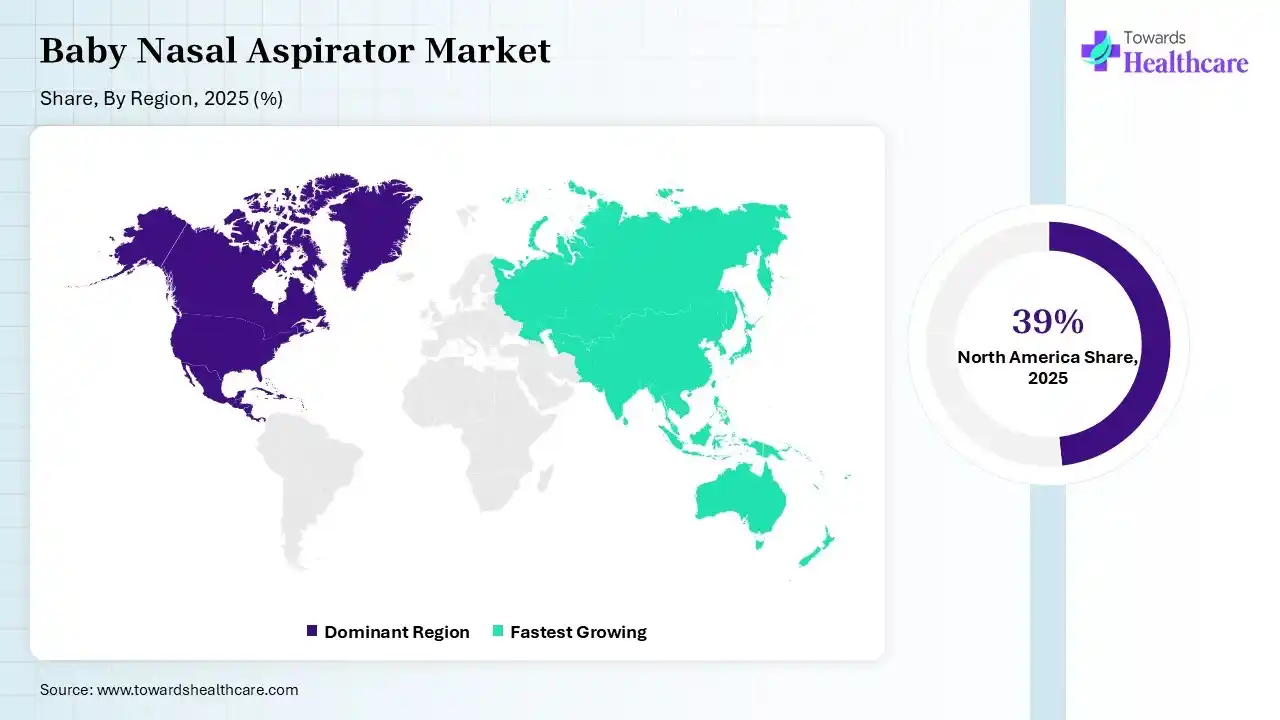
In 2025, North America dominated the baby nasal aspirator market by 39% because of the increasing wellness economy, also one of the fastest-growing healthcare sectors. The broader wellness economy has grown rapidly, presenting novel perspectives in biohacking, apoptogenic beverages, nervous system science, wearable technology, cultural ritual, and sustainable innovation. Growing awareness of the impact of nutrition on overall health. Many North Americans are moderating alcohol consumption to enhance mental well-being, sleep, and overall health.
For Instance,
U.S. Market Trends
In the U.S., growing respiratory infections and tuberculosis caused 339,703 cases per 100,000 people, with major cases being upper respiratory infections and deaths being reduced respiratory infections. Constant technical novelties, like smart ventilators, associated CPAP systems, and oxygen therapy tools. Increasing stress levels in the parents and caregivers are rising, according to the U.S. Surgeon General.
Asia Pacific is expected to see rapid growth in the baby nasal aspirator market, driven by increasing awareness of developing healthcare milestones and nutrition. Growing consciousness in the parents related to respiratory health in children. Rapid technological development and the pandemic have led to quicker e-commerce growth. Growing awareness of infant hygiene and rising cases of nasal congestion which contributes the growth of the market.
India Market Trends
India has 18% of the worldwide population and a growing challenge of chronic respiratory diseases. Around 400 000 children aged below five years die every year from ARI-driven diseases. Increasing E-health consistently shows improvement in the quality of care, enhances adherence to therapy, and enables early identification of challenges in chronic pulmonary diseases.
Europe is growing significantly in the baby nasal aspirator market, as respiratory syncytial virus (RSV) continues to be the main cause of acute lower respiratory tract infections in children across Europe. Pediatric respiratory diseases pose a significant worldwide health issue in Europe, with continuing research advances attracting considerable interest from both the medical field and the public health sector. There is a noteworthy cultural lean toward non-invasive, drug-free medicines for child congestion, making aspirators a standard nursery staple, which contributes to the growth of the market.
| Ecosystem Category | Market Participants / Explanation |
| Product Manufacturers | Companies developing and selling baby nasal aspirators, including manual, electric, and hospital-adapted suction products. |
| Medical Device Companies | Pediatric healthcare device manufacturers producing respiratory care equipment and infant care solutions. |
| Consumer Healthcare Brands | Baby-care brands integrating nasal hygiene products into broader infant wellness portfolios. |
| Retail & Distribution Platforms | Pharmacies, baby-care retailers, online marketplaces, and healthcare distributors enabling global product availability. |
| Technology Providers | Battery technology, compact motor systems, suction-control technologies, and ergonomic design providers supporting electric aspirator innovation. |
| Healthcare Providers | Pediatric hospitals, clinics, and neonatal care centers using professional suction equipment and recommending infant respiratory products. |
| Research Institutions | Pediatric respiratory research centers studying infant airway health, congestion management, and respiratory infections. |
| End-User Industries | Baby care, consumer healthcare, pediatrics, maternity care, home healthcare |
R&D:
Manufacturing Processes:
Patient Services:
| Tier 1 | Tier 2 | Tier 3 | |
| Typical Market Influence | 52% | 33% | 15% |
| Tier 1 | ||||
| Company Name | Headquarters | Country | Why Relevant to This Market | Key Products/Services |
| Koninklijke Philips N.V. | Amsterdam, Netherlands | Netherlands | Global leader in healthcare technology and consumer health products with strong pediatric respiratory-care presence | Philips Avent nasal aspirators, infant care products |
| Nuk | Zeven, Lower Saxony, Germany | Germany | Major infant-care brand with worldwide distribution and baby hygiene portfolio | NUK nasal aspirators, baby-care accessories |
| Pigeon Corporation | Tokyo, Japan | Japan | Established global baby-care manufacturer with strong newborn product ecosystem | Pigeon nasal aspirators, infant hygiene products |
| Tier 2 | ||||
| Company Name | Headquarters | Country | Why Relevant to This Market | Key Products/Services |
| Frida | Miami, Florida, USA | United States | Strong direct-to-consumer baby healthcare brand known for newborn problem-solving products | FridaBaby NoseFrida nasal aspirator |
| Chicco | Grandate, Como, Italy | Italy | Global infant-care brand offering healthcare and hygiene products | Chicco nasal aspirators, baby respiratory products |
| Braun | Kronberg im Taunus, Germany | Germany | Consumer healthcare leader with pediatric health devices | Braun electric nasal aspirators |
| Tier 3 | ||||
| Company Name | Headquarters | Country | Why Relevant to This Market | Key Products/Services |
| Rumble Tuff | Cedar City, Utah, USA | United States | Specialized maternal and infant-care product manufacturer | Baby nasal aspirators and infant accessories |
| NoseFrida | Miami, Florida, USA | United States | Specialized nasal-care brand with strong recognition in infant congestion relief | Manual nasal aspirator systems |
| Little Martin's Drawer | United States | United States | Niche manufacturer focused on baby-care electronics | Electric baby nasal aspirators |
Strengths
Weaknesses
Opportunities
Threat
By Product Type
By Application
By End User
By Age Group
Regional Outlook





Principal Consultant
Shivani Zoting is a dedicated research analyst specializing in the healthcare industry. With a strong academic foundation, a B.Sc. in Biotechnology and an MBA in Pharmabiotechnology, she brings a unique blend of scientific understanding and strategy.
Learn more about Shivani Zoting
Reviewed By
Aditi Shivarkar is a seasoned professional with over 14 years of experience in healthcare market research. As a content reviewer, Aditi ensures the quality and accuracy of all market insights and data presented by the research team.
Learn more about Aditi Shivarkar