


The China medical robotics market size was estimated at USD 1881.57 million in 2025 and is predicted to increase from USD 2176.79 million in 2026 to approximately USD 8081.25 million by 2035, expanding at a CAGR of 15.69% from 2026 to 2035. Analysis also highlights that the China medical robotics market is rapidly expanding due to increasing robotic systems healthcare applications, growing AI integration, domestic medical-device development, shift towards minimally invasive procedures, and advancements in healthcare infrastructure.
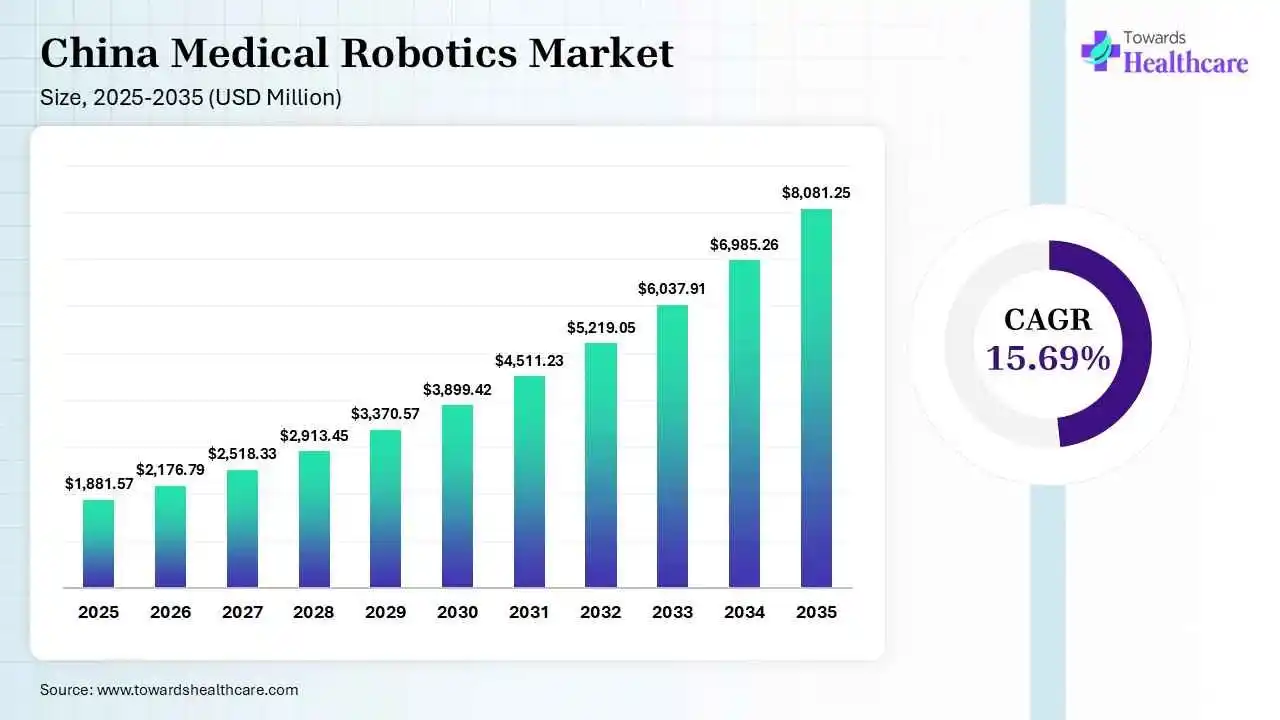
China's medical robotics refers to the field combining medicine, computer science, and engineering used to assist healthcare professionals in enhancing healthcare delivery across China. They include robotic systems used across surgical procedures, rehabilitation, hospital logistics, pharmacy automation, imaging, radiosurgery, emergency response, patient transportation, and other healthcare applications. Increasing healthcare automation, aging demographics, domestic medical-device development and integration of AI, demand for minimally invasive procedures, imaging and software technologies, and expansion of advanced hospitals are driving the market expansion.
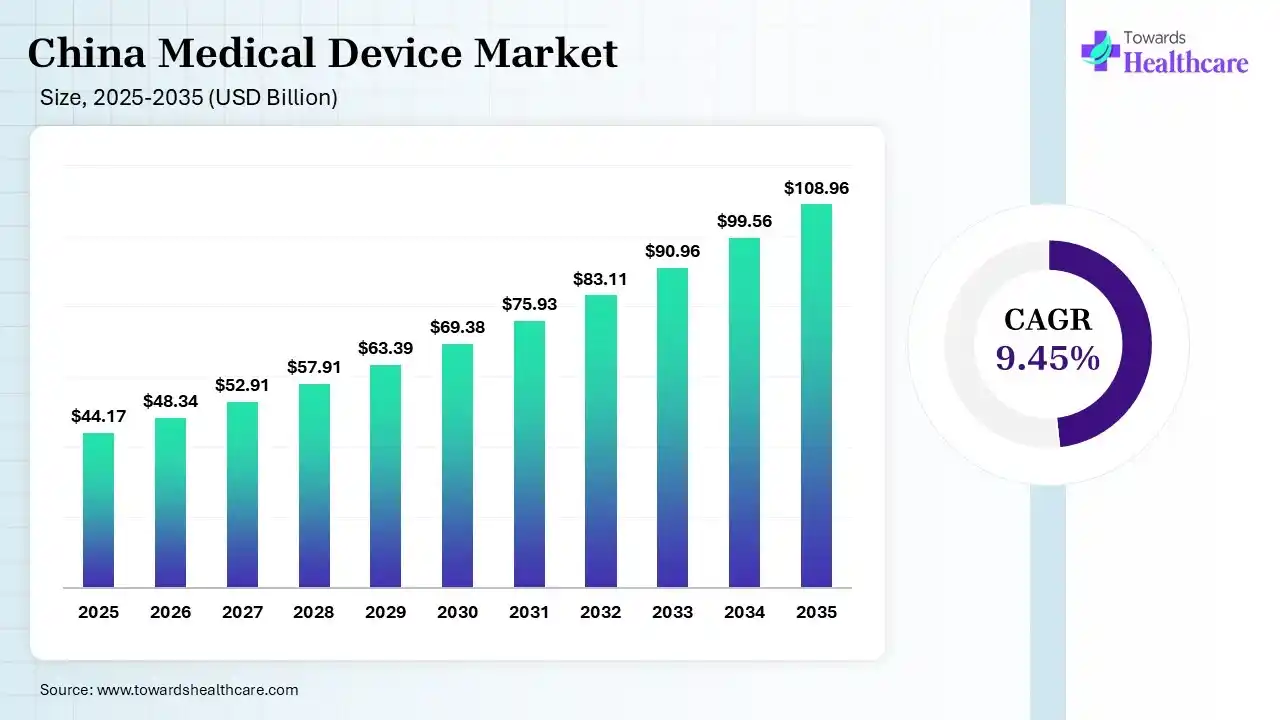
The China medical-device market was valued at US$44.17 billion in 2025 and is anticipated to grow at 9.45%, driven by important market drivers, aging, chronic disease, healthcare infrastructure, AI integration, government support, and domestic manufacturing. Additionally, Towards Healthcare estimates the global robotic surgery market was valued at US$13.79 billion in 2025 and is anticipated to grow at a 16.54% CAGR during the forecast period, where orthopedics is the leading application, and ASC is the fastest-growing end-user category.
Analyst View - Market Size
Chinese medical robotics is among the faster-growing areas of medical technology, with its 15.69% CAGR, which is driven by three overlapping demand pools.
The higher installation rate promotes recurring demand for instruments, accessories, consumables, software, maintenance, training, and integration services, expanding commercial opportunity beyond initial robot-system sales.
Surgical Robots Segment Dominates the Market with 55% share in 2025
| Segment/Sub-segment Name | Market Share | CAGR | Growth Driver |
| Surgical Robots | 55.00% | 17.80% | Hospitals expand robotic-assisted procedures; domestic systems broaden adoption; procedure volumes support recurring instruments |
| Rehabilitation Robots | 20.00% | 16.90% | Aging population, robotic gait/limb therapy and home rehabilitation |
| Hospital & Pharmacy Robots | 12.00% | 19.40% | Pharmacy automation, logistics automation and labor-efficiency requirements |
| Non-Invasive Radiosurgery Robots | 5.00% | 14.80% | Cancer-treatment capacity and precision radiation |
| Imaging Robots | 3.00% | 18.70% | Robotic imaging, AI-assisted imaging and diagnostic throughput |
| Emergency Response Robotic Systems | 1.00% | 18.20% | Emergency logistics and high-risk environments |
| Medical Transportation & Handling Robots | 2.00% | 17.60% | Autonomous internal transportation and material delivery |
| Other Medical Robots | 2.00% | 15.90% | Telemedicine, assistive robotics and emerging platforms |
As per our research, the table highlights medical robotics types, market share, and CAGR. The surgical robots segment dominated the market with a 55% share in 2025 due to growth in robotic-assisted procedures, broader clinical adoption, and a rise in recurring instrument demand. The hospital & pharmacy robots segment is anticipated to expand rapidly at a 19.40% CAGR during the forecast period due to hospitals automating medication and material workflows, improving dispensing accuracy, and increasing logistics automation.
Analyst View - Type
The surgical robots segment held more than half of the supplied market, which made it a commercial anchor, and its relatively high 17.8% CAGR is also driving its fast growth. On the other hand, the hospital and pharmacy robots segment has the highest CAGR of 19.4%, which opens new opportunities for suppliers that currently depend heavily on capital-intensive surgical platforms. This hierarchy also highlights a transition from robots used exclusively for specialist procedures toward broader hospital automation, such as pharmacy dispensing, logistics, disinfection, and transportation.
The surgical robotics segment includes a wide range of robots such as laparoscopic surgical robots, orthopedic surgical robots, neurosurgical robots, cardiovascular & vascular robots, gynecological surgical robots, urological surgical robots, dental surgical robots, natural-orifice & endoluminal robots, and percutaneous surgical robots.
Based on Towards Healthcare's global robotic-surgery research, orthopedics, neurology, urology, gynecology, and general surgery are considered the major applications, with orthopedics contributing to the dominant application and general surgery as the high-growth application.
Analyst View - Surgical Robotics
China's opportunity is expanding beyond replicating a single robotic surgery platform to a broader addressable market that includes specialty systems designed around procedure-specific instruments, navigation, imaging, AI-assisted planning, and specialty workflows. Orthopedic and urological applications are particularly relevant to procedure-specific robotics, whereas laparoscopic platforms contribute to a broader procedural base. Furthermore, in the near future, differentiation is likely to shift toward clinical indication coverage, software, instrument ecosystems, surgeon training, and imaging integration.
Equipment Segment Leads the Market with 68%
| Segment/Sub-segment Name | Market Share | CAGR | Growth Driver |
| Equipment | 68.00% | 15.90% | Direct hospital investment, domestic manufacturing, and expanding indications |
| Instruments & Accessories | 19.00% | 18.80% | Higher procedure volumes and recurring disposable/accessory demand |
| Consumables | 7.00% | 17.30% | Procedure growth and specialized kits |
| Services | 6.00% | 17.90% | Maintenance, integration, software and training |
Based on the information gathered, the table encompasses product types with their market share and CAGR. The equipment segment led the market with a 68% share in 2025 due to growth in robotic platforms investment by hospitals, enhanced equipment availability by expansion of domestic manufacturing, and a rise in utilization due to new clinical indications. The instruments & accessories segment is expected to show the fastest growth with 18.80% CAGR during the predicted period, due to higher procedure volumes increasing instrument demand, disposable accessories generating recurring revenue, and more robotic procedures expanding accessory consumption.
Analyst View - Product
Medical robots require significant upfront capital expenditure, which contributes to equipment segment dominance, whereas the instruments and accessories segment is expanding at an 18.8% CAGR, creating recurring revenue after system installation.
This produces a two-layer revenue model:
Thus, manufacturers capable of launching installed-base models can build recurring revenue streams instead of relying exclusively on new system placements.
Clinical Segment Held a Dominant Share of 72% of the Market
| Segment/Sub-segment Name | Market Share | CAGR | Growth Driver |
| Clinical | 72.00% | 16.10% | Robotic clinical procedures, minimally invasive surgery, and clinical evidence |
| Pharmacy | 11.00% | 19.70% | Automated dispensing, centralized pharmacy and robotic compounding |
| Research | 7.00% | 15.80% | University robotics programs, simulation and domestic R&D |
| Hospital Operations | 10.00% | 18.90% | Logistics, disinfection, telepresence and transportation |
As per the analysis conducted, the clinical segment held the major market share of 72% in 2025 due to growth in hospital-based robotic-assisted clinical procedures, minimally invasive techniques, which increased system utilization, and expansion of application towards broader indications. The pharmacy segment is anticipated to show the highest growth with 19.70% CAGR during the predicted period as it improves medication workflows, centralizes pharmacy operations, and supports precision and traceability.
Analyst View - Application
The largest revenue base is held by the clinical applications segment, while the stronger growth rates are demonstrated by the pharmacy segment and the hospital operations segment. This is strategically significant because hospital robotics can expand even where hospitals are not ready to invest in complex surgical systems. The repetitive, measurable, and workflow-driven use case makes pharmacy automation particularly attractive. Throughput, accuracy, inventory control, and labor-efficiency metrics can evaluate dispensing, compounding, medication storage, and retrieval. Moreover, hospital/clinical care is identified as the largest application, while home healthcare is among the faster-growing areas as per Towards Healthcare's broader medical-service-robot research.
Inpatient Segment Contributed to 69% of Market Share
| Setting | Market Share | CAGR | Growth Driver |
| Inpatient | 69.00% | 15.80% | Large hospitals, high procedure volumes, and tertiary-care investment |
| Outpatient | 17.00% | 18.90% | Ambulatory procedures and compact robotic systems |
| Home Care | 8.00% | 18.60% | Aging, home rehabilitation and remote assistance |
| Research & Academic | 6.00% | 15.40% | Robotics laboratories, simulation and technology development |
The given the table highlights medical robotics types, market share, and CAGR. The inpatient segment held the largest share of the market with a 69% share in 2025 as large hospitals remained the primary deployment base, high procedure volumes supported equipment utilization, and tertiary hospitals expanded robotic capabilities. The outpatient segment is expected to show the fastest growth with 18.90% CAGR during the forecast period due to increasing ambulatory procedures, rising demand for compact robotic systems, and hospitals shifting suitable procedures toward day-care settings.
Analyst View - Setting
China's tertiary hospitals can support the surgical teams, infrastructure, and capital investment required for sophisticated robotic systems, which makes the inpatient environment the principal deployment base. Moreover, the outpatient segment's 18.9% CAGR drives a structural shift toward smaller and procedure-specific robotic platforms, while an important expansion pathway, particularly for orthopedic, laparoscopic, and rehabilitation applications, is highlighted by ASCs and specialty clinics.
Hospitals & Clinics Segment Held Major Revenue Share of 80.37%
| End User | Market Share | CAGR | Growth Driver |
| Hospitals & Clinics | 80.37% | 17.90% | Advanced hospital infrastructure and automation investment |
| Ambulatory Surgical Centers | 12.85% | 18.50% | Outpatient surgery and compact high-throughput systems |
| Pharmacies | 3.99% | 15.90% | Centralized dispensing and medication automation |
| Rehabilitation Centers | 1.72% | 17.30% | Neurological/orthopedic rehabilitation |
| Other End Users | 1.06% | 12.70% | Long-term care, home healthcare and emergency facilities |
According to the survey conducted, the hospitals & clinics segment led the market with an 80.37% share in 2025 due to high robotic system procurement, expansion of advanced surgical infrastructure, and growth in public and private hospitals' automation investments. The ambulatory surgical centers segment is expected to expand rapidly with an 18.50% CAGR during the upcoming years due to expanding outpatient surgery volumes, ASCs seeking compact high-throughput robotic systems, and shorter stays improving the economics of selected procedures.
Analyst View - End User
More than four-fifths of the supplied market contributes to the hospitals and clinics segment, which confirms that China medical robotics remains primarily an institutional B2B market. Additionally, a slightly higher growth rate than hospitals is reported by the ambulatory surgical centers segment, highlighting a meaningful expansion channel, while robotic rehabilitation moves beyond large hospitals, creating a second growth pathway for rehabilitation centers and home-health.
| TAM Indicator | 2025 Data | Forecast/Growth | Market Relevance |
| China Medical Devices Market | US$44.17B | 9.45% CAGR | Broad medical-device ecosystem |
| China Smart Healthcare Market | US$33.59B | 22.6% CAGR | Connected and automated healthcare ecosystem |
| China AI in Healthcare Market | US$2.67B | 41.20% CAGR | AI layer supporting robotic vision, navigation and decision systems |
| Global Robotic Surgery Market | US$13.79B | 16.54% CAGR | Technology benchmark for surgical robotics |
The table covers the China medical robotics TAM framework. It represents that the China medical devices market contributed the highest US$; the China smart healthcare market is anticipated to demonstrate high US$ growth; the China AI in healthcare market is expected to expand rapidly with the highest CAGR, while the global robotic surgery market is predicted to show significant growth.
Analyst View – TAM
The intersection of medical devices + smart healthcare + AI + robotics is considered the broadest opportunity instead of medical robotics alone. A technology tailwind for remote monitoring, intelligent workflow management, and robots incorporating computer vision, navigation, and AI-assisted planning is provided by the high growth of China's AI-healthcare market.
| SAM Layer | Relevant Market | Commercial Relevance |
| Surgical robotics | Laparoscopic, orthopedic, neurosurgical, cardiovascular, gynecological, urological | Largest immediate clinical robotics opportunity |
| Rehabilitation robotics | Exoskeletons, gait training, upper/lower limb | Aging and neurological/orthopedic rehabilitation demand |
| Hospital & pharmacy automation | Dispensing, compounding, logistics, disinfection | High-growth operational robotics opportunity |
| Imaging robotics | Ultrasound, endoscopy, robotic imaging | AI and minimally invasive procedure integration |
| Radiosurgery | Stereotactic radiosurgery and robotic positioning | Precision oncology opportunity |
| Hospital logistics | Autonomous transportation and material handling | Labor and workflow optimization |
| Home robotics | Home rehabilitation and remote assistance | Longer-term expansion opportunity |
Based on the information gathered by our multidisciplinary strategist, Aman Singh, the table reflects that surgical robotics contributes to the largest market opportunities, while hospital & pharmacy automation accounts for the high growth opportunities.
Analyst View - SAM
Surgical robots, rehabilitation robots, and hospital/pharmacy automation should be prioritized by the practical SAM instead of considering every emerging robotic technology as equally commercial. The direct clinical needs are addressed by the first two categories, whereas a separate purchasing case based on labor productivity, medication accuracy, and workflow efficiency is provided in hospital automation.
| Target | Commercial Role | Key Requirement |
| Tertiary hospitals | Core surgical-robot deployment | Capital budget, specialist surgeons and infrastructure |
| Academic medical centers | Early technology adoption and clinical validation | Research partnerships and clinical evidence |
| Specialty hospitals | Procedure-specific robotics | Indication-focused economics |
| Cancer centers | Radiosurgery and precision robotics | Oncology capacity and radiation infrastructure |
| Orthopedic centers | Orthopedic surgical and rehabilitation robots | Procedure volume |
| Cardiovascular centers | Cardiovascular/vascular robotics | Specialized surgical teams |
| Neuroscience centers | Neurosurgical robotics | Advanced imaging/navigation |
| ASCs | Growth channel | Compact systems and high throughput |
| Rehabilitation centers | Rehabilitation robots/exoskeletons | Therapy volume and trained staff |
The table illustrates the priority institutional deployment base. It covers different types of hospitals and specialty centers utilizing medical robotics for a wide range of applications.
Analyst View - SOM
The most realistic initial obtainable market consists of major academic medical centers, specialty hospitals, and tertiary hospitals in China's major healthcare clusters, along with ASCs and specialized rehabilitation centers. Therefore, deployment strategy should prioritize hospitals that already possess high procedure volumes, advanced imaging infrastructure, specialist surgical teams, robotic-training programs, capital-equipment procurement capability, and established digital hospital infrastructure.
| Consumer Behavior Factor | Market Evidence | Implication |
| Minimally invasive treatment preference | Robotic surgery supports minimally invasive procedures | Supports surgical robot utilization |
| Faster recovery expectation | Robotic surgery is positioned around less invasive procedures and shorter recovery | Influences patient willingness to consider robotic procedures |
| Advanced-treatment preference | Aging and chronic-disease burden increase demand for specialized treatment | Supports advanced robotic technologies |
| Precision expectations | Robotic systems provide enhanced visualization and instrument control | Increases perceived clinical value |
| Technology awareness | Growth of smart healthcare and AI healthcare | Improves familiarity with technology-enabled care |
| Medical-tourism demand | Advanced specialty procedures contribute to destination-care opportunities | Supports high-end hospital investment |
| Affordability | High robot acquisition and procedure costs can constrain adoption | Important for patient access and hospital ROI |
The above-mentioned table focuses on factors influencing consumer behavior, their evidence, and market implications. Moreover, Towards Healthcare identifies minimally invasive procedures, reduced blood loss, pain, scarring, and recovery time as factors supporting robotic surgery adoption.
Analyst View - Consumer Behavior
The medical robots are not purchased directly by patient, instead are influenced by the procedure-selection process. On the other hand, hospitals, surgeons, and payers control the actual purchasing decision. The strongest patient-facing value propositions include minimally invasive treatment, precision, recovery time, reduced procedural trauma, and access to advanced treatment, which in turn makes clinical evidence and physician communication particularly important for adoption.
| Buyer Intelligence Factor | Market Evidence/Requirement | Commercial Implication |
| Primary buyer | Hospitals and clinics | Core institutional procurement base |
| Secondary buyer | ASCs | Expanding outpatient opportunity |
| Capital expenditure | Robot systems require substantial upfront investment | ROI is central to procurement |
| Maintenance | Technical support and maintenance required | Creates recurring service revenue |
| Training | Surgeons, nurses and technicians require specialized training | Vendor training ecosystem matters |
| Clinical capability | Precision, visualization and procedure coverage | Key selection criterion |
| AI integration | AI, imaging and software increasingly integrated | Technology differentiation |
| Workflow integration | PACS, hospital IT and operating-room infrastructure | Interoperability is important |
| Domestic vs. imported systems | China is supporting domestic high-end medical technology | Local manufacturing can influence access and cost |
| Regulatory status | NMPA registration/approval | Essential commercialization requirement |
| Consumables | Instruments and disposable accessories | Determines recurring economics |
| Reimbursement/cost | Procedure economics affect utilization | Hospital value analysis |
| Service availability | Local installation and technical support | Important for system uptime |
The given table highlights buyer intelligence factors, their evidence, and market implications. The high system cost, maintenance, training, and operating expenses are important restraints on robotic-surgery adoption, as per Towards Healthcare.
Analyst View - Buyer Intelligence
A shift from robot acquisition price toward total cost of ownership is anticipated in the hospital procurement decision. Thus, hospitals evaluating a system need to consider capital cost + installation + training + maintenance + instruments + consumables + software + operating-room utilization + procedure volume + clinical outcomes, making installed-base economics critical. Furthermore, the need for expensive consumables, weak service coverage, or limited procedure compatibility makes lower-priced systems less attractive.
To optimize whole-life-cycle regulation and support innovative development of high-end medical devices, including medical robots, new measures were introduced by China's National Medical Products Administration (NMPA) in July 2025, according to Towards Healthcare reports. Moreover, structural market drivers such as government investment, favorable policies, and domestic manufacturing were also outlined in the China medical-device market research.
Analyst View - Regulatory Environment
Regulation acts as both a barrier and competitive differentiator. The NMPA registration, clinical evidence generation, software validation, cybersecurity, functional safety, robotic-system reliability, instrument traceability, post-market surveillance, and local technical support are important capabilities for manufacturers. China's emphasis on development of high-end domestic medical technologies provides benefits to domestic manufacturers, while established clinical evidence, global installed bases, and advanced technology drive competition among foreign suppliers.
As per Towards Healthcare analysis, China's AI-healthcare market accounted for US$2.67 billion in 2025 and is projected to expand at a 41.20% CAGR during the predicted period. On the other hand, China's broader smart-healthcare market was valued at US$33.59 billion in 2025 and is projected to expand significantly by 2035. Furthermore, the relevant robotic applications include computer vision, image-guided surgery, automated surgical planning, anatomical recognition, robotic navigation, motion prediction, surgical simulation, remote assistance, predictive maintenance, workflow automation, and intelligent pharmacy systems.
Analyst View - AI & Software
AI is anticipated to become a technology layer across medical robotics, instead of a separate robotic category. The effective AI integration with sensors, imaging, robotic controls, and clinical workflows will drive its commercial value, as well as provide additional recurring-revenue opportunities by analytics and AI-enabled modules, software subscriptions, and upgrades.
The global surgical robotics companies, Chinese medical-device manufacturers, rehabilitation-robot developers and hospital-automation suppliers are covered in this competitive landscape. Intuitive Surgical, Smith+Nephew, Medrobotics, TransEnterix, Renishaw, Stryker, THINK Surgical, Zimmer Biomet, Medtronic, and CMR Surgical are the companies identified in the global robotic-surgery research of Towards Healthcare. Similarly, based on medical-service-robot research of Towards Healthcare, additional companies such as Ekso Bionics, Hocoma, Cyberdyne, ReWalk Robotics, ABB Robotics, Aethon, Diligent Robotics, Kinova, Savioke, and OhmniLabs contribute to the market growth.
| Competitive Layer | Major Capability |
| Surgical robotics | Procedure precision, instruments, visualization |
| Orthopedic robotics | Navigation, planning and implant positioning |
| Rehabilitation robotics | Exoskeletons, gait and limb therapy |
| Pharmacy robotics | Dispensing, compounding and medication management |
| Hospital logistics | Autonomous navigation and delivery |
| Disinfection | Autonomous infection-control workflows |
| Imaging robotics | Automated imaging and image-guided intervention |
| AI robotics | Computer vision, navigation and clinical intelligence |
Based on our research, the table highlights competitive layers along with their major capabilities. It confirms that with the growing use of robotics, the procedure precision, treatment delivery, diagnostics, and other healthcare workflows can be improved, promoting market expansion.
Analyst View - Competitive Landscape
Therefore, considering the above-mentioned data, it is highlighted that competition is likely to become increasingly ecosystem-based rather than system-based, while additional revenue can be generated through instruments, accessories, software, training, and service contracts by manufacturers with a strong installed base. Moreover, competitive differentiation for Chinese suppliers can originate from lower total cost of ownership, localization, domestic service networks, procedure-specific systems, NMPA expertise, integration with Chinese hospital infrastructure, and AI/software capabilities. Additionally, the major purchasing considerations such as clinical evidence, installed base, specialized instruments, and surgeon familiarity provide advantages to the global suppliers.
| Procurement Factor | Hospital Question |
| Capital cost | What is the initial acquisition cost? |
| Procedure volume | Can sufficient procedures be performed annually? |
| Consumables | What is the cost per procedure? |
| Maintenance | What is the annual service requirement? |
| Training | How quickly can surgical teams become proficient? |
| Utilization | Can the system support multiple specialties? |
| Clinical outcomes | What evidence supports the system? |
| Operating-room time | Does robotics improve workflow or procedure efficiency? |
| Integration | Can it connect with imaging and hospital IT? |
| Upgradeability | Can software and instruments be upgraded? |
| Local support | Is technical service available within China? |
| Regulatory status | Is the intended application NMPA-approved? |
Table 12: The given table outlines robotic-system purchase evaluation. It covers procurement factors along with the questions raised by the hospitals. The questions revolve around the cost associated with the factors, their specifications, and workflow efficiency.
Analyst View – Procurement
The lowest equipment price will not necessarily be the strongest commercial proposition. Economic value across the complete system lifecycle is essential to be demonstrated by the suppliers. Higher utilization rates are driven by a system with multi-specialty capability, whereas stronger clinical differentiation can be provided by procedure-specific robots. Thus, pricing and sales strategy should be decided according to hospital size, procedure volume, and specialty mix by the vendors.
Only 12% of the supplied market is held by the hospitals & pharmacy robots, but 19.4% CAGR makes them the highest among the major type categories. They provide a wide range of applications across pharmacy, logistics, and hospital operations. For pharmacy, they provide pharmacy dispensing robots, medication compounding robots, and medication storage/retrieval; for logistics, they focus on autonomous hospital delivery, material transportation, medication delivery, and internal supply-chain automation; while for hospital operations, they offer disinfection, telepresence, patient transportation, and critical-care assistance. The hospital logistics, medication delivery, disinfection, telepresence, and patient-care robotics are recorded as important applications by Towards Healthcare's medical-service-robot research, while labor shortages and workflow efficiency are anticipated to support their adoption.
Analyst View - Hospital Automation
As the ROI can be measured through labor hours, delivery time, medication accuracy, inventory efficiency, and infection-control workflows, hospital automation provides a potentially easier deployment pathway compared to complex surgical robotics, as well as creates opportunities for vendors unable to compete directly in capital-intensive surgical robotics.
The rehabilitation segment captured 20% of the supplied market and is predicted to expand at 16.90% CAGR. The key subsegments propelling its expansion include lower-limb rehabilitation robots, upper-limb rehabilitation robots, gait-training robots, exoskeletons, and assistive rehabilitation robots. Furthermore, Towards Healthcare's medical-service-robot research also highlighted that more than 2.4 billion people globally live with a health condition which require rehabilation, while shortages of healthcare professionals act as a potential driver for rehabilitation robotics.
Analyst View - Rehabilitation
A bridge between hospital robotics and home healthcare is offered by rehabilitation robotics, where they can be initially deployed in specialist neurological and orthopedic rehabilitation centers and later migrated toward home-based therapy. Products demonstrating measurable improvements in therapy repetition, gait training, range of motion, treatment consistency, therapist productivity, and patient engagement are expected to experience the strongest growth opportunities.
The research segment accounted for 7% of applications and is anticipated to grow at 15.80% CAGR during the predicted period. It includes applications such as medical robotics research, surgical simulation, robotic R&D, university research, and institute research. Additionally, research institutions are strategically important because they can act as technology-development and clinical-validation partners.
Analyst View - R&D
Commercialization through collaboration among universities, hospitals, and medical-device companies can be supported by China's research ecosystem. Moreover, research partnerships offer access to surgeons, clinical data, simulation environments and validation infrastructure, which help in reducing the gap between prototype robotics and clinically deployable systems.
| Driver | Market Impact |
| Aging population | Increases rehabilitation and chronic-care demand |
| Rising chronic diseases | Expands surgical and treatment volumes |
| Minimally invasive surgery | Supports robotic-assisted procedures |
| Healthcare automation | Drives logistics/pharmacy robotics |
| AI integration | Improves navigation, imaging and automation |
| Domestic medical-device development | Expands local supply |
| Tertiary-hospital expansion | Increases advanced robotics installations |
| Outpatient surgery | Creates demand for compact systems |
| Labor efficiency | Supports hospital automation |
| Smart healthcare infrastructure | Enables connected robotics |
As per the survey conducted, the table encompasses market drivers and their impact. The chronic disease, healthcare infrastructure, AI, government policies, aging, and domestic manufacturing are considered among the principal drivers of China's broader medical-device market by Towards Healthcare.
| Constraint | Potential Impact |
| High acquisition cost | Limits smaller-hospital adoption |
| Maintenance expense | Raises total cost of ownership |
| Training requirements | Slows deployment |
| Limited specialist workforce | Restricts utilization |
| Regulatory requirements | Extends commercialization timelines |
| Reimbursement/cost concerns | Can limit procedure adoption |
| Cybersecurity | Important for connected robotic systems |
| Interoperability | Integration with existing hospital IT can be complex |
| Clinical evidence | Required for broader procedure adoption |
| Domestic/global competition | Increases pricing and innovation pressure |
The above-mentioned table covers various market constraints and their potential impact. Based on the information gathered by Towards Healthcare, high equipment and maintenance costs, training requirements, operational costs, complex implementation, and cybersecurity are the major challenges within medical-service robotics and robotic surgery.
Our expert business strategist, Aditi Shivarkar, conducted detailed market research, analyzed company data, clinical trends, and industry developments. Based on her comprehensive analysis, the following strategic key takeaways highlight the most important market insights and opportunities.
For Service Providers & CDMOs
For Pharma & Biotech Companies
For Investors & Corporate Strategy Teams
Based on the assessment, the market is expanding significantly due to rapid healthcare digitalization. The growth in AI integration and adoption of software technologies are also expected to expand innovations. The new collaboration among the major companies can enhance access to their services and accelerate the development of new specialty robots. The strong growth in hospital & pharmacy robots and rehabilitation robots are also expected to create new market opportunities.
Payal Rabde, Senior Research Analyst, led the primary market research, developed the methodology, analysed trends, segmentation, competition, forecasts, and strategic opportunities, forming the report's analytical foundation.
Aman Singh, a multidisciplinary strategist, was responsible for collecting and validating clinical trial data, research publications, company information, partnerships, and other quantitative datasets, strengthening evidence-based analysis and market estimations.
Aditi Shivarkar, an expert business strategist, reviewed the complete research document, performed quality checks, validated findings, refined content, corrected inconsistencies, and finalized the report, ensuring accuracy, clarity, credibility, and publication-ready quality.
By Type
By Product
By Application
By Setting
By End User



Principal Consultant
Payal Rabde is a Healthcare Market Research Analyst at Towards Healthcare Research & Consulting with 4+ years of experience in pharmaceuticals, biotechnology, medical devices, and life sciences.
Learn more about Payal Rabde

Reviewed By
Aditi Shivarkar is a seasoned professional with over 14 years of experience in healthcare market research. As a content reviewer, Aditi ensures the quality and accuracy of all market insights and data presented by the research team.
Learn more about Aditi Shivarkar









