The market is projected to grow from USD 3.62 billion in 2025 to USD 7.67 billion by 2035 because almost every biologic is purified with chromatography resins, and antibody and biosimilar production keeps growing. Biologics growth, biosimilars, new modalities, and CDMO expansion support strong growth, lifting the market to USD 5.27 billion by 2030 and sustaining a CAGR of 7.80% from 2026 to 2035. Resins purify products from cell culture, cell culture media processes, and cell-based vaccine production.
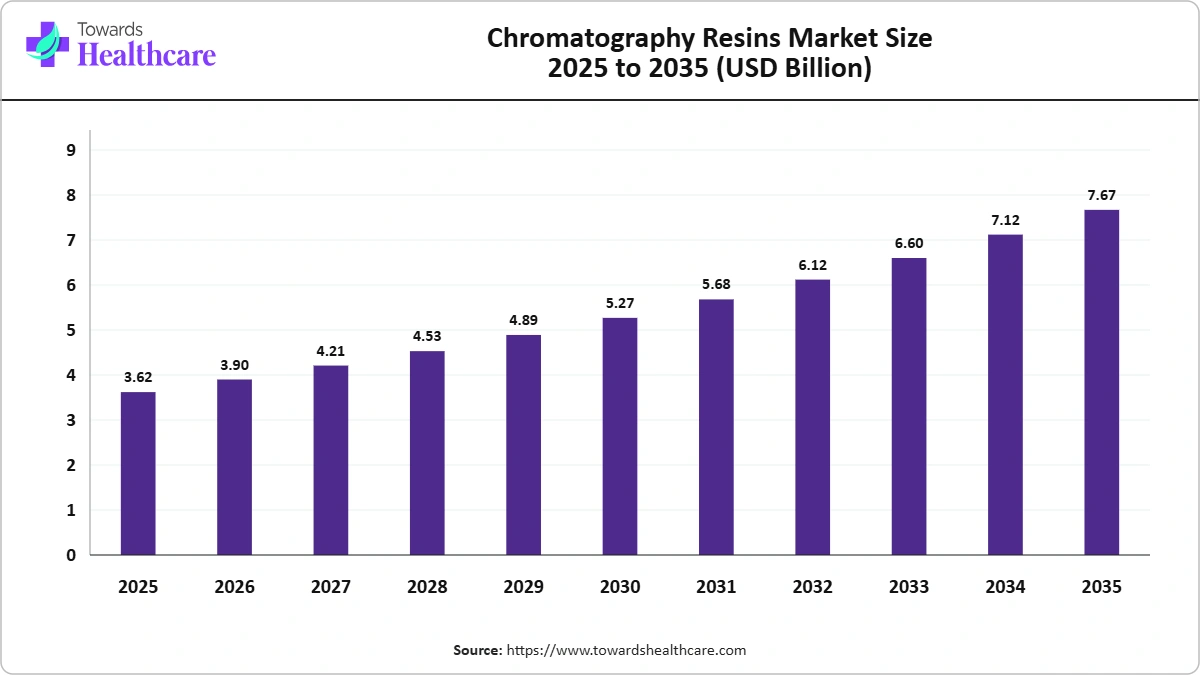
Analyst View: We built the estimate from biologics production, resin use per kilogram, and average resin prices by type and region, cross-checked against resin revenues of leading suppliers. Our value sits just above published comparable estimates.
| Driver | Impact | ≈ CAGR Contribution | Time Horizon | Key Regions |
| Biologics and biosimilars grow | High | +3.05 pp | Short to long term | Global, strongest in North America |
| Antibody output rises | Medium | +2.57 pp | Medium to long term | Global, fastest uptake in Asia Pacific |
| New modalities need purification | Medium | +2.19 pp | Short to medium term | Global |
| CDMOs expand | Low | +1.71 pp | Long term | Developed and emerging markets |
Note: Contributions are indicative estimates of each factor's effect on annual growth.
Sources: Expert interviews, secondary sources, Towards Healthcare database and Towards Healthcare analysts.
These drivers together add about 9.52 percentage points to the annual growth of the market, with biologics and biosimilars growing at a significant rate and having the largest effect. Their influence is strongest in North America, while uptake grows fastest in Asia Pacific.
| Restraint | Impact | ≈ Negative CAGR Contribution | Time Horizon | Key Regions |
| High resin cost | High | -0.77 pp | Short to medium term | Global |
| Long validation lock-in | High | -0.57 pp | Medium term | Price-sensitive and emerging markets |
| Competition from membranes | Medium | -0.38 pp | Short term | North America and other mature markets |
Note: Contributions are indicative estimates of each factor's effect on annual growth.
Sources: Expert interviews, secondary sources, Towards Healthcare database and Towards Healthcare analysts.
These restraints are expected to reduce the annual growth rate of the market by about 1.72 percentage points, led by high resin costs. Their effect eases over the forecast period as suppliers, buyers, and regulators adapt, leaving a net CAGR of 7.80% from 2026 to 2035.
The production of gene therapies is increasing, which creates opportunities for specialized chromatography resins. Expansion of biosimilar manufacturing in Asia is fueling the demand for affordable chromatography resins and purification solutions. Continuous bioprocessing is being increasingly adopted, which creates opportunities for resins that support higher productivity and reduced processing costs.
Note: 2025 is the base year; 2035 shares and CAGRs are forecasts.
Sources: Expert interviews, secondary sources, Towards Healthcare database and Towards Healthcare analysts.
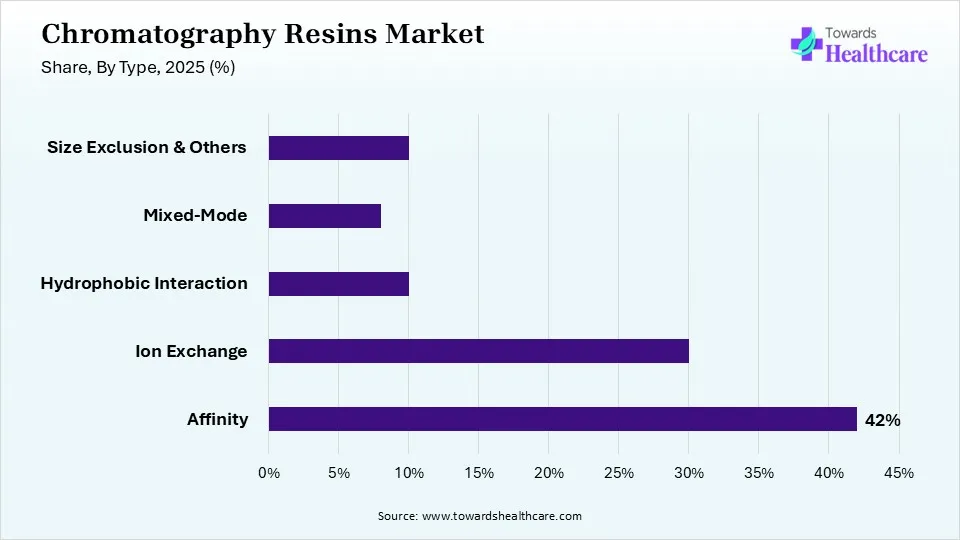
Affinity accounted for 42.00% of the market in 2025 and is projected to expand at a CAGR of 7.39% during the forecast period. Affinity resins lead because Protein A resins capture almost all monoclonal antibodies. This segment is expected to grow slower than the overall market between 2026 and 2035.
Ion Exchange resins polish proteins and remove impurities. This segment is expected to grow broadly in line with the market over the forecast period.
Hydrophobic Interaction resins remove aggregates. The hydrophobic interaction segment is expected to grow broadly in line with the overall market from 2026 to 2035.
Mixed-Mode resins grow fastest for complex molecules. This segment is expected to grow faster than the overall market over the forecast period.
Size Exclusion & Others complete demand. The size exclusion & others segment is expected to grow broadly in line with the overall market between 2026 and 2035.
Note: 2025 is the base year; 2035 shares and CAGRs are forecasts.
Sources: Expert interviews, secondary sources, Towards Healthcare database and Towards Healthcare analysts.
Natural Polymers (Agarose, Dextran) accounted for 52.00% of the market in 2025 and is projected to expand at a CAGR of 7.15% from 2026 to 2035. Natural polymers hold the dominant share because agarose resins are standard in bioprocessing. The natural polymers (agarose, dextran) segment is expected to grow slower than the market over the forecast period.
Synthetic Polymers growing fastest as they provide pressure stability. This segment is expected to grow faster than the overall market between 2026 and 2035.
Inorganic Media include silica and ceramic. This segment is expected to grow broadly in line with the market over the forecast period.
Note: 2025 is the base year; 2035 shares and CAGRs are forecasts.
Sources: Expert interviews, secondary sources, Towards Healthcare database and Towards Healthcare analysts.
Pharma & Biotech held 76.00% of revenue in 2025 and is projected to expand at a CAGR of 7.89% from 2026 to 2035. Pharmaceutical and biotechnology lead because biologics purification uses the most resin. The pharma & biotech segment is expected to grow broadly in line with the overall market over the forecast period.
Food & Beverage uses resins for proteins and sugars. The food & beverage segment is expected to grow slower than the overall market between 2026 and 2035.
Water & Environmental uses remove contaminants. The water & environmental segment is expected to grow slower than the overall market over the forecast period.
Others include academic research. This segment is expected to grow slower than the overall market from 2026 to 2035.
Analyst View: Segment shares were allocated from demand, product portfolios, and pricing in each category. Affinity, Natural Polymers (Agarose, Dextran) and Pharma & Biotech lead their categories because they meet the core needs of today's buyers. We expect Mixed-Mode and Synthetic Polymers to gain share as newer technologies, users, and applications grow faster.
Note: 2025 is the base year; 2035 shares and CAGRs are forecasts.
Sources: Expert interviews, secondary sources, Towards Healthcare database and Towards Healthcare analysts.
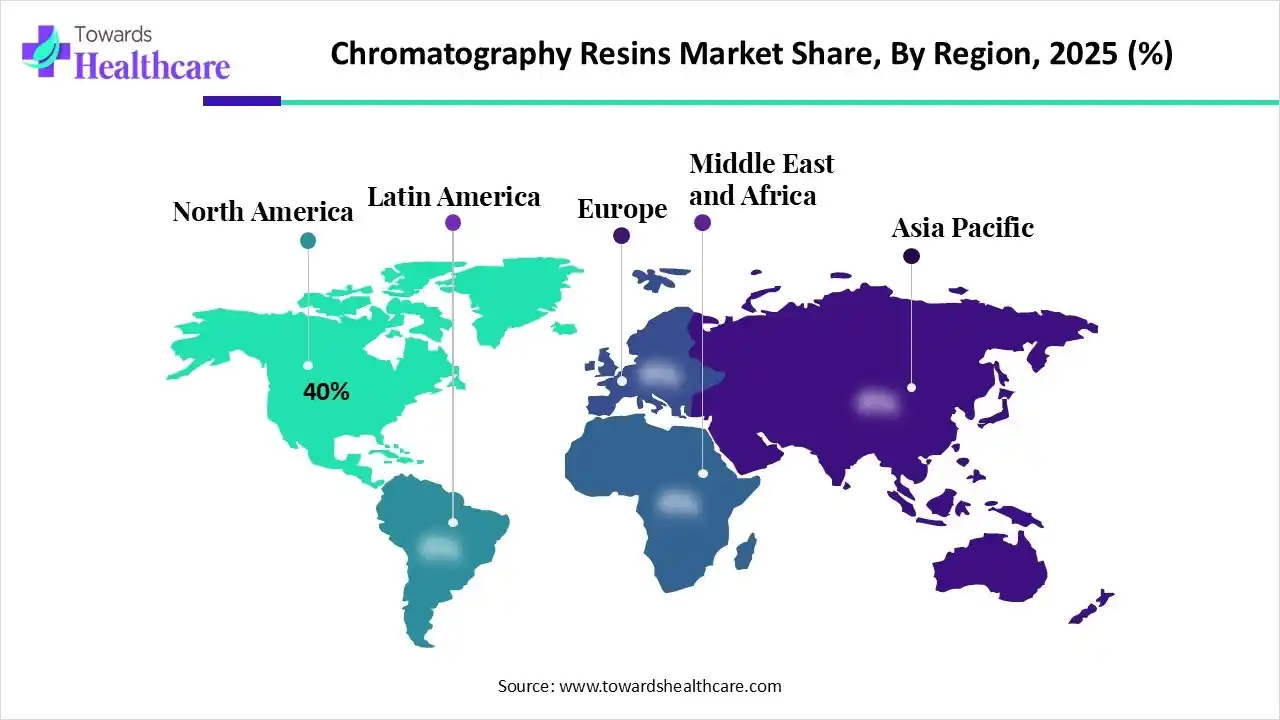
North America accounted for 40.00% of the market in 2025 and is projected to expand at a CAGR of 7.27% from 2026 to 2035. North America leads because of large biologics production and CDMO capacity. This region is expected to grow slower than the overall market over the forecast period.
Europe has major resin manufacturers and biologics plants. This region is expected to grow broadly in line with the overall market between 2026 and 2035.
Asia Pacific grows fastest, with biosimilar and biologics capacity in China, Korea, India, and Singapore. Asia Pacific is expected to grow faster than the overall market over the forecast period.
Latin America has growing biosimilar production. This region is expected to grow broadly in line with the market between 2026 and 2035.
Middle East & Africa have low demand. Middle East & Africa is expected to grow broadly in line with the overall market throughout the forecast period.
Analyst View: Regional shares were built from demand, installed base, spending and supplier presence in each region. North America leads because of its mature demand base and strong suppliers. We assign Asia Pacific the highest growth premium because investment, adoption and capacity are expanding fastest there.
| Rank | Company Name | 2025 Share (%) | Key Products / Business | Headquarters |
| 1 | Cytiva (Danaher) | 36.00% | MabSelect, Capto and Sepharose resins | United States |
| 2 | Merck KGaA (MilliporeSigma) | 11.00% | Eshmuno and Fractogel resins | Germany |
| 3 | Tosoh Bioscience | 9.00% | TOYOPEARL resins | Japan |
| 4 | Bio-Rad Laboratories | 8.00% | Nuvia and CHT resins | United States |
| 5 | Purolite (Ecolab) | 7.00% | Praesto resins | United States |
| 6 | Thermo Fisher Scientific | 4.00% | POROS resins | United States |
| 7 | Sartorius | 3.00% | Membrane and resin chromatography | Germany |
| 8 | Sunresin | 3.00% | Chromatography resins | China |
| 9 | Repligen | 2.00% | Protein A ligands and columns | United States |
| 10 | JNC | 2.00% | Cellufine resins | Japan |
Note: Company shares are 2025 estimates.
Sources: Company press releases, expert interviews, secondary sources, Towards Healthcare database and Towards Healthcare analysts.
Cytiva (Danaher) led the market with a 36.00% share in 2025, followed by Merck KGaA (MilliporeSigma) at 11.00% share and Tosoh Bioscience at 9.00% share.
Cytiva (Danaher) leads with mabSelect, Capto and Sepharose resins, Merck KGaA (MilliporeSigma) competes with eshmuno and Fractogel resins, and Tosoh Bioscience offers TOYOPEARL resins. Bio-Rad Laboratories, Purolite (Ecolab), Thermo Fisher Scientific, Sartorius, Sunresin, Repligen and JNC compete through nuvia and CHT resins, praesto resins, POROS resins, membrane and resin chromatography, chromatography resins, protein A ligands and columns and cellufine resins.
The top 10 companies accounted for 85.08% of revenue in 2025, while the remaining 14.92% was shared among several Chinese and Indian resin manufacturers. The market is concentrated, and competition revolves around binding capacity, resin lifetime, regulatory support files, supply security, alkaline stability and price per liter.
Cytiva (Danaher) is headquartered in the United States. It captured 36.00% share of the market in 2025. Its offering revolves around MabSelect, Capto and Sepharose resins. In the Towards Healthcare Companies Quadrant it is positioned as a Leader.
Merck KGaA (MilliporeSigma) has its corporate headquarters in Germany. It accounted for 11.00% of revenue in 2025. Its offering centres on Eshmuno and Fractogel resins. This company has been positioned as a Leader in the Towards Healthcare Companies Quadrant.
Tosoh Bioscience has its global headquarters in Japan. It held a 9.00% share in 2025. Its offering centres on TOYOPEARL resins. In the Towards Healthcare Companies Quadrant it is positioned as a Leader.
Bio-Rad Laboratories is headquartered in the United States. It captured 8.00% of the market in 2025. The company’s portfolio comprises Nuvia and CHT resins. It is positioned as a Leader in the Towards Healthcare Companies Quadrant.
Purolite (Ecolab) is headquartered in the United States. It accounted for a 7.00% share in 2025. Its offering centres on Praesto resins. In the Towards Healthcare Companies Quadrant it is positioned as a Leader.
Thermo Fisher Scientific has its corporate headquarters in the United States. It held 4.00% of revenue in 2025. Its offering revolves around POROS resins. Thermo Fisher Scientific has been positioned as a Leader in the Towards Healthcare Companies Quadrant.
Sartorius is headquartered in Germany. It held a 3.00% share in 2025. The company’s portfolio consists of Membrane and resin chromatography. It has been positioned as a Leader in the Towards Healthcare Companies Quadrant.
Sunresin has its corporate headquarters in China. It captured 3.00% of the market in 2025. Its offering centres on Chromatography resins. In the Towards Healthcare Companies Quadrant it is positioned as an Innovator.
Repligen is headquartered in the United States. It accounted for 2.00% of revenue in 2025. Its offering revolves around Protein A ligands and columns. Repligen has been positioned as an Innovator in the Towards Healthcare Companies Quadrant.
JNC has its global headquarters in Japan. It held a 2.00% share in 2025. Its offering centres on Cellufine resins. In the Precedence Research Companies Quadrant it is positioned as an Innovator.
The chromatography resins ecosystem links ligand & base matrix suppliers, resin makers, column & system makers, users and regulators, with each stage adding value before products reach end users.
| Ecosystem Stage | Role in the Market | Key Companies |
| Ligand & Base Matrix Suppliers | Make agarose and ligands | Ligand makers, Repligen |
| Resin Makers | Make resins | Cytiva, MilliporeSigma, Tosoh, Bio-Rad, Purolite |
| Column & System Makers | Pack columns and run systems | Cytiva, Repligen, Sartorius |
| Users | Purify products | Biopharma, CDMOs, food makers |
| Regulators | Approve processes | FDA, EMA |
Sources: Company press releases, expert interviews, secondary sources, Towards Healthcare database and Towards Healthcare analysts.
Ligand & Base Matrix Suppliers: Make agarose and ligands. Key participants include Ligand makers, Repligen.
Resin Makers: Make resins. Key participants include Cytiva, MilliporeSigma, Tosoh, Bio-Rad, Purolite.
Column & System Makers: Pack columns and run systems. Key participants include Cytiva, Repligen, Sartorius.
Users: Purify products. Key participants include Biopharma, CDMOs, food makers.
Regulators: Approve processes. Key participants include FDA, EMA.
Value in the market flows from upstream material and technology suppliers to manufacturers and service providers, then through distribution partners to end users. Companies that integrate several stages or build long-term relationships with end users capture a larger share of this value.
The Towards Healthcare Companies Quadrant positions key participants in the chromatography resins market by market strength, reflecting revenue scale, market share and geographic reach, and by innovation and growth strategy, reflecting product portfolio breadth, research and development intensity and partnerships. Positions reflect each company's estimated 2025 share of the market and our assessment of its product innovation, portfolio breadth and partnerships.
Sources: Company press releases, expert interviews, secondary sources, Towards Healthcare database and Towards Healthcare analysts.
Leaders: Cytiva (Danaher), Merck KGaA (MilliporeSigma), Tosoh Bioscience, Bio-Rad Laboratories, Purolite (Ecolab) and Thermo Fisher Scientific combine high market share with broad portfolios and strong innovation.
Innovators: Sartorius, Sunresin, Repligen and JNC bring newer technologies and specialised products.
By Type
By Base Material
By End User
By Region
The market is defined as chromatography resins used to separate and purify molecules, including affinity (such as Protein A), ion exchange, hydrophobic interaction, mixed-mode, size exclusion and other resins, made on natural polymer, synthetic polymer and inorganic bases, used in pharmaceutical and biotechnology production, food and beverage, water and environmental and other applications.
The 2025 base year was built bottom-up from demand volumes and average prices by type, base material and end user and region, and checked top-down against the market-specific revenues of leading companies and published estimates. Segment, regional and company values were allocated from type, base material and end user and region demand. Key estimates were verified by cross-checking company disclosures, regulatory and industry data and published third-party estimates, and inputs that could not be reconciled were excluded. All segment, regional and company figures were reconciled to the same 2025 base year, and the 2026-2035 forecast, which applies a constant CAGR from the 2025 base, was recalculated and validated.
Analyst View: The market is set for steady expansion as biologics growth and related demand keep growing. Our estimate links value to underlying demand, installed base and pricing, so the forecast follows real adoption rather than headline hype. The main upside comes from gene therapy resins and Asian biosimilars, while the main risks are high resin costs and validation lock-in.