The conversational AI in healthcare market is on a remarkable upward trajectory, with revenue expected to soar by hundreds of millions of dollars between 2025 and 2034. In 2025, this market already held a significant share, setting the stage for explosive growth in the coming years. A growing number of chronic diseases and the geriatric population increases the demand for healthcare services, which demands conversational AI to reduce the burden on healthcare professionals and improve the quality of care.
The procedures and materials required to create chatbots and AI helpers for a range of healthcare-related tasks are included in the conversational AI in healthcare market. Conversational artificial intelligence (AI) blends traditional, static types of interactive technology, including chatbots, with machine learning (ML) and natural language processing (NLP). With this combination, user interactions are modeled after those with standard human agents in order to reply to them. As the healthcare sector has embraced major technological breakthroughs over the years to improve patient care, conversational AI has grown in prominence in this field. Included in this are the applications of automation and artificial intelligence (AI). In particular, conversational AI systems increase patient engagement and communication through the use of chatbots and AI assistants, such as text and voice assistants.
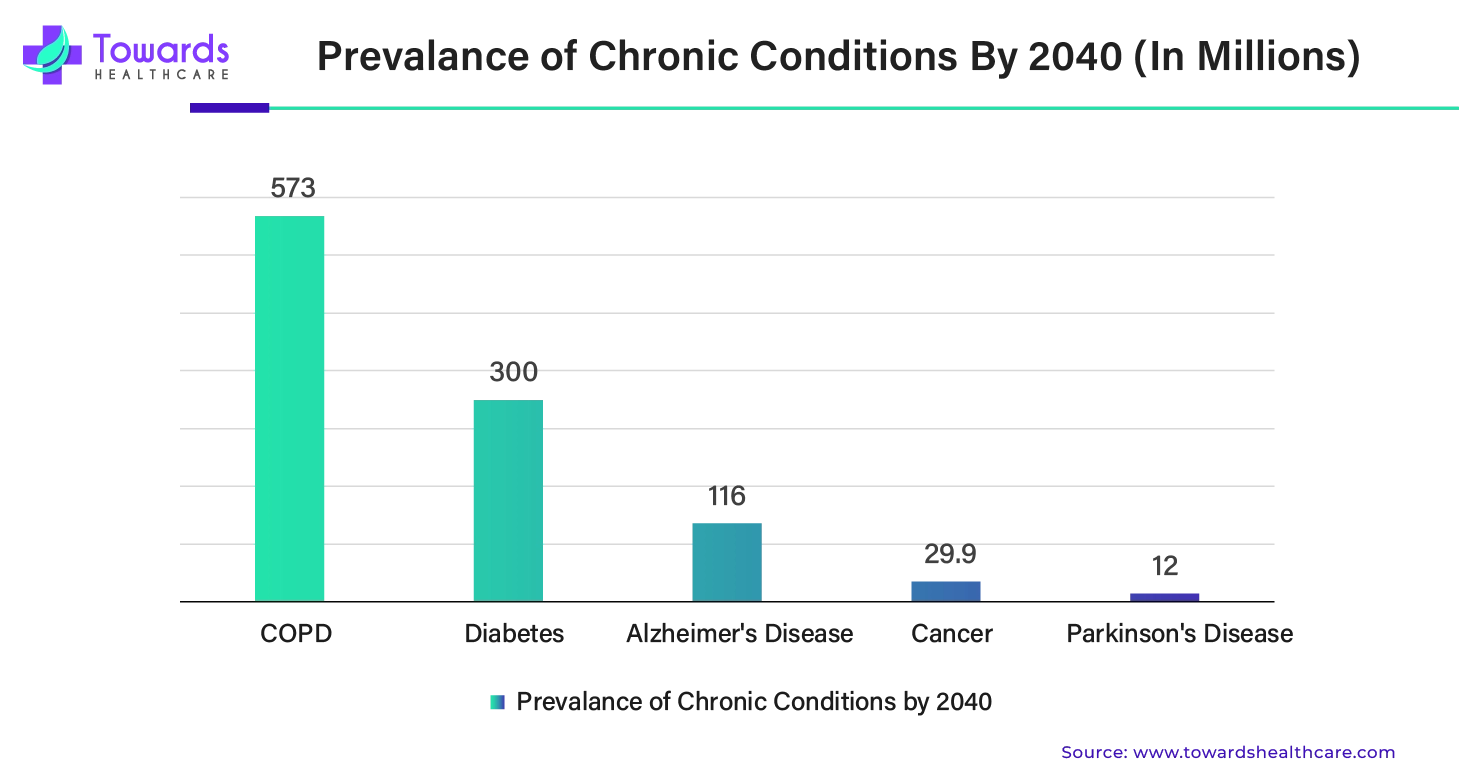
Globally, the prevalence of chronic illnesses is rising, making it one of the biggest healthcare issues of the twenty-first century. These chronic illnesses require continual care from patients and medical professionals because their effects are lifelong and can affect a person for their whole lifespan.
AI in chatbots is becoming more and more common, particularly for chronic illnesses. AI chatbots have the ability to monitor symptoms, provide individualized information and services, and provide emotional support to people with long-term medical issues. Scholars have extensively examined the application of chatbots in the treatment of a range of chronic conditions. These AI-powered chatbots are essential resources for improving patient-provider communication, tackling the growing incidence of chronic illnesses, and satisfying the expanding need for applications that assist healthcare.
Concerns about data quality, data ownership, usability, patient and doctor faith in the efficacy of AI software, patient and doctor acceptance of risk, and ethics are just a few of the issues that need to be resolved as the medical field uses AI-based solutions more and more. Concerns around patient privacy, confidentiality, and ethics are critical to the development of this new area of biological research and its applications. A morally sound policy framework is necessary to advance AI technology and its use in healthcare.
Chatbots, which attempt to simulate human speech, are becoming more and more popular in research and industrial domains as the industry shifts towards AI-based solutions. With the ability to offer individualized advice and support to assist us in making better decisions regarding our lifestyles and healthcare, these digital health tools have the potential to completely change the way health and wellness are managed. These AI-powered solutions aim to improve healthcare efficiency and accessibility while offering a more customized experience. AI can assist in optimizing diagnosis and treatment strategies by considering the patient's medical history and making data-driven recommendations. AI can also notify users of impending appointments and serve as a reminder to take precautions against different illnesses. By enabling fast and dependable access to healthcare services when people need them most, this could contribute to a revolution in healthcare.
The natural language processing (NLP) segment held the largest share of the conversational AI in healthcare market in 2025. Any company may engage customers and improve user experience by utilizing natural language processing (NLP) in chatbot interactions. Customers can receive pertinent information from it in an approachable, conversational manner. AI is used by NLP chatbots to learn "on the job" from every client encounter. With time, they keep becoming smarter and more capable. Language and spelling errors can also be detected by NLP chatbots. They accurately understand the user's purpose while identifying misspelled words. Because NLP chatbots provide excellent customer service and convenience, their use has increased.
The machine learning (ML) segment is anticipated to grow at a significant rate in the conversational AI in healthcare market during the forecast period. The way machine-learning chatbots operate and engage with users has radically changed. A machine-learning chatbot is made to function independently of a human operator. Chatbots with machine learning greatly surpass the capabilities of basic chatbots. Thanks to the sophisticated use of machine learning techniques, such as image analysis, natural language processing, and text analytics, these intelligent bots are able to extract entities and sentiments from a given text, recognize items inside a picture, and comprehend concepts in a sentence.
The medical record mining segment dominated the conversational AI in healthcare market in 2025. It is not feasible to manage and/or process the quickly growing body of literature using conventional technology and procedures in a timely manner. As a result, it is anticipated that new artificial intelligence-based data mining techniques will be developed quickly in the near future for the benefit of both doctors and patients.
Artificial intelligence, which also includes machine learning (ML), deep learning (DL), and natural language processing (NLP) as subsets, gives the data mining process additional advantages. These advantages include the ability to process large datasets more accurately and efficiently, acquire new insights into the decision-making process, and continuously learn from new data. Worldwide, there is a growing trend toward the implementation of electronic health record (EHR) data mining, with a primary focus on structured data. The underutilization of unstructured EHR data could be reversed, and the quality of clinical care and research could be improved, thanks to artificial intelligence (AI).
North America dominated the conversational AI in healthcare market in 2025. There is a great need for chatbots that can improve patient interaction, expedite healthcare services, and offer affordable solutions because the region has been at the forefront of implementing digital technology in healthcare. Aside from this, the existence of top NLP and AI technology companies in North America has accelerated the development of chatbot capabilities, increasing their precision and efficiency. The U.S.'s rising healthcare expenditures are driving the need for healthcare chatbots as more individuals search for easily accessible and reasonably priced healthcare solutions.
Due to significant demographic changes, rising costs, and disruptive technology, the American healthcare system is at a critical turning point. It is projected that the United States will spend $6.8 trillion on healthcare annually by 2030. With more than 10,000 Americans becoming eligible for Medicare every day, it is anticipated that the government will bear 48% of this spending by 2030. This growth in enrollment is an outcome of this.
Canada
Canada is seeing interest in the conversational AI healthcare market as providers seek easier patient communication. Virtual assistants can help with appointment requests, basic questions, and follow-ups. Staff shortages may support wider use. Stronger links with electronic medical records, clear privacy rules, and better multilingual support could accelerate adoption across hospitals and primary care in the coming decade.
Asia Pacific is expected to grow at the fastest rate during the forecast period. This region's conversational AI in healthcare market growth is being driven by factors such as a sizable population base, rising healthcare spending, and a move toward the adoption of digital health solutions. Businesses are utilizing this potential by implementing chatbots that are tailored to a wide range of healthcare requirements.
In March 2024, The Chinese Academy of Sciences (CAS), one of China's leading research institutes, and the Centre for Artificial Intelligence and Robotics (CAIR) in Hong Kong developed a large-scale language model-based chatbot to assist doctors in diagnosing and treating patients. In the upcoming months, seven hospitals in Beijing and other cities will test an AI helper designed for neurosurgeons. This is just one of several efforts supported by the government to try and make use of the technology. An AI model built on Meta Platform's Llama 2.0 was unveiled on Monday by a Hong Kong-based organization affiliated with the Chinese Academy of Sciences. According to Liu Hongbin, executive director of the center, researchers used papers, medical journals, and manuals to educate and refine the model to serve as surgical consultants for physicians.
India
India offers a broad runway for the conversational AI healthcare market. Chatbots can support symptom guidance, appointment booking, health education, and follow-up care at scale. Smartphone use and digital health programs create strong foundations. Future growth could come from regional language tools, affordable platforms, rural access, and deeper hospital integration. Better clinical validation will also build trust among patients.
Europe is projected to grow at a notable rate in the foreseeable future. Government organizations in Europe launch numerous initiatives to promote digitization in healthcare. The government and private organizations conduct seminars and workshops to create awareness about cutting-edge technologies and their applications in healthcare. The increasing investments, collaborations, and mergers & acquisitions foster market growth. The presence of a robust healthcare infrastructure and the growing need for personalized care potentiate the use of conversational AI in healthcare.
Germany
Germany is moving the conversational AI healthcare market toward practical use. Digital health infrastructure is improving, while providers face an aging population and workforce pressure. Assistants could simplify patient queries, scheduling, and routine communication. Wider integration with electronic health records, stronger interoperability, reimbursement pathways, and trusted data safeguards may encourage adoption. Hospitals will value tools that reduce administrative workload significantly.
UK
The UK has a strong setting for the conversational AI healthcare market, supported by NHS digital transformation and growing interest in AI-enabled services. Patient access and staff capacity remain concerns. Conversational tools can handle routine requests and guide patients toward appropriate care. Over time, stronger safety standards, evidence from real deployments, and NHS workflow integration could support wider adoption.
In April 2025, the UK government announced that the NHS clinicians will be supported to use groundbreaking AI tools that demolish bureaucracy and take notes to free up staff time. The clinical trials demonstrated a significant reduction in admin and more time for direct patient care. Ambient voice technologies (AVTs) is one of the tools that can transcribe patient-clinician conversations.
France Market Trends
The French President announced a plan to accelerate the adoption of AI in healthcare, with an aim to train 100,000 caregivers annually and build Europe’s largest AI-focused data center. The plan was announced at the AI Action Summit held in February 2025. The federal government also focuses on developing a national roadmap to drive innovation and ensure ethical AI use in healthcare.

In April 2026, “Nurses have told us clearly: the problem isn’t just how long it takes to chart, it’s how long it takes to understand the patient in front of them,” said Nikhil Buduma, Co-Founder and CEO of Ambience Healthcare. “Chart Chat for Nursing meets nurses where they already are, inside the EHR, and gives them the full picture of every patient in seconds.”
| Company Name | Happiest Minds Technologies |
| Headquarters | Bengaluru, India, Asia Pacific |
| Recent Development | In April 2024, the Generative AI Business Services (GBS) subsidiary of Happiest Minds Technologies unveiled 'hAPPI,' a new GenAI chatbot designed for Happiest Health. hAppI is a revolutionary chatbot driven by Generative AI that is set to revolutionize the way people converse about health and well-being. It is a major step forward in offering users in the healthcare industry-tailored and educational interactions. |
| Company Name | Fortis Healthcare |
| Headquarters | Haryana, India, Asia Pacific |
| Recent Development | In April 2024, Fortis Healthcare introduced an AI-powered chatbot to help people struggling with mental health issues. The "Adayu Mindfulness" app provides psychological support, much like a first aid kit, and is specifically designed for people who are afraid to ask for professional help because of social stigma. The app's built-in AI chatbot, Stella, converses with users and suggests self-assessment resources to help them gauge their mental health. |
By Type
By Application
By Region
The market for chatbots in mental health is growing quickly because people are looking for more accessible and convenient ways to get mental health support. These chatbots are AI-powered programs that can talk to people and help with mental health issues like depression and anxiety. There are a few reasons why chatbots are becoming popular. First, many people have mental health problems but can’t easily see a therapist. Second, digital health technologies, like chatbots, are becoming more widely accepted.
Chatbots have some key benefits. They are available all day and night, so people can get help whenever they need it. They can have personalized conversations, provide helpful advice and information, and even track how someone is feeling over time. This makes them a useful and affordable option for mental health support.
The global chatbots in mental health and therapy market size was valued at approximately USD 0.99 billion in 2022. It is projected to exceed USD 6.51 billion by 2032, growing at a compound annual growth rate (CAGR) of 21.3%, driven by increasing demand for accessible and convenient healthcare services.



Principal Consultant
Payal Rabde is a Healthcare Market Research Analyst at Towards Healthcare Research & Consulting with 4+ years of experience in pharmaceuticals, biotechnology, medical devices, and life sciences.
Learn more about Payal Rabde

Reviewed By
Aditi Shivarkar is a seasoned professional with over 14 years of experience in healthcare market research. As a content reviewer, Aditi ensures the quality and accuracy of all market insights and data presented by the research team.
Learn more about Aditi Shivarkar