
The dialysis disinfectant market generates recurring revenue from ongoing dialysis procedures. The market is estimated at USD 134.8 million in 2026 and is projected to reach USD 142.48 million in 2027 and USD 234.66 million by 2036, at a CAGR of 5.7%. Market growth is driven by the rising prevalence of chronic kidney disease and end-stage renal disease, increasing demand for dialysis services, and greater emphasis on infection prevention in healthcare settings.
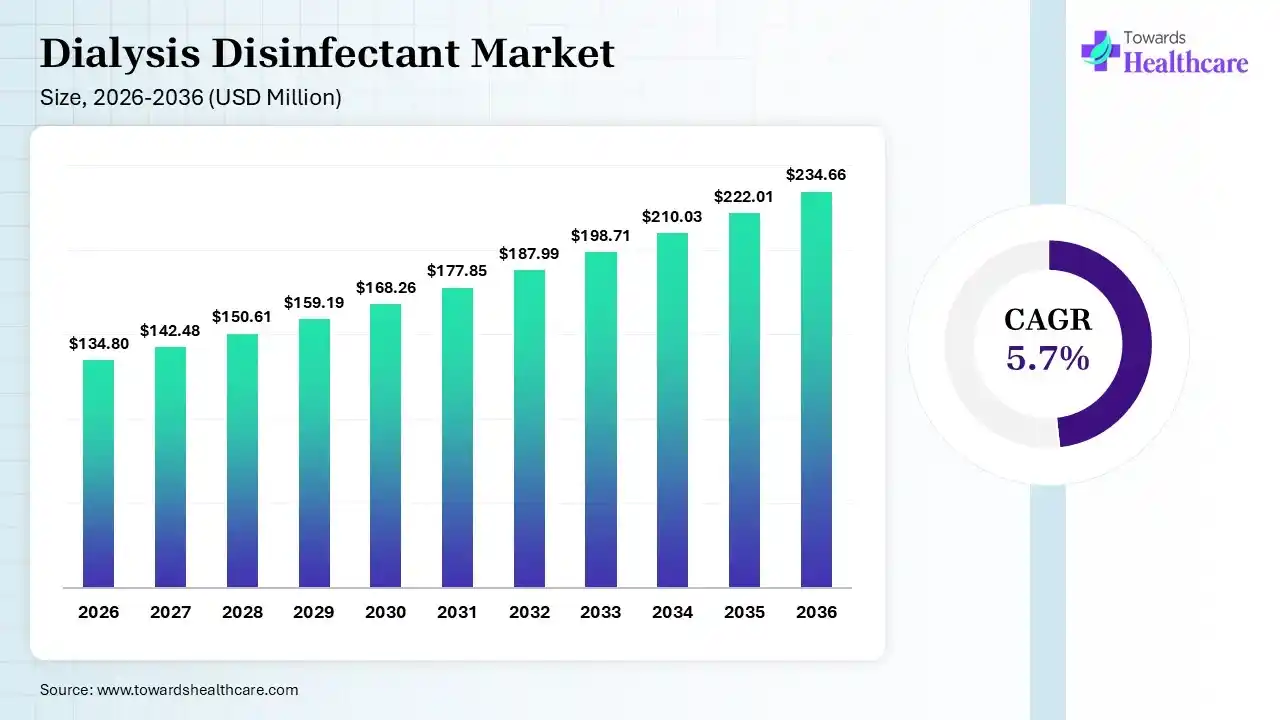
The expansion of hospitals and standalone dialysis centers is increasing the installed base of dialysis equipment, supporting recurring demand for disinfectants used in machines, water treatment systems, and clinical environments. Stringent water quality requirements and the need to control microbial contamination and biofilm formation are further supporting market growth.
The dialysis disinfectant market represents a niche in the kidney care industry that caters to the needs for infection control, water treatment, and equipment maintenance at hemodialysis centers. Factors influencing demand include the number of dialysis patients, frequency of treatment, dialysis machine capacity installed, water system setup, cleaning methods prescribed by the equipment manufacturers, as well as regulatory requirements for disinfectant efficacy and residual removal.
An important consideration when assessing the market is the distinction made between dialysis disinfectants and all other surface disinfectants, biocides, water treatment products, and dialysis equipment available in hospitals. The addressed market comprises those chemicals that are applied in order to disinfect or chemically de-scale dialysis machines, fluid handling equipment, associated water distribution systems, and, in some cases, the surfaces in dialysis units.
The research model considers machine-compatible chemical disinfectants and water treatment solutions as the key markets; surface disinfectants and other infection control products will be analyzed independently in order to avoid double counting. This approach is especially useful when assessing the potential market value of the product offerings in concentrated, ready-to-use format and automated systems.
Economics for each product vary based on its active ingredient, formulation, packaging, method of application, and customer segment. In a limited-scope 2025 market forecast, citric acid was estimated to account for approximately 58.2% of revenue, hemodialysis machine disinfection 74.6%, liquids 89.5%, 1-5 litres packaging 54.2%, and dialysis clinics 68.6%.
| Segmentation dimension | Indicative 2025 share | Commercial interpretation |
| Active ingredient: citric acid | 58.2% | Established chemical-cleaning and disinfection workflows |
| Application: machine disinfection | 74.6% | Core recurring demand |
| Form: liquid | 89.5% | Established dosing and handling practices |
| Packaging: 1-5 litres | 54.2% | Balance between replenishment and storage |
| End use: dialysis centres | 68.6% | Centralized purchasing and repeat consumption |
Disinfection of water treatment and distribution systems presents a unique strategic opportunity since contaminants could come from outside the dialysis machine. Home-dialysis compatible powders or cartridges, as well as the development of products in such a form, provide more room for differentiation.
The key source of demand is growing adoption of kidney replacement therapy. The more dialysis patients, the greater will be the use of machines and the number of disinfections performed. Hemodialysis carried out in hospitals usually happens several times a week; hence demand will be recurring.
However, demand growth will be constrained by the necessity of product compatibility, existing procedures used on the equipment, qualification costs, and the potential of using heat disinfection instead of chemical disinfection for particular applications.
Disinfectants used in the dialysis process have pricing based on the volume, concentration, doses required, and price per one cycle of disinfection. Therefore, larger packaging may have a lower price per litre, but it does not necessarily result in a lower price per one cycle of disinfection because of different concentrations, dilution requirements, or rinse time.
Benchmarks for prices of disinfectants for dialysis at the transactional level that will be used to calculate a global average selling price are inconsistent. The study therefore analyzes prices of products based on their formulation, pack size, geography, and applications.
The value chain starts from raw material suppliers up to formulation, mixing, filling, quality testing, product qualification, distribution, and use in dialysis facilities. Quality and product and equipment compatibility may be more critical than production volume.
The supply-demand approach has to separate chemical manufacturing capacity from capacity to manufacture dialysis-related products. An industrial manufacturer of disinfectants does not automatically qualify to provide this segment without proper performance and material compatibility, labeling, and regulatory compliance.
The development of dialysis disinfectant technology has become more differentiated based on the following factors: the efficiency of the chemical used, compatibility with machine materials, consistent dosing, residue removal, safety of use, and compatibility with automated disinfection processes. Citric acid-based compounds, peracetic acid products, and chlorine-based compounds have different cleaning and contamination control applications and are not interchangeable with each other. The ISO 23500 standard, revised in 2024, provides requirements associated with the preparation and quality management of fluids for haemodialysis and similar treatments. Nevertheless, meeting the water quality standards does not mean that the product is approved for disinfection use.
It is apparent from our findings that the commercial success of disinfectants and descalants is more dependent on the validation of performance and the compatibility with the existing dialysis equipment than on the development of new chemicals. Those formulations that can provide safe disinfection, efficient descaling, adequate residual activity, and reproducible performance within defined conditions of operation might have an advantage in securing their qualification and subsequent procurement. We believe that the switching between systems is limited by the differences in terms of requirements for applications, instructions for use, contact and rinsing times.
From our perspective, the technology-based opportunities of greatest value include the formulations offering efficacy proven in addition to being safer to handle, less corrosive, using less rinse water, and ease of dosing. These factors may allow dialysis providers to increase efficiency and solve issues related to exposure, equipment durability, and sustainability goals. Sustainability must be proven along with the effectiveness of disinfection and applicable regulations; a decrease in chemicals used or amount of water should not necessarily make the process more economical when the whole process of disinfection is evaluated. For suppliers, the key challenge is to convert operational advantages into equipment suitability, qualification, and cost-of-use savings.
The full report analyzes the positioning of technologies based on active ingredient, formulation, application, equipment compatibility, methods of removing residues, and challenges to adoption. The report also addresses the relevance of dialysis water quality frameworks, regulatory requirements applicable to specific products, considerations related to handling chemicals, and sustainability efforts up to 2035. When such data is available, we distinguish the capabilities of products and suppliers’ claims and evaluate the technology gaps potentially useful for product development.
The dialysis centres are the biggest identified end-use segment, contributing an estimated 68.6% to the narrow scope market revenues in 2025. The dialysis centres in the hospitals generate demand through institutional purchasing, whereas home dialysis generates another strategic demand for convenient packaging, clear instructions, and reliable resupply.
The purchasing considerations will include effectiveness, compatibility with the machine manufacturer, total cost per cycle, reliability of the supply, safety of the personnel and documentation. Multi-site organizations have the possibility to standardize the products in different facilities, making the qualification and retention of the contract important.
| Segments | 2026 Share | 2026 Market Value (USD Million) |
| Dialysis machine disinfectants | 28% | $37.74 |
| Dialysis machine cleaning and descaling agents | 17% | $22.91 |
| Dialysis water-treatment and disinfection chemicals | 16% | $21.56 |
| Dialysis water-distribution system disinfectants | 11% | $14.82 |
| Dialyzer reprocessing disinfectants and cleaning agents | 10% | $13.4 |
| Dialysis-unit surface disinfectants | 12% | $16.17 |
| Other dialysis-specific disinfectants | 6% | $8.08 |
Dialysis machine disinfectants are estimated to lead because regular disinfection is essential to routine hemodialysis operations. Cleaning agents and water-system chemicals also contribute substantially because mineral scale, biofilm and microbial contamination must be controlled.
| Segments | 2026 Share | 2026 Market Value (USD Million) |
| Citric acid-based disinfectants and descaling agents | 24% | $32.35 |
| Peracetic acid-based disinfectants | 20% | $26.96 |
| Chlorine-based disinfectants | 13% | $17.52 |
| Hydrogen peroxide-based disinfectants | 12% | $16.18 |
| Sodium hypochlorite-based disinfectants | 18% | $24.26 |
| Other chemical disinfectants | 13% | $17.52 |
Citric acid-based products are estimated to lead because of their role in removing mineral deposits and supporting equipment maintenance. Peracetic acid and sodium hypochlorite also contribute to disinfection and cleaning, depending on equipment compatibility and manufacturer instructions.
| Segments | 2026 Share | 2026 Market Value (USD Million) |
| Hemodialysis machine disinfection | 25% | $33.70 |
| Dialysis machine cleaning and descaling | 17% | $22.92 |
| Dialysis water-treatment system disinfection | 15% | $20.22 |
| Water-distribution loop disinfection | 11% | $14.83 |
| Dialyzer reprocessing and disinfection | 9% | $12.13 |
| Dialysis equipment and accessory disinfection | 12% | $16.18 |
| Dialysis-unit surface disinfection | 11% | $14.83 |
Hemodialysis machine disinfection is estimated to be the leading application because machines require routine disinfection as part of treatment and infection-control procedures. Machine descaling and water-system disinfection also generate recurring demand to maintain equipment performance and water quality.
| Segments | 2026 Share | 2026 Market Value (USD Million) |
| Liquid concentrates | 32% | $43.14 |
| Ready-to-use liquid formulations | 22% | $29.66 |
| Powder formulations | 7% | $9.44 |
| Granular formulations | 4% | $5.39 |
| Tablet formulations | 6% | $8.09 |
| Cartridge-based formulations | 24% | $32.35 |
| Other formulations | 5% | $6.74 |
Liquid concentrates are estimated to lead because facilities can dilute them according to validated procedures for repeated cleaning and disinfection cycles. Cartridge-based formulations also represent a substantial share where dialysis machines use compatible, manufacturer-approved consumables.
| Segments | 2026 Share | 2026 Market Value (USD Million) |
| Less than 1 litre | 18% | $24.26 |
| 1-5 litres | 34% | $45.83 |
| 5-10 litres | 22% | $29.66 |
| More than 10 litres | 16% | $21.57 |
| Bulk and industrial packaging | 10% | $13.48 |
The 1–5 litre category is estimated to lead because it balances manageable handling and storage with the recurring requirements of dialysis facilities. Larger containers and bulk packaging serve high-volume clinics and centralized purchasing, while smaller packs suit lower-volume applications.
| Segments | 2026 Share | 2026 Market Value (USD Million) |
| Independent dialysis centres | 30% | $40.44 |
| Hospital-based dialysis units | 24% | $32.35 |
| Multisite dialysis provider networks | 18% | $24.26 |
| Home dialysis patients and home-care providers | 12% | $16.18 |
| Specialty renal-care clinics | 10% | $13.48 |
| Other healthcare facilities providing dialysis services | 6% | $8.09 |
Independent dialysis centres are estimated to represent the largest end-user category because they conduct recurring treatments and need regular supplies for machine and water-system hygiene. Hospital-based units and multisite provider networks also generate consistent demand through routine treatment schedules and infection-control protocols.
| Segments | 2026 Share | 2026 Market Value (USD Million) |
| In-centre hemodialysis | 64% | $86.27 |
| Hospital-based hemodialysis | 18% | $24.26 |
| Home hemodialysis | 12% | $16.18 |
| Peritoneal dialysis facilities and associated equipment-care applications | 6% | $8.09 |
In-centre hemodialysis is estimated to dominate because dedicated facilities treat multiple patients daily, creating frequent requirements for equipment cleaning and disinfection. Home hemodialysis represents a smaller share, while peritoneal dialysis-related demand is more limited for specialized dialysis-machine disinfectants.
| Segments | 2026 Share | 2026 Market Value (USD Million) |
| Direct sales to dialysis providers | 25% | $33.7 |
| Direct sales through equipment manufacturers (OEM channels) | 18% | $24.26 |
| Medical and healthcare supply distributors | 27% | $36.40 |
| Specialty chemical distributors | 12% | $16.18 |
| Hospital procurement and group purchasing organizations | 12% | $16.18 |
| Online and other distribution channels | 6% | $8.09 |
Medical and healthcare supply distributors are estimated to lead because they consolidate recurring purchases and serve multiple healthcare facilities. Direct provider sales and OEM channels remain important where buyers require technical support, equipment compatibility and approved disinfection procedures.
| Segments | 2026 Share | 2026 Market Value (USD Million) |
| Public healthcare providers | 23% | $31.00 |
| Private healthcare providers | 25% | $33.70 |
| Government-operated dialysis centres | 17% | $22.92 |
| Private dialysis clinic chains | 18% | $24.26 |
| Independent healthcare institutions | 11% | $14.83 |
| Home-care service providers | 6% | $8.09 |
Private healthcare providers are estimated to account for the largest share because private hospitals and dialysis facilities purchase recurring consumables to support treatment volumes and infection-control requirements. Public providers and government-operated centres also contribute significant demand through institutional procurement.
| Segments | 2026 Share | 2026 Market Value (USD Million) |
| Original equipment manufacturer (OEM)-approved products | 35% | $47.18 |
| Third-party compatible disinfectants | 22% | $29.66 |
| Private-label disinfectants | 10% | $13.48 |
| Contract-manufactured disinfectants | 8% | $10.78 |
| Proprietary branded products | 25% | $33.70 |
OEM-approved products are estimated to lead because equipment manufacturers specify compatible disinfectants and cleaning procedures to protect machine performance and patient safety. Proprietary branded and compatible third-party products also serve facilities seeking established formulations and alternative supply options, subject to compatibility requirements.
| Segments | 2026 Share | 2026 Market Value (USD Million) |
| North America | 32% | $43.14 |
| Latin America | 7% | $9.44 |
| Europe | 27% | $36.40 |
| Asia Pacific | 25% | $33.70 |
| MEA | 9% | $12.13 |
North America is estimated to lead because of its established dialysis infrastructure and emphasis on infection prevention. Europe and Asia Pacific also represent substantial demand, supported by established renal-care systems and growing dialysis needs.
The U.S. is estimated to account for most North American demand because of its extensive dialysis provider network and recurring requirements for machine and water-system disinfection.
Brazil is estimated to lead Latin America because of its large population and established demand for renal replacement therapy. Other countries contribute through hospital-based and independent dialysis services.
Western Europe is estimated to account for most European demand, reflecting established healthcare infrastructure and dialysis provision. Eastern European demand varies with healthcare funding, treatment access and the development of dialysis services.
Germany and France are estimated to be among the largest individual Western European markets because of their substantial healthcare systems and established dialysis services. The UK, Italy and Spain also contribute meaningful demand.
Russia and Belarus are estimated to represent a substantial combined share of this category, while Türkiye contributes through its established renal-care infrastructure. Demand across the remaining countries depends on access to dialysis and healthcare resources.
China is estimated to lead the region, supported by its large population and substantial kidney disease burden. Japan represents an established dialysis market, while India contributes through rising demand for dialysis services and expanding treatment access.
The GCC countries are estimated to account for a substantial portion of MEA demand because of investment in healthcare facilities and dialysis services. South Africa and Egypt also contribute through established treatment centres and ongoing renal-care needs.
Saudi Arabia is estimated to lead the GCC category because of its larger population and healthcare system. The UAE and other Gulf countries contribute through hospital-based dialysis services and specialized renal-care facilities.
Competitive dynamics must be examined in terms of a mixture of dialysis system producers, specialized providers of healthcare-chemical products, companies producing disinfection devices for medical purposes, and regional formulators.
Unlike markets for broad-spectrum surface disinfectants, competition in the segment of dialysis is highly dependent on validated usage instructions, compatibility with existing equipment, replenishment, and access to procurement systems used by clinical trial facilities.
The competitive landscape encompasses firms with renal care integration as well as suppliers of disinfectant formulas. The former could leverage machine compatibility, servicing history, and bundled procurement opportunities; the latter could compete via their specialization, regional presence, and affordable pricing.
The market is segmented in terms of suppliers, but access to the business may be consolidated inside individual equipment platforms or dialysis provider networks. The difference is important because a supplier's participation in the total disinfectant market may be small while its share inside the specific machine platform, country or product line is considerable.
| Company | Headquarters | Market position | Core strength | Major applications/segments |
| Fresenius Medical Care | Germany | Integrated renal-care leader | Dialysis equipment and consumables | Machine disinfection, renal-care systems |
| B. Braun | Germany | Integrated medical technology supplier | Renal-care products and clinical consumables | Dialysis and medical-device hygiene |
| Nipro | Japan | Global renal-care supplier | Dialysis equipment and disposables | Dialysis systems and associated consumables |
| Vantive | United States | Kidney-care specialist | Renal therapies and service relationships | Dialysis equipment ecosystem |
| AMTEC | South Korea | Specialist supplier | Dialysis-related products | Dialysis hygiene and consumables |
| Farmasol | Europe | Specialist supplier | Dialysis disinfection formulations | Machine disinfection |
| Schülke | Germany | Healthcare hygiene specialist | Disinfection chemistry | Medical-device and clinical hygiene |
| STERIS | United States | Sterilization and infection-prevention supplier | Reprocessing and infection control | Healthcare disinfection |
| Saraya | Japan | Hygiene technology supplier | Healthcare hygiene formulations | Clinical infection prevention |
| Detrox | Turkey | Regional specialist | Disinfection products | Medical-device hygiene |
| Shandong Lircon Medical Technology | China | Regional manufacturer | Healthcare disinfection chemistry | Clinical and equipment hygiene |
| Advin Health Care | India | Medical equipment supplier | Renal-care equipment portfolio | Dialysis equipment and consumables |
| Voda Chemicals | India | Regional chemical supplier | Formulated chemical products | Dialysis-related disinfectants |
| Sri Ramakrishna's Renomate | India | Specialist manufacturer | Dialysis equipment and associated products | Renal-care consumables |
| Sceptre Medical | India | Regional medical supplier | Dialysis-related products | Dialysis facilities |
| Dialife | Switzerland | Renal-care specialist | Dialysis products | Renal-care systems |
| Ecolab | United States | Healthcare and hygiene supplier | Infection prevention and chemical management | Clinical hygiene |
| Dr. Schumacher | Germany | Medical hygiene specialist | Healthcare disinfection formulations | Medical-device and surface hygiene |
Integrated renal care providers will benefit from equipment qualifications, infrastructure of service, and existing clinical relationships. Chemical providers with specialization will bring added value in formulation flexibility, localization, and a focused product portfolio. Wide healthcare hygiene providers will have procurement relationships and manufacturing advantage, but proximity to market does not guarantee technical qualification in dialysis.
| Benchmark dimension | Integrated renal-care suppliers | Specialist chemical suppliers | Broad healthcare-hygiene suppliers |
| Machine compatibility | Potentially strong | Product-dependent | Product-dependent |
| Formulation specialization | Moderate to high | High | Variable |
| Regional distribution | Strong in established markets | Often locally concentrated | Broad |
| Portfolio breadth | Renal-care focused | Dialysis-specific or adjacent | Broad clinical hygiene |
| Price flexibility | Contract-dependent | Potentially high | Scale-dependent |
| Qualification advantage | Established equipment relationships | Requires product validation | Requires application-specific validation |
The comprehensive benchmarking includes the relevant revenues of the market, scope of the product line, geographical spread, technical support, manufacturing capability, regulatory preparedness, and strategic investments. Research and development expenses and capital investments by public companies are assessed in relation to their overall business operations.
The main product portfolio comprises citric acid-based formulations, peracetic acid-based formulations, chlorinated ones, other chemical disinfectants, concentrated liquid products, dried forms of disinfectants, as well as cleaning products tailored for certain functions.
Technology benchmarking is meant to differentiate chemical innovation from commercialization. Newly developed formulations can be interesting due to their material compatibility and other attributes but should also prove effective and compatible with equipment cycles.
North America accounts for approximately 32.3% of the narrow-scope market benchmark in 2025, while Asia Pacific is identified as a fast-growing region. North American markets benefit from established product qualification processes and service networks. Asia Pacific offers growth opportunities through expanding dialysis infrastructure and stronger local manufacturing and distribution capabilities.
The geographic assessment distinguishes actual manufacturing operations from sales offices and distribution networks. It also evaluates whether regional suppliers can meet institutional requirements for product documentation, quality standards and equipment compatibility. These factors determine supplier eligibility and competitive access across regional markets.
The process of making disinfectant for dialysis is mostly characterized by mixing, bottling, packing, and batch testing. This advantage is rooted in the ability to have a validated formulation, concentration, packaging, and continuity in supplies.
The difference between capacity benchmarking and total chemical capacity is based on the fact that dialysis-disinfectant capacity and its utilization can hardly be compared to publicly available information.
Retention of customers requires performance validated at some level, equipment compatibility, availability, and administrative costs of changing to a different set of products. Direct sales would help in case of technical assistance related to large dialysis networks, while distribution would be helpful to independent dialysis centers as well as small hospitals.
Access to institutional tenders, network of equipment/services, distribution network, and technical training are part of this report. It examines the concentration of customers separately with total revenues of the healthcare industry to see whether there is high dependency on a few dialysis networks/equipment platforms.
Strategic initiatives in this sector come from portfolio development in healthcare disinfection, proximity to dialysis patients, local production facilities, and the acquisition of specific formulations.
The report covers relevant occurrences, differentiating between acquisitions that have already been made and deals announced, investments into healthcare hygiene, and occurrences which are connected specifically to dialysis products. Deal size and acquired sales figures are cited when reliable data are available.
There are various growth opportunities in the dialysis disinfectant market apart from traditional hemodialysis machine disinfection, such as water distribution system hygiene, developing dialysis markets, and the convenience of product forms for small clinics and home care applications. The commercial opportunity of each depends on installed base, frequency of disinfection, product price, adoption, and competition.
From our analysis, it becomes clear that there could be another differentiating approach related to the use of water system disinfection and maintenance that could complement the already existing machine disinfection products. The use of more compact packaging and easier chemical handling could solve certain problems for small clinics and even decentralized dialysis centers. We believe that there could be other growth opportunities in emerging markets where the infrastructure is developing and where the demand for high-quality consumables exists from a commercial perspective. However, these opportunities will not be available to everyone.
Our view is that the most effective business strategies will focus on those options that are a combination of regular chemical usage coupled with clear benefits for the customer, such as increased reliability of the supply chain, convenience in handling, less need for storage, or reduced cost per validated disinfection cycle. Local manufacture coupled with regional distribution agreements can increase affordability and reliability of the supply chain, while specialized product formulas can help in differentiating the company’s products in water system sanitation and home dialysis settings. There still needs to be validation of demand before capacity build-up and new product introductions.
The white space is stated in the detailed report in respect of the addressable facilities, the installed base of the dialysis machines, water system design, frequency of disinfection, average selling price, possible penetration, and regional market potential. Apart from that, the size of opportunity is analyzed based on various situations of acceptance and pricing. The opportunity database is built up to include entries for the product category, applications, geography, customer segments, installed base, estimated consumption, pricing, penetration level, revenue opportunity, and forecast year.
Porter's Five Forces highlights the market's balance between technical qualification and procurement economics.
| Force | Assessment | Market-specific rationale |
| Supplier power | Medium | Dependence on selected ingredients, packaging and qualified suppliers |
| Buyer power | Medium-High | Institutional purchasing, tenders and multi-site contracts |
| New entrants | Medium | Formulation is accessible, but qualification and distribution are barriers. |
| Substitutes | Medium | Thermal disinfection and alternative protocols can displace some chemical uses. |
| Rivalry | Medium-High | Regional price competition coexists with technical and compatibility differentiation. |
Three scenarios have been proposed for the market outlook:
Products offering qualified formulations, reliability of supply, and cost efficiency in terms of cost per dialysis will be the most interesting positions. In particular, it is worth considering the Asia Pacific region as an option for the development of the company, while the more developed markets may take advantage of differentiation on such aspects as technical performance and service.
By Product Type
By Active Ingredient/Chemical Composition
By Application
By Formulation
By Packaging Size
By End User
By Dialysis Setting
By Distribution Channel
By Customer Type
By Sales Model
By Region