
The market is projected to expand from USD 11.60 billion in 2025 to USD 21.57 billion by 2035 because hormone tests are among the most common lab tests, and diabetes and thyroid disease affect hundreds of millions of people. The market demand is being supported by the significant prevalence of diabetes and thyroid, ageing populations, hormone health awareness, and automation technology development. The market is expected to reach USD 15.82 billion by 2030 and sustain a CAGR of 6.40% from 2026 to 2035. Endocrine testing supports precision medicine and telehealth hormone care.
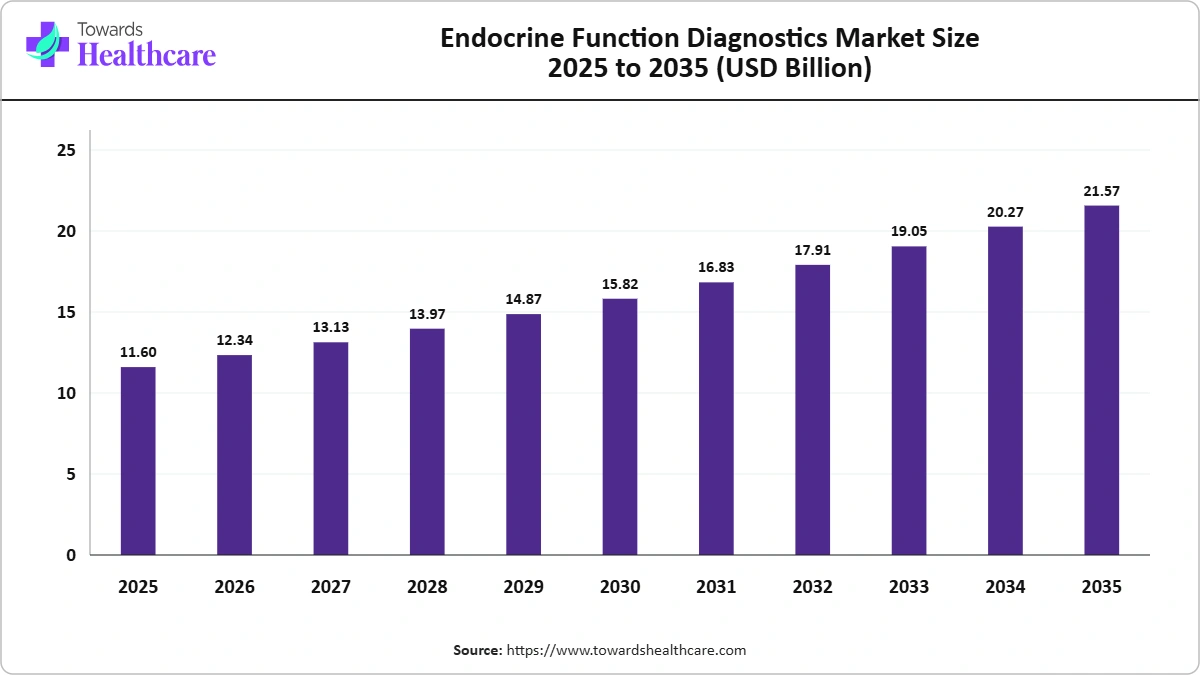
Analyst View: We built the estimate from endocrine test volumes and average test prices by type and region, cross-checked against endocrine diagnostics revenues of leading suppliers. Our value sits just above published comparable estimates.
| Driver | Impact | ≈ CAGR Contribution | Time Horizon | Key Regions |
| Diabetes and thyroid disease are common | High | +2.50 pp | Short to long term | Global, strongest in North America |
| Populations age | Medium | +2.11 pp | Medium to long term | Global, fastest uptake in Asia Pacific |
| Hormone health awareness grows | Medium | +1.80 pp | Short to medium term | Global |
| Automation supports volume | Low | +1.41 pp | Long term | Developed and emerging markets |
Note: Contributions are indicative estimates of each factor's effect on annual growth.
Sources: Expert interviews, secondary sources, Towards Healthcare database and Towards Healthcare analysts.
Taken together, these drivers add about 7.82 percentage points to the annual growth of the endocrine function diagnostics market, with diabetes and thyroid disease being common and having the largest effect. Their influence is strongest in North America, while uptake grows fastest in Asia Pacific.
| Restraint | Impact | ≈ Negative CAGR Contribution | Time Horizon | Key Regions |
| Price pressure | High | -0.63 pp | Short to medium term | Global |
| Assay variability | High | -0.46 pp | Medium term | Price-sensitive and emerging markets |
| Reimbursement limits | Medium | -0.31 pp | Short term | North America and other mature markets |
Note: Contributions are indicative estimates of each factor's effect on annual growth.
Sources: Expert interviews, secondary sources, Towards Healthcare database and Towards Healthcare analysts.
These restraints are expected to reduce annual growth of the market by about 1.41 percentage points, led by price pressure. Their effect eases over the forecast period as suppliers, buyers and regulators adapt, leaving a net CAGR of 6.40% from 2026 to 2035.
Rising demand for home-based hormone testing, development of LC-MS/MS technologies, and menopause and testosterone assessments present growth opportunities in endocrine diagnostics. Expansion of healthcare accessibility in Asia and swift adoption of point-of-care HbA1c testing are driving market growth.
Note: 2025 is the base year; 2035 shares and CAGRs are forecasts.
Sources: Expert interviews, secondary sources, Towards Healthcare database and Towards Healthcare analysts.
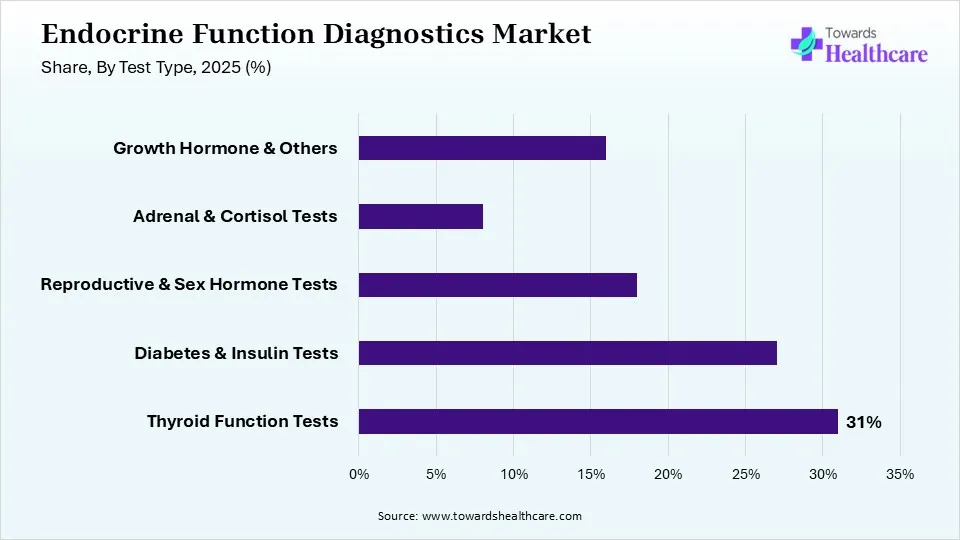
Thyroid Function Tests accounted for a 31.00% share in 2025 and is projected to expand at a CAGR of 5.84% from 2026 to 2035. Thyroid function tests hold the leading position because TSH and T4 are among the most ordered lab tests. This segment is expected to grow at a slower rate than the overall market over the forecast period.
Diabetes & Insulin Tests are significant because of HbA1c monitoring. This segment is expected to grow broadly in line with the overall market between 2026 and 2035.
Reproductive & Sex Hormone Tests grow with fertility and hypogonadism care. This segment is expected to grow at a faster rate than the market over the forecast period.
Adrenal & Cortisol Tests are used to diagnose Cushing's and Addison's disease. This segment is expected to grow broadly in line with the overall market between 2026 and 2035.
Growth Hormone & Others There is a significant demand for growth hormones to treat GHD (Growth Hormone Deficiency). This segment is expected to grow broadly in line with the market over the forecast period.
Note: 2025 is the base year; 2035 shares and CAGRs are forecasts.
Sources: Expert interviews, secondary sources, Towards Healthcare database and Towards Healthcare analysts.
Immunoassays accounted for 62.00% of revenue in 2025 and is projected to expand at a CAGR of 6.07% from 2026 to 2035. Immunoassays hold the largest share because automated platforms run a major proportion of hormone tests. The immunoassays segment is expected to grow slower than the overall market over the forecast period.
Clinical Chemistry & HbA1c Analyzers are used in diabetes monitoring. This segment is expected to grow broadly in line with the overall market between 2026 and 2035.
LC-MS/MS are growing at the highest rate owing to rapid adoption of steroid hormones. This segment is expected to grow at a faster rate than the overall market throughout the forecast period.
Point-of-Care & Others serve clinics and homes. The point-of-care & others segment is expected to grow broadly in line with the overall market from 2026 to 2035.
Note: 2025 is the base year; 2035 shares and CAGRs are forecasts.
Sources: Expert interviews, secondary sources, Towards Healthcare database and Towards Healthcare analysts.
Hospitals accounted for 38.00% of the market in 2025 and is projected to expand at a CAGR of 6.29% from 2026 to 2035. Hospitals lead because inpatients and specialists widely use hormone tests. The hospitals segment is expected to grow broadly in line with the market over the forecast period.
Diagnostic Laboratories run high volumes of outpatient tests. This segment is expected to grow slower than the overall market between 2026 and 2035.
Clinics & Home Care grow fastest owing to an expanding point-of-care and home tests ecosystem. This segment is expected to grow faster than the overall market over the forecast period.
Analyst View: Segment shares were allocated from demand, product portfolios and pricing in each category. Thyroid Function Tests, Immunoassays and Diagnostic Laboratories lead their categories because they meet the core needs of today's buyers. We expect the shares of Reproductive & Sex Hormone Tests, LC-MS/MS and Clinics & Home Care to increase as newer technologies, users and applications grow at a significant rate.
Note: 2025 is the base year; 2035 shares and CAGRs are forecasts.
Sources: Expert interviews, secondary sources, Towards Healthcare database and Towards Healthcare analysts.
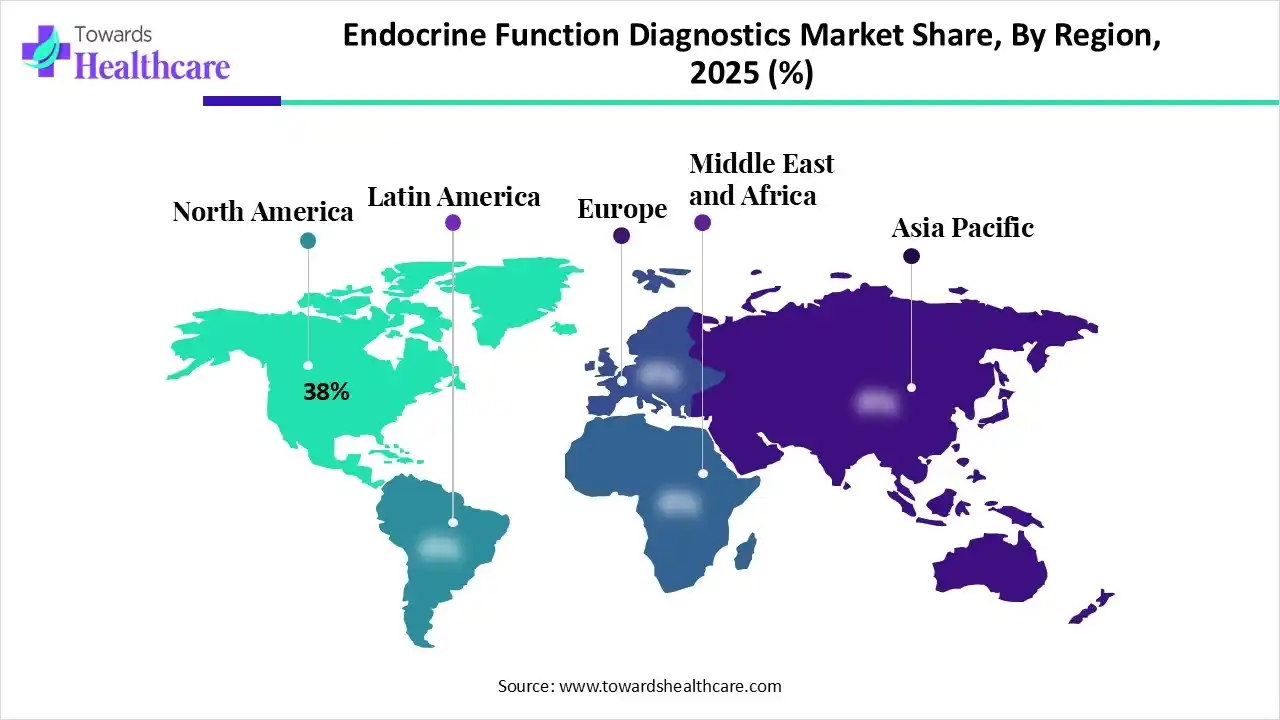
North America held 38.00% of revenue in 2025 and is projected to expand at a CAGR of 5.81% throughout the forecast period. North America leads because of high testing volumes, significant diabetes prevalence and strong reimbursement landscape. North America is expected to grow at a slower rate than the market between 2026 and 2035.
Europe has large lab networks and endocrine care. Europe is expected to grow broadly in line with the market over the forecast period.
Asia Pacific grows fastest with the rising prevalence of diabetes and thyroid disease in China and India. Asia Pacific is expected to grow at a faster pace than the market between 2026 and 2035.
Latin America has an expanding diabetes testing ecosystem. This region is expected to grow broadly in line with the overall market throughout the forecast period.
Middle East & Africa this region has a high diabetes prevalence. Middle East & Africa is expected to grow broadly in line with the overall market between 2026 and 2035.
Analyst View: Regional shares were built from demand, installed base, spending and supplier presence in each region. North America leads because of its mature demand base and strong suppliers. We assign Asia Pacific the highest growth premium because investment, adoption and capacity are expanding at the fastest rate in this region.
| Rank | Company Name | 2025 Share (%) | Key Products / Business | Headquarters |
| 1 | Roche Diagnostics | 21.00% | Elecsys hormone and HbA1c tests | Switzerland |
| 2 | Abbott | 15.00% | Alinity and ARCHITECT hormone tests | United States |
| 3 | Siemens Healthineers | 12.00% | Atellica immunoassays | Germany |
| 4 | Beckman Coulter (Danaher) | 8.00% | Access hormone assays | United States |
| 5 | Tosoh | 4.00% | AIA hormone and HbA1c analyzers | Japan |
| 6 | QuidelOrtho | 4.00% | VITROS hormone tests | United States |
| 7 | Mindray | 4.00% | CLIA hormone assays | China |
| 8 | Revvity | 3.00% | IDS endocrine assays | United States |
| 9 | Bio-Rad Laboratories | 3.00% | HbA1c systems and controls | United States |
| 10 | Snibe | 3.00% | MAGLUMI hormone assays | China |
Note: Company shares are 2025 estimates.
Sources: Company press releases, expert interviews, secondary sources, Towards Healthcare database and Towards Healthcare analysts.
Roche Diagnostics led the market with a 21.00% share in 2025, followed by Abbott at 15.00% share and Siemens Healthineers at 12.00% share. Roche Diagnostics is the leader owing to its elecsys hormone and HbA1c tests, Abbott competes with alinity and ARCHITECT hormone tests, and Siemens Healthineers offers atellica immunoassays. Beckman Coulter (Danaher), Tosoh, QuidelOrtho, Mindray, Revvity, Bio-Rad Laboratories and Snibe compete through access hormone assays, AIA hormone and HbA1c analyzers, VITROS hormone tests, CLIA hormone assays, IDS endocrine assays, hbA1c systems and controls and MAGLUMI hormone assays. The top 10 companies accounted for 76.98% of revenue in 2025, while the remaining 23.02% was shared among many regional immunoassay and rapid test manufacturers. The market is concentrated among large immunoassay suppliers, and competition revolves around menu breadth, assay accuracy, automation, LC-MS/MS alternatives, installed base and price per test.
Roche Diagnostics, part of F. Hoffmann-La Roche Ltd, is headquartered in Switzerland. It held 21.00% share of revenue in 2025. Its offering centres on Elecsys hormone and HbA1c tests. In the Towards Healthcare Companies Quadrant it is positioned as a Leader.
Abbott has its global headquarters in the United States. It held a 15.00% share in 2025. Its offering revolves around Alinity and ARCHITECT hormone tests. Abbott has been awarded the status of a Leader in the Towards Healthcare Companies Quadrant.
The corporate headquarters of Siemens Healthineers are in Germany. The company held 12.00% of the market in 2025. Its offerings centers on Atellica immunoassays. In the Towards Healthcare Companies Quadrant it is positioned as a Leader.
Beckman Coulter (Danaher) is headquartered in the United States. It held a 8.00% share in 2025. The company provides Access hormone assays. It has been positioned as a Leader in the Towards Healthcare Companies Quadrant.
Tosoh is headquartered in Japan. Tosoh captured 4.00% of revenue in 2025. Its portfolio comprises AIA hormone and HbA1c analyzers. In the Towards Healthcare Companies Quadrant it is positioned as a Leader.
QuidelOrtho has its corporate headquarters in the United States. It accounted for a 4.00% share in 2025. Its offering revolves around VITROS hormone tests. In the Towards Healthcare Companies Quadrant it is positioned as a Leader.
Mindray, part of Shenzhen Mindray Bio-Medical Electronics Co., Ltd., is headquartered in China. The company held a 4.00% share in 2025. It offers CLIA hormone assays. Mindray has been positioned as an Innovator in the Towards Healthcare Companies Quadrant.
Revvity is headquartered in the United States. It captured 3.00% of the market in 2025. Its portfolio consists of IDS endocrine assays. In the Towards Healthcare Companies Quadrant it is positioned as an Innovator.
Bio-Rad Laboratories has its global headquarters in the United States. The company accounted for 3.00% of revenue in 2025. Its offering centres on HbA1c systems and controls. The company has been awarded the status of a Innovator in the Towards Healthcare Companies Quadrant.
Snibe, part of Shenzhen New Industries Biomedical Engineering Co., Ltd., is headquartered in China. It held a 3.00% in 2025. The company offers MAGLUMI hormone assays. In the Towards Healthcare Companies Quadrant it is positioned as an Innovator.
The endocrine function diagnostics ecosystem links antibody & reagent suppliers, diagnostic makers, laboratories, clinicians and regulators, with each stage adding value before products reach end users.
| Ecosystem Stage | Role in the Market | Key Companies |
| Antibody & Reagent Suppliers | Supply antibodies and calibrators | Reagent makers |
| Diagnostic Makers | Make tests and analyzers | Roche, Abbott, Siemens Healthineers, Revvity |
| Laboratories | Run tests | Hospital and reference labs |
| Clinicians | Order tests | Endocrinologists, primary care, gynaecologists |
| Regulators | Clear tests | FDA, EU IVDR, NMPA |
Sources: Company press releases, expert interviews, secondary sources, Towards Healthcare database and Towards Healthcare analysts.
Antibody & Reagent Suppliers: Supply antibodies and calibrators. Key participants include Reagent makers.
Diagnostic Makers: Make tests and analyzers. Key participants include Roche, Abbott, Siemens Healthineers, Revvity.
Laboratories: Run tests. Key participants include Hospital and reference labs.
Clinicians: Order tests. Key participants include Endocrinologists, primary care, gynaecologists.
Regulators: Clear tests. Key participants include FDA, EU IVDR, NMPA.
Value in the market flows from upstream material and technology suppliers to manufacturers and service providers, then through distribution partners to end users. Companies that integrate several stages or build long-term relationships with end users capture a larger share of this value.
The Towards Healthcare Companies Quadrant positions key participants in the endocrine function diagnostics market by market strength, reflecting revenue scale, market share and geographic reach, and by innovation and growth strategy, reflecting product portfolio breadth, research and development intensity and collaborations. Positions reflect each company's estimated 2025 share of the endocrine function diagnostics market and our assessment of its product innovation, portfolio breadth and partnerships.
Sources: Company press releases, expert interviews, secondary sources, Precedence Research database and Precedence Research analysts.
Leaders: Roche Diagnostics, Abbott, Siemens Healthineers, Beckman Coulter (Danaher), Tosoh and QuidelOrtho combine high market share with broad portfolios and strong innovation.
Innovators: Mindray, Revvity, Bio-Rad Laboratories and Snibe bring newer technologies and specialized products.
By Test Type
By Technology
By End User
By Region
The market was defined as tests and systems used to assess endocrine gland function, including thyroid function tests (TSH, T3, T4), diabetes and insulin tests (HbA1c, insulin, C-peptide), reproductive and sex hormone tests (testosterone, estradiol, LH, FSH), adrenal and cortisol tests, growth hormone and other hormone tests, using immunoassays, LC-MS/MS, clinical chemistry and point-of-care methods, in hospitals, diagnostic laboratories, clinics and home settings.
The 2025 base year was built bottom-up from demand volumes and average prices by test type, technology and end user and region, and checked top-down against the market-specific revenues of leading companies and published estimates. Segment, regional and company values were allocated from test type, technology and end user and region demand. Key estimates were verified by cross-checking company disclosures, regulatory and industry data, and published third-party estimates, and inputs that could not be reconciled have not been included. All segment, regional and company figures were reconciled to the same 2025 base year, and the 2026-2035 forecast, which applies a constant CAGR from the 2025 base, was recalculated and validated.
Analyst View: The market is set for steady expansion as diabetes and thyroid prevalence and related demand keep growing. Our estimate links value to underlying demand, installed base and pricing, so the forecast follows real adoption rather than headline hype. The main upside comes from home hormone tests and LC-MS/MS, while the main risks are price pressure and assay variability.