
The Europe veterinary 3D printing market is projected to grow from USD 48.60 million in 2025 to USD 136.76 million by 2035. This growth is attributed to the growing usage of CT-based 3D models, guides and patient-specific implants to treat complex fractures, deformities, hip dysplasia and bone tumours in pets by leading veterinary hospitals. Lower printing costs and wider CT access promote these tools from referral centres to larger general practices, lifting the market to USD 81.53 million by 2030 and sustaining a CAGR of 10.90% from 2026 to 2035.
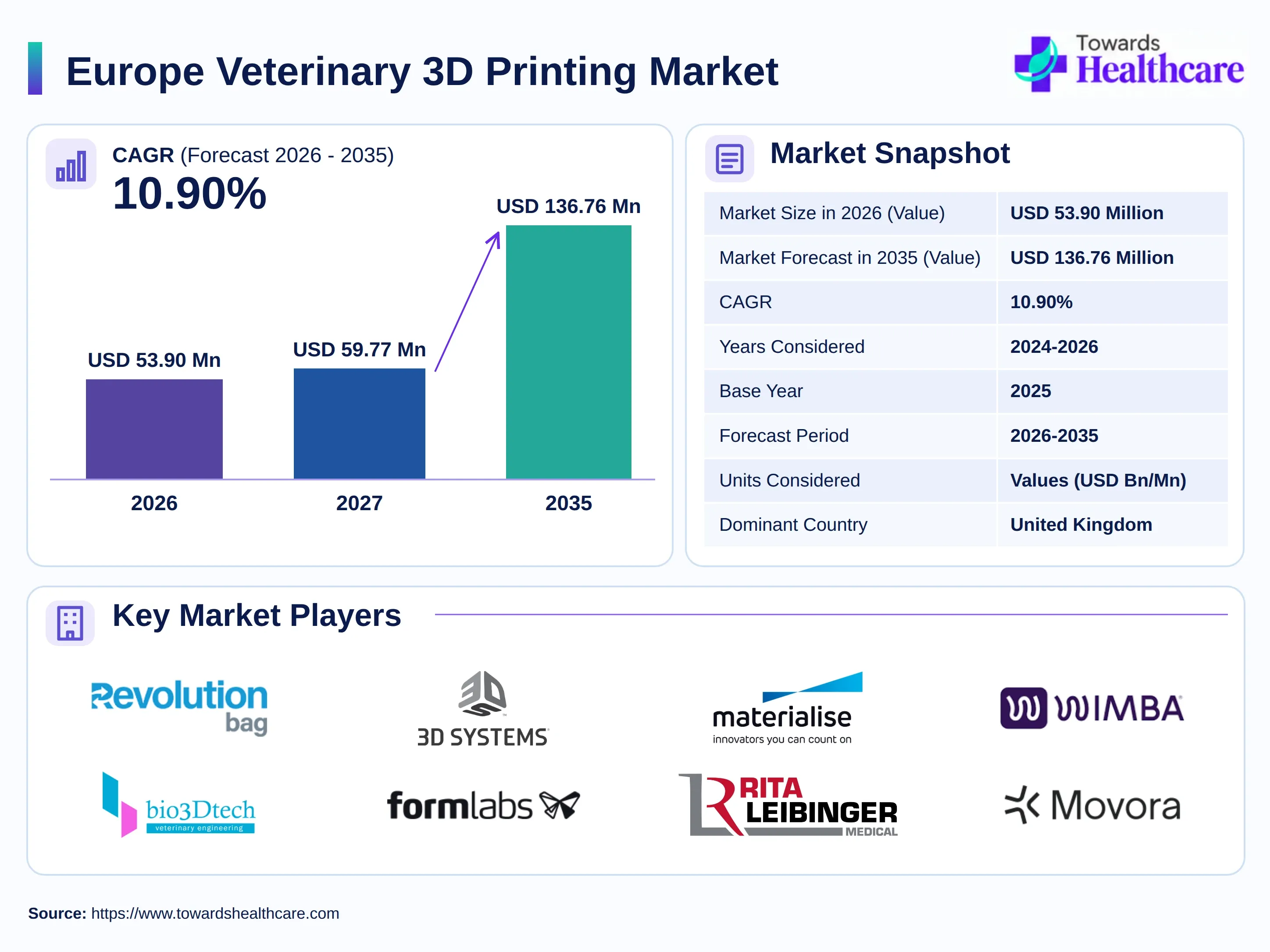
Analyst View: We built the estimate from the number of complex orthopaedic, oncology and maxillofacial cases. Especially those treated at European referral and specialist hospitals and multiplied by the share using 3D-printed models, guides or implants and the average price per case for each product. Case volumes reflect national pet populations: referral hospital counts, and CT scanner installations in veterinary practice. The total market estimate was cross-checked against the European activity of implant designers, printer suppliers, and service bureaus against published estimates. This differentiate our base year slightly above the comparable figures. The growth rate reflects rising adoption in referral surgery and teaching, tempered by the cost of custom implants and the limited number of trained specialists.
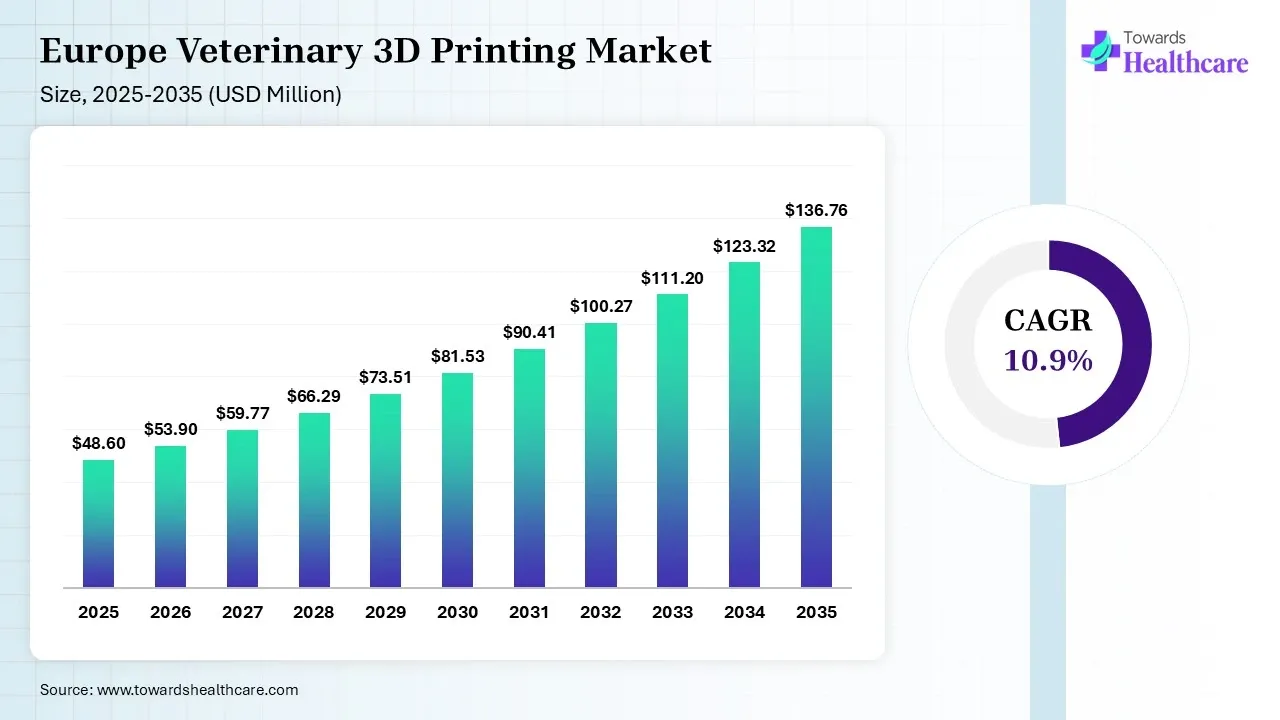
Market Size & Growth Outlook
Regional Market Spotlight
Segmental Spotlight
Driver: Pet owners are spending more on advanced surgery;due to this, referral hospitals are adding CT scanners and specialist surgeons. 3D-printed models and guides simplified surgery and improve outcomes in complex cases. Customized implants ease treatment of conditions that standard implants unable to address.
Restraint: Custom implants and planning services are expensive, which restricts use to owners willing to fund specialist care. Few veterinary surgeons are trained in 3D planning and custom implant surgery. Regulatory frameworks for veterinary implants are less defined than in human medicine, which can hamper sales of commercial products.
Opportunity: Low-cost desktop printers allow general practices to create planning models in-house. Licensed patient-specific implants can scale from university research to routine clinical use. Teaching models and simulators offer growth as veterinary schools reduce live-animal training.
| Segments | 2025 Share | 2025 Market Value |
| Implants | 32.40% | USD 15.75 million |
| Anatomical Models | 24.60% | USD 11.96 million |
| Surgical Guides & Instruments | 19.80% | USD 9.62 million |
| Prosthetics & Orthotics | 15.60% | USD 7.58 million |
| Others (Masks and Splints) | 7.60% | USD 3.69 million |
Implants accounted for the largest market share of 32.40% (USD 15.75 million) in 2025 because patient-specific titanium implants solve cases that standard plates cannot, such as hip dysplasia, limb salvage, and jaw reconstruction. Anatomical models, at 24.60% (USD 11.96 million), is a fastest growing segment, as surgeons use printed bones to plan and rehearse complex procedures, while surgical guides and instruments account for 19.80% (USD 9.62 million). Prosthetics and orthotics, at 15.60% (USD 7.58 million), serve amputees and animals with limb deformities, and other products such as radiotherapy masks and splints account for 7.60% (USD 3.69 million).
| Segments | 2025 Share | 2025 Market Value |
| Dogs | 68.40% | USD 33.24 million |
| Cats | 17.20% | USD 8.36 million |
| Horses | 8.60% | USD 4.18 million |
| Other Animals | 5.80% | USD 2.82 million |
Dogs accounted for 68.40% (USD 33.24 million) in 2025.Orthopedic problems such as cruciate ligament rupture, hip dysplasia and limb deformities are common in dogs, and owners often prefer specialist surgery. Cats, at 17.20% (USD 8.36 million), account for a growing prevalence of trauma and oncology cases, horses for 8.60% (USD 4.18 million), mainly through models and orthotics. Other segment include exotic and zoo animals, for 5.80% (USD 2.82 million).
|
Segments
|
2025 Share
|
2025 Market Value
|
|
Orthopedics
|
46.80%
|
USD 22.74 million
|
|
Surgical Planning
|
24.20%
|
USD 11.76 million
|
|
Oncology & Maxillofacial Reconstruction
|
12.60%
|
USD 6.12 million
|
|
Education & Training
|
9.20%
|
USD 4.47 million
|
|
Others
|
7.20%
|
USD 3.50 million
|
Orthopedics accounted for 46.80% (USD 22.74 million) of the global market revenue in 2025, supported by fracture repair, deformity correction, and joint surgery. Surgical planning, at 24.20% (USD 11.76 million), is gaining share as models and virtual planning become routine in referral centres. On the other hand,oncology and maxillofacial reconstruction account for 12.60% (USD 6.12 million). Education and training account for 9.20% (USD 4.47 million) and other applications for 7.20% (USD 3.50 million).
| Segments | 2025 Share | 2025 Market Value |
| Veterinary Hospitals & Clinics | 71.30% | USD 34.65 million |
| Academic & Research Institutes | 20.40% | USD 9.91 million |
| Others | 8.30% | USD 4.03 million |
Veterinary hospitals and clinics accounted for 71.30% (USD 34.65 million) in 2025. specialist referral hospitals that handle complex surgery are leading the segment. Academic and research institutes, at 20.40% (USD 9.91 million) as they prominenty use 3D printing for teaching, research and novel implant development.Other users including service bureaus and zoos, account for 8.30% (USD 4.03 million).
Analyst View: Segment values were allocated by mapping case types to the 3D-printed products used and weighting by price per case. Implants lead to revenue because each patient-specific implant carries a much higher price than a model or guide, even though models are used in more cases. We expect anatomical models and surgical planning to gain share as in-house printers spread, while implants grow steadily as licensed products replace one-off designs.
| Country | 2025 Share | 2025 Market Value |
| United Kingdom | 24.60% | USD 11.96 million |
| Germany | 19.80% | USD 9.62 million |
| France | 13.40% | USD 6.51 million |
| Italy | 9.60% | USD 4.67 million |
| Spain | 7.40% | USD 3.60 million |
| Netherlands | 6.20% | USD 3.01 million |
| Nordics | 5.80% | USD 2.82 million |
| Switzerland | 3.40% | USD 1.65 million |
| Rest of Europe | 9.80% | USD 4.76 million |
Analyst View: Country shares were built from pet populations, the number of specialist referral hospitals and CT installations, and spending on advanced pet care in each country. The UK and Germany lead because they combine large pet populations with many specialist surgeons. We project the Netherlands as highest growth premium because university-developed patient-specific implants are being licensed and used more widely, starting from a smaller base.
| Rank | Company Name | Market-Specific Revenue (USD Million) | 2025 Share | Key Products / Business | Headquarters |
| 1 | Vimian Group AB (Movora) | 6.80 | 13.99% | Veterinary orthopaedic implants and patient-specific solutions | Sweden |
| 2 | Rita Leibinger GmbH & Co. KG | 3.40 | 7.00% | Patient-specific 3D-printed shelf implants for canine hip dysplasia | Germany |
| 3 | Formlabs Inc. | 2.80 | 5.76% | Resin 3D printers used for models and guides | United States |
| 4 | bio3Dvet | 2.60 | 5.35% | Patient-specific 3D-printed implants and surgical guides | Spain |
| 5 | Materialise NV | 2.40 | 4.94% | Medical 3D printing software and patient-specific services | Belgium |
| 6 | 3D Systems Corporation | 2.20 | 4.53% | 3D printers and planning services | United States |
| 7 | WIMBA | 1.90 | 3.91% | Custom 3D-printed orthoses and prostheses for animals | Poland |
| 8 | r3volutionD AG | 1.40 | 2.88% | Patient-specific 3D-printed medical solutions | Switzerland |
| 9 | Fusion Implants | 1.20 | 2.47% | 3D-printed porous titanium veterinary implants | United Kingdom |
| 10 | Ortho Vet 3D | 0.90 | 1.85% | Veterinary surgical planning and 3D-printed guides | Spain |
Vimian Group led the Europe veterinary 3D printing market with an estimated 13.99% (USD 6.80 million) of 2025 revenue, followed by Rita Leibinger at 7.00% (USD 3.40 million) and Formlabs at 5.76% (USD 2.80 million). Vimian leads through its Movora veterinary orthopaedic business, Rita Leibinger through its licensed patient-specific shelf implant for canine hip dysplasia, and Formlabs through resin printers widely used for in-house models and guides. The top 10 companies accounted for an estimated 52.67% (USD 25.60 million) of 2025 revenue, while the remaining 47.33% (USD 23.00 million) was shared among university 3D labs, in-house hospital printing, small design bureaus and printer resellers. The Europe veterinary 3D printing market remains fragmented, and competition centres on design speed, surgical planning support and regulatory-ready implant manufacturing, as university spin-outs and specialised firms compete with orthopaedic suppliers.
By Product
By Animal
By Application
By End User
By Country
The Europe veterinary 3D printing market comprises 3D-printed implants, anatomical models, surgical guides, prosthetics, orthotics and related products and services used in veterinary medicine in Europe, counted at supplier and service-provider level. The 2025 base year was built bottom-up from complex case volumes at referral hospitals, the share using 3D-printed products and average price per case and checked minutely against the European activity of implant designers, printer suppliers and service bureaus. Segment, country and company values were allocated from case types by application, national pet populations and referral capacity, and supplier portfolios.
Key estimates were verified by cross-checking company disclosures, regulatory and industry data and published third-party estimates, and inputs that could not be reconciled were excluded. All segment, regional and company figures were stated to the same 2025 base year, and the 2026–2035 forecast, which applies a constant CAGR from the 2025 base, was recalculated and validated.
Analyst View: Overall Market
Veterinary 3D printing in Europe is still a specialist niche, but it is switching from one-off cases toward repeatable products and routine planning tools. Our estimate links demand to complex case volumes, adoption rates and price per case, so the forecast follows the growth of referral surgery and CT access. The main upside comes from licensed patient-specific implants and in-house model printing, while the main risks are high costs, limited specialist capacity, and uncertain regulation.