
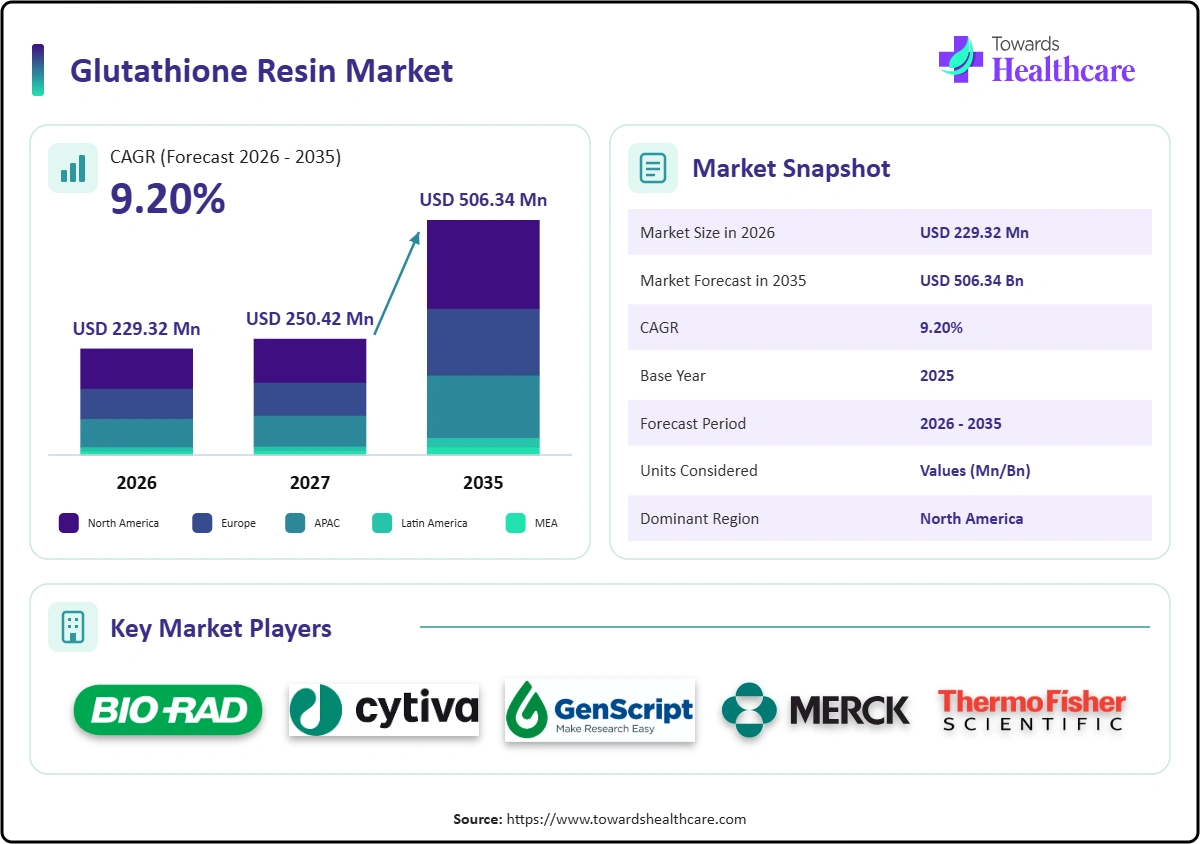
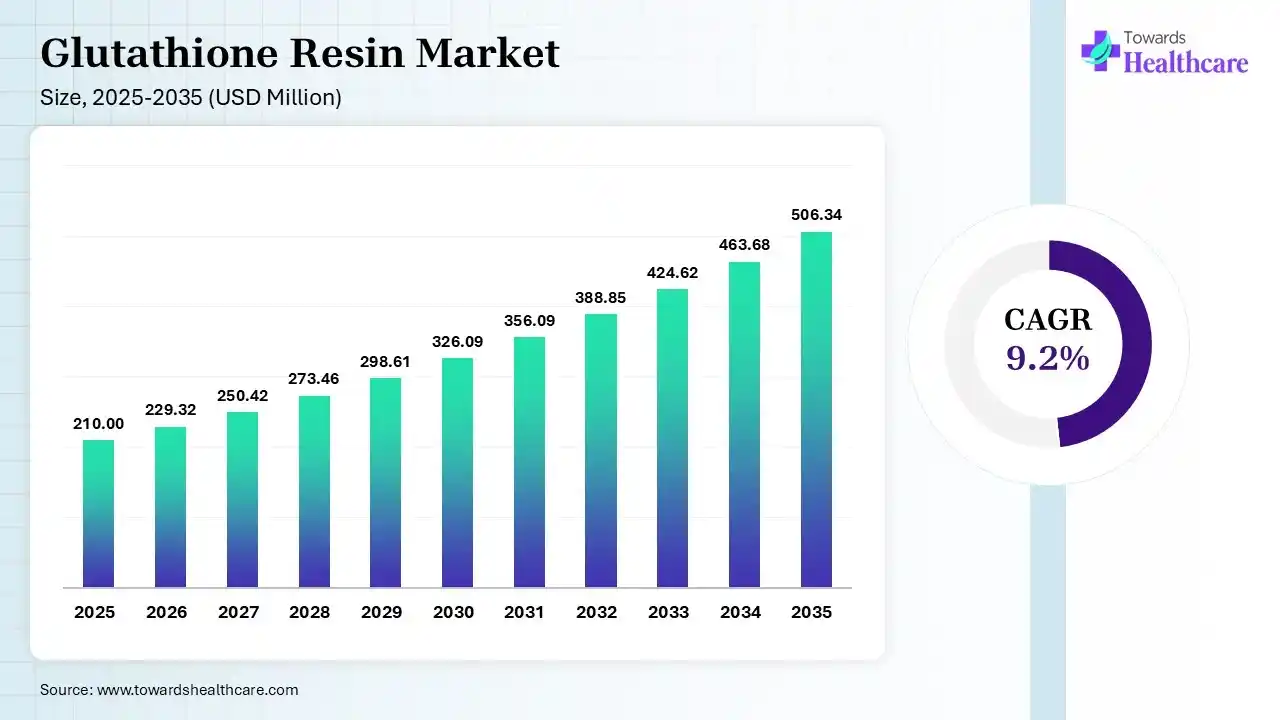
The glutathione resin market is projected to grow from USD 210.00 million in 2025 to USD 506.34 million by the end of the forecast period because GST tagging continues to be one of the most widely used methods to express and purify recombinant proteins for structural biology, assay development, and drug discovery, and glutathione resins are consumed in every purification. Growth in biologics and protein research, contract research outsourcing, and automated purification in magnetic and prepacked formats supports demand, propelling the market to USD 326.09 million by 2030 and maintaining a CAGR of 9.20% during the forecast period.
Analyst View: We built the estimate from the number of laboratories and companies performing GST-tagged protein purification by end user and region, multiplied by average annual resin and column consumption and prices, by resin type, format and application. Consumption reflects research funding, drug discovery activity, and recombinant protein production volumes. The total was cross-checked against the protein purification product revenue of prominent life science suppliers and against published estimates. The growth rate reflects steady research and biologics demand, and competition from other affinity tags such as His-tag systems negatively affects the market growth.
Driver: Recombinant proteins are important for drug discovery and structural biology. GST tags enhance solubility and simplify purification. Biologics research is growing, and contract research organizations are expanding protein production. Automation fuels demand for magnetic and prepacked configurations.
Restraint: Other affinity tags such as His-tag are widely adopted and are cheaper. GST tags can affect protein behavior and may need to be removed. Academic research funding can experience fluctuations, and price competition from generic resins puts significant pressure on margins. Resin reuse reduces recurring purchases.
Opportunity: Automated high-throughput purification creates demand for magnetic and plate configurations. Emerging biotech hubs in Asia provide growth potential. Higher-capacity and more stable resins can command premiums. Kits that combine expression and purification add value. Protein interaction studies for drug discovery expand use.
| Segments | 2025 Share | 2025 Market Value |
| Agarose-Based Resin | 46.40% | USD 97.44 million |
| Sepharose-Based Resin | 38.60% | USD 81.06 million |
| Magnetic Beads & Others | 15.00% | USD 31.50 million |
Note: 2025 is the base year.
Sources: Expert interviews, secondary sources, Towards Healthcare database and Towards Healthcare analysts.
Agarose-based resins accounted for 46.40% (USD 97.44 million) of revenue in 2025 because cross-linked agarose offers high binding capacity and low non-specific binding at a moderate cost. The Sepharose-based resins held a market share of 38.60% (USD 81.06 million), as they are widely used through well-established high-performance and fast-flow products, and magnetic beads and others held 15.00% (USD 31.50 million), which is the fastest-growing type as laboratories are increasingly automating purification and pull-down assays.
| Segments | 2025 Share | 2025 Market Value |
| Loose Resin | 52.80% | USD 110.88 million |
| Prepacked Columns | 31.60% | USD 66.36 million |
| Spin Columns & Kits | 15.60% | USD 32.76 million |
Note: 2025 is the base year.
Sources: Expert interviews, secondary sources, Towards Healthcare database and Towards Healthcare analysts.
Loose resin accounted for 52.80% (USD 110.88 million) share in 2025 because laboratories pack their own columns and scale purifications flexibly. Prepacked columns account for 31.60% (USD 66.36 million) and are growing at a significant rate as users want reproducibility with automated chromatography systems. Spin columns and kits account for 15.60% (USD 32.76 million) of net market revenue.
| Segments | 2025 Share | 2025 Market Value |
| Protein Purification | 61.40% | USD 128.94 million |
| Pull-Down & Protein Interaction Studies | 21.80% | USD 45.78 million |
| Immunoprecipitation & Others | 16.80% | USD 35.28 million |
Note: 2025 is the base year.
Sources: Expert interviews, secondary sources, Towards Healthcare database and Towards Healthcare analysts.
Protein purification held a market share of 61.40% (USD 128.94 million) in 2025 because isolating GST-tagged recombinant proteins is the main use of glutathione resins. Pull-down and protein interaction studies accounted for 21.80% (USD 45.78 million) of revenue, and immunoprecipitation and others for 16.80% (USD 35.28 million).
| Segments | 2025 Share | 2025 Market Value |
| Pharmaceutical & Biotechnology Companies | 48.60% | USD 102.06 million |
| Academic & Research Institutes | 36.20% | USD 76.02 million |
| CROs & Others | 15.20% | USD 31.92 million |
Note: 2025 is the base year.
Sources: Expert interviews, secondary sources, Towards Healthcare database and Towards Healthcare analysts.
Pharmaceutical and biotechnology companies accounted for a market share of 48.60% (USD 102.06 million) in 2025 due to the fact that they produce a significant number of recombinant proteins for target validation, screening, and structural studies. Academic and research institutes held 36.20% (USD 76.02 million) of revenue, and CROs and others accounted for 15.20% (USD 31.92 million), which is the fastest-growing end user as protein production is being increasingly outsourced.
Analyst View: Segment values were allocated by matching laboratory consumption and prices to resin types, formats, applications, and end users, using supplier catalogues and revenue mixes. The leadership of Agarose resins, loose formats, purification, and pharma and biotech can be attributed to routine recombinant protein work. We expect magnetic beads, prepacked columns, and CROs to gain share.
| Region | 2025 Share | 2025 Market Value |
| North America | 37.80% | USD 79.38 million |
| Europe | 28.40% | USD 59.64 million |
| Asia Pacific | 26.60% | USD 55.86 million |
| Latin America | 4.00% | USD 8.40 million |
| Middle East & Africa | 3.20% | USD 6.72 million |
Note: 2025 is the base year.
Sources: Expert interviews, secondary sources, Towards Healthcare database and Towards Healthcare analysts.
North America accounted for 37.80% (USD 79.38 million) of revenue in 2025. Drug discovery and academic structural biology create consistent demand. Research funding fluctuations can affect academic purchasing.
Europe held 28.40% (USD 59.64 million) of the market in 2025. Germany, the UK, Switzerland, and France have well-established protein science and biotech sectors.
Asia Pacific accounted for a market share of 26.60% (USD 55.86 million) in 2025 and is growing at a faster rate than any other region across the globe. China's CROs, biotech companies, and domestic chromatography resin manufacturers are rapidly expanding their operations.
Latin America held a 4.00% (USD 8.40 million) share in 2025. Biotech research bases in Brazil and Mexico are growing at a significant rate.
The Middle East and Africa accounted for 3.20% (USD 6.72 million) of revenue in 2025. Research investment in Israel, Saudi Arabia, and the UAE drives regional market demand.
Analyst View: Regional shares were built from laboratory consumption and prices in each region. North America dominates due to research spending. We assign Asia Pacific the highest growth premium because life science research and contract research are expanding at the fastest rate in this region.
| Rank | Company Name | Market-Specific Revenue (USD Million) | 2025 Share | Key Products / Business | Headquarters |
| 1 | Cytiva | 54.00 | 25.71% | Glutathione Sepharose 4B and HP, GSTrap columns | United States |
| 2 | Thermo Fisher Scientific | 34.00 | 16.19% | Pierce Glutathione Agarose and magnetic beads | United States |
| 3 | Merck | 24.00 | 11.43% | Glutathione agarose and magnetic beads | Germany |
| 4 | Bio-Rad Laboratories | 10.00 | 4.76% | Affinity purification resins and columns | United States |
| 5 | GenScript | 9.00 | 4.29% | Glutathione resins and protein services | China |
| 6 | Takara Bio | 7.00 | 3.33% | Glutathione resins and kits | Japan |
| 7 | Cube Biotech | 5.00 | 2.38% | Glutathione agarose and magnetic beads | Germany |
| 8 | Gold Biotechnology | 4.00 | 1.90% | Glutathione agarose resins | United States |
| 9 | Jena Bioscience | 4.00 | 1.90% | Glutathione agarose resins | Germany |
| 10 | Agarose Bead Technologies | 3.00 | 1.43% | Glutathione agarose beads | Spain |
Note: Company revenues and shares are 2025 estimates.
Sources: Company press releases, expert interviews, secondary sources, Towards Healthcare database and Towards Healthcare analysts.
Cytiva led the market with 25.71% (USD 54.00 million) of net market revenue in 2025, followed by Thermo Fisher Scientific at 16.19% (USD 34.00 million) and Merck at 11.43% (USD 24.00 million). The leading position of Cytiva can be attributed to its Glutathione Sepharose resins and GSTrap prepacked columns, which are widely used in research and process development. Thermo Fisher Scientific provides Pierce Glutathione Agarose and magnetic beads through its broad laboratory distribution, and Merck supplies glutathione agarose and magnetic beads through its Sigma-Aldrich portfolio. Bio-Rad Laboratories, GenScript, Takara Bio, Cube Biotech, Gold Biotechnology, Jena Bioscience and Agarose Bead Technologies compete through affinity columns, protein services, kits, specialized beads and cost-effective resins.
The top 10 companies accounted for an estimated 73.33% (USD 154.00 million) of revenue in 2025, while the remaining 26.67% (USD 56.00 million) was shared among Chinese chromatography resin manufacturers, reagent suppliers, and contract manufacturers. The market is moderately concentrated, and competition revolves around binding capacity, purity of eluted protein, flow properties, reusability, lot-to-lot consistency, format range, and price. There is fierce competition among Chinese resin manufacturers on price, while established suppliers rely on brand trust and distribution.
The glutathione resin ecosystem links raw material suppliers with resin manufacturers, distributors, chromatography system manufacturers, and research and biopharmaceutical users.
| Ecosystem Stage | Role in the Market | Key Companies |
| Raw Materials | Supply agarose, glutathione ligand and activation chemicals | Agarose producers, glutathione manufacturers, chemical suppliers |
| Resin Manufacturers | Produce glutathione resins, columns and beads | Cytiva, Thermo Fisher, Merck, Bio-Rad, GenScript, Cube Biotech |
| Distributors | Sell to laboratories | Fisher Scientific, VWR, Thomas Scientific, regional distributors |
| Chromatography Systems | Provide instruments that use prepacked columns | Cytiva ÄKTA, Bio-Rad NGC, automated liquid handlers |
| End Users | Purify proteins and study interactions | Pharma and biotech companies, universities, CROs |
Sources: Company press releases, expert interviews, secondary sources, Towards Healthcare database and Towards Healthcare analysts.
The Towards Healthcare Companies Quadrant positions key participants in the market by market strength, reflecting revenue scale, market share and geographic reach, and by innovation and growth strategy, reflecting product portfolio breadth, research and development intensity and partnerships. Positions reflect glutathione resin revenue of each company in 2025 and our evaluation of its product range, innovation, and distribution.
Sources: Company press releases, expert interviews, secondary sources, Towards Healthcare database and Towards Healthcare analysts.
Leaders: Cytiva, Thermo Fisher Scientific and Merck bring together significant glutathione resin revenue and broad formats, strong brands and global distribution.
Challengers: Bio-Rad Laboratories has mature purification portfolios but less focus on glutathione media.
Innovators: GenScript, Cube Biotech and Agarose Bead Technologies are developing protein services, magnetic beads and specialized bead technologies that are gaining users.
Niche Players: Takara Bio, Gold Biotechnology and Jena Bioscience provide cost-effective resins and kits to research laboratories.
By Resin Type
By Format
By Application
By End User
By Region
The glutathione resin market is defined as glutathione-based affinity resins, prepacked columns, spin columns, and magnetic beads for GST-tagged protein purification and interaction studies. The 2025 base year was built bottom-up from laboratories performing GST purification by end user and region, and mean resin and column consumption and prices, and checked top-down against the protein purification product revenue of prominent life science suppliers. Segment, regional and company values were allocated from resin types, formats, applications, end users and regional demand. Key estimates were verified by cross-checking company disclosures, regulatory and industry data and published third-party estimates, and inputs that could not be reconciled were not included. All segment, regional and company figures were reconciled to the same 2025 base year, and the 2026–2035 forecast, which applies a constant CAGR from the 2025 base, was recalculated and validated.
Analyst View: The market is a stable, research-driven niche that is growing due to recombinant protein work in drug discovery and academia. Our estimate links demand to laboratory consumption and prices, so the forecast takes into consideration research funding, biologics activity, and contract research. The main upside comes from automation and Asian research growth, while the main risks are competing tag systems and funding pressures.