

Pipeline Programs

CGT Companies Tracked

Manufacturing Facilities


The global heart transplant market size was estimated at USD 13.62 billion in 2025 and is predicted to increase from USD 15.01 billion in 2026 to approximately USD 35.79 billion by 2035, expanding at a CAGR of 10.14% from 2026 to 2035.
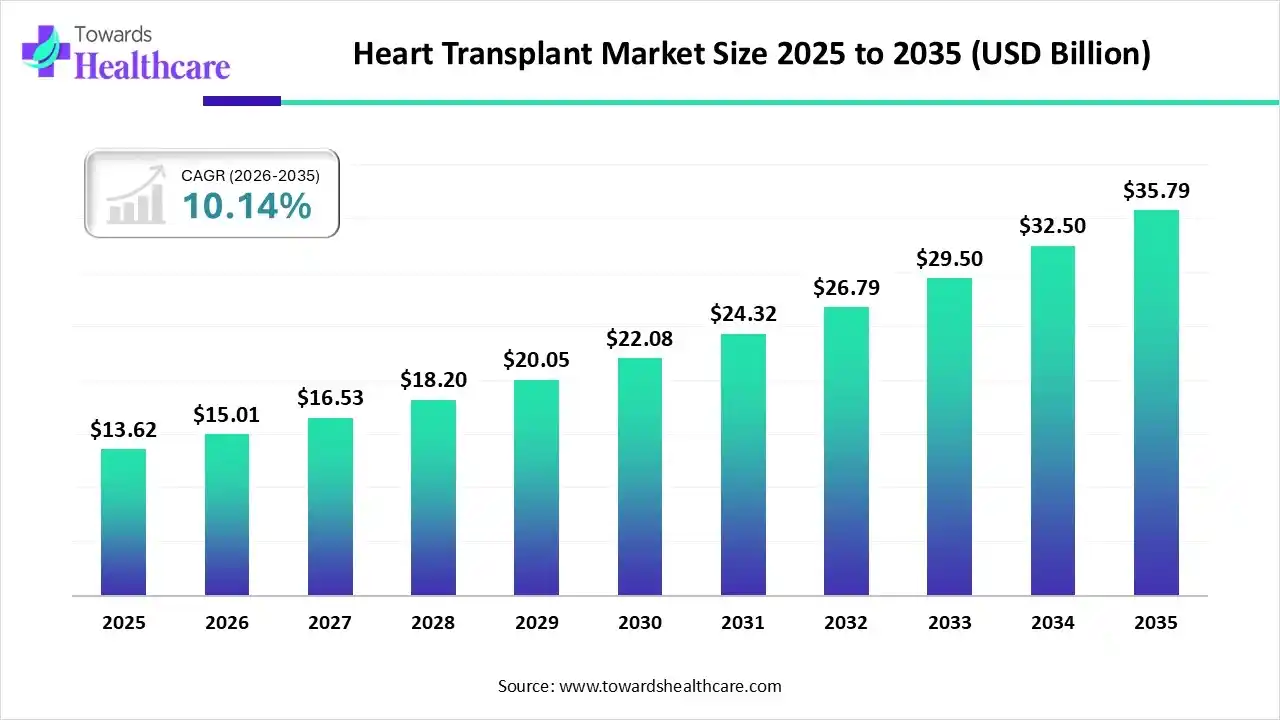
The heart transplant market is growing, as major heart transplant patients live longer, enjoy an advanced quality of life, have increased energy levels, and enhanced general well-being.
The heart transplant market is growing because of rising cardiovascular diseases, especially in the elderly population. An orthotopic heart transplant is the most commonly utilized technique, whereas a heterotopic transplant has described and performed. Patients with progressive heart failure need mechanical circulatory support, and those with inotropic support have a poor prognosis. A heart transplant is a challenging surgical process in which a failing or diseased heart is replaced with a healthy donor heart from someone who has passed away. It’s generally done for patients with end-stage heart failure or complex heart failure. Heart transplantation is a well-established and life-saving treatment for qualified patients.
The heart transplant market is expanding due to the rising prevalence of advanced heart failure and other severe cardiovascular diseases that require transplantation when conventional treatments are no longer effective. Improvements in organ preservation techniques, transplant surgery, and post-transplant patient management have significantly increased survival rates and long-term outcomes. The growing availability of advanced immunosuppressive therapies has also reduced the risk of organ rejection, supporting better patient recovery. Increased investments in transplant research, improved donor-recipient matching technologies, and greater awareness about organ donation are contributing to market growth. Furthermore, ongoing research into artificial hearts and regenerative medicine is expected to enhance future treatment options.
Integration of AI-driven technology in heart transplant drives market growth, as applications for AI-based technology include identifying heart disease, managing strokes rapidly, and improving diagnostic radiology abilities. These AI-based tools and processes also play a significant role in healthcare education. AI is applied to optimize the matching technology among donors and recipients, an important step in ensuring that the transplanted heart is compatible with the recipient’s body. AI-driven technology rapidly analyzes a patient’s health history, type of blood, and genetic markers, along with other factors, to forecast the likelihood of organ refusal or other challenges. This allows physicians to make more up-to-date decisions related to which donor heart to use and which recipient is the ideal match. AI-driven technology supports monitoring patients after the transplant, tracing significant signs and identifying early signs of organ rejection, which significantly enhances long-term results.
| Table | Scope |
| Market Size in 2026 | USD 15.01 Billion |
| Projected Market Size in 2035 | USD 35.79 Billion |
| CAGR (2026 - 2035) | 10.14% |
| Leading Region | North America by 43% |
| Key Applications | End-stage heart failure treatment, congenital heart disease management, bridge-to-transplant therapy, post-transplant monitoring, organ preservation |
| Primary End Users | Transplant Centers, Hospitals, Academic Medical Centers, Organ Procurement Organizations (OPOs), Specialty Cardiac Clinics |
| Key Growth Drivers | Rising heart failure prevalence, advancements in organ preservation, increasing transplant success rates, growing use of ventricular assist devices (VADs), expansion of donor pools |
| Measurable Values | USD Millions/Units/Volume |
| Market Segmentation | By Age Group, By Type of Donor, By Surgical Technique, By Region |
| Top Key Players | Medtronic, Abbott Laboratories, Janssen Pharmaceuticals, Boston Scientific, Terumo Corporation, Cardinal Health |
| Segments | Shares % |
| Deceased Donor | 81% |
| Living Donor | 19% |
Which Type of Donor Led the Heart Transplant Market in 2025?
In 2025, the deceased donor segment held the dominant market by 81% share in 2025, due to from this type of donor organs are available more readily than living donors, as they come from deceased patients who have consented to organ donation. Organs from a deceased donor support one or more patients by donating various organs that the patients require. A deceased donor transplant eliminates organs from a dead person who has been accepted to donate their heart.
Living Donor
Whereas the living donor segment is the fastest-growing in the market, a living donor transplant includes a living patient who donates an organ for transplantation, like a kidney or heart, to a patient in need. Living donor transplants are more significant and reliable, as the screening is done before the transplant to ensure compatibility with the recipient before the transplant. The quality of the organ is higher as it comes from a well-living donor.
| Segments | Shares % |
| Adult | 68% |
| Pediatric | 18% |
| Geriatrics | 14% |
Why did the Adult Segment Dominate the Market in 2025?
The adult segment is dominant in the heart transplant market by 68% share in 2025, as heart transplants in adult is performed in patients with refractory acute and chronic heart failure. Patients with serious, chronic symptoms such as fatigue and shortness of breath that persist despite optimum and maximum medical therapy (GDMT). Adults born with heart defects who have developed severe and irreversible failure.
Pediatric
Whereas the pediatric segment is the fastest-growing in the market, as pediatric heart transplantation (pHTx) shows a small (14%) but very significant and specific part in the field of cardiac transplantation. It presents hopeful uses in continuity of follow-up, medication titration, and patient counseling. Pediatric cardiac transplantation is performed as treatment for palliated congenital heart disease (CHD) and Cardiomyopathy refractory to operating and medical services.
| Segments | Shares % |
| Orthotopic Transplantation | 72% |
| Heterotopic Transplantation | 11% |
| Minimally Invasive Surgery | 17% |
Why did the Orthotopic Transplantation Segment Dominate the Market in 2025?
The orthotopic transplantation segment is dominant in the heart transplant market by 72% in 2025, as it is a well-established and commonly utilized technology for end-stage heart failure patients. With these processes, there is less tricuspid spewing, less sinus node dysfunction, less atrial dilatation, and a decreasing requirement for pacemaker implantation. The process replaces the deteriorating organ with a healthy donor heart, with the goal of restoring normal heart function and improving overall well-being.
Minimally Invasive Surgery
Whereas the minimally invasive surgery segment is the fastest-growing in the market, as providing smaller incisions, shorter recovery periods, lower pain and complications, and better cosmetic outcomes, MICS has become the preferred option for a growing number of patients.
| Segments | Shares % |
| Immunosuppressive Therapy | 61% |
| Cardiac Rehabilitation | 24% |
| Others | 15% |
Why did the Immunosuppressive Therapy Segment Dominate the Market in 2025?
The immunosuppressive therapy segment is dominant in the heart transplant market by 61% share in 2025. Immunosuppressants lower the chances that the body will reject the transplanted organ. Immunosuppression aims to prevent or manage cardiac allograft rejection while reducing drug toxicities, as well as the major sequelae of immunosuppression, such as infection and malignancy. Immunosuppressive regimens consist of a mixture of many agents used concurrently, and the regimen design incorporates several general principles.
Cardiac Rehabilitation
Whereas the cardiac rehabilitation segment is the fastest-growing in the market, as CR has been shown to enhance different important patient results, including exercise capacity, control of cardiovascular challenging factors, and quality of life. This integrates exercise and education to support improving health and recovery after a heart transplant. CR helps enhance the function of the heart, growing peak oxygen uptake (peak) and encouraging cardiac reinnervation.
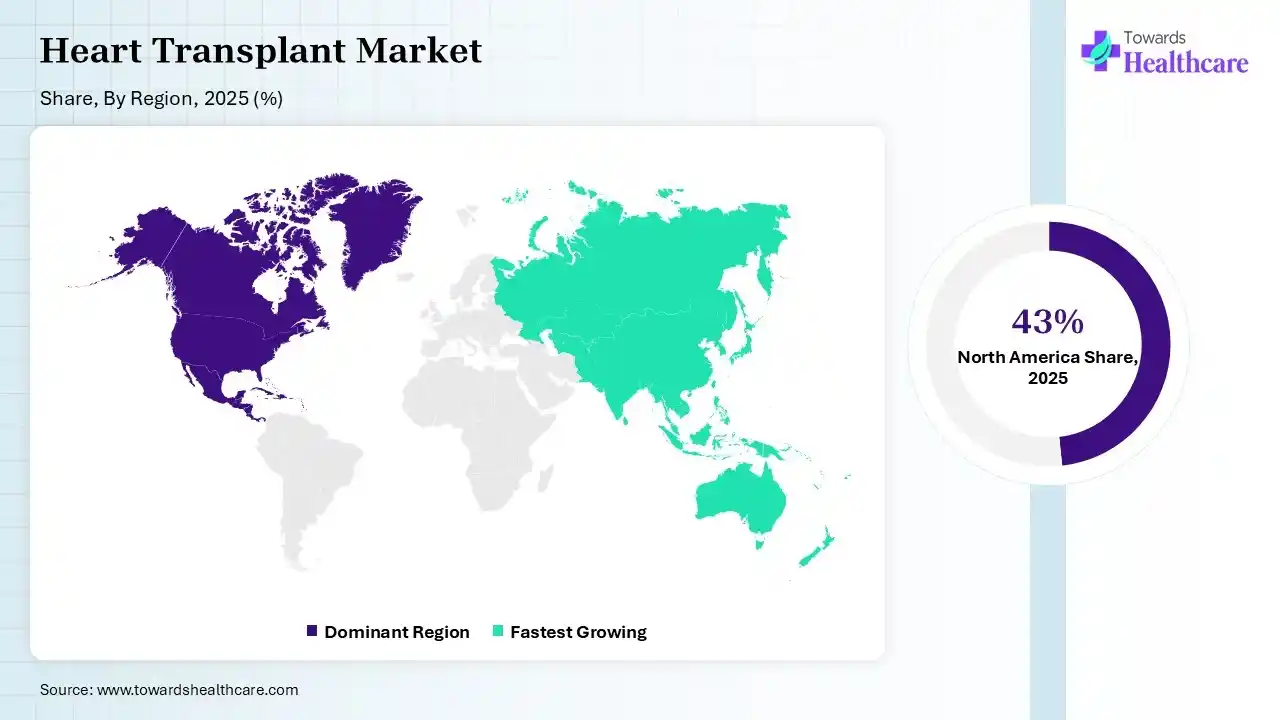
In 2025, North America dominated the heart transplant market by 43% share, as this region's adoption of three-dimensional (3D) bioprinting technology for tissue engineering has shown increasing advantages in generating micro-scale cardiac tissues. The presence of major companies that adopt advanced technology like HeartFlow leads the market in renovating cardiovascular care. It is successful digital health care organizations in the world that drive the growth of the market.
U.S. Market Trends
In the U.S., nearly 6.7 million Americans live with heart failure, with a per-person lifetime occurrence estimated at 24%. With a projected 1 in 5 Americans 40 years and older expected to experience heart failure and 1 in 5 U.S. citizens expected to be 65 years or older by 2050, which growing demand for heart transplant solutions. The U.S. leads in advancing and adopting advanced technologies such as Mechanical Circulatory Support (MCS), total artificial hearts, and ventricular assist devices (VADs), which drives the growth of the market.
Canada Market Trends
Canada is witnessing steady growth in the heart transplant market because of its well-developed healthcare system and growing expertise in organ transplantation. Leading hospitals are adopting advanced surgical techniques and better post-transplant care to improve patient outcomes. Rising awareness about organ donation and increasing government support for transplant programs are helping more patients receive timely treatment. Continuous research in immunosuppressive therapies, improved donor organ preservation methods, and collaboration between healthcare institutions are further supporting the development of heart transplant services across the country.
Mexico Market Trends
Mexico is experiencing gradual growth in the heart transplant market as healthcare infrastructure continues to improve and access to specialized cardiac care expands. Hospitals are investing in advanced transplant facilities and skilled medical professionals to perform complex heart transplant procedures. Increasing awareness about organ donation and growing efforts to strengthen transplant programs are supporting market development. Government initiatives to improve healthcare services, along with better diagnostic capabilities and post-transplant patient management, are helping increase the success and availability of heart transplantation across the country.
Asia Pacific is expected to see rapid growth in the heart transplant market by 21% share, driven by improving healthcare abilities and increasing patient pool in evolving nations, and a growing geriatric population are in the significant factors attributed to the Asia Pacific. The number of older persons is growing rapidly, contributing to increasing incidences of cancer and chronic diseases. Unhealthy dietary patterns, high blood pressure, and air pollution are prevalent IHD challenging factors in the Asia-Pacific region, which drives the growth of the market.
India Market Trends
India’s cardiac transplantation programme is the number one programme in the Asia Pacific, with an average heart transplantation rate of 0.2 per million population. Among both men and women in India, heart diseases range from 1.3 to 4.6 million, with a yearly incidence of 491,600 to 1.8 million according to the Associated Chambers of Commerce and Industry of India (ASSOCHAM). Heart Transplantation in India emphasizes prolonging life with advanced quality for these patients with complex heart failure.
China Market Trends
China is experiencing strong growth in the heart transplant market due to significant improvements in healthcare infrastructure and expanding cardiac care services. Major hospitals are adopting advanced surgical technologies and enhancing transplant capabilities to meet rising demand. Increasing cases of severe heart disease, greater investment in medical research, and improved organ preservation techniques are supporting market expansion. Government efforts to strengthen the organ donation system, along with continuous advancements in post-transplant care and immunosuppressive treatments, are driving further development of the market.
Japan Market Trends
Japan is witnessing steady growth in the heart transplant market because of its advanced healthcare system and continuous progress in cardiovascular care. Hospitals are improving transplant procedures through advanced surgical technologies and better patient monitoring. Growing awareness about organ donation and increasing support for specialized transplant centers are helping expand access to treatment. Ongoing research in immunosuppressive therapies, regenerative medicine, and long-term patient care is improving transplant outcomes. These developments are strengthening Japan's heart transplant market and supporting future medical innovation.
| Ecosystem Segment | Key Participants | Role in Market |
| Technology Providers | TransMedics, XVIVO Perfusion, OrganOx | Develop organ preservation and perfusion technologies that improve donor heart viability. |
| Product Manufacturers | Abbott, Medtronic, Berlin Heart, SynCardia | Manufacture VADs, total artificial hearts, and transplant-support devices. |
| Service Providers | United Network for Organ Sharing (UNOS), Eurotransplant, Organ Procurement Organizations | Coordinate donor matching, allocation, and transplantation logistics. |
| Platform Providers | CareDx, Natera | Provide molecular diagnostics and transplant monitoring platforms. |
| CROs/CDMOs | IQVIA, ICON plc, Syneos Health | Support transplant-related clinical trials and immunosuppressive drug development. |
| Software Vendors | Philips Healthcare, GE HealthCare | Provide cardiac imaging, transplant workflow, and patient monitoring systems. |
| Research Institutions | Mayo Clinic, Cleveland Clinic, Stanford University, Cedars-Sinai | Conduct transplant research, clinical trials, and innovation programs. |
| End-User Industries | Hospitals, Academic Medical Centers, Specialty Cardiac Institutes | Perform transplantation procedures and long-term patient management. |
R&D:
Manufacturing Processes:
Patient Services:
| Tier 1 | Tier 2 | Tier 3 | |
| Typical Market Influence | 68% | 23% | 9% |
| Tier 1 | ||||
| Company Name | Headquarters | Country | Why Relevant to This Market | Key Products/Services |
| Abbott Laboratories | Abbott Park, Illinois, USA | USA | Global leader in mechanical circulatory support and transplant bridging therapies | HeartMate 3 LVAD, transplant support technologies |
| Medtronic plc | Dublin | Ireland | Major provider of advanced cardiac therapies and transplant-support solutions | Cardiac rhythm management, heart failure devices |
| TransMedics Group, Inc. | Andover, Massachusetts, USA | USA | Pioneer in heart preservation and transportation technology | Organ Care System (OCS) Heart |
| Tier 2 | ||||
| Company Name | Headquarters | Country | Why Relevant to This Market | Key Products/Services |
| XVIVO Perfusion AB | Gothenburg | Sweden | Specialist in organ preservation and transplantation technologies | XVIVO Heart Preservation Solutions |
| Natera, Inc. | Austin, Texas, USA | USA | Growing transplant diagnostics provider | Prospera Heart Transplant Assessment |
| SynCardia Systems LLC | Tucson, Arizona, USA | USA | Leader in total artificial heart technology | SynCardia Total Artificial Heart |
| Tier 3 | ||||
| Company Name | Headquarters | Country | Why Relevant to This Market | Key Products/Services |
| Carmat SA | Vélizy-Villacoublay | France | Developer of next-generation artificial heart technology | Aeson Total Artificial Heart |
| Leviticus Cardio Ltd. | Petah Tikva | Israel | Developing wireless energy systems for VADs | FiVAD wireless power technology |
| CorWave SA | Clichy | France | Innovative heart pump developer | Wave membrane pump technology |
Strengths
Weaknesses
Opportunities
Threat
In June 2026, “despite decades of breakthrough advances in cardiovascular medicine, the system supporting heart transplantation has remained largely unchanged. Today, transplant recipients still face serious challenges, including difficulty detecting heart rejection early, reliance on immunosuppressive therapies that have seen little advancement over the past 20 years, and inconsistent outcomes, especially among Black patients and children,” said Mariell Jessup, M.D., FAHA, chief science and medical officer, American Heart Association.
By Age Group
By Type of Donor
By Surgical Technique
By Region





Principal Consultant
Rohan Patil is a seasoned market research professional with over 5+ years of focused experience in the healthcare sector, bringing deep domain expertise, strategic foresight, and analytical precision to every project he undertakes.
Learn more about Rohan Patil

Reviewed By
Aditi Shivarkar is a seasoned professional with over 14 years of experience in healthcare market research. As a content reviewer, Aditi ensures the quality and accuracy of all market insights and data presented by the research team.
Learn more about Aditi Shivarkar










