Pipeline Programs

CGT Companies Tracked

Manufacturing Facilities


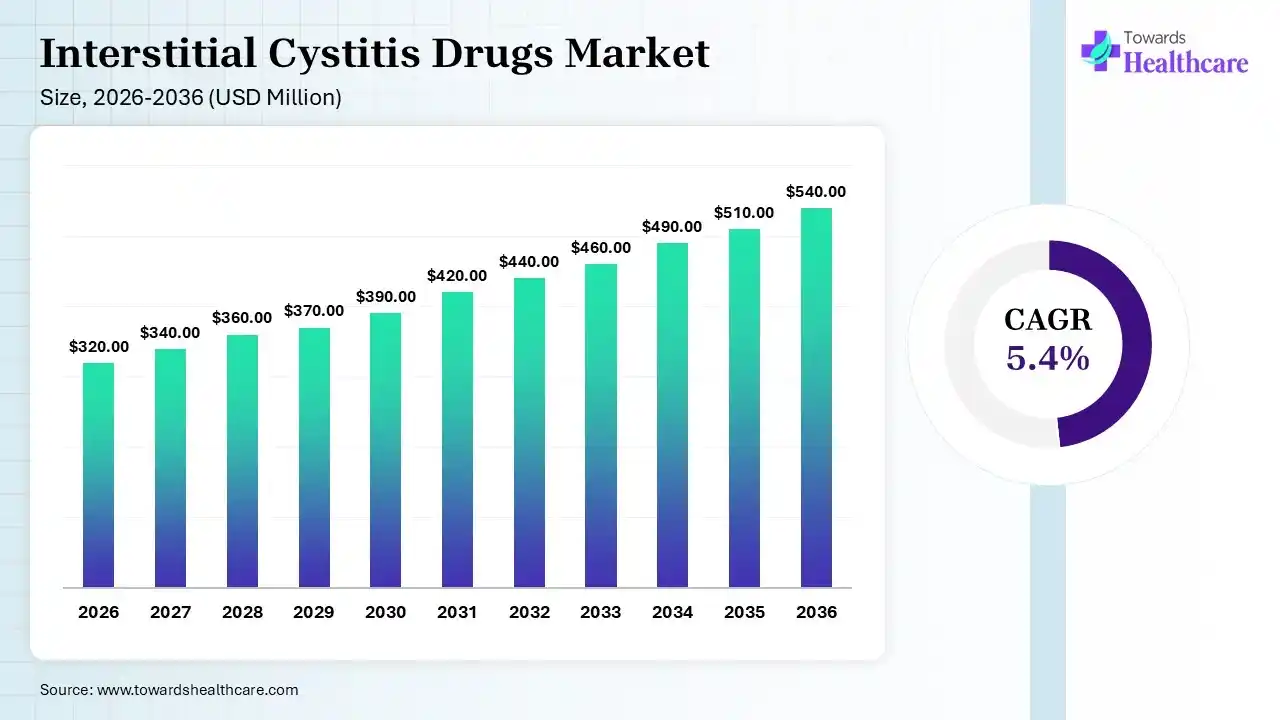
The interstitial cystitis drug market is anticipated to reach US$ 320 million in 2026 and is projected to grow to approximately US$ 540 million by 2036, expanding at a CAGR of 5.4% during 2026-2036. Market growth will depend on the demand for symptom management, the availability of effective treatment options, and the adoption of emerging therapies. Since IC/BPS lacks a universally effective treatment approach, market revenue will continue to reflect a mix of oral medications, intravesical therapies, and other pharmacological interventions used to manage bladder pain, urinary urgency, and frequency.
The market outlook is influenced by disease awareness, diagnostic rates, treatment selection, reimbursement coverage, and patient response to existing therapies. Differences in treatment practices and the use of off-label medications also affect market size estimates. A clear distinction between drugs specifically approved for IC/BPS and medications used off-label is therefore essential to assess the market's commercial potential accurately and avoid inconsistencies across published estimates.
Through 2035, new drug approvals, improvements in clinical evidence, and the introduction of therapies with better efficacy or tolerability could create additional revenue opportunities. However, the pace of market expansion will depend on clinical outcomes, physician adoption, pricing, and patient access. Forecast scenarios should account for these factors alongside treatment persistence and competitive developments to provide a realistic assessment of market growth and the potential impact of emerging therapies.
The global market for drugs to treat interstitial cystitis possesses a unique place among urological conditions and chronic pain conditions. Interstitial cystitis/bladder pain syndrome (IC/BPS) represents a chronic condition whereby a person experiences pain, pressure or discomfort in the bladder and is often accompanied by the need to urinate urgently and frequently, with severe impact on the quality of life. Unlike many other pharmaceutical markets that center on the presence of a specific disease pathology and the associated treatment approach, IC/BPS involves diverse populations and symptoms, as well as possible biological pathologies.
As such, what makes this commercial market viable goes beyond the presence of the condition itself in the population. The revenue potential is dependent on the number of people with symptoms who are correctly diagnosed, treated with pharmaceuticals, continue with the therapy, get sufficient results to warrant continued treatment, and are reimbursed for their treatment.
A key market attribute is the lack of an efficacious, disease-modifying pharmaceutical therapy for all patients suffering from interstitial cystitis and bladder pain syndrome. The standard therapy usually consists of a combination of oral drugs, instillation treatment, symptom-targeted management, behavior modification, and procedures in selected cases. The use of drugs may involve pain relief, use of some oral medication, bladder instillation therapies, and therapies targeting specific symptom clusters. Efficacy and tolerance data vary depending on the method of treatment used and patient subgroup.
This market is highly fragmented by treatment methods, with commercial potential spread over prescription drugs, generics, compounding medicines and investigational products. An exhaustive market analysis should differentiate between prescription drugs that are approved for IC/BPS and those that are not. It is also necessary to separate drug-based therapy from other treatment options competing for the same treatment dollars.
Three structural changes will be necessary for market evolution: better awareness and diagnosis, better selection of patients' subgroups, and introduction of therapies with reproducible effects on pain and urinary symptoms.
The Interstitial Cystitis drug market is segmented by drug class, route of administration, treatment setting, disease phenotype, line of therapy, and reimbursement status. These factors influence treatment selection, prescribing patterns, and market opportunities.
Oral therapies include pentosan polysulfate sodium (PPS), tricyclic antidepressants, selected antihistamines, and other medicines used to manage IC/BPS symptoms. PPS is the only FDA-approved oral drug specifically indicated for bladder pain associated with IC/BPS in the United States. However, its clinical benefits remain uncertain, and the risk of pigmentary maculopathy requires attention to long-term vision safety.
Intravesical therapies include dimethyl sulfoxide (DMSO), heparin, lidocaine, and combination treatments administered directly into the bladder. Their use depends on clinical facilities, treatment frequency, administration costs, and patient tolerance for catheter-based procedures. These factors influence treatment adoption and the commercial potential of intravesical therapies across hospitals, urology clinics, and specialized care centers.
| Segmentation dimension | Principal categories | Commercial significance |
| Drug class | PPS, analgesics, tricyclic antidepressants, antihistamines, DMSO, heparin/lidocaine combinations, other agents | Distinguishes disease-specific revenue from broader symptom management |
| Route | Oral; intravesical | Separates prescription-driven retail revenue from clinic-administered treatment |
| Patient phenotype | Hunner-lesion disease; non-Hunner IC/BPS; pain-dominant; urinary-symptom-dominant | Supports differentiated clinical development and patient targeting |
| Treatment stage | Initial pharmacotherapy; combination treatment; refractory disease | Identifies escalation and unmet-need opportunities |
| Channel | Retail and mail-order pharmacies; hospital and specialty pharmacies; clinic-administered supply | Determines access, distribution economics and net realization |
| Geography | North America; Europe; Asia-Pacific; Latin America; Middle East and Africa | Captures differences in diagnosis, approval and reimbursement |
Demand for IC drugs is driven by chronic symptoms and repeated requirements to treat the problem, along with an extensive number of patients' needs that remain unaddressed clinically. But translating the medical burden to sales is limited by overlapping symptoms with other urological and pelvic pain conditions, poor recognition, and lack of a diagnostic test for all patients.
The case of the US public health situation shows why patient identification is critical, as the disease strikes women almost two times more than men, though it can be present among both genders. The symptoms can persist for many years and even for a lifetime. The aforementioned features indicate the necessity of long-term treatment but do not mean that all sufferers take drugs.
The principal growth drivers are:
Among the key constraints are uncertain effectiveness among varied patient groups, discontinuation of the therapy, side effects, burden of multiple treatments, and payer evaluation of the treatments lacking comparative data. The safety monitoring for PPS-related retinal problems is an additional issue. In the case of intravesical treatment, such constraints as the burden of multiple treatments and painful administration emerge.
One of the opportunities is the clinical differentiation. A drug that offers significant relief from pain, and improved quality of life within a well-defined patient group will be more popular than a broadly positioned medication with an inconsistent evidence base.
There is no single average selling price that accurately represents the IC/BPS drug market. Oral medications are typically priced per prescription or treatment month, while intravesical therapies may be priced per vial, instillation, or treatment course. This distinction is important when comparing the ongoing cost of oral therapy with bladder-directed treatment.
Pricing analysis should distinguish manufacturer list prices from net revenue and drug costs from treatment delivery costs. For intravesical therapies, the total cost of care may include the medication, preparation, administration, facility charges, and follow-up visits. These expenses should be assessed separately from pharmaceutical manufacturers’ revenue.
A comprehensive pricing analysis should benchmark individual products by country, dosage, package size, and payment channel. It should cover branded drugs, generics, and compounded medications to support meaningful comparisons across treatment options and markets.
The IC/BPS drug supply chain varies by treatment type. Oral medications move through pharmaceutical manufacturing, quality control, packaging, distribution, and pharmacy channels. Intravesical therapies require additional coordination with hospital formularies, clinical supply systems, and urology clinics to ensure product availability and proper administration.
Supply risks also differ across drug categories. Oral medications may face manufacturing disruptions, limited competition, or country-specific distribution constraints. Intravesical therapies may be affected by supplier limitations, formulary decisions, and commercial availability. Supply capacity and potential shortages should therefore be assessed by drug and product type.
Value creation also varies across the supply chain. Manufacturers generate revenue from drug sales, while wholesalers and pharmacies earn margins from distribution and dispensing. Healthcare providers may receive revenue for administering intravesical treatments and delivering related services. For proprietary therapies, intellectual property, clinical differentiation, and market access can be more important to commercial success than manufacturing scale alone.
International trade analysis should distinguish finished pharmaceutical products from active pharmaceutical ingredients (APIs). National pharmaceutical import and export figures provide limited insight into IC/BPS drug flows because these products are generally reported within broader therapeutic or customs categories. Product-level trade estimates therefore require more specific data wherever available.
IC/BPS innovation is now more about enhancing the patient’s experience compared to developing yet another broad-spectrum analgesic. Such innovations as bladder lining protection, local anesthetic, pain pathway modulation, and phenotype-specific treatment can be considered primary.
An important advancement in the field is the use of ready-to-use intravesical preparations. Alenura, which is developed by Hyloris Pharmaceuticals, is an alkalinized lidocaine with heparin and is aimed at tackling acute pain episodes. Its commercialization prospects depend on its clinical effectiveness, applicability, and safety profile. Updates on the drug’s development indicate that it has passed Phase II trials, and future development will be based on the results obtained.
A second program that is relevant in this case is ONO-1110, under evaluation in the treatment of Hunner-type IC. This drug is currently undergoing a Phase IIa trial which involved 57 patients and was concluded in June 2026. The completion of the study is a development milestone but does not mean approval or commercial success and needs careful interpretation of results and next development steps.
The regulatory approach is particularly critical since the evidence in favor of the treatment of bladder pain is not necessarily sufficient to approve a drug for the treatment of a particular disease.
This company universe provides an overview of key market participants.
| Company | Headquarters | Market position | Core strength / relevant exposure |
| Janssen Pharmaceuticals | Beerse, Belgium / US operations | Established-product history | PPS / Elmiron association |
| Hyloris Pharmaceuticals | Liège, Belgium | Pipeline developer | Alenura intravesical program |
| Ono Pharmaceutical | Osaka, Japan | Pipeline developer | ONO-1110, Hunner-type IC |
| Viatris | Canonsburg, Pennsylvania, US | Established pharmaceutical participant | Established medicines and commercialization |
| Bausch Health | Laval, Canada | Adjacent pharmaceutical participant | Product and distribution relevance to be verified |
| Teva Pharmaceutical Industries | Tel Aviv, Israel | Generic / adjacent participant | Oral generic-drug capabilities |
| Sun Pharmaceutical Industries | Mumbai, India | Generic / adjacent participant | Pharmaceutical manufacturing and regional access |
| Cipla | Mumbai, India | Generic / adjacent participant | Oral medicines and emerging-market distribution |
| Dr. Reddy's Laboratories | Hyderabad, India | Generic / adjacent participant | Generic pharmaceutical capabilities |
| Aurobindo Pharma | Hyderabad, India | Generic / adjacent participant | Oral formulation and supply capabilities |
| Lupin | Mumbai, India | Generic / adjacent participant | Specialty and generic medicines |
| Zydus Lifesciences | Ahmedabad, India | Generic / adjacent participant | Formulation development and manufacturing |
| Sandoz | Basel, Switzerland | Generic / adjacent participant | Generic pharmaceutical commercialization |
| STADA Arzneimittel | Bad Vilbel, Germany | Generic / adjacent participant | European pharmaceutical distribution |
| Recordati | Milan, Italy | Specialty pharmaceutical participant | Regional commercial capabilities; direct exposure to verify |
| Ferring Pharmaceuticals | Saint-Prex, Switzerland | Urology-adjacent participant | Urology and specialty-care capabilities |
| Seikagaku Corporation | Tokyo, Japan | Bladder-treatment-adjacent participant | Glycosaminoglycan-related technology and products |
| Kyorin Pharmaceutical | Tokyo, Japan | Urology-adjacent participant | Urology-focused therapeutic expertise |
Competition in the IC drug market depends on how well products address specific treatment needs. Key areas of comparison include oral medications, intravesical preparations, anesthetic combinations, bladder-targeted drugs, and emerging therapies.
Portfolio benchmarking focuses on gaps in rapid pain relief, long-term symptom control, treatment safety, ease of administration, and options for patients who do not respond to standard therapies.
Technology benchmarking evaluates formulation development, delivery methods, scientific rationale, clinical development stage, and supporting evidence. Application benchmarking assesses how well each treatment addresses the broader IC/BPS population, patients with Hunner lesions, acute pain episodes, and persistent symptoms despite standard treatment.
North America holds the largest share in many broad market estimates, while Asia-Pacific is often identified as a fast-growing region.
Market competitiveness depends on product approvals, reimbursement policies, diagnostic capabilities, specialist availability, and the position of branded and generic drugs. Japan is an important market for clinical research into Hunner-type IC. Other markets may offer growth opportunities as specialist access and diagnostic capabilities improve.
Sales channel benchmarking distinguishes retail prescription sales, hospital purchases, and intravesical treatments administered in clinical settings. These differences influence commercial strategies, including specialist engagement, institutional sales, pharmacy distribution, and partnerships with local licensees.
The commercial opportunity in the interstitial cystitis drug market depends on the number of patients eligible for and willing to use a therapy, the net price per patient, and the rate of treatment adoption. Given the relatively narrow disease indication and varied treatment approaches, companies must assess the addressable patient population and likely demand before committing to clinical development or commercialization. Revenue potential will also depend on treatment persistence, reimbursement access, and the ability to demonstrate meaningful clinical benefits.
Strategic partnerships and licensing agreements can help companies access clinical expertise, formulation capabilities, regulatory support, and established urology networks. For smaller pharmaceutical and biotechnology companies, licensing can reduce development and commercialization risks while providing access to markets without requiring an extensive in-house sales infrastructure. Partnerships with established pharmaceutical companies may also support clinical development, regulatory execution, market access, and product distribution.
This report examines strategic partnerships, licensing agreements, clinical development collaborations, and product rights transactions announced, distinguishing confirmed deals from proposed arrangements. Mergers and acquisitions are assessed based on the assets involved and their relevance to IC/BPS treatment. The analysis evaluates how these transactions may influence product development, competitive positioning, commercialization opportunities, and the ability of companies to capture value in the IC/BPS Drug Market.
Opportunities are primarily attractive when there is an unfulfilled medical need and a defined commercial patient population.
| Force | Preliminary assessment | Market-specific rationale |
| Supplier power | Medium | Pharmaceutical ingredient sourcing is established, but specific formulations and sterile products may have narrower supplier bases. |
| Buyer power | Medium-High | Payers and providers can influence utilization, reimbursement, and generic substitution. |
| Threat of new entrants | Medium | Clinical development and regulatory requirements create barriers, while niche markets may constrain launch economics. |
| Threat of substitutes | High | Multiple oral medicines, intravesical approaches, non-drug interventions, and procedural options compete for treatment use. |
| Competitive rivalry | Medium-High | Established treatments compete with off-label alternatives, while emerging products must prove meaningful differentiation. |
The base-case scenario assumes continued demand for established symptom-management drugs, gradual improvements in diagnosis and treatment access, and selective progress in differentiated bladder-targeted therapies. Market growth will depend on the scope of market inclusion, treatment persistence, pricing trends, and the conversion of investigational therapies into FDA-approved products.
The upside scenario considers earlier diagnosis, successful development of differentiated treatments, and improved reimbursement for therapies that demonstrate clinical value. The downside scenario accounts for clinical pipeline failures, limited predictability of treatment response, affordability constraints, and slow adoption of new therapies.
The report evaluates these scenarios through revenue modelling and assesses how potential product launches could affect treatment options, pricing, competitive positioning, market share, and strategic partnerships.
By Drug Class
By Route of Administration
By Disease Phenotype
By Treatment Stage
By Distribution Channel
By End User
By Region


Principal Consultant
Payal Rabde is a Healthcare Market Research Analyst at Towards Healthcare Research & Consulting with 4+ years of experience in pharmaceuticals, biotechnology, medical devices, and life sciences.
Learn more about Payal Rabde

Reviewed By
Aditi Shivarkar is a seasoned professional with over 14 years of experience in healthcare market research. As a content reviewer, Aditi ensures the quality and accuracy of all market insights and data presented by the research team.
Learn more about Aditi Shivarkar