
The North America, Europe, and Asia Pacific ELISA analyzers market is projected to grow from USD 1,620 million in 2025 to USD 2,928.66 million by 2035 as ELISA continues to serve as an established immunoassay technique across clinical diagnostics, blood screening, and scientific research. The increasing replacement of manual laboratory processes with automated analyzers is supporting market development. Rising testing volumes, growing autoimmune and allergy diagnostics, continued blood screening requirements, and expanding research activities are further strengthening demand. These factors are expected to increase market revenue to USD 2,178.17 million by 2030 and sustain a CAGR of 6.1% from 2026 to 2035. ELISA also complements broader laboratory research workflows, including apoptosis assays and cell culture studies.
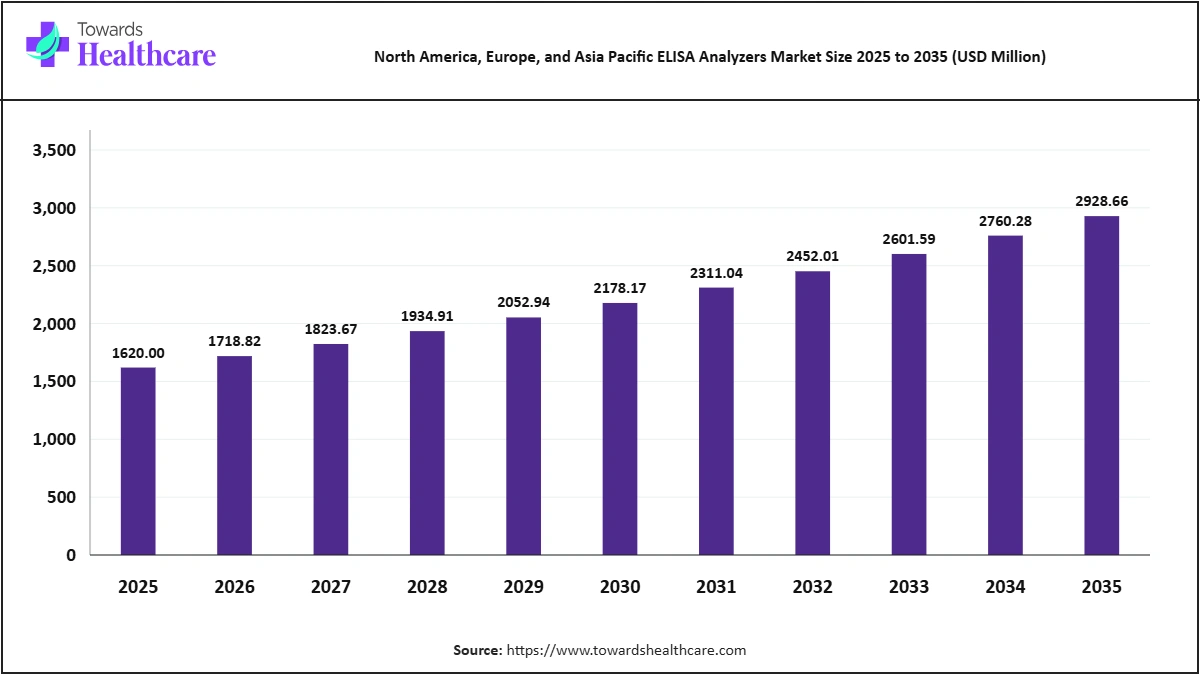
Analyst View: We estimated the market using ELISA analyzer installations and average selling prices across North America, Europe, and Asia Pacific, with cross-validation against supplier revenues. The assessment incorporates fully automated analyzers, semi-automated systems, and microplate readers and washers across clinical, blood screening, and research applications. Since many published estimates primarily cover the global market, our regional estimate was developed through a demand-based assessment of installed equipment, product pricing, supplier presence, and end-user requirements.
The ELISA analyzers market in North America, Europe, and Asia Pacific is driven by increasing diagnostic testing volumes and the growing adoption of laboratory automation. Hospitals and diagnostic laboratories are investing in automated systems to improve operational efficiency, reduce manual intervention, and increase testing capacity. Growing autoimmune and allergy testing requirements are creating additional demand for ELISA-based diagnostic workflows. Continued blood screening activities and expanding pharmaceutical and academic research programs are also supporting the adoption of ELISA analyzers across the covered regions.
Competition from chemiluminescence-based immunoassay technologies represents a significant challenge to the ELISA analyzers market. These alternative technologies compete in several diagnostic applications and influence purchasing decisions among laboratories. Budget limitations, particularly among smaller healthcare facilities and research laboratories, can delay equipment procurement and replacement. The continued use of manual ELISA workflows and pricing pressure from competing manufacturers restrict the pace of automation adoption in North America, Europe, and Asia.
Expanding laboratory infrastructure across Asia Pacific is creating significant growth opportunities for ELISA analyzer manufacturers. Rising investments in diagnostic facilities, blood screening infrastructure, and research laboratories in China and India are driving demand for laboratory equipment. The transition from semi-automated to fully automated systems presents another key growth opportunity. Manufacturers can capture this demand through specialized autoimmune and allergy assay panels, advanced research automation capabilities, and integrated solutions combining instruments, reagents, and services.
| Driver | Impact | ≈ CAGR Contribution | Time Horizon | Key Regions |
| Test volumes rise | High | +2.38 pp | Short to long term | All covered regions, strongest in North America |
| Labs automate | Medium | +2.01 pp | Medium to long term | All covered regions, fastest uptake in Asia Pacific |
| Autoimmune testing grows | Medium | +1.71 pp | Short to medium term | All covered regions |
| Blood screening continues | Low | +1.34 pp | Long term | North America and Asia Pacific |
Note: Contributions are indicative estimates of each factor's effect on annual growth.
Sources: Expert interviews, secondary sources, Towards Healthcare database and Towards Healthcare analysts.
Increasing testing volumes, expanding laboratory automation, growing autoimmune diagnostics, and continued blood screening collectively contribute around 7.44 percentage points to annual market growth. Increasing test volumes represent the largest individual growth contributor, supported by established diagnostic infrastructure in North America. Laboratory automation is another important contributor, with adoption expected to accelerate across Asia Pacific as diagnostic capacity expands.
| Restraint | Impact | ≈ Negative CAGR Contribution | Time Horizon | Key Regions |
| Chemiluminescence competes | High | -0.60 pp | Short to medium term | All covered regions |
| Budgets limit | High | -0.44 pp | Medium term | Smaller and price-sensitive markets |
| Manual ELISA persists | Medium | -0.30 pp | Short term | North America and other mature markets |
Note: Contributions are indicative estimates of each factor's effect on annual growth.
Sources: Expert interviews, secondary sources, Towards Healthcare database and Towards Healthcare analysts.
Competition from chemiluminescence-based immunoassays, budget constraints, and the continued use of manual ELISA workflows are expected to reduce annual market growth by approximately 1.34 percentage points. Chemiluminescence represents the largest restraint because it competes directly with ELISA in several diagnostic testing applications. However, ongoing equipment replacement, automation adoption, and improvements in assay availability are expected to support the market's expansion, resulting in a projected CAGR of 6.1% from 2026 to 2035.
Note: 2025 is the base year; 2035 shares and CAGRs are forecasts.
Sources: Expert interviews, secondary sources, Towards Healthcare database and Towards Healthcare analysts.
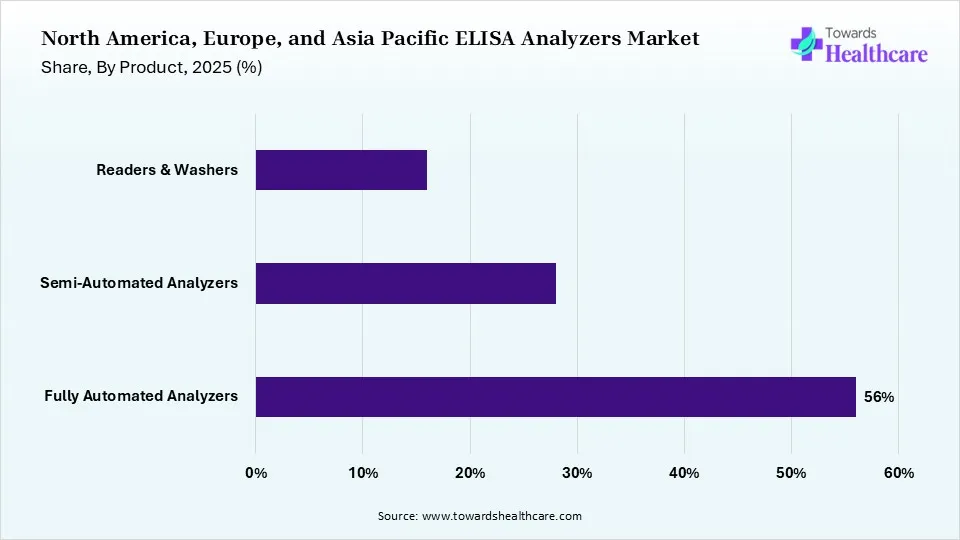
Fully automated analyzers are projected to expand at a CAGR of 6.45% from 2026 to 2035. Fully automated systems are preferred by hospitals and diagnostic laboratories for walk-away processing, improved consistency, reduced manual intervention, and improved workflow traceability, and are expected to grow faster than the total market during the forecast period.
Semi-automated systems are still important for smaller diagnostic labs with moderate testing needs due to their lower costs and compatibility with existing workflows. However, the growing preference for higher throughput and less manual intervention could hinder their growth compared to fully automated systems.
They assist in reading and washing plates. While demand is projected to stay stable, the rise of integrated automated platforms may lead to a gradual slowdown in the growth of standalone equipment.
The segment is projected to record the highest product-level CAGR of 6.45% from 2026 to 2035. Increasing laboratory automation, testing throughput requirements, and demand for traceable workflows will continue to strengthen the segment’s position.
Note: 2025 is the base year; 2035 shares and CAGRs are forecasts.
Sources: Expert interviews, secondary sources, Towards Healthcare database and Towards Healthcare analysts.
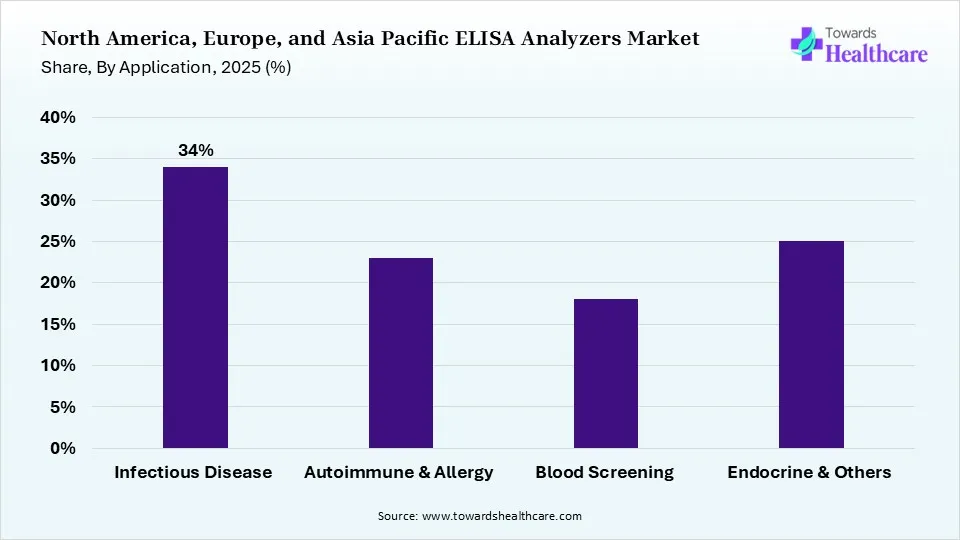
Infectious diseases are projected to expand at a CAGR of 5.47% from 2026 to 2035. ELISA analyzers are crucial for identifying infectious disease markers and facilitating diagnostic testing in hospitals and laboratories. Despite their dominance, competition from alternative immunoassay technologies may limit their growth compared to other applications.
Healthcare providers are increasingly aware of autoimmune disorders and allergic conditions, leading to the expansion of specialized diagnostic testing. ELISA-based assays are utilized to identify antibodies and biomarkers for these conditions, and rising demand for specialized testing panels is anticipated to drive market growth.
ELISA technologies are integral in blood screening to identify infectious disease markers, enhancing blood safety. Ongoing screening needs in blood banks and healthcare systems are projected to drive demand for analyzer platforms.
Applications include endocrine testing and other diagnostic and research activities that rely on ELISA-based biomarker detection. The diversity of testing requirements across clinical and research laboratories supports continued demand for ELISA analyzers in this category.
Autoimmune and allergies are expected to gain market share, reaching 25.90% by 2035, while recording the highest application-level CAGR of 7.37%. Increasing demand for specialized autoimmune and allergy testing is expected to support this shift in application mix.
Note: 2025 is the base year; 2035 shares and CAGRs are forecasts.
Sources: Expert interviews, secondary sources, Towards Healthcare database and Towards Healthcare analysts.
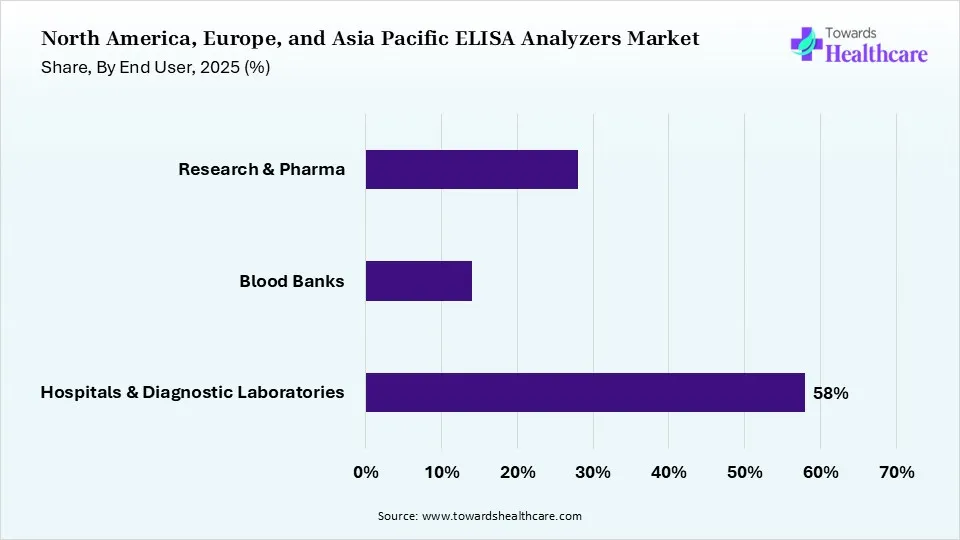
Hospitals and diagnostic laboratories are projected to record a CAGR of 5.64% from 2026 to 2035. Hospitals and diagnostic laboratories represent the largest end-user group because of their extensive diagnostic testing requirements and established use of ELISA-based assays. Increasing patient testing volumes and the need for reliable laboratory workflows are expected to support continued equipment demand.
Blood banks are anticipated to expand at a CAGR of 6.04% from 2026 to 2035. Blood banks use ELISA-based testing as part of donor screening and blood safety procedures. Continued requirements for infectious disease screening and improvements in blood banking infrastructure are expected to support demand for analyzer systems.
The research and pharma segment is expected to register a CAGR of 7.04% from 2026 to 2035. Pharmaceutical companies, biotechnology developers, and academic research institutes use ELISA analyzers for biomarker analysis, protein detection, drug development, and experimental research. Increasing research investments and demand for automated laboratory workflows are expected to support faster growth in this category.
Segment Outlook: By 2035, hospitals and diagnostic laboratories are expected to retain their position as the largest end-user segment, although their share is projected to decline from 58% in 2025 to 55.51% in 2035. Research and pharma is projected to increase its share to 30.57% by 2035 and record the highest end-user CAGR of 7.04%, supported by expanding pharmaceutical research and laboratory automation.
Analyst View: Segment estimates were developed by allocating market demand according to analyzer installations, application requirements, product portfolios, and average pricing across each category. Fully automated analyzers, infectious disease, and hospitals and diagnostic laboratories represent the leading segments because they address the largest established equipment requirements. However, autoimmune and allergy and research and pharma are expected to gain market share as specialized testing, pharmaceutical research, and laboratory automation expand.
Note: 2025 is the base year; 2035 shares and CAGRs are forecasts.
Sources: Expert interviews, secondary sources, Towards Healthcare database and Towards Healthcare analysts.
North America is projected to expand at a CAGR of 5.52% from 2026 to 2035. North America excels in diagnostics due to robust laboratory infrastructure, high research spending, and key manufacturers like Dynex Technologies, Bio-Rad Laboratories, and Thermo Fisher Scientific. The region is supported by established reference laboratories, advanced healthcare systems, and strong demand for testing in infectious diseases, autoimmunity, and allergies. North America is expected to grow slower than the total market during the forecast period.
Europe The region is well-supported by clinical laboratory networks and strong diagnostic capabilities, driving demand for ELISA-based testing for infectious diseases, autoimmune conditions, and allergies. Key suppliers such as Tecan, Siemens Healthineers, and EUROIMMUN (Revvity) bolster market development, with growth in Europe anticipated to align with broader market trends.
Asia Pacific Regional demand for diagnostic laboratory analyzers in China and India is rising due to expanding lab capacity, increased healthcare investments, and growing blood screening needs. Improvements in research infrastructure and the adoption of automated systems are creating opportunities for manufacturers. Asia Pacific is expected to grow faster than the overall market and increase its regional share to 29.70% by 2035.
Analyst View: Regional market estimates were developed using demand patterns, installed equipment bases, laboratory spending, and supplier presence across North America, Europe, and Asia Pacific. North America maintains its leading position because of its mature diagnostic infrastructure, established suppliers, and substantial research expenditure. Asia Pacific receives the highest growth premium due to increasing investments in laboratory infrastructure, expanding diagnostic capacity, and growing adoption of automated testing platforms.
| Rank | Company Name | 2025 Share (%) | Key Products / Business | Headquarters |
| 1 | Thermo Fisher Scientific | 11.11% | Microplate readers and ELISA platforms | United States |
| 2 | Bio-Rad Laboratories | 9.88% | EVOLIS and ELISA systems | United States |
| 3 | Tecan | 8.02% | Automated ELISA workstations | Switzerland |
| 4 | Dynex Technologies | 5.86% | DS2 and Agility ELISA processors | United States |
| 5 | Siemens Healthineers | 5.56% | BEP 2000 Advance and immunoassay systems | Germany |
| 6 | EUROIMMUN (Revvity) | 5.25% | Automated ELISA systems | Germany |
| 7 | Agilent (BioTek) | 4.32% | BioTek readers and washers | United States |
| 8 | Grifols | 3.40% | Triturus ELISA analyzer | Spain |
| 9 | Hamilton Company | 1.85% | ELISA automation | United States |
| 10 | Awareness Technology | 1.36% | ChemWell and Stat Fax analyzers | United States |
Note: Company shares are 2025 estimates.
Sources: Company press releases, expert interviews, secondary sources, Towards Healthcare database and Towards Healthcare analysts.
Thermo Fisher Scientific led the North America, Europe, and Asia Pacific ELISA analyzers market with an estimated 11.11% share of 2025 revenue, followed by Bio-Rad Laboratories at 9.88% and Tecan at 8.02%. Thermo Fisher Scientific maintains its competitive position through its microplate readers and ELISA platforms, while Bio-Rad Laboratories competes through its EVOLIS and ELISA systems. Tecan offers automated ELISA workstations designed to support laboratory automation and high-throughput workflows.
Other prominent competitors include Dynex Technologies, Siemens Healthineers, EUROIMMUN (Revvity), Agilent (BioTek), Grifols, Hamilton Company, and Awareness Technology. These companies compete through automated ELISA processors, immunoassay platforms, microplate readers and washers, specialized ELISA analyzers, and laboratory automation solutions.
In 2025, the top 10 companies accounted for an estimated 56.61% of market revenue, while the remaining 43.39% was distributed among regional manufacturers and distributors. The market is moderately concentrated, with competition centered on automation capabilities, testing throughput, open assay menus, equipment reliability, technical service, product pricing, and geographic distribution networks.
Thermo Fisher Scientific: Headquartered in the United States, Thermo Fisher Scientific held an 11.11% share of the ELISA analyzers market in 2025. Its market offering includes microplate readers and ELISA platforms that support laboratory testing and research workflows. Based on the Precedence Research Companies Quadrant assessment, the company is positioned as a Leader.
Bio-Rad Laboratories: Based in the United States, Bio-Rad Laboratories accounted for 9.88% market share in 2025. Its ELISA analyzer portfolio includes EVOLIS and other ELISA systems serving diagnostic and research laboratories. The company is positioned as a Leader.
Tecan: Headquartered in Switzerland, Tecan held an estimated 8.02% market share in 2025. The company offers automated ELISA workstations designed to improve laboratory efficiency and support high-throughput testing. Tecan is positioned as a Leader.
Dynex Technologies: Based in the United States, Dynex Technologies captured 5.86% share of the market in 2025. Its product portfolio includes DS2 and Agility ELISA processors, which support automated immunoassay workflows. The company is positioned as a Leader.
Siemens Healthineers: Headquartered in Germany, Siemens Healthineers held 5.56% market share in 2025. Its relevant portfolio includes the BEP 2000 Advance and immunoassay systems. The company is positioned as a Leader.
EUROIMMUN (Revvity): Based in Germany, EUROIMMUN accounted for a 5.25% share of the market in 2025. Its offering includes automated ELISA systems designed for diagnostic laboratory applications. The company is positioned as a Leader.
Agilent (BioTek): Headquartered in the United States, Agilent held 4.32% market share in 2025. Its BioTek portfolio includes microplate readers and washers used in laboratory testing and research applications. The company is positioned as an Innovator.
Grifols: Based in Spain, Grifols captured a 3.40% share of the market in 2025. Its product offering includes the Triturus ELISA analyzer, which supports automated laboratory testing workflows. The company is positioned as an Innovator.
Hamilton Company: Headquartered in the United States, Hamilton Company held a 1.85% market share in 2025. Its market offering includes laboratory automation technologies and solutions that support ELISA processing workflows. The company is positioned as an Innovator.
Awareness Technology: Based in the United States, Awareness Technology accounted for a 1.36% share of the market in 2025. Its product portfolio includes ChemWell and Stat Fax analyzers designed for laboratory testing applications. The company is positioned as an Innovator.
The North America, Europe, and Asia Pacific ELISA analyzers ecosystem links analyzer makers, assay makers, distributors, users, and regulators, with each stage adding value before products reach end users.
| Ecosystem Stage | Role in the Market | Key Companies |
| Analyzer Makers | Build ELISA systems | Dynex, Bio-Rad, Tecan, Grifols |
| Assay Makers | Supply ELISA kits | EUROIMMUN, Bio-Rad, Tecan |
| Distributors | Sell and service | Lab distributors |
| Users | Run tests | Hospitals, labs, blood banks |
| Regulators | Clear systems | FDA, EU IVDR bodies, NMPA |
Sources: Company press releases, expert interviews, secondary sources, Towards Healthcare database and Towards Healthcare analysts.
Analyzer Makers: These companies design and manufacture ELISA analyzers, automated processors, microplate readers, and related laboratory equipment. Key participants include Dynex Technologies, Bio-Rad Laboratories, Tecan, and Grifols.
Assay Makers: Assay manufacturers develop and supply ELISA kits, reagents, and diagnostic testing solutions compatible with laboratory analyzer platforms. Key participants include EUROIMMUN, Bio-Rad Laboratories, and Tecan.
Distributors: Distribution partners support the commercialization of ELISA analyzers, consumables, and associated services. They provide regional market access, equipment installation, maintenance, and technical support.
Users: Hospitals, diagnostic laboratories, blood banks, research institutes, and pharmaceutical companies operate ELISA systems for clinical testing, blood screening, biomarker analysis, and research activities.
Regulators: Regulatory organizations establish quality, safety, and performance requirements for ELISA analyzer systems and applicable diagnostic products. Important authorities include the U.S. Food and Drug Administration (FDA), European Union In Vitro Diagnostic Regulation (IVDR) authorities, and China’s National Medical Products Administration (NMPA).
Value in the ELISA analyzers market flows from upstream technology and component suppliers to analyzer manufacturers and assay developers, followed by distributors and end users. Companies that combine instrument development with assay compatibility, technical support, and long-term customer relationships can strengthen their competitive positions and capture a larger share of market value.
The Towards Healthcare Companies Quadrant positions key participants in the North America, Europe, and Asia Pacific ELISA Analyzers Market by market strength, reflecting revenue scale, market share and geographic reach, and by innovation and growth strategy, reflecting product portfolio breadth, R&D intensity, and partnerships. Positions reflect each company's estimated 2025 share of the North America, Europe, and Asia Pacific ELISA Analyzers Market and our assessment of its product innovation, portfolio breadth, and partnerships.
Sources: Company press releases, expert interviews, secondary sources, Towards Healthcare database and Towards Healthcare analysts.
Leaders: Thermo Fisher Scientific, Bio-Rad Laboratories, Tecan, Dynex Technologies, Siemens Healthineers and EUROIMMUN (Revvity) combine high market share with broad portfolios and strong innovation.
Innovators: Agilent (BioTek), Grifols, Hamilton Company and Awareness Technology bring newer technologies and specialised products.
By Product
By Application
By End User
By Region
The North America, Europe, and Asia Pacific ELISA analyzers market was defined as ELISA analyzers sold in North America, Europe and Asia Pacific, including fully automated ELISA processors, semi-automated systems and microplate readers and washers, for infectious disease, autoimmune, allergy and endocrine testing, blood screening and research, used by hospitals and diagnostic laboratories, blood banks, research institutes and pharmaceutical companies. The 2025 base year was built bottom-up from demand volumes and average prices by product, application and end user and region, and checked top-down against the market-specific revenues of leading companies and published estimates. Segment, regional and company values were allocated from product, application and end user and region demand. Key estimates were verified by cross-checking company disclosures, regulatory and industry data and published third-party estimates, and inputs that could not be reconciled were excluded. All segment, regional and company figures were reconciled to the same 2025 base year, and the 2026-2035 forecast, which applies a constant CAGR from the 2025 base, was recalculated and validated.
Analyst View: The North America, Europe, and Asia Pacific ELISA analyzers market is expected to experience steady expansion as clinical testing volumes, laboratory automation, and research activities continue to increase. ELISA remains an established immunoassay technique across infectious disease diagnostics, autoimmune and allergy testing, blood screening, and pharmaceutical research. The growing preference for automated platforms is expected to support equipment replacement and new installations across established and emerging laboratory markets.
Our market estimate connects regional demand to analyzer installations, average equipment prices, and supplier revenues, allowing the forecast to reflect underlying adoption trends. The strongest growth opportunities are expected to emerge from Asia Pacific laboratory expansion, increasing demand for autoimmune and allergy testing, and the replacement of semi-automated systems with fully automated platforms. Research and pharmaceutical applications are also expected to contribute to market expansion.
However, competition from chemiluminescence-based immunoassays, procurement budget limitations, and the continued use of manual ELISA workflows remain important challenges. Manufacturers that strengthen assay compatibility, improve automation capabilities, expand regional distribution, and provide reliable technical support are expected to maintain stronger competitive positions through 2035.
1.1.1 Market Definition and Scope of Study
1.1.2 Inclusions and Exclusions
1.1.3 Currency, Units and Base Year
1.2.1 By Product
1.2.2 By Application
1.2.3 By End User
1.3.1 Market Value (USD) and Annual Growth
1.3.2 Historical Market Analysis
1.3.3 Market Growth Analysis and CAGR 2026-2035
2.2.1 Test volumes rise
2.2.2 Labs automate
2.2.3 Autoimmune testing grows
2.2.4 Blood screening continues
2.4.1 Chemiluminescence competes
2.4.2 Budgets limit
2.4.3 Manual ELISA persists
2.4.4 Price pressure
2.7.1 Asia Pacific labs
2.7.2 Autoimmune panels
2.7.3 Replacement of semi-automated systems
2.7.4 Research automation
2.8.1 Walk-away automation
2.8.2 Open assay menus
2.8.3 LIS connectivity
2.8.4 Compact benchtop systems
2.8.5 Multiplex migration
2.8.6 Service contracts
3.1.1 Fully Automated Analyzers: Market Share and CAGR
3.1.2 Semi-Automated Analyzers: Market Share and CAGR
3.1.3 Readers & Washers: Market Share and CAGR
3.2.1 Infectious Disease: Market Share and CAGR
3.2.2 Autoimmune & Allergy: Market Share and CAGR
3.2.3 Blood Screening: Market Share and CAGR
3.2.4 Endocrine & Others: Market Share and CAGR
3.3.1 Hospitals & Diagnostic Laboratories: Market Share and CAGR
3.3.2 Blood Banks: Market Share and CAGR
3.3.3 Research & Pharma: Market Share and CAGR
4.1.1 Market Size and Forecast, 2025-2035
4.1.2 Market Share by Product
4.1.3 Demand Drivers, Regulation and Local Competition
4.2.1 Market Size and Forecast, 2025-2035
4.2.2 Market Share by Product
4.2.3 Demand Drivers, Regulation and Local Competition
4.3.1 Market Size and Forecast, 2025-2035
4.3.2 Market Share by Product
4.3.3 Demand Drivers, Regulation and Local Competition
5.5.1 Product Portfolio Benchmarking
5.5.2 Geographic Presence Benchmarking
5.5.3 Technology and Innovation Benchmarking
6.1.1 Instrument list price and discount analysis
6.1.2 Consumables and reagent pricing per test or sample
6.1.3 Service contract and subscription pricing
6.1.4 Academic vs. biopharma pricing tiers
7.1.1 Pharmaceutical and biotechnology companies
7.1.2 Academic and government research institutes
7.1.3 CROs, CDMOs and core facilities
7.1.4 Clinical and diagnostic laboratories
9.1.1 Key raw materials and component sourcing
9.1.2 OEM and contract manufacturing
9.1.3 Distributor and e-procurement channels
9.1.4 Cold chain and logistics requirements
11.1.1 Automation and high-throughput workflows
11.1.2 Digital, cloud and AI-enabled analysis
11.1.3 Next-generation platforms and consumables
11.1.4 Patent and IP landscape
12.1.1 Research-use-only vs. IVD regulatory pathways
12.1.2 GMP and quality standards for bioprocessing
12.1.3 Biosafety and laboratory standards
12.1.4 Data integrity and compliance requirements
17.1.1 Company Overview
17.1.2 North America & Europe Asia Pacific Elisa Analyzers Product Portfolio
17.1.3 Financial Performance and Market Share
17.1.4 Recent Developments and Strategy
17.1.5 SWOT Analysis
17.2.1 Company Overview
17.2.2 North America & Europe Asia Pacific Elisa Analyzers Product Portfolio
17.2.3 Financial Performance and Market Share
17.2.4 Recent Developments and Strategy
17.2.5 SWOT Analysis
17.3.1 Company Overview
17.3.2 North America & Europe Asia Pacific Elisa Analyzers Product Portfolio
17.3.3 Financial Performance and Market Share
17.3.4 Recent Developments and Strategy
17.3.5 SWOT Analysis
17.4.1 Company Overview
17.4.2 North America & Europe Asia Pacific Elisa Analyzers Product Portfolio
17.4.3 Financial Performance and Market Share
17.4.4 Recent Developments and Strategy
17.4.5 SWOT Analysis
17.5.1 Company Overview
17.5.2 North America & Europe Asia Pacific Elisa Analyzers Product Portfolio
17.5.3 Financial Performance and Market Share
17.5.4 Recent Developments and Strategy
17.5.5 SWOT Analysis
17.6.1 Company Overview
17.6.2 North America & Europe Asia Pacific Elisa Analyzers Product Portfolio
17.6.3 Financial Performance and Market Share
17.6.4 Recent Developments and Strategy
17.6.5 SWOT Analysis
17.7.1 Company Overview
17.7.2 North America & Europe Asia Pacific Elisa Analyzers Product Portfolio
17.7.3 Financial Performance and Market Share
17.7.4 Recent Developments and Strategy
17.7.5 SWOT Analysis
17.8.1 Company Overview
17.8.2 North America & Europe Asia Pacific Elisa Analyzers Product Portfolio
17.8.3 Financial Performance and Market Share
17.8.4 Recent Developments and Strategy
17.8.5 SWOT Analysis
17.9.1 Company Overview
17.9.2 North America & Europe Asia Pacific Elisa Analyzers Product Portfolio
17.9.3 Financial Performance and Market Share
17.9.4 Recent Developments and Strategy
17.9.5 SWOT Analysis
17.10.1 Company Overview
17.10.2 North America & Europe Asia Pacific Elisa Analyzers Product Portfolio
17.10.3 Financial Performance and Market Share
17.10.4 Recent Developments and Strategy
17.10.5 SWOT Analysis