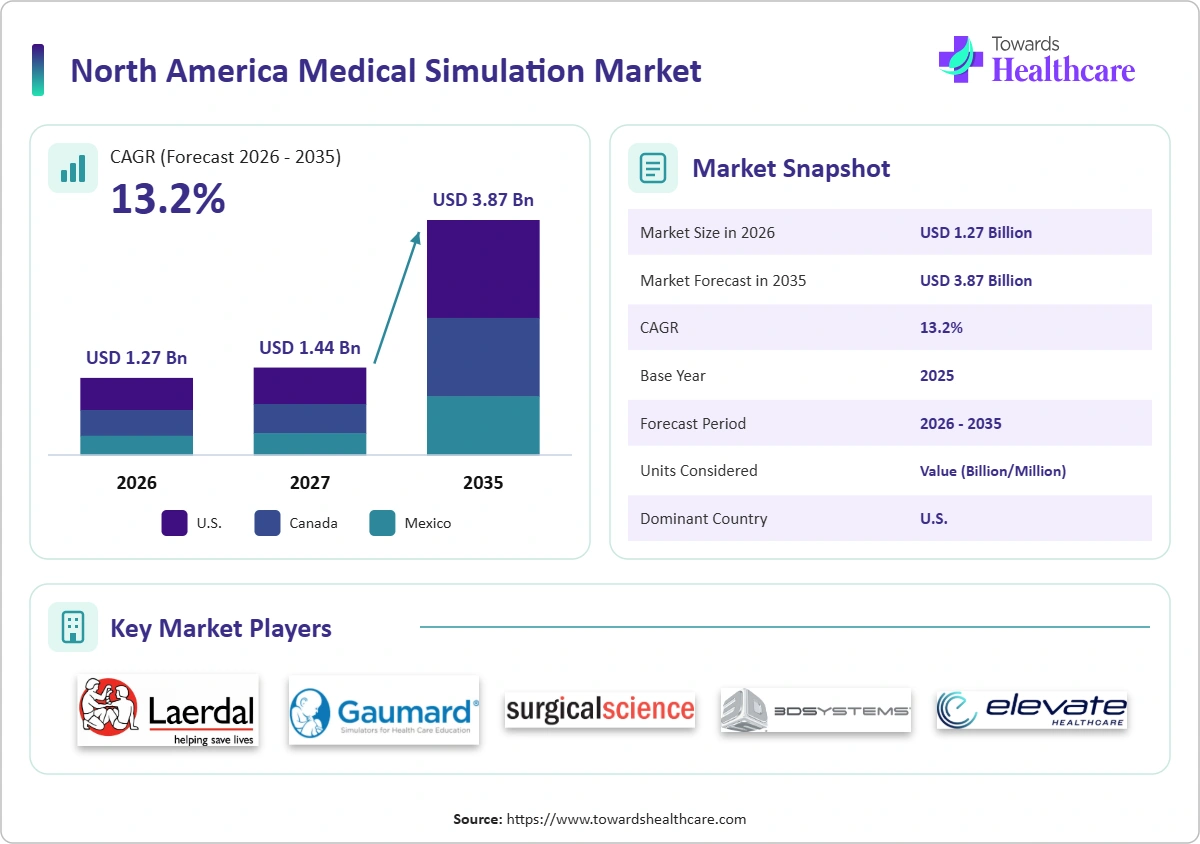
The North America medical simulation market is projected to grow from USD 1.12 billion in 2025 to USD 3.87 billion by 2035, driven by increasing demand for medical and nursing training and the need to improve patient safety. Medical schools and hospitals use simulation-based training to prepare healthcare professionals, while workforce shortages are increasing training requirements.
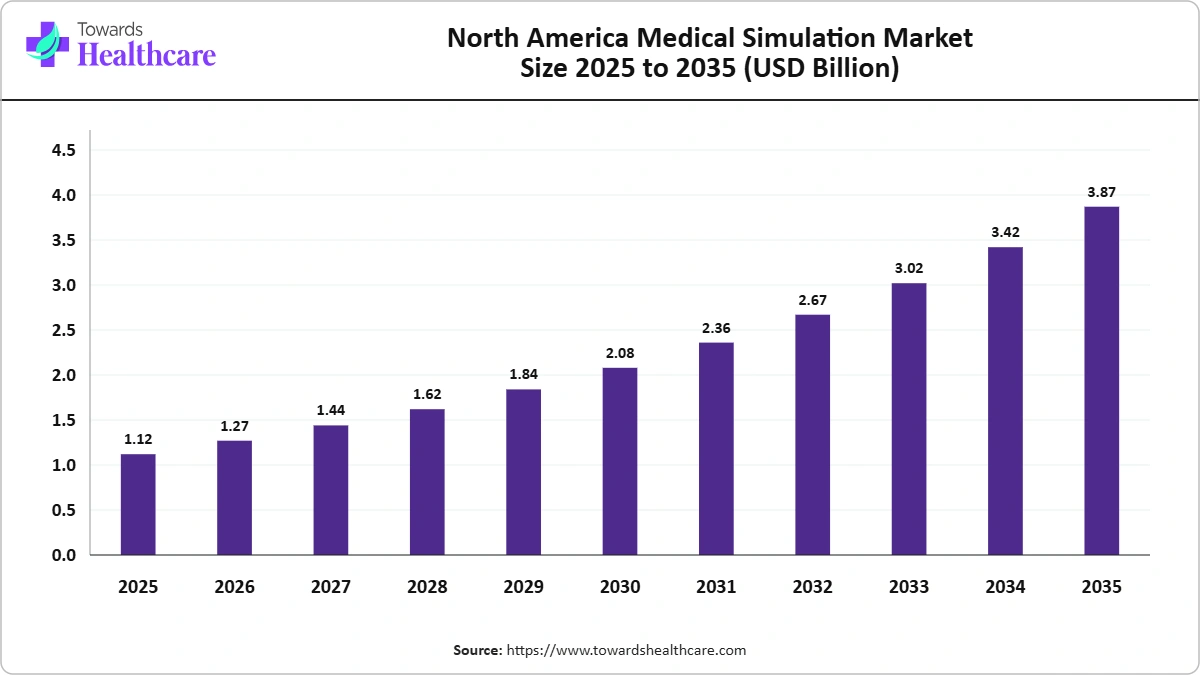
The market is expected to reach USD 2.08 billion by 2030 and sustain a CAGR of 13.2% from 2026 to 2035. Accreditation requirements, VR technology, limited clinical placements, and the use of 3D-printed medical device models and telehealth training are supporting market expansion.
Analyst View: We developed the market estimate using simulator installations, software subscriptions, and services by country, cross-validated against the North American revenues of leading simulation companies. Our estimate sits slightly above published comparable estimates.
| Driver | Impact | ≈ CAGR Contribution | Time Horizon | Key Regions |
| Nursing and physician shortages | High | +5.15 pp | Short to long term | North America-wide, strongest in U.S. |
| Patient safety focus | Medium | +4.35 pp | Medium to long term | North America-wide, fastest uptake in Mexico |
| Accreditation requirements | Medium | +3.70 pp | Short to medium term | North America-wide |
| VR technology | Low | +2.90 pp | Long term | U.S. and Mexico |
Note: Contributions are indicative estimates of each factor's effect on annual growth.
Sources: Expert interviews, secondary sources, Towards Healthcare database and Towards Healthcare analysts.
Nursing and physician shortages are major factors driving market growth, contributing approximately 5.15 percentage points annually. Furthermore, the need for patient safety and accreditation standards is increasing demand for simulation-based training in healthcare. The use of VR technology for immersive training solutions adds about 16.10 percentage points to growth, particularly in the U.S., with Mexico showing the fastest adoption rate.
| Restraint | Impact | ≈ Negative CAGR Contribution | Time Horizon | Key Regions |
| High simulator costs | High | -1.31 pp | Short to medium term | North America-wide |
| Budget limits | High | -0.96 pp | Medium term | Smaller and price-sensitive markets |
| Faculty training needs | Medium | -0.64 pp | Short term | U.S. and other mature markets |
Note: Contributions are indicative estimates of each factor's effect on annual growth.
Sources: Expert interviews, secondary sources, Towards Healthcare database and Towards Healthcare analysts.
High simulator costs, budget limitations, and faculty training needs are forecast to decrease annual market growth by around 2.90 percentage points, with simulator costs being the most significant constraint. These factors are expected to moderate market expansion, resulting in a projected CAGR of 13.2% from 2026 to 2035.
The increasing adoption of simulation-based medical education and clinical training is creating opportunities across North America. VR simulation software represents a key opportunity as healthcare institutions adopt immersive training technologies. With the expansion of in-situ simulation programmes, Hospitals are increasing investment in in-situ simulation systems to strengthen clinical preparedness and staff competency.
Mexico offers additional growth potential as medical schools expand their simulation centre infrastructure. AI-driven debriefing and subscription-based software models provide opportunities for suppliers to expand their offerings.
Note: 2025 is the base year; 2035 shares and CAGRs are forecasts.
Sources: Expert interviews, secondary sources, Towards Healthcare database and Towards Healthcare analysts.
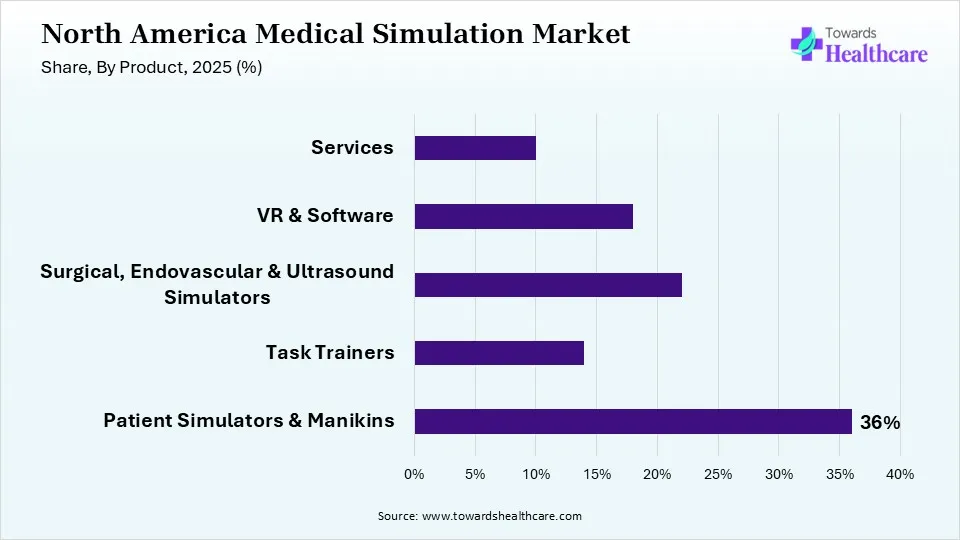
Patient Simulators and Manikins accounted for 36% of the market in 2025, making them the leading product segment. The segment is projected to grow at a CAGR of 12.34% from 2026 to 2035. Their extensive use in medical and nursing institutions for clinical education and hands-on training continues to drive demand. However, growth is expected to remain below the overall market.
Task Trainers products facilitate practical training in specific medical procedures, such as intravenous (IV) insertion. Their importance in developing clinical skills and procedural competencies is expected to sustain demand. Nevertheless, the segment is projected to grow at a slower pace than the market.
Surgical, Endovascular, and Ultrasound Simulators solutions enable specialized training in surgical interventions, endovascular procedures, and ultrasound applications. Their relevance to advanced medical education and specialist clinical training is expected to support continued market demand. Despite this, the segment is projected to grow more slowly than the overall market.
VR and Software provide immersive, interactive, and technology-driven learning experiences for healthcare professionals. The adoption of advanced digital simulation solutions is expected to accelerate segment growth, which is projected to outpace the total market.
Services segment includes services such as training delivery and simulation centre management, which support the implementation, administration, and effective operation of medical simulation programmes. However, growth is expected to remain below the market average.
Segment Outlook: Patient Simulators and Manikins are projected to retain their position as the largest product segment in the North America medical simulation market through 2035, although their market share is expected to decrease from 36% in 2025 to around 33.33% in 2035. In contrast, the VR and Software segment is anticipated to emerge as the fastest-growing segment, registering a CAGR of 15.74% and increasing its market share to 22.48% by 2035. Services are expected to maintain the smallest share of the market throughout the forecast period.
Academic Institutions and Nursing Schools represented 46% of the market in 2025 and are projected to record a CAGR of 12.58% between 2026 and 2035. These institutions incorporate simulation technologies into medical and nursing education to enhance practical learning and clinical training. Well-established training requirements continue to drive the segment's leading market share. However, the segment is anticipated to grow at a slower pace than the overall market.
Hospitals adoption of in-situ simulation programmes to strengthen clinical readiness, enhance healthcare professionals' competencies, and improve patient safety is driving segment growth. Rising demand for workforce training and clinical skill development is further supporting adoption. Therefore, the segment is projected to grow faster than the market.
Military, EMS, and Others leverage simulation technologies to prepare personnel for trauma management, critical incidents, and emergency response scenarios. The need for specialized and realistic training solutions is expected to sustain demand. Accordingly, the segment is anticipated to grow broadly in line with the overall market.
Segment Outlook: During the forecast period, Academic Institutions and Nursing Schools are expected to remain the largest end-user segment, although their share is projected to decline from 46% in 2025 to around 43.67% in 2035. Hospitals are expected to record the highest end-user-level CAGR of 14.18%, increasing their share to 34.88%. Military, EMS, and Others will continue to serve specialized training requirements within the market.
Analyst View: In our analysis, segment estimates were developed by allocating market demand according to product portfolios, end-user requirements, pricing, and adoption across the region. Patient Simulators and Manikins, along with Academic Institutions and Nursing Schools, remain the leading segments because they address the core training requirements of medical and nursing education. However, VR and Software and Hospitals are expected to gain market share as advanced simulation technologies and hospital-based training programmes expand. Increasing adoption of immersive training, in-situ simulation, and specialized medical simulators is expected to support market development through 2035.
Note: 2025 is the base year; 2035 shares and CAGRs are forecasts.
Sources: Expert interviews, secondary sources, Towards Healthcare database and Towards Healthcare analysts.
The U.S. dominated the market in 2025, accounting for 84% of the total share, and is forecast to register a CAGR of 13.07% during the forecast period. The country benefits from a well-developed healthcare education system, supported by medical and nursing institutions, hospital-based simulation facilities, and military training programmes. This extensive infrastructure drives substantial demand for a wide range of medical training solutions. The U.S. is expected to maintain a growth trajectory broadly aligned with the overall market.
Canada country has a well-established simulation training ecosystem, particularly across Ontario and Quebec. Requirements for medical education and hospital-based training continue to support the adoption of simulation products and services. Accordingly, the Canadian market is projected to grow at a pace largely consistent with the overall market.
Mexico Integration of simulation technologies into medical schools, alongside the establishment of new simulation centers, is accelerating market adoption. The demand for advanced medical education and training solutions is expected to drive Mexico's market growth beyond the market average.
Analyst View: In our analysis, country-level estimates were developed using demand, installed base, spending, and supplier presence across individual markets. The U.S. is expected to maintain its leading position, supported by mature demand base and established suppliers. Mexico will grow rapidly because investment, adoption, and simulation capacity are expanding faster.
| Rank | Company Name | 2025 Share (%) | Key Products / Business | Headquarters |
| 1 | Laerdal Medical | 22.00% | SimMan, SimBaby and VitalsBridge | Norway |
| 2 | Elevate Healthcare (formerly CAE Healthcare) | 16.00% | Patient, ultrasound and VR simulators | United States |
| 3 | Gaumard Scientific | 12.00% | HAL and Victoria simulators | United States |
| 4 | Simulab | 5.00% | Task trainers | United States |
| 5 | Surgical Science | 5.00% | Surgical simulators | Sweden |
| 6 | Limbs & Things | 4.00% | Task trainers | United Kingdom |
| 7 | 3D Systems (Simbionix) | 3.00% | Surgical simulators | United States |
| 8 | Kyoto Kagaku | 3.00% | Training models | Japan |
| 9 | Mentice | 2.00% | Endovascular simulators | Sweden |
| 10 | Oxford Medical Simulation | 1.00% | VR simulation | United Kingdom |
Note: Company shares are 2025 estimates.
Sources: Company press releases, expert interviews, secondary sources, Towards Healthcare database and Towards Healthcare analysts.
Laerdal Medical led the North America medical simulation market with an estimated 22% share of 2025 revenue, followed by Elevate Healthcare (formerly CAE Healthcare) at 16% and Gaumard Scientific at 12%. Laerdal Medical maintains its lead with its SimMan, SimBaby, and VitalsBridge products. Elevate Healthcare competes through patient, ultrasound, and VR simulators, while Gaumard Scientific offers HAL and Victoria simulators.
Other prominent participants include Simulab, Surgical Science, Limbs & Things, 3D Systems (Simbionix), Kyoto Kagaku, Mentice, and Oxford Medical Simulation. These companies compete through task trainers, surgical simulators, training models, endovascular simulators, and VR simulation products.
The top 10 companies generated 73.21% of the market’s 2025 revenue, while the remaining 26.79% comes from software start-ups and task trainer manufacturers. The North America medical simulation market is moderately concentrated, with companies competing on simulator realism, curriculum integration, software and analytics, training services, and pricing.
Laerdal Medical: The Norwegian company accounted for an estimated 22% share of the North America medical simulation market in 2025, supported by an extended portfolio featuring SimMan, SimBaby, and VitalsBridge. According to the Towards Healthcare Companies Quadrant, the company is classified as a Leader.
Elevate Healthcare (formerly CAE Healthcare): Part of Madison Industries from the United States, captured around 16% of the market in 2025, offering products such as patient simulators, ultrasound simulation systems, and VR-based training solutions. The company is classified as a Leader in the Towards Healthcare Companies Quadrant.
Gaumard Scientific: The U.S.-based company held an estimated 12% share of the North American market in 2025, driven by its established HAL and Victoria simulator product lines. Its market position is reflected in its classification as a Leader in the Towards Healthcare Companies Quadrant.
Simulab: Headquartered in the United States, the company represented approximately 5% of the medical simulation market in North America in 2025, with its product portfolio focused on task trainers. According to the Towards Healthcare Companies Quadrant, the company holds a Leader position.
Surgical Science: The Swedish company captured an estimated 5% share of the market in 2025, with its offerings primarily concentrated on surgical simulation technologies. Its specialization and market presence position it as a Leader in the Towards Healthcare Companies Quadrant.
Limbs & Things: Headquartered in the United Kingdom, the company accounted for approximately 4% of the North American market in 2025. Its portfolio comprises task trainers designed to support clinical skills development. The company is classified as a Leader in the Towards Healthcare Companies Quadrant.
3D Systems (Simbionix): The U.S.-headquartered company held an estimated 3% market share in 2025, with its product portfolio mainly focused on surgical simulation solutions. Based on its market positioning, the company is ranked as an Innovator in the Towards Healthcare Companies Quadrant.
Kyoto Kagaku: The Japan-based company accounted for approximately 3% of the market in 2025, offering a range of medical training models for clinical education and skills development. Its competitive positioning places it in the Innovator category of the Towards Healthcare Companies Quadrant.
Mentice: Headquartered in Sweden, the company represented an estimated 2% share of the North American market in 2025, with a portfolio specializing in endovascular simulation technologies. The company is recognized as an Innovator in the Towards Healthcare Companies Quadrant.
Oxford Medical Simulation: The United Kingdom-based company captured approximately 1% of the market in 2025, with its solutions primarily focused on VR-based medical simulation and training. Its position in the Towards Healthcare Companies Quadrant is classified as an Innovator.
The North America medical simulation ecosystem connects component and software suppliers, simulator manufacturers, simulation centres, learners, and accreditors. Each stage contributes to the development, production, adoption, and use of medical simulation technologies across healthcare education and training.
| Ecosystem Stage | Role in the Market | Key Companies |
| Component & Software Suppliers | Supply electronics and engines | Software and component makers |
| Simulator Makers | Build simulators | Laerdal, Elevate, Gaumard, Surgical Science |
| Simulation Centres | Run training | Universities, hospitals |
| Learners | Train | Students, clinicians, military |
| Accreditors | Set standards | SSH, nursing boards |
Sources: Company press releases, expert interviews, secondary sources, Towards Healthcare database and Towards Healthcare analysts.
Component & Software Suppliers: These suppliers provide crucial electronics and software components for medical simulation technologies, including software and component manufacturers.
Simulator Makers: Simulator manufacturers develop and supply medical simulation products. Key participants include Laerdal, Elevate, Gaumard, and Surgical Science.
Simulation Centres: Simulation centres provide medical training facilities and programs, with universities and hospitals as major participants.
Learners: Learners enhance clinical skills through simulation technologies, involving students, clinicians, and military personnel.
Accreditors: Accreditation organizations set standards for medical and nursing education, with key participants including SSH and nursing boards.
Value in the North America medical simulation market flows from upstream component and technology suppliers to simulator manufacturers and service providers, then through distribution partners to end users. Companies that integrate multiple stages or establish long-term relationships with end users can capture a larger share of market value.
The Towards Healthcare Companies Quadrant positions key participants in the North America medical simulation market by market strength, reflecting revenue scale, market share, and geographic reach, and by innovation and growth strategy, reflecting product portfolio breadth, R&D intensity, and partnerships. Positions reflect each company's estimated 2025 share of the North America medical simulation market and our assessment of its product innovation, portfolio breadth, and partnerships.
Sources: Company press releases, expert interviews, secondary sources, Towards Healthcare database and Towards Healthcare analysts.
Leaders: Laerdal Medical, Elevate Healthcare (formerly CAE Healthcare), Gaumard Scientific, Simulab, Surgical Science, and Limbs & Things combine high market share with broad portfolios and strong innovation.
Innovators: 3D Systems (Simbionix), Kyoto Kagaku, Mentice, and Oxford Medical Simulation bring newer technologies and specialised products.
By Product
By End User
By Country
The North America medical simulation market was defined as the market for medical simulation products and services across the United States, Canada, and Mexico. The assessment includes high-fidelity patient simulators and manikins, task trainers, surgical, endovascular, and ultrasound simulators, virtual reality and web-based simulation software, and simulation services and training. The market covers demand from academic institutions and nursing schools, hospitals, military and emergency services, and medical device companies.
The 2025 base-year estimate was derived from a thorough bottom-up analysis of demand volumes and prices across product categories, end users, and countries. It was validated using revenues from simulation companies and existing data, with values based on product portfolios and consumption patterns validated through company disclosures, regulatory data, and expert interviews, while excluding unreconciled inputs.
The market forecast for medical simulation products and services is shaped by workforce training needs, patient safety demands, accreditation standards, VR technology, and the expansion of simulation-based medical education. It considers costs, budget constraints, faculty training, software subscriptions, and advancements in simulation technology. Estimates are based on a 2025 base year, with a projected CAGR of 13.2% validating forecasts for 2026-2035 across segments and countries.
Analyst View: The North American medical simulation market is projected to record strong growth until 2035, driven by workforce training needs, patient safety efforts, and the rise of simulation-based medical education. Patient Simulators and Manikins will be the dominant product segment, with Academic Institutions and Nursing Schools as the largest end-users. However, the market share of VR & Software and hospital-based simulation programs is expected to increase as advanced training technologies are adopted. The U.S. will maintain market dominance due to its established infrastructure, while Mexico will experience the fastest growth as it expands simulation center resources. Challenges such as high simulator costs and training needs may hinder growth, but suppliers focusing on realism, software, and training services can enhance competitiveness.