
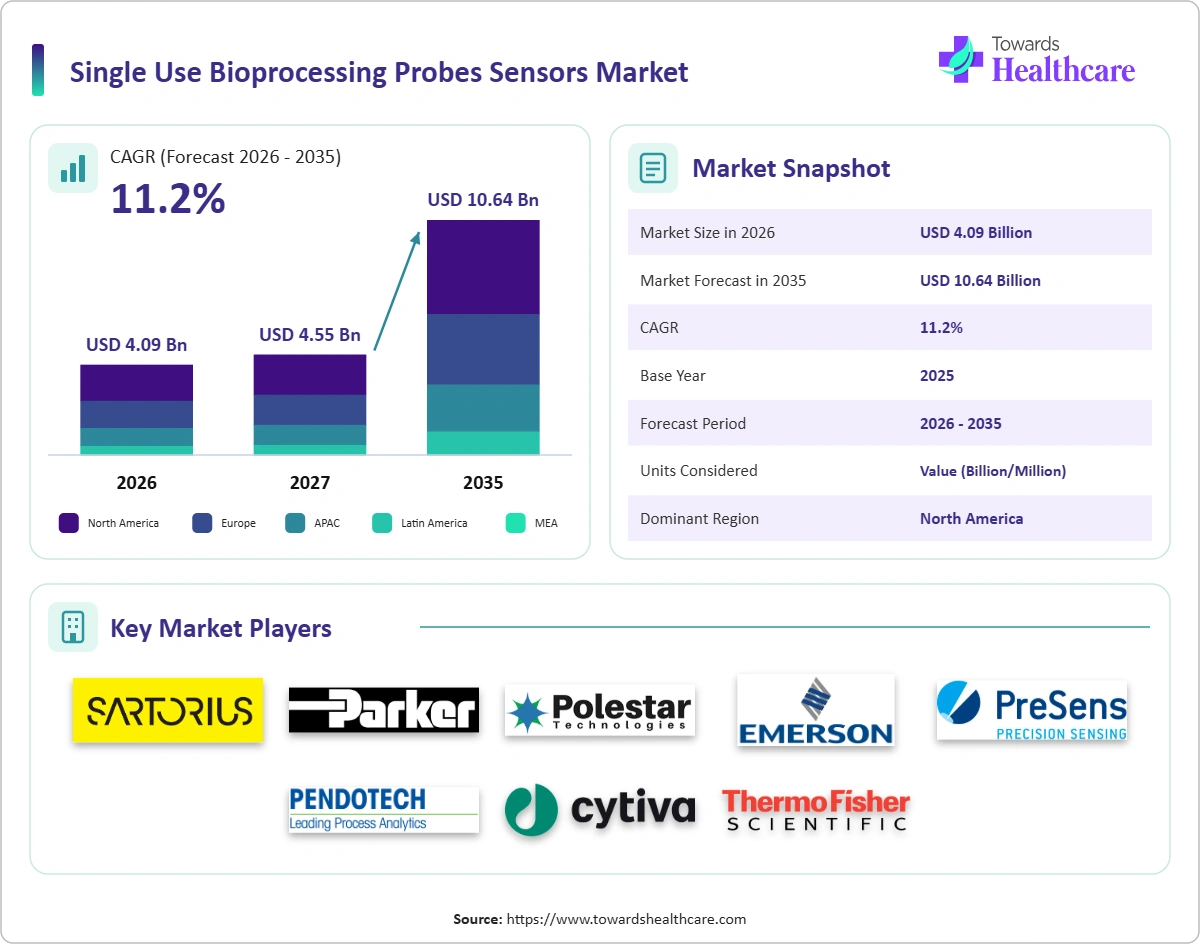
The market is projected to grow from USD 3.68 billion in 2025 to USD 10.64 billion by 2035 because single-use bioreactors and process lines need disposable sensors in every batch. The market is benefiting from single-use adoption, process analytical technology, CDMO growth, and cell therapy monitoring. The market is expected to reach USD 6.26 billion by 2030 and sustain a CAGR of 11.20% during the forecast period. Sensors monitor cell culture in bioreactors used for cell therapy and cell-based vaccine production.
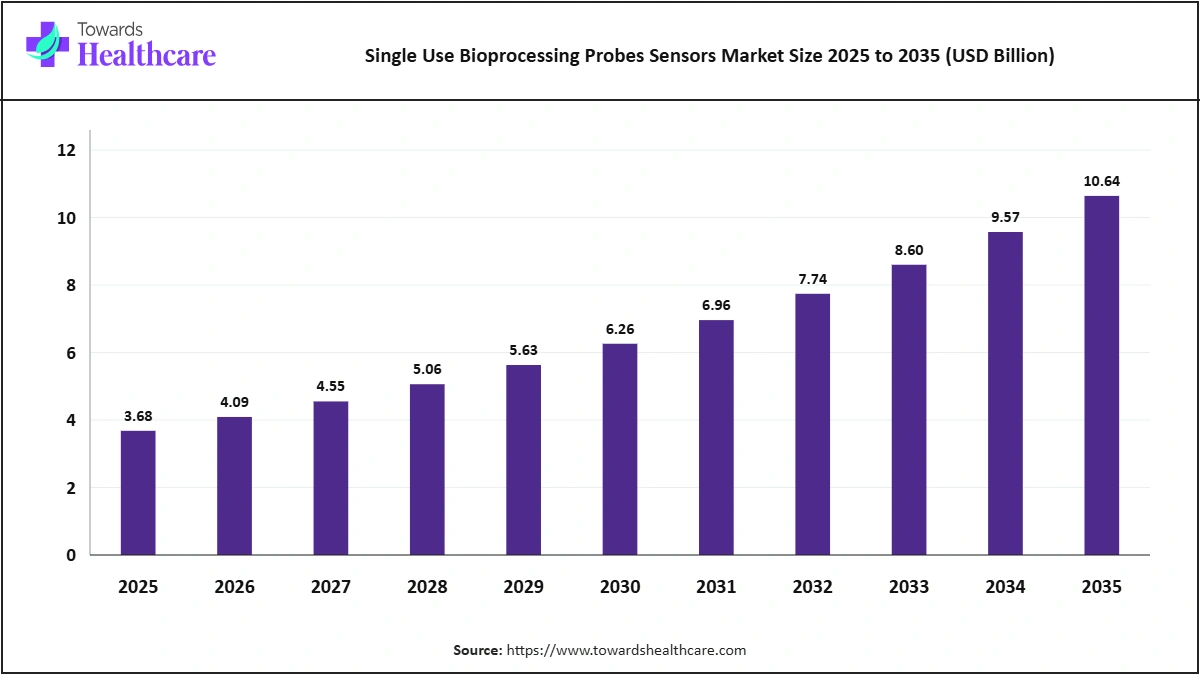
Analyst View: We built the estimate from single-use bioreactor and process runs and sensors used per run, multiplied by prices, cross-checked against published estimates of about USD 3.6 billion for 2025 and supplier revenues.
| Driver | Impact | ≈ CAGR Contribution | Time Horizon | Key Regions |
| Single-use bioreactors spread | High | +4.37 pp | Short to long term | Global, strongest in North America |
| Real-time control improves yields | Medium | +3.69 pp | Medium to long term | Global, fastest uptake in Asia Pacific |
| PAT is encouraged | Medium | +3.14 pp | Short to medium term | Global |
| CDMOs grow | Low | +2.46 pp | Long term | Developed and emerging markets |
Note: Contributions are indicative estimates of each factor's effect on annual growth.
Sources: Expert interviews, secondary sources, Towards Healthcare database and Towards Healthcare analysts.
Taken together, these drivers contribute 13.66 percentage points to the annual growth of the market, with single-use bioreactors spread having the largest effect. Their influence is strongest in North America, while the pace of adoption is fastest in Asia Pacific.
| Restraint | Impact | ≈ Negative CAGR Contribution | Time Horizon | Key Regions |
| Sensor drift | High | -1.11 pp | Short to medium term | Global |
| Calibration challenges | High | -0.81 pp | Medium term | Price-sensitive and emerging markets |
| Cost per batch | Medium | -0.54 pp | Short term | North America and other mature markets |
Note: Contributions are indicative estimates of each factor's effect on annual growth.
Sources: Expert interviews, secondary sources, Towards Healthcare database and Towards Healthcare analysts.
These restraints are expected to reduce annual growth of the market by about 2.46 percentage points, led by sensor drift. Their effect eases over the forecast period as suppliers, buyers, and regulators adapt, leaving a net CAGR of 11.20% from 2026 to 2035.
The development of advanced sensors creates opportunities to simplify data transmission and remote monitoring in single-use bioprocessing systems. The demand for downstream process monitoring is increasing, which fuels the demand for advanced sensors that monitor purification and product recovery parameters. The biopharmaceutical manufacturing ecosystem in Asia Pacific is expanding, which adds to the demand for single-use probes and sensors. The development of advanced spectroscopic sensors allows real-time monitoring of important process parameters and metabolite concentrations. The growth of cell therapy manufacturing creates opportunities for specialized sensors, developed specifically for closed and automated production systems.
Note: 2025 is the base year; 2035 shares and CAGRs are forecasts.
Sources: Expert interviews, secondary sources, Towards Healthcare database and Towards Healthcare analysts.
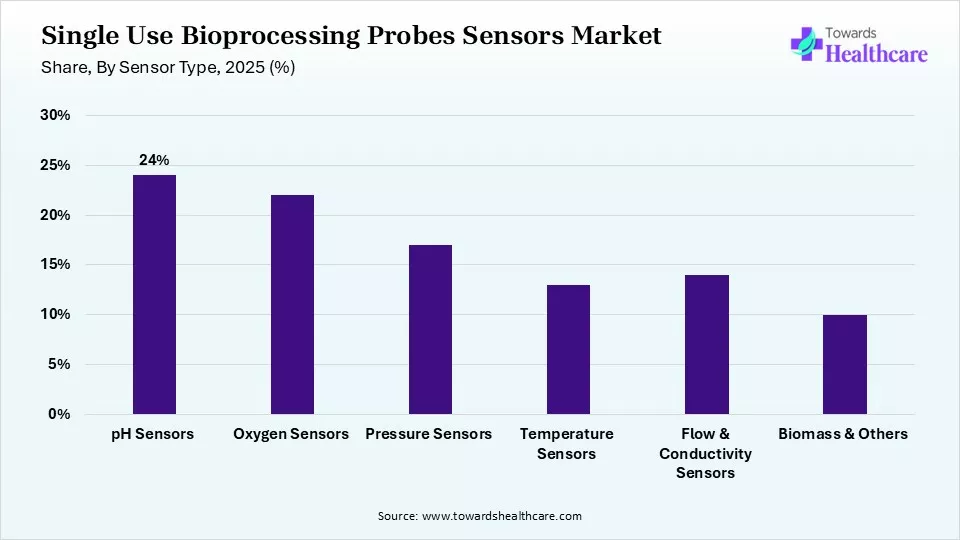
pH Sensors held a market share of 24.00% in 2025 and are projected to expand at a CAGR of 10.56% during the forecast period. pH sensors hold a leading position because pH is critical for cell growth and product quality. The pH sensors segment is expected to grow slower than the overall market over the forecast period.
Dissolved oxygen sensors monitor cell respiration. The oxygen sensors segment is expected to grow broadly in line with the overall market over the forecast period.
The pressure sensors segment is expected to grow broadly in line with the overall market over the forecast period.
Temperature sensors control culture conditions. The temperature sensors segment is expected to grow broadly in line with the overall market over the forecast period.
Flow and conductivity sensors grow in downstream steps. The flow & conductivity sensors segment is expected to grow broadly in line with the overall market over the forecast period.
Biomass and other sensors grow fastest owing to the development of process analytical technology. The biomass & others segment is expected to grow faster than the overall market over the forecast period.
Although Biomass & Others starts from the smallest base, its faster growth shows how demand is shifting within the market.
Note: 2025 is the base year; 2035 shares and CAGRs are forecasts.
Sources: Expert interviews, secondary sources, Towards Healthcare database and Towards Healthcare analysts.
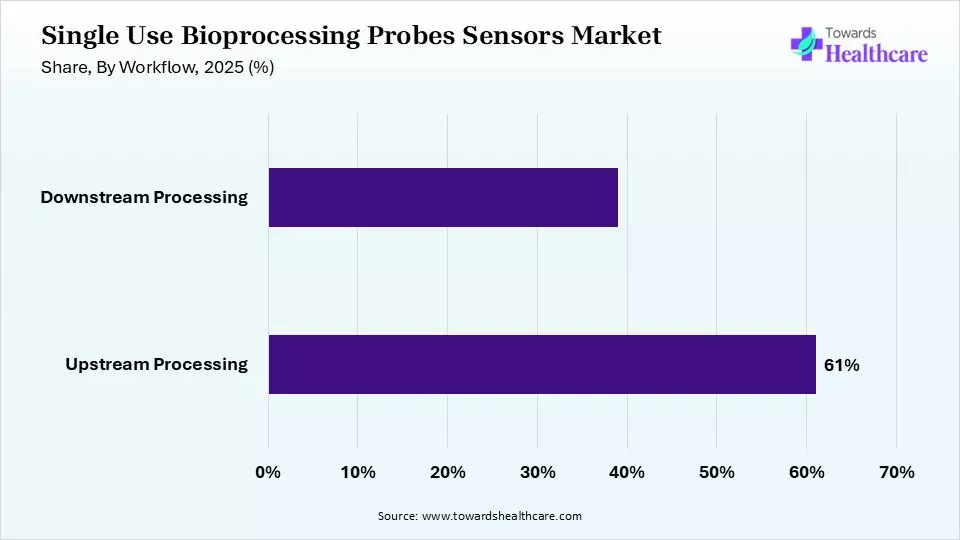
Upstream Processing held 61.00% of revenue in 2025 and is projected to expand at a CAGR of 10.72% from 2026 to 2035. Upstream processing holds the dominant share because bioreactors need many control parameters. The upstream processing segment is expected to grow slower than the overall market over the forecast period.
The growth of this segment can be attributed to the adoption of single-use sensors in chromatography and filtration applications. The downstream processing segment is expected to grow faster than the overall market over the forecast period.
Although Downstream Processing starts from the smallest base, its faster growth shows how demand is shifting within the market.
Note: 2025 is the base year; 2035 shares and CAGRs are forecasts.
Sources: Expert interviews, secondary sources, Towards Healthcare database and Towards Healthcare analysts.
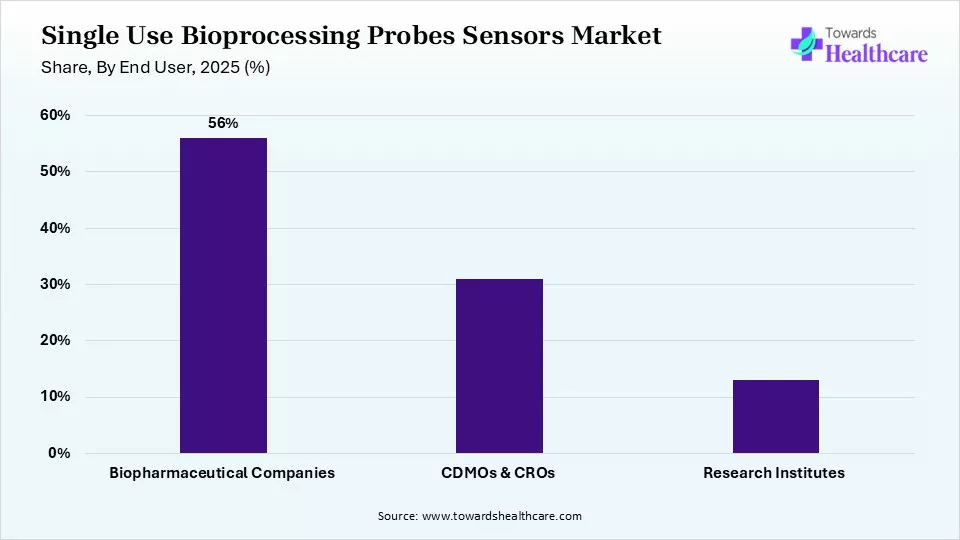
Biopharmaceutical Companies held a market share of 56.00% in 2025 and is projected to expand at a CAGR of 10.53% from 2026 to 2035. Biopharmaceutical companies represent the largest end-user base. The biopharmaceutical companies segment is expected to grow slower than the overall market over the forecast period.
The CDMOs & CROs segment is expected to grow faster than the overall market over the forecast period.
Research institutes use sensors in development labs. The research institutes segment is expected to grow broadly in line with the overall market over the forecast period.
Research Institutes hold the smallest share today and serve more specialized needs within the market.
Analyst View: Segment shares were allocated from demand, product portfolios, and pricing in each category. pH Sensors, Upstream Processing, and Biopharmaceutical Companies lead their categories because they meet the core needs of today's buyers. We expect Biomass & Others, Downstream Processing, and CDMOs & CROs to gain share as newer technologies, users, and applications grow faster.
Note: 2025 is the base year; 2035 shares and CAGRs are forecasts.
Sources: Expert interviews, secondary sources, Towards Healthcare database, and Towards Healthcare analysts.
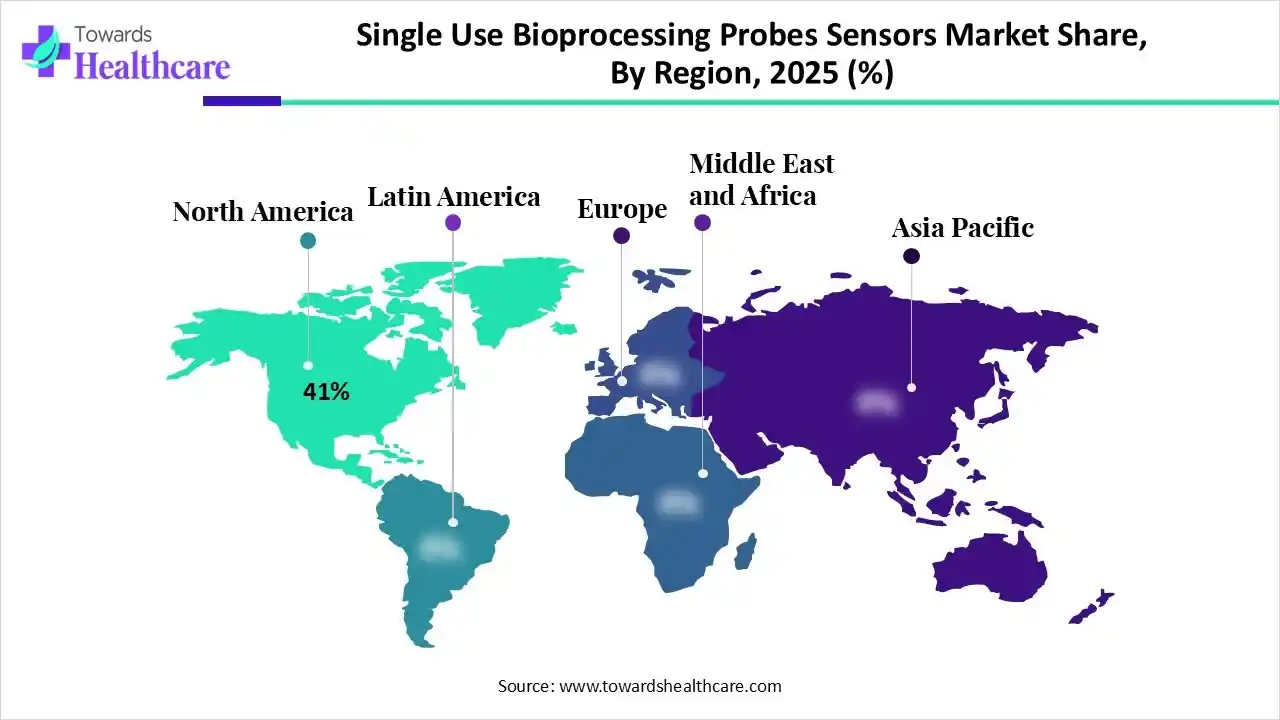
North America holds the dominant share because of large biologics production and the presence of suppliers such as Thermo Fisher, PendoTech, and Hamilton. North America is expected to grow slower than the overall market between 2026 and 2035.
Europe has strong biologics manufacturing and sensor makers such as Sartorius, PreSens, and Mettler-Toledo. Europe is expected to grow broadly in line with the overall market throughout the forecast period.
Asia Pacific exhibits growth at the highest rate owing to the establishment of new single-use plants. Asia Pacific is expected to grow faster than the overall market between 2026 and 2035.
Latin America has a significant vaccine and biosimilar production ecosystem. Latin America is expected to grow broadly in line with the overall market between 2026 and 2035.
Middle East & Africa has an emerging biomanufacturing industry. Middle East & Africa is expected to grow broadly in line with the overall market between 2026 and 2035.
Analyst View: Regional shares were built from demand, installed base, spending, and supplier presence in each region. North America leads because of its mature demand base and strong suppliers. We assign Asia Pacific the highest growth premium because investment, adoption, and capacity are expanding fastest there.
| Rank | Company Name | 2025 Share (%) | Key Products / Business | Headquarters |
| 1 | Sartorius | 11.41% | BioPAT single-use sensors | Germany |
| 2 | Thermo Fisher Scientific | 9.51% | Single-use bioreactor sensors | United States |
| 3 | Cytiva | 8.15% | Single-use sensors for bioprocess systems | United States |
| 4 | Hamilton Company | 5.98% | Process sensors incl. single-use | United States |
| 5 | Mettler-Toledo | 4.89% | Process analytics sensors | Switzerland |
| 6 | PendoTech | 3.26% | Single-use pressure, temperature and conductivity sensors | United States |
| 7 | PreSens Precision Sensing | 2.72% | Optical oxygen and pH sensors | Germany |
| 8 | Parker Hannifin | 2.17% | SciLog single-use sensors | United States |
| 9 | Emerson | 2.17% | Single-use flow and pressure sensors | United States |
| 10 | Polestar Technologies | 1.09% | Optical single-use sensors | United States |
Note: Company shares are 2025 estimates.
Sources: Company press releases, expert interviews, secondary sources, Towards Healthcare database and Towards Healthcare analysts.
Sartorius led the market with an 11.41% share in 2025, followed by Thermo Fisher Scientific at 9.51% share and Cytiva at 8.15% share.
Sartorius is the leader owing to its bioPAT single-use sensors; Thermo Fisher Scientific competes with single-use bioreactor sensors, and Cytiva offers single-use sensors for bioprocess systems. Hamilton Company, Mettler-Toledo, PendoTech, PreSens Precision Sensing, Parker Hannifin, Emerson, and Polestar Technologies compete through process sensors, including single-use, process analytics sensors, single-use pressure, temperature, and conductivity sensors, optical oxygen and pH sensors, sciLog single-use sensors, single-use flow and pressure sensors, and optical single-use sensors.
The top 10 companies held 51.36% of revenue in 2025, while the remaining 48.64% was shared among specialized sensor makers and integrators. The market is moderately concentrated, and competition centers on accuracy and drift, gamma stability, integration with bags and bioreactors, data connectivity, and price.
Sartorius is headquartered in Germany. It held an 11.41% share in 2025. Its offering revolves around BioPAT single-use sensors. In the Towards Healthcare Companies Quadrant it is positioned as a Leader.
Thermo Fisher Scientific has its global headquarters in the United States. It held 9.51% of revenue in 2025. Its offering centers on Single-use bioreactor sensors. This company is positioned as a leader in the Towards Healthcare companies quadrant.
Cytiva, part of Danaher Corporation, is headquartered in the United States. It held 8.15% of revenue in 2025. Its portfolio consists of Single-use sensors for bioprocess systems. In the Towards Healthcare Companies Quadrant it is positioned as a Leader.
Hamilton Company has its corporate headquarters in the United States. It captured a 5.98% share in 2025. Its offering centers on Process sensors incl. single-use. In the Towards Healthcare Companies Quadrant it is positioned as a Leader.
The headquarters of Mettler-Toledo is in Switzerland. It accounted for a 4.89% share in 2025. Its offering revolves around Process analytics sensors. This company has been positioned as a leader in the Towards Healthcare companies quadrant.
PendoTech has its global headquarters in the United States. It held 3.26% of revenue in 2025. It has a portfolio of Single-use pressure, temperature, and conductivity sensors. In the Towards Healthcare Companies Quadrant it is positioned as a Leader.
PreSens Precision Sensing is headquartered in Germany. It captured a market share of 2.72% in 2025. Its offering centers on Optical oxygen and pH sensors. This company has been positioned as an innovator in the Towards Healthcare companies quadrant.
Parker Hannifin, part of Parker-Hannifin Corporation, is headquartered in the United States. It held 2.17% of revenue in 2025. Its offering revolves around SciLog single-use sensors. In the Towards Healthcare Companies Quadrant it is positioned as an Innovator.
The headquarters of Emerson is in the U.S. It held a 2.17% share in 2025. Its offering centres on Single-use flow and pressure sensors. This company is positioned as an innovator in the Towards Healthcare companies quadrant.
Polestar Technologies has its corporate headquarters in the United States. This company captured 1.09% of net market revenue in 2025. The company’s portfolio includes Optical single-use sensors. In the Towards Healthcare Companies Quadrant this company has been positioned as an Innovator.
The single use bioprocessing probes sensors ecosystem links sensor makers, equipment makers, software & pat, users, and regulators, with each stage adding value before products reach end users.
| Ecosystem Stage | Role in the Market | Key Companies |
| Sensor Makers | Make disposable sensors | Sartorius, PendoTech, PreSens, Hamilton |
| Equipment Makers | Integrate sensors into bioreactors | Thermo Fisher, Cytiva, Sartorius |
| Software & PAT | Analyse process data | PAT and control software vendors |
| Users | Run processes | Biopharma, CDMOs |
| Regulators | Encourage PAT and quality by design | FDA, EMA |
Sources: Company press releases, expert interviews, secondary sources, Towards Healthcare database and Towards Healthcare analysts.
Sensor Makers: Make disposable sensors. Key participants include Sartorius, PendoTech, PreSens, and Hamilton.
Equipment Makers: Integrate sensors into bioreactors. Key participants include Thermo Fisher, Cytiva, Sartorius.
Software & PAT: Analyze process data. Key participants include PAT and control software vendors.
Users: Run processes. Key participants include Biopharma, and CDMOs.
Regulators: Encourage PAT and quality by design. Key participants include FDA and EMA.
Value in the market flows from upstream material and technology suppliers to manufacturers and service providers, then through distribution partners to end users. Companies that integrate several stages or build long-term relationships with end users will be well-positioned to capture a larger share of this value.
The Towards Healthcareh Companies Quadrant positions key participants in the market by market strength, reflecting revenue scale, market share, and geographic reach, and by innovation and growth strategy, reflecting product portfolio breadth, research and development intensity, and collaboration. Positions reflect each company's estimated 2025 share of the market and our assessment of its product innovation, portfolio breadth, and partnerships.
Sources: Company press releases, expert interviews, secondary sources, Towards Healthcare database and Towards Healthcare analysts.
Leaders: Sartorius, Thermo Fisher Scientific, Cytiva, Hamilton Company, Mettler-Toledo and PendoTech bring together high market share, broad portfolios and strong innovation.
Innovators: PreSens Precision Sensing, Parker Hannifin, Emerson and Polestar Technologies offer newer technologies and specialized products.
By Sensor Type
By Workflow
By End User
By Region
The market is defined as pre-sterilized, disposable probes and sensors integrated into single-use bioprocess equipment, including pH, dissolved oxygen, pressure, temperature, conductivity, flow and biomass sensors, in optical, electrochemical and other technologies, for upstream and downstream processing, used by biopharmaceutical companies, CDMOs and CROs and research institutes.
The 2025 base year was built bottom-up from demand volumes and average prices by sensor type, workflow and end user and region, and checked top-down against the market-specific revenues of leading companies and published estimates. Segment, regional and company values were allocated from sensor type, workflow and end user and region demand. Key estimates were verified by cross-checking company disclosures, regulatory and industry data and published third-party estimates, and inputs that could not be reconciled were excluded. All segment, regional and company figures were reconciled to the same 2025 base year, and the 2026-2035 forecast, which applies a constant CAGR from the 2025 base, was recalculated and validated.
Analyst View: The market is set for steady expansion as single-use bioreactor adoption and related demand keep growing. Our estimate links value to underlying demand, installed base, and pricing, so the forecast follows real adoption rather than headline hype. The main upside comes from PAT and wireless sensors, while the main risks are sensor drift and cost per batch.