
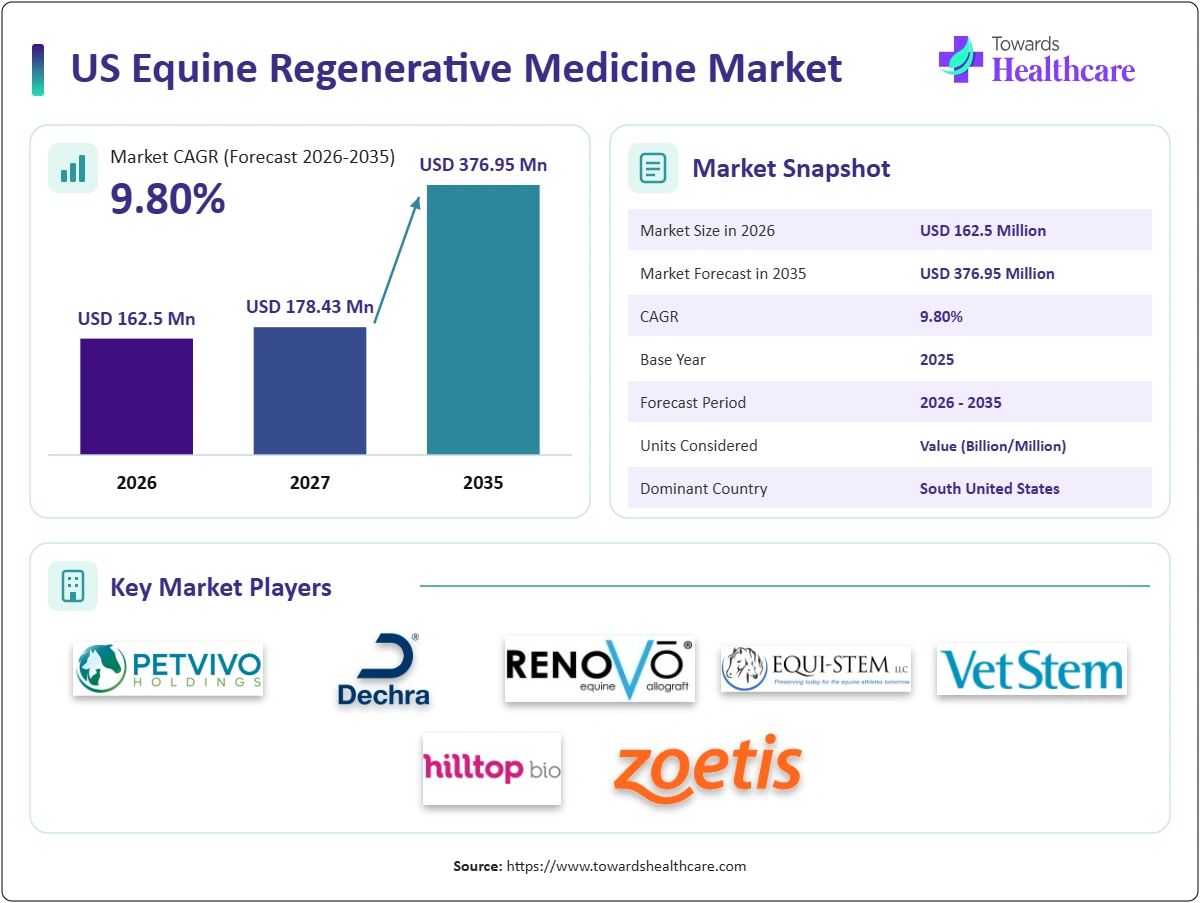
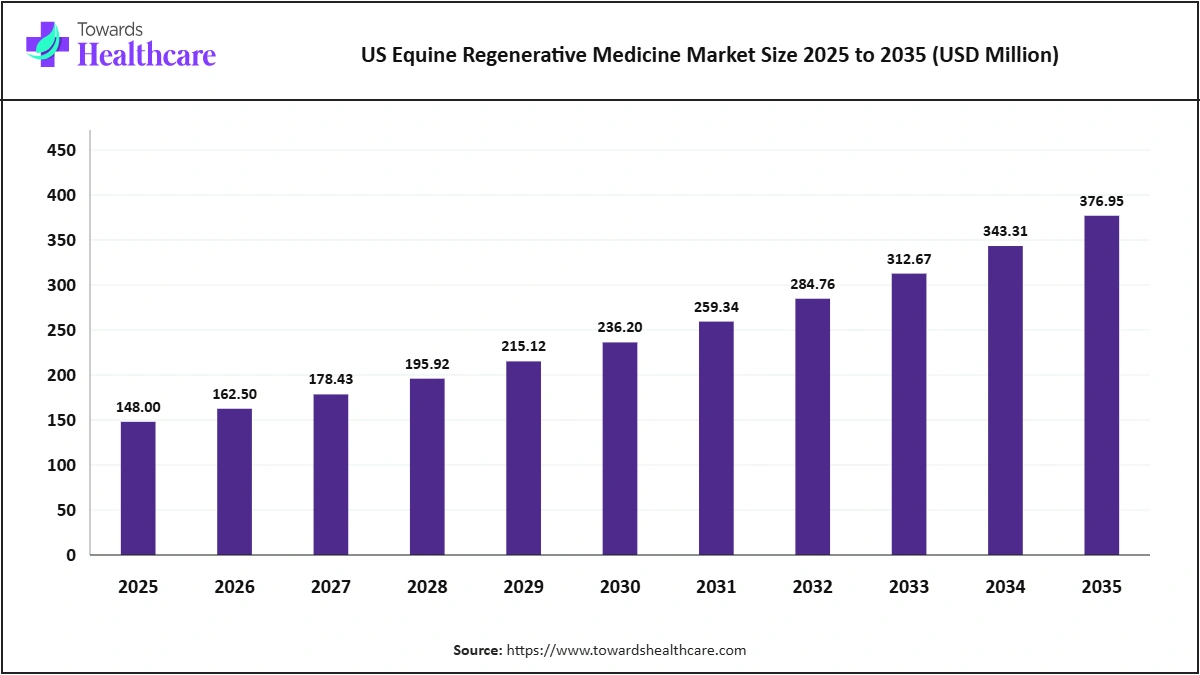
The U.S. equine regenerative medicine market is expected to increase from USD 148.00 million in 2025 to USD 376.95 million by 2035 owing to the owners of expensive performance horses opting for biological treatment in order to treat tendon, ligament, and joint injuries of horses and getting them back into work. Greater adoption of stall-side PRP and APS kits, ready-to-use allogeneic products, and stem cell therapies for severe injuries, along with positive results from various horse-based research, is anticipated to ensure robust growth and take the market up to USD 236.20 million by 2030 and maintain the CAGR of 9.80% during 2026-2035.
Analyst View: The estimate has been arrived at based on the volume of regenerative treatments administered annually on horses in the U.S. per type of product and per application setting multiplied by the cost of kits, cells, and lab services. The treatment volumes are dependent on the number of horses in the U.S., the proportion that are performance or racing horses, their injury rates, and the adoption of biological treatments by veterinarians. There is no existing literature on a comparable figure; hence, the estimate was cross-referenced to revenues of leading suppliers of equine regenerative therapies and U.S. estimates on veterinary regenerative medicine where horses comprise a significant proportion. The growth rate is based on increased adoption and emergence of pre-packaged solutions but is tempered by cost considerations and lack of regulatory approval for cell-based therapies.
Driver: Value of performance horses. Prevalence of tendon and joint injuries. Preferences for biologic treatments. Restrictions on drug administration. Increasing evidence for regenerative therapies.
Restraint: Treatment is expensive. Variation in outcomes from horse to horse. Limited FDA approval of products. Quality of evidence is variable. Pleasure horses' owners are sensitive to cost.
Opportunity: Allogeneic products allow for quick treatment. Combination therapies could enhance outcomes. Education increases veterinarians’ awareness. Insurance could help pay for treatment. Partnerships with the racing industry would increase awareness.
| Segments | 2025 Share | 2025 Value (USD Million) | 2035 Value (USD Million) | CAGR 2026–2035 |
| PRP & Autologous Blood Products | 46.80% | 69.26 | 166.00 | 9.13% |
| Stem Cell Therapies | 28.40% | 42.03 | 119.71 | 11.03% |
| Amniotic & Placental Products | 16.20% | 23.98 | 59.60 | 9.53% |
| Others | 8.60% | 12.73 | 31.64 | 9.53% |
Note: 2025 is the base year; 2035 values are forecasts.
Sources: Expert interviews, secondary sources, Towards Healthcare database, and Towards Healthcare analysts.
PRP & Autologous Blood Products: This segment held a 46.80% (USD 69.26 million) share of the U.S. equine regenerative medicine market in 2025 and is expected to grow to USD 166.00 million by 2035, growing at a CAGR of 9.13% during 2026-2035. The PRP and autologous blood products consist of platelet-rich plasma kits, autologous conditioned serum systems such as IRAP and IRAP II, and autologous protein solution systems such as Pro-Stride APS. These are dominant owing to being prepared from the blood of the horse, stall-side in less than an hour, and being widely used in joint inflammation and soft tissue injury cases. Arthrex Vet Systems, Zoetis, and Dechra are some leading vendors of this product type, while off-the-shelf PRP products like those of PetVivo and Precise PRP are also gaining momentum.
Stem Cell Therapies: This segment constituted 28.40% (USD 42.03 million) of the total U.S. equine regenerative medicine market in 2025 and will reach USD 119.71 million by 2035, registering a CAGR of 11.03% during the period of 2026 to 2035. Stem cell treatments involve mesenchymal stem cells taken from the bone marrow or fat tissues of the horse, which are processed in laboratories such as VetStem or bone marrow concentrate made stall-side. Stem cells constitute the most rapidly growing product category since these are used for treating serious tendon and suspensory ligament injuries of high-value horses, while allogeneic products are being developed.
Amniotic & Placental Products: It constituted a 16.20% (USD 23.98 million) share of the U.S. equine regenerative medicine market in 2025 and is expected to reach USD 59.60 million by 2035, growing at a CAGR of 9.53% during 2026-2035. The amniotic and placental products are obtained from equine birth tissues and consist of growth factors and matrix proteins. These are used for the treatment of tendon, joint, and wound, and providers such as Equine Amnio Solutions and Hilltop Bio provide ready-to-use products that do not need harvesting from the patient.
Others: It constituted an 8.60% (USD 12.73 million) share of the U.S. equine regenerative medicine market in 2025 and is expected to reach USD 31.64 million by 2035, growing at a CAGR of 9.53% during 2026-2035. Others include exosome products, scaffolds and matrices, and combination joint therapies.
| Segments | 2025 Share | 2025 Value (USD Million) | 2035 Value (USD Million) | CAGR 2026–2035 |
| Tendon & Ligament Injuries | 44.60% | 66.01 | 160.03 | 9.26% |
| Joint Disease & Osteoarthritis | 38.20% | 56.54 | 152.90 | 10.46% |
| Wound Healing | 10.40% | 15.39 | 38.71 | 9.66% |
| Others | 6.80% | 10.06 | 25.31 | 9.66% |
Note: 2025 is the base year; 2035 values are forecasts.
Sources: Expert interviews, secondary sources, Towards Healthcare database, and Towards Healthcare analysts.
Tendon & Ligament Injuries: The segment contributed to 44.60% (USD 66.01 million) of the total U.S. equine regenerative medicine market size in 2025 and is expected to be worth USD 160.03 million by 2035, growing at a CAGR of 9.26% during the period from 2026 to 2035. Tendons and ligament injuries are the largest application as they frequently occur in racehorses and sports horses, healing slowly and with recurring frequency. The goal of regenerative therapies is to improve tissue quality and minimize re-injuries.
Joint Disease & Osteoarthritis: The segment contributed to 38.20% (USD 56.54 million) of the total U.S. equine regenerative medicine market in 2025 and is expected to reach USD 152.90 million by 2035, exhibiting a CAGR of 10.46% during the period from 2026 to 2035. Injections of IRAP, APS, PRP, and stem cells into joints and osteoarthritic areas for treatment reduce inflammation and protect cartilage. This is the most rapidly growing application, due to the high prevalence of osteoarthritis as a cause of lameness.
Wound Healing: The segment had a 10.40% (USD 15.39 million) share of the U.S. equine regenerative medicine market in 2025 and is expected to be worth USD 38.71 million by 2035 at a CAGR of 9.66% between 2026 and 2035. The segment utilizes PRP gels and amniotic materials for wound healing of difficult-to-heal wounds of the lower limbs of the horse.
Others: The segment had a 6.80% (USD 10.06 million) share of the U.S. equine regenerative medicine market in 2025 and is expected to be worth USD 25.31 million by 2035 at a CAGR of 9.66% between 2026 and 2035. Bone injuries, sinusitis, and ophthalmic problems come under the others category.
| Segments | 2025 Share | 2025 Value (USD Million) | 2035 Value (USD Million) | CAGR 2026–2035 |
| Equine Hospitals & Clinics | 52.60% | 77.85 | 190.19 | 9.34% |
| Ambulatory Practitioners | 31.80% | 47.06 | 128.25 | 10.54% |
| Academic & Referral Centers | 15.60% | 23.09 | 58.51 | 9.74% |
Note: 2025 is the base year; 2035 values are forecasts.
Sources: Expert interviews, secondary sources, Towards Healthcare database, and Towards Healthcare analysts.
Equine Hospitals & Clinics: This segment contributed to 52.60% (USD 77.85 million) of the U.S. equine regenerative medicine market in 2025 and will be worth USD 190.19 million by 2035, growing at a CAGR of 9.34% during the forecast period 2026 to 2035. They are the largest end users since they identify the injuries using ultrasound and MRI scans, treat high-value patients, and have the equipment to process blood cells and cells.
Ambulatory Practitioners: This segment contributed to 31.80% (USD 47.06 million) of the U.S. equine regenerative medicine market in 2025 and will be worth USD 128.25 million by 2035, growing at a CAGR of 10.54% during the forecast period 2026 to 2035. They are responsible for treating the horses on farms, stables, and racetracks. It is the fastest-growing end user as stall-side kits and ready-made kits make it easy to administer regenerative therapy in the field.
Academic & Referral Centers: This segment represented 15.60% (USD 23.09 million) of the U.S. equine regenerative medicine market in 2025 and is forecasted to reach USD 58.51 million by 2035, growing at a CAGR of 9.74% between 2026 and 2035. Academies and referral clinics, including veterinary schools at universities like Colorado State, UC Davis, Cornell, and referral clinics in Kentucky, handle complicated cases and conduct clinical research.
Analyst View: The values of each segment have been assigned based on treatment volumes and price per product type, application, and practice setting through supplier and veterinarian practice insights. PRP and autologous products, tendon disorders, and hospitals are key segments. We predict the rise of stem cell therapy in joint and ambulatory practices.
| Region | 2025 Share | 2025 Value (USD Million) | 2035 Value (USD Million) | CAGR 2026–2035 |
| South | 40.20% | 59.50 | 146.20 | 9.41% |
| West | 24.60% | 36.41 | 97.98 | 10.41% |
| Midwest | 18.80% | 27.82 | 70.91 | 9.81% |
| Northeast | 16.40% | 24.27 | 61.86 | 9.81% |
Note: 2025 is the base year; 2035 values are forecasts.
Sources: Expert interviews, secondary sources, Towards Healthcare database, and Towards Healthcare analysts.
South: This region made up 40.20% (USD 59.50 million) of the total U.S. equine regenerative medicine market share in 2025 and is expected to grow to USD 146.20 million in 2035, at a CAGR of 9.41% between 2026 and 2035. The South consists of Kentucky, known as the epicenter of the U.S. Thoroughbred industry, and Texas and Florida, with large horse populations and big racing, Quarter Horse, and show hubs. Leading equine hospitals located in Lexington, Ocala, and Texas practice regenerative medicine extensively.
West: This region made up 24.60% (USD 36.41 million) of the total U.S. equine regenerative medicine market share in 2025 and is expected to grow to USD 97.98 million in 2035, at a CAGR of 10.41% between 2026 and 2035. The West comprises California, Colorado, and Arizona, with large numbers of sport horses, racehorses, and Western performance horses and top veterinary colleges at UC Davis and Colorado State. This region is the fastest-growing due to high adoption of stem cell and off-the-shelf products in performance horses.
Midwest: The region constituted 18.80% (USD 27.82 million) of the U.S. equine regenerative medicine market in 2025 and is forecasted to be worth USD 70.91 million by 2035, growing at a CAGR of 9.81% during 2026-2035. The Midwest is known for having many pleasure, Quarter Horse, and Standardbred horses in Ohio, Michigan, and Illinois, which have increasing stall-side PRP and IRAP applications.
Northeast: The region accounted for 16.40% (USD 24.27 million) of the U.S. equine regenerative medicine market in 2025 and is forecasted to be worth USD 61.86 million by 2035, growing at a CAGR of 9.81% during 2026-2035. The Northeast region is home to horses in New York, Pennsylvania, and New Jersey, and features Thoroughbred and Standardbred racing, show jumping and dressage horses, and referral hospitals like Cornell and New Bolton Center.
Analyst View: We used horse populations, proportion of performance and racing horses, and veterinary hospital capacity of each region to calculate regional shares. The South dominates the segment because of the region's horse racing and horse population. However, we allocate the highest growth premium to the West due to rapid adoption of regenerative products in its performance horse category.
| Rank | Company Name | Market-Specific Revenue (USD Million) | 2025 Share | Key Products / Business | Headquarters |
| 1 | Arthrex Vet Systems | 22.00 | 14.86% | ACP PRP and IRAP II systems | United States |
| 2 | Zoetis | 18.00 | 12.16% | Pro-Stride APS, Restigen PRP, CenTrate BMA | United States |
| 3 | Dechra | 10.00 | 6.76% | IRAP autologous conditioned serum | United Kingdom |
| 4 | VetStem Biopharma | 8.00 | 5.41% | Adipose-derived stem cell services | United States |
| 5 | Equine Amnio Solutions | 6.00 | 4.05% | Amniotic regenerative products | United States |
| 6 | Hilltop Bio | 5.00 | 3.38% | Equine amniotic and allogeneic products | United States |
| 7 | Equi-Stem | 4.00 | 2.70% | Equine stem cell therapies. | United States |
| 8 | PetVivo | 3.00 | 2.03% | Precise PRP and Spryng joint device | United States |
| 9 | AniCell BioTech | 3.00 | 2.03% | Regenerative biologics for animals | United States |
| 10 | Ardent Equine | 2.00 | 1.35% | Equine regenerative products | United States |
Note: Company revenues and shares are 2025 estimates.
Sources: Company press releases, expert interviews, secondary sources, Towards Healthcare database, and Towards Healthcare analysts.
In 2025, Arthrex Vet Systems was the dominant firm in the U.S. equine regenerative medicine industry, holding an estimated 14.86% (USD 22.00 million) share of the revenues, followed by Zoetis and Dechra with 12.16% (USD 18.00 million) and 6.76% (USD 10.00 million), respectively. Arthrex Vet Systems is a leader due to the use of its ACP PRP and IRAP II autologous conditioned serum systems among equine veterinarians in the United States. Zoetis provides Pro-Stride APS, Restigen PRP, and CenTrate bone marrow concentrate systems to distributors and Dechra – IRAP. Competitors like VetStem Biopharma, Equine Amnio Solutions, Hilltop Bio, Equi-Stem, PetVivo, AniCell BioTech and Ardent Equine compete with stem cell services, amniotic products, allogeneic products, off-the-shelf PRP and regenerative biologics. The leading ten companies have an estimated 54.73% (USD 81.00 million) share of the revenues of the year, while the other 45.27% (USD 67.00 million) belongs to veterinary laboratories and equine hospitals providing cell processing and smaller biologics providers. The U.S. equine regenerative medicine market is fragmented, and the competition takes place based on clinical proof, ease of use, processing time, cost of treatment, regulation, distribution, and veterinary education.
The U.S. equine regenerative medicine ecosystem links device and biologics makers with laboratories, distributors, veterinarians, and horse owners, overseen by the FDA's Center for Veterinary Medicine.
| Ecosystem Stage | Role in the Market | Key Companies |
| Device & Kit Makers | Supply PRP, IRAP, APS, and BMA systems | Arthrex, Zoetis, Dechra |
| Biologics & Cell Labs | Produce stem cell, amniotic, and allogeneic products | VetStem, Equine Amnio Solutions, Hilltop Bio, Equi-Stem |
| Distribution | Sell products to veterinarians | Animal health distributors, direct sales |
| Veterinarians | Diagnose and treat horses | Equine hospitals, ambulatory vets, referral centers |
| Owners & Regulators | Pay for care and set rules | Owners, trainers, FDA CVM, racing authorities |
Sources: Company press releases, expert interviews, secondary sources, Towards Healthcare database and Towards Healthcare analysts.
The Towards Healthcare Companies Quadrant segments important players in the U.S. equine regenerative medicines market on the basis of their market strength as well as their innovation and growth strategies. The segmentation of the players in the Towards Healthcare Companies Quadrant is done based on the estimated revenue of the companies in 2025 along with an analysis of the products they sell.
Sources: Company press releases, expert interviews, secondary sources, Towards Healthcare database, and Towards Healthcare analysts.
Leaders: Arthrex Vet Systems, Zoetis, Dechra, and VetStem Biopharma combine the largest revenue with established stall-side systems and broad veterinary distribution.
Innovators: Equine Amnio Solutions, Hilltop Bio, PetVivo and AniCell BioTech bring stem cell, allogeneic, off-the-shelf and amniotic therapies.
Niche Players: Equi-Stem and Ardent Equine serve narrower regional or product segments.
By Product Type
By Application
By End User
By Region
The U.S. equine regenerative medicine market was estimated for the PRP and autologous blood products, stem cells, amniotic and placental products, and other regenerative treatments and services for horses in the United States. The 2025 base year was estimated bottom-up based on regenerative treatment volumes by product type, application, practice setting, and region, along with average prices, and then top-down validated against the revenues of leading equine regenerative medical companies in the U.S. and U.S. veterinary regenerative medicine revenue estimates. Segment, regional, and company revenues were estimated bottom-up from product types, applications, practice settings, and horse populations. Major inputs were cross-verified by using company disclosures, regulatory information, industry information, and third-party published estimates; those that could not be reconciled were discarded. All segment, regional, and company revenues were reconciled to the same 2025 base, and the forecast for 2026-2035, which assumes constant CAGR from the 2025 base year, was recalculated and validated.
Analyst View: The U.S. equine regenerative medicine market represents a specialized but developing niche within equine veterinary services, which are mainly focused on horses used for performance and racing. The projected market value will depend on the number of procedures performed and their prices, and will be determined based on the number of horses, their injuries, and veterinarians adopting the technology.