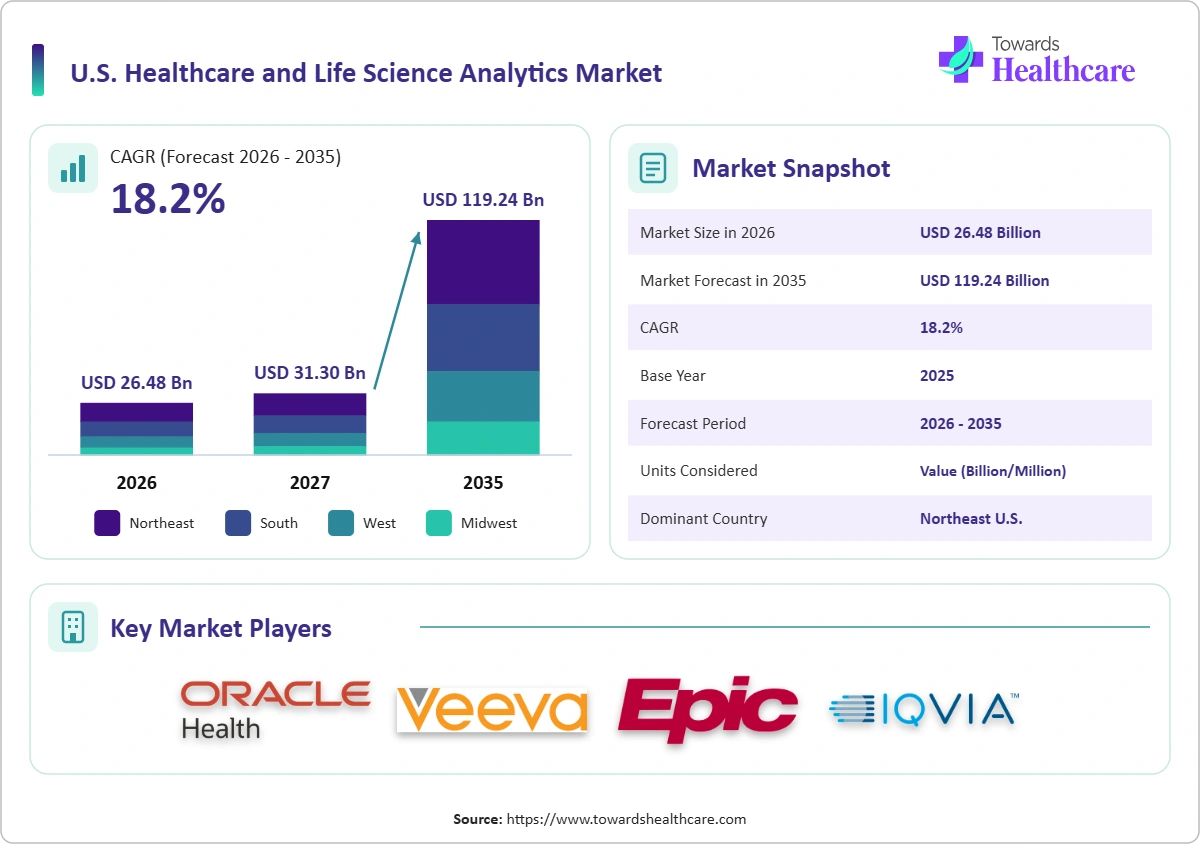
The market is expected to expand from USD 22.40 billion in 2025 to USD 119.24 billion by the end of the forecast period because a huge amount of data is generated by the U.S. healthcare ecosystem, and analytics helps providers, payers, and drug makers optimize costs and improve outcomes. Key growth drivers include data growth, value-based care, cost pressure, and AI advances. The market is expected to reach USD 51.68 billion by 2030 and sustain a CAGR of 18.20% during the forecast period. Analytics is also supporting precision medicine, genomics and telehealth initiatives.
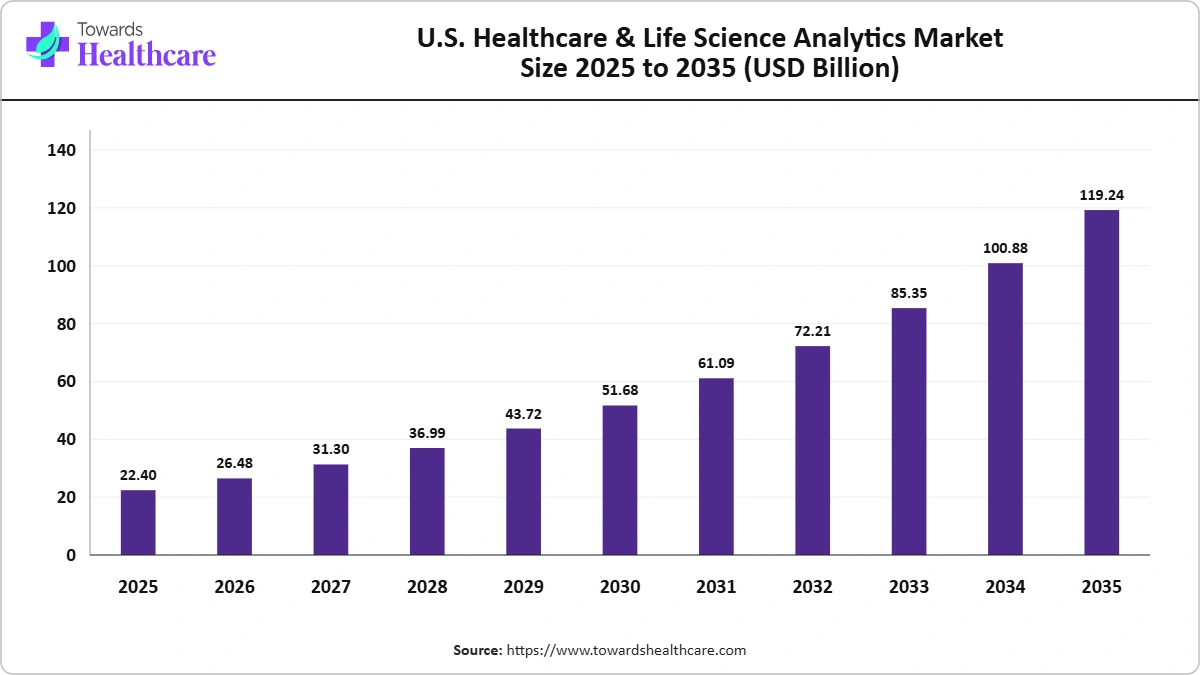
Analyst View: We built the estimate from analytics spending by providers, payers and life science companies by type and region, cross-checked against healthcare analytics revenues of leading vendors. Our value sits just above published comparable estimates.
| Driver | Impact | ≈ CAGR Contribution | Time Horizon | Key Regions |
| Data volume grows | High | +7.11 pp | Short to long term | U.S.-wide, strongest in Northeast |
| Value-based care | Medium | +6.00 pp | Medium to long term | U.S.-wide, fastest uptake in West |
| Cost pressure | Medium | +5.11 pp | Short to medium term | U.S.-wide |
| AI advances | Low | +4.00 pp | Long term | Northeast and West |
Note: Contributions are indicative estimates of each factor's effect on annual growth.
Sources: Expert interviews, secondary sources, Towards Healthcare database and Towards Healthcare analysts.
These drivers combined contribute 22.20 percentage points to the annual growth of the market, and growth in data volume is the largest contributor. They have the greatest impact in the Northeast, while the West is experiencing the fastest adoption.
| Restraint | Impact | ≈ Negative CAGR Contribution | Time Horizon | Key Regions |
| Data privacy | High | -1.80 pp | Short to medium term | U.S.-wide |
| Interoperability gaps | High | -1.32 pp | Medium term | Smaller and price-sensitive markets |
| Skills shortages | Medium | -0.88 pp | Short term | Northeast and other mature markets |
Note: Contributions are indicative estimates of each factor's effect on annual growth.
Sources: Expert interviews, secondary sources, Towards Healthcare database and Towards Healthcare analysts.
These restraints are expected to decrease the annual growth rate of the market by about 4.00 percentage points, with data privacy being the largest restraint. Their impact gradually diminishes over the forecast period as suppliers, buyers, and regulators adapt, resulting in a net CAGR of 18.20% from 2026 to 2035.
Generative AI and revenue cycle automation have the potential to improve clinical workflows and financial performance. The demand for real-world evidence in life sciences, payer analytics, and solutions tailored to small practices is growing, which expands market opportunities.
Note: 2025 is the base year; 2035 shares and CAGRs are forecasts.
Sources: Expert interviews, secondary sources, Towards Healthcare database and Towards Healthcare analysts.
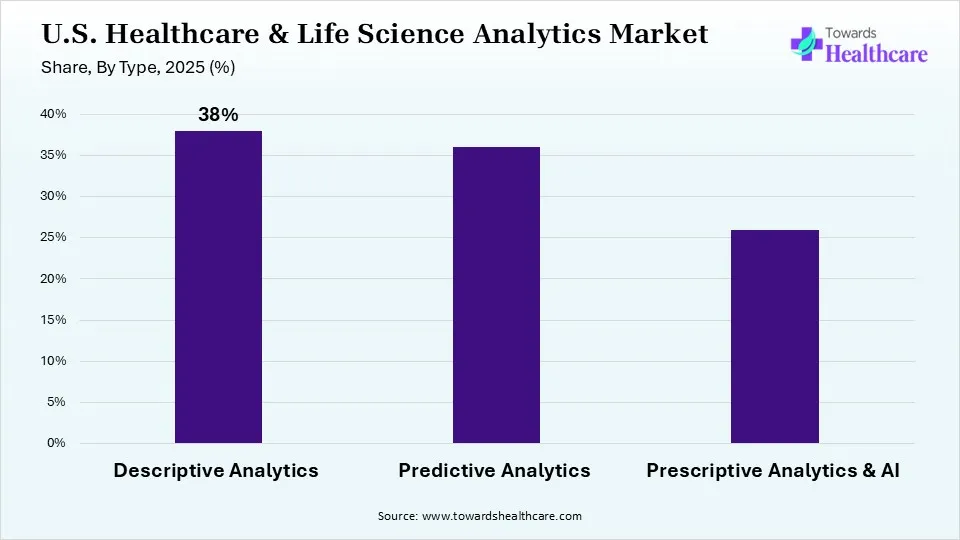
Descriptive Analytics accounted for 38.00% of the market in 2025 and is projected to expand at a CAGR of 17.09% from 2026 to 2035. Descriptive analytics holds leadership because organizations rely on dashboards and reporting. This segment is expected to grow at a slower rate than the overall market over the forecast period.
Predictive Analytics grows with risk and readmission models. The rate of growth of this segment is expected to be lower than the market between 2026 and 2035.
Prescriptive Analytics & AI are growing fastest, with generative AI and automation. This segment is expected to grow faster than the overall market over the forecast period.
Financial & Revenue Cycle captured 28.00% of the market in 2025 and is projected to expand at a CAGR of 17.50% from 2026 to 2035. Financial and revenue cycle analytics lead because it is important for providers to improve their collections. This segment is expected to grow at a slower rate than the overall market over the forecast period.
Clinical & Population Health analytics support value-based care. The market growth rate of this segment is expected to be lower than that of the market between 2026 and 2035.
Commercial & R&D (Life Sciences) are growing at the fastest rate because more and more real-world data is being generated. This segment is expected to grow at a faster rate than the overall market throughout the forecast period.
Operational analytics improve staffing and capacity. The market growth pace of this segment is expected to be lower than that of the overall market from 2026 to 2035.
Providers accounted for 40.00% of the market in 2025 and are projected to expand at a CAGR of 17.56% from 2026 to 2035. Providers lead because hospitals and physician groups buy analytics solutions. The growth rate of the overall market is expected to be higher than this segment over the forecast period.
Payers use analytics for risk and claims. The growth of this segment is expected to stay aligned with the market from 2026 to 2035.
Life Science Companies grow fastest with real-world evidence. This segment is expected to grow at a faster rate than the overall market over the forecast period.
Analyst View: Segment shares were estimated based on demand, product portfolios and pricing within each category. Descriptive Analytics, Financial & Revenue Cycle and Providers hold the largest share in their respective categories, reflecting their alignment with current buyer needs. We expect Prescriptive Analytics & AI, Commercial & R&D (Life Sciences) and Life Science Companies to gain share as newer technologies, users and applications grow faster.
Note: 2025 is the base year; 2035 shares and CAGRs are forecasts.
Sources: Expert interviews, secondary sources, Towards Healthcare database and Towards Healthcare analysts.
Northeast accounted for 30.00% of the market in 2025 and is projected to expand at a CAGR of 17.62% from 2026 to 2035. The Northeast leads because of the presence of major pharma, payers, and academic health systems in New Jersey, New York, Massachusetts and Pennsylvania. Northeast is expected to grow at a slower rate than the overall market throughout the forecast period.
South has large health systems and payers. The growth of this region is expected to stay aligned with the market between 2026 and 2035.
West is growing at the fastest rate owing to the presence of AI health tech companies in California. West is expected to grow faster than the overall market throughout the forecast period.
Midwest has large payers and health systems. Midwest is expected to grow broadly in line with the overall market between 2026 and 2035.
Analyst View: Regional shares were built from demand, installed base, spending and supplier presence in each region. Northeast leads because of its mature demand base and strong suppliers. We assign West the highest growth premium because investment, adoption, and capacity are expanding fastest there.
| Rank | Company Name | 2025 Share (%) | Key Products / Business | Headquarters |
| 1 | Optum (UnitedHealth Group) | 10.00% | Health analytics and services | United States |
| 2 | IQVIA | 9.00% | Life science analytics and real-world data | United States |
| 3 | Oracle Health | 5.00% | EHR and analytics | United States |
| 4 | Epic Systems | 5.00% | EHR analytics | United States |
| 5 | Veeva Systems | 3.00% | Life science data and analytics | United States |
| 6 | Microsoft | 3.00% | Cloud and AI for healthcare | United States |
| 7 | Innovaccer | 2.00% | Healthcare data platform and AI | United States |
| 8 | SAS Institute | 2.00% | Analytics software | United States |
| 9 | Health Catalyst | 1.00% | Data and analytics | United States |
| 10 | Komodo Health | 1.00% | Healthcare map and analytics | United States |
Note: Company shares are 2025 estimates.
Sources: Company press releases, expert interviews, secondary sources, Towards Healthcare database and Towards Healthcare analysts.
Optum (UnitedHealth Group) led the market with a 10.00% share in 2025, followed by IQVIA at 9.00% share and Oracle Health at 5.00% share.
Optum (UnitedHealth Group) is the leader owing to its health analytics and services; IQVIA competes with life science analytics and real-world data, and Oracle Health offers EHR and analytics. Epic Systems, Veeva Systems, Microsoft, Innovaccer, SAS Institute, Health Catalyst, and Komodo Health compete through EHR analytics, life science data and analytics, cloud and AI for healthcare, healthcare data platform and AI, analytics software, data and analytics, and healthcare map and analytics.
The top 10 companies captured 40.98% of revenue in 2025, while the remaining 59.02% was shared among many start-ups, consultancies and data providers. The market is fragmented, and competition centres on data access, AI capabilities, interoperability, privacy compliance, domain expertise and measurable ROI.
Optum (UnitedHealth Group) is headquartered in the United States. It held a market share of 10.00% in 2025. Its offering centres on Health analytics and services. In the Towards Healthcare Companies Quadrant it is positioned as a Leader.
IQVIA has its global headquarters in the United States. The company captured 9.00% of revenue in 2025. Its offering revolves around Life science analytics and real-world data. It has been awarded the status of a Leader in the Towards Healthcare Companies Quadrant.
Oracle Health has its corporate headquarters in the United States. It held a 5.00% share in 2025. Its portfolio comprises EHR and analytics solutions. In the Towards Healthcare Companies Quadrant it is positioned as a Leader.
Epic Systems is headquartered in the United States. It accounted for a market share of 5.00% in the base year. It provides EHR analytics. The company is positioned as a Leader in the Towards Healthcare Companies Quadrant.
The headquarters of Veeva Systems is in the United States. It captured 3.00% share of the market in 2025. Its offering centres on Life science data and analytics. In the Towards Healthcare Companies Quadrant it is positioned as a Leader.
Microsoft is headquartered in the United States. It accounted for 3.00% of net market revenue in 2025. Its portfolio comprises Cloud and AI for the healthcare sector. Towards Healthcare Companies Quadrant identifies the company as a Leader.
Innovaccer has its global headquarters in the United States. It held a market share of 2.00% in 2025. Its offering centres on Healthcare data platform and AI. Innovaccer has been classified as an Innovator in the Towards Healthcare Companies Quadrant.
SAS Institute has its corporate headquarters in the United States. The company captured 2.00% of the market in 2025. It provides Analytics software. It has been awarded the status of an Innovator in the Towards Healthcare Companies Quadrant.
The headquarters of Health Catalyst is in the United States. It held 1.00% of revenue in 2025. Its offering centres on Data and analytics. In the Towards Healthcare Companies Quadrant it is positioned as an Innovator.
Komodo Health is headquartered in the United States. It held a 1.00% share in 2025. Its offering centres on healthcare mapping and analytics. In the Towards Healthcare Companies Quadrant it is positioned as an Innovator.
The U.S. healthcare & life science analytics ecosystem links data sources, analytics vendors, cloud providers, users, and regulators, with each stage adding value before products reach end users.
| Ecosystem Stage | Role in the Market | Key Companies |
| Data Sources | Generate data | EHRs, claims, labs, devices |
| Analytics Vendors | Provide platforms and AI | Optum, IQVIA, Innovaccer, Health Catalyst |
| Cloud Providers | Host data | Microsoft, AWS, Google |
| Users | Act on insights | Providers, payers, life science companies |
| Regulators | Set privacy and data rules | HHS, ONC, FTC |
Sources: Company press releases, expert interviews, secondary sources, Towards Healthcare database and Towards Healthcare analysts.
Data Sources: Generate data. Key participants include EHRs, claims, labs, and devices.
Analytics Vendors: Provide platforms and AI. Key participants include Optum, IQVIA, Innovaccer, and Health Catalyst.
Cloud Providers: Host data. Key participants include Microsoft, AWS, and Google.
Users: Act on insights. Key participants include Providers, payers, and life science companies.
Regulators: Set privacy and data rules. Key participants include HHS, ONC, and FTC.
Market value flows from upstream material and technology suppliers to manufacturers and service providers, then through distribution partners to end users. Companies that integrate their operations or build long-term relationships with end users will be well-positioned to capture a large share of this value.
The Towards Healthcare Companies Quadrant evaluates key participants in the market based on market strength, including revenue scale, market share, and geographic reach, along with innovation and growth strategy, including product portfolio breadth, research and development investment, and strategic partnerships. Positions reflect each company's market share in 2025 and our evaluation of its product innovation, portfolio diversity, and partnerships.
Sources: Company press releases, expert interviews, secondary sources, Towards Healthcare database and Towards Healthcare analysts.
Leaders: Optum (UnitedHealth Group), IQVIA, Oracle Health, Epic Systems, Veeva Systems and Microsoft combine strong market positions with broad lineups and strong innovation.
Innovators: Innovaccer, SAS Institute, Health Catalyst and Komodo Health offer new technologies and specialized products.
By Type
By Application
By End User
By Region
The U.S. healthcare & life science analytics market was defined as analytics software, platforms and services used in U.S. healthcare and life sciences, including descriptive, predictive and prescriptive analytics and AI, delivered via cloud and on-premises, for clinical, financial and revenue cycle, operational, population health and commercial and R&D applications, used by healthcare providers, payers, and pharmaceutical, biotech and medtech companies.
The 2025 base year was developed using a bottom-up approach from demand volumes and average prices by type, application, end user and region, and checked top-down against the market-specific revenues of leading companies and published estimates. Segment, regional and company values were allocated from type, application and end user and region demand. Key estimates were verified by cross-checking company disclosures, regulatory and industry data, and published third-party estimates, and inputs that could not be reconciled were excluded. All segment, regional and company figures were reconciled to the same 2025 base year, and the 2026-2035 forecast, which applies a constant CAGR from the 2025 base, was recalculated and validated.
Analyst View: The market is set to expand at a steady pace owing to rising data volumes and related demand. Our estimate links value to underlying demand, installed base, and pricing, so the forecast follows real adoption rather than headline hype. Growth opportunities are presented by generative AI and revenue cycle automation, while data privacy and interoperability gaps continue to be the key risks.