
The U.S. neuroscience market is projected to grow from USD 13.40 billion in 2025 to USD 23.55 billion by 2035 because neurological disorders are rising and brain research continues to attract funding and new tools. Rising neurological disease, brain research funding, imaging advances, AI analysis, and neurotech innovation support steady growth, lifting the market to USD 17.76 billion by 2030 and sustaining a CAGR of 5.80% from 2026 to 2035. Neuroscience research uses life science microscopes, genomics, and precision medicine tools.
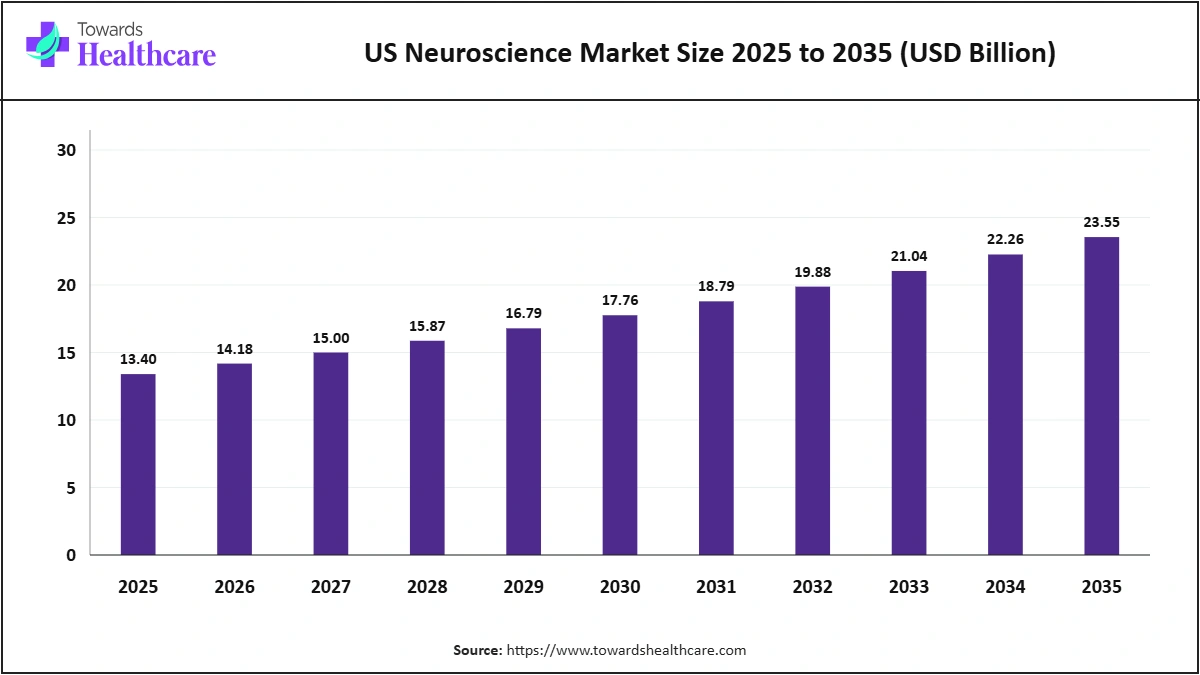
Analyst View: The estimate was developed using U.S. sales of neuroscience instruments, consumables and software, segmented by technology and end user. The results were cross-checked against published 2025 market estimates of approximately USD 13.25 billion and supplier revenue figures. Based on these comparisons, our base-year estimate is slightly higher than the highest credible published benchmark.
Driver: The rising prevalence of neurological disorders and increased funding for brain research are driving market growth. Advances in brain imaging technologies, the growing use of AI in neuroscience data analysis and continued innovation in neurotechnology are further supporting demand for neuroscience instruments, consumables and software.
Restraint: High equipment costs and uncertainty around research funding can limit market expansion. Researchers also face challenges in managing and interpreting complex neuroscience data, while reimbursement limitations may restrict the adoption of certain diagnostic technologies and procedures.
Opportunity: Emerging opportunities include functional ultrasound imaging, brain-computer interfaces (BCIs) and the growing use of neuroscience tools in central nervous system (CNS) drug trials. The development of home-based neurodiagnostic solutions and AI-powered data analysis services is also creating new growth opportunities for market participants.
Market Drivers - Impact & CAGR Contribution (2026–2035)
| Driver | Impact | ≈ CAGR Contribution | Time Horizon | Key Regions |
| Neurological disease grows | High | +2.26 pp | Short to long term | U.S.-wide, strongest in Northeast |
| Brain research funding | Medium | +1.91 pp | Medium to long term | U.S.-wide, fastest uptake in South |
| Imaging advances | Medium | +1.63 pp | Short to medium term | U.S.-wide |
| AI analysis | Low | +1.27 pp | Long term | Northeast and South |
Note: Contributions are indicative estimates of each factor's effect on annual growth.
Sources: Expert interviews, secondary sources, Towards Healthcare database, and Towards Healthcare analysts.
Taken together, these drivers add about 7.08 percentage points to the annual growth of the U.S. neuroscience market, with neurological disease grows having the largest effect. Their influence is strongest in Northeast, while uptake grows fastest in South.
Market Restraints - Impact & Negative CAGR Contribution (2026-2035)
| Restraint | Impact | ≈ Negative CAGR Contribution | Time Horizon | Key Regions |
| Equipment costs | High | -0.57 pp | Short to medium term | U.S.-wide |
| Funding uncertainty | High | -0.42 pp | Medium term | Smaller and price-sensitive markets |
| Complex data | Medium | -0.28 pp | Short term | Northeast and other mature markets |
Note: Contributions are indicative estimates of each factor's effect on annual growth.
Sources: Expert interviews, secondary sources, Towards Healthcare database and Towards Healthcare analysts.
These restraints are expected to reduce annual growth of the U.S. neuroscience market by about 1.28 percentage points, led by equipment costs. Their effect eases over the forecast period as suppliers, buyers and regulators adapt, leaving a net CAGR of 5.80% from 2026 to 2035.
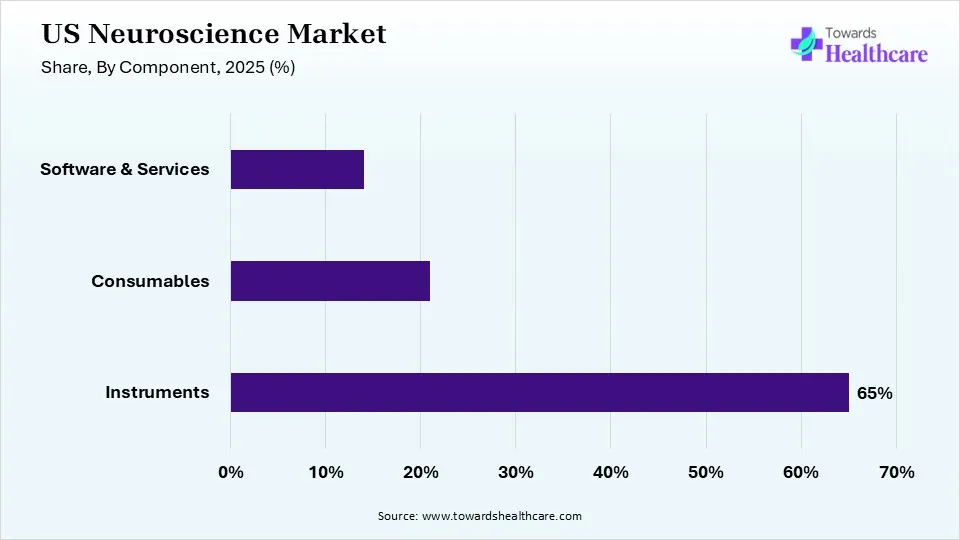
Note: 2025 is the base year; 2035 shares and CAGRs are forecasts.
Sources: Expert interviews, secondary sources, Towards Healthcare database, and Towards Healthcare analysts.
Instruments: This segment accounted for 65.00% of the U.S. neuroscience market in 2025 and is projected to expand at a CAGR of 5.27% from 2026 to 2035. Instruments lead because MRI, PET, EEG, microscopy and electrophysiology systems are high-value purchases. The instruments segment is expected to grow slower than the overall market over the forecast period.
Consumables include reagents, electrodes and probes. The consumables segment is expected to grow broadly in line with the overall market over the forecast period.
Software and services grow fastest with AI image analysis and data platforms. The software & services segment is expected to grow faster than the overall market over the forecast period.
Although Software & Services starts from the smallest base, its faster growth shows how demand is shifting within the U.S. neuroscience market.
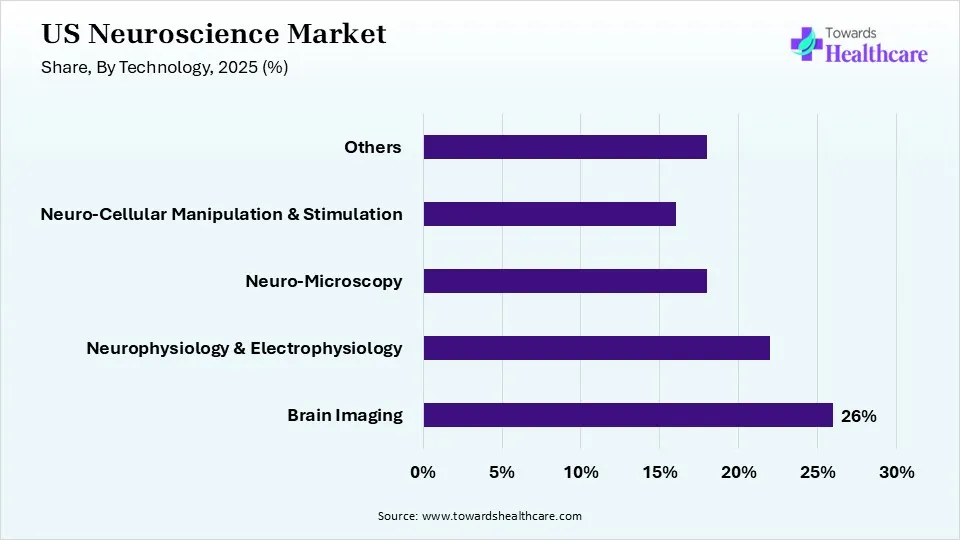
Note: 2025 is the base year; 2035 shares and CAGRs are forecasts.
Sources: Expert interviews, secondary sources, Towards Healthcare database, and Towards Healthcare analysts.
Brain Imaging: This segment accounted for 26.00% of the U.S. neuroscience market in 2025 and is projected to expand at a CAGR of 5.11% from 2026 to 2035. Brain imaging leads, including MRI, PET, and functional ultrasound. The brain imaging segment is expected to grow slower than the overall market over the forecast period.
Neurophysiology and electrophysiology record brain activity. The neurophysiology & electrophysiology segment is expected to grow broadly in line with the overall market over the forecast period.
Neuro-microscopy grows fastest with advanced light-sheet and two-photon imaging. The neuro-microscopy segment is expected to grow faster than the overall market over the forecast period.
Neuro-cellular manipulation and stimulation tools include optogenetics. The neuro-cellular manipulation & stimulation segment is expected to grow broadly in line with the overall market over the forecast period.
Others include whole-brain analysis and stereotaxic tools. The others segment is expected to grow broadly in line with the overall market over the forecast period.
Neuro-Cellular Manipulation & Stimulation holds the smallest share today and serves more specialised needs within the U.S. neuroscience market.
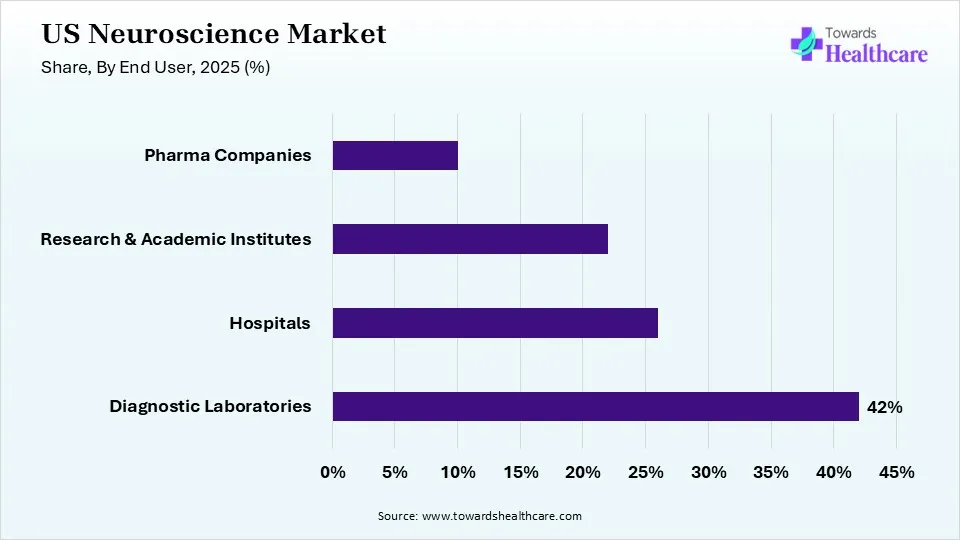
Note: 2025 is the base year; 2035 shares and CAGRs are forecasts.
Sources: Expert interviews, secondary sources, Towards Healthcare database, and Towards Healthcare analysts.
Diagnostic Laboratories: This segment accounted for 42.00% of the U.S. neuroscience market in 2025 and is projected to expand at a CAGR of 5.24% from 2026 to 2035. Diagnostic laboratories lead. The diagnostic laboratories segment is expected to grow slower than the overall market over the forecast period.
Hospitals grow fastest with neurology services. The hospitals segment is expected to grow faster than the overall market over the forecast period.
Research institutes run brain research. The research & academic institutes segment is expected to grow broadly in line with the overall market over the forecast period.
Pharmaceutical companies study CNS drugs. The pharma companies segment is expected to grow broadly in line with the overall market over the forecast period.
Pharma Companies holds the smallest share today and serves more specialised needs within the U.S. neuroscience market.
Analyst View: Segment shares were allocated from demand, product portfolios and pricing in each category. Instruments, Brain Imaging and Diagnostic Laboratories lead their categories because they meet the core needs of today's buyers. We expect Software & Services, Neuro-Microscopy and Hospitals to gain share as newer technologies, users and applications grow faster.
Note: 2025 is the base year; 2035 shares and CAGRs are forecasts.
Sources: Expert interviews, secondary sources, Towards Healthcare database, and Towards Healthcare analysts.
Northeast: This region accounted for 31.00% of the U.S. neuroscience market in 2025 and is projected to expand at a CAGR of 5.21% from 2026 to 2035. The Northeast leads because of Boston, New York, and Philadelphia neuroscience research centres and hospitals. Northeast is expected to grow slower than the overall market between 2026 and 2035.
West: The region benefits from a strong neuroscience research base and the presence of neurotechnology companies, particularly in California. The West is expected to grow broadly in line with the overall market during the forecast period.
South: The South grows fastest, with expanding health systems and research in Texas and North Carolina. South is expected to grow faster than the overall market between 2026 and 2035.
Midwest: The Midwest has major medical centres such as Mayo Clinic and research universities. Midwest is expected to grow broadly in line with the overall market between 2026 and 2035.
Analyst View: Regional shares were built from demand, installed base, spending and supplier presence in each region. Northeast leads because of its mature demand base and strong suppliers. We assign South the highest growth premium because investment, adoption, and capacity are expanding fastest there.
| Rank | Company Name | 2025 Share (%) | Key Products / Business | Headquarters |
| 1 | GE HealthCare | 9.70% | MRI and PET brain imaging | United States |
| 2 | Siemens Healthineers | 8.96% | MRI and PET imaging | Germany |
| 3 | Philips | 5.60% | MRI and EEG systems | Netherlands |
| 4 | Medtronic | 5.22% | Neuromodulation and neuromonitoring | Ireland |
| 5 | Thermo Fisher Scientific | 4.10% | Neuroscience reagents and microscopy | United States |
| 6 | Danaher (Leica, Molecular Devices) | 2.61% | Microscopy and electrophysiology | United States |
| 7 | Carl Zeiss | 2.24% | Neuro-microscopy | Germany |
| 8 | Canon Medical Systems | 2.24% | MRI and CT imaging | Japan |
| 9 | Natus Medical | 1.87% | EEG and neurodiagnostics | United States |
| 10 | Boston Scientific | 1.87% | Neuromodulation systems | United States |
Note: Company shares are 2025 estimates.
Sources: Company press releases, expert interviews, secondary sources, Towards Healthcare database and Towards Healthcare analysts.
GE HealthCare led the U.S. neuroscience market with an estimated 9.70% share of 2025 revenue, followed by Siemens Healthineers at 8.96% share and Philips at 5.60% share. GE HealthCare leads with MRI and PET brain imaging, Siemens Healthineers competes with MRI and PET imaging, and Philips offers MRI and EEG systems. Medtronic, Thermo Fisher Scientific, Danaher (Leica, Molecular Devices), Carl Zeiss, Canon Medical Systems, Natus Medical and Boston Scientific compete through neuromodulation and neuromonitoring, neuroscience reagents and microscopy, microscopy and electrophysiology, neuro-microscopy, MRI and CT imaging, EEG and neurodiagnostics and neuromodulation systems.
The top 10 companies accounted for an estimated 44.40% of 2025 revenue, while the remaining 55.60% was shared among many neurotech start-ups, reagent makers and service providers. The U.S. neuroscience market is moderately fragmented, and competition centres on imaging performance, research-grade tools, AI analysis, clinical evidence, service and price.
GE HealthCare: GE HealthCare is headquartered in the United States. It held an estimated 9.70% share of the U.S. neuroscience market in 2025. Its offering centres on MRI and PET brain imaging. In the Towards Healthcare Companies Quadrant it is positioned as a Leader.
Siemens Healthineers: Siemens Healthineers is headquartered in Germany. It held an estimated 8.96% share of the U.S. neuroscience market in 2025. Its offering centres on MRI and PET imaging. In the Towards Healthcare Companies Quadrant it is positioned as a Leader.
Philips: Philips, part of Koninklijke Philips N.V., is headquartered in the Netherlands. It held an estimated 5.60% share of the U.S. neuroscience market in 2025. Its offering centres on MRI and EEG systems. In the Towards Healthcare Companies Quadrant it is positioned as a Leader.
Medtronic: Medtronic is headquartered in Ireland. It held an estimated 5.22% share of the U.S. neuroscience market in 2025. Its offering centres on Neuromodulation and neuromonitoring. In the Towards Healthcare Companies Quadrant it is positioned as a Leader.
Thermo Fisher Scientific: Thermo Fisher Scientific is headquartered in the United States. It held an estimated 4.10% share of the U.S. neuroscience market in 2025. Its offering centres on Neuroscience reagents and microscopy. In the Towards Healthcare Companies Quadrant it is positioned as a Leader.
Danaher (Leica, Molecular Devices): Danaher (Leica, Molecular Devices) is headquartered in the United States. It held an estimated 2.61% share of the U.S. neuroscience market in 2025. Its offering centres on Microscopy and electrophysiology. In the Towards Healthcare Companies Quadrant it is positioned as a Leader.
Carl Zeiss: Carl Zeiss is headquartered in Germany. It held an estimated 2.24% share of the U.S. neuroscience market in 2025. Its offering centres on Neuro-microscopy. In the Towards Healthcare Companies Quadrant it is positioned as an Innovator.
Canon Medical Systems: Canon Medical Systems is headquartered in Japan. It held an estimated 2.24% share of the U.S. neuroscience market in 2025. Its offering centres on MRI and CT imaging. In the Towards Healthcare Companies Quadrant it is positioned as an Innovator.
Natus Medical: Natus Medical is headquartered in the United States. It held an estimated 1.87% share of the U.S. neuroscience market in 2025. Its offering centres on EEG and neurodiagnostics. In the Towards Healthcare Companies Quadrant it is positioned as an Innovator.
Boston Scientific: Boston Scientific is headquartered in the United States. It held an estimated 1.87% share of the U.S. neuroscience market in 2025. Its offering centres on Neuromodulation systems. In the Towards Healthcare Companies Quadrant it is positioned as an Innovator.
The U.S. neuroscience ecosystem links imaging & device makers, research tool suppliers, neurotech innovators, users and funders & regulators, with each stage adding value before products reach end users.
| Ecosystem Stage | Role in the Market | Key Companies |
| Imaging & Device Makers | Make imaging and neurophysiology systems | GE HealthCare, Siemens Healthineers, Philips, Natus |
| Research Tool Suppliers | Supply microscopy and reagents | Thermo Fisher, Zeiss, Danaher |
| Neurotech Innovators | Develop BCI and neuromodulation | Medtronic, Boston Scientific, start-ups |
| Users | Research and treat | Hospitals, labs, universities, pharma |
| Funders & Regulators | Fund and approve | NIH BRAIN Initiative, FDA |
Sources: Company press releases, expert interviews, secondary sources, Towards Healthcare database and Towards Healthcare analysts.
Imaging & Device Makers: Make imaging and neurophysiology systems. Key participants include GE HealthCare, Siemens Healthineers, Philips, Natus.
Research Tool Suppliers: Supply microscopy and reagents. Key participants include Thermo Fisher, Zeiss, Danaher.
Neurotech Innovators: Develop BCI and neuromodulation. Key participants include Medtronic, Boston Scientific, and start-ups.
Users: Research and treat. Key participants include Hospitals, labs, universities, and pharma.
Funders & Regulators: Fund and approve. Key participants include NIH BRAIN Initiative, FDA.
Value in the U.S. neuroscience market flows from upstream material and technology suppliers to manufacturers and service providers, then through distribution partners to end users. Companies that integrate several stages or build long-term relationships with end users capture a larger share of this value.
The Towards Healthcare Companies Quadrant positions key participants in the U.S. neuroscience market by market strength, reflecting revenue scale, market share and geographic reach, and by innovation and growth strategy, reflecting product portfolio breadth, R&D intensity and partnerships. Positions reflect each company's estimated 2025 share of the U.S. neuroscience market and our assessment of its product innovation, portfolio breadth and partnerships.
Sources: Company press releases, expert interviews, secondary sources, Towards Healthcare database and Towards Healthcare analysts.
Leaders: GE HealthCare, Siemens Healthineers, Philips, Medtronic, Thermo Fisher Scientific and Danaher (Leica, Molecular Devices) combine high market share with broad portfolios and strong innovation.
Innovators: Carl Zeiss, Canon Medical Systems, Natus Medical and Boston Scientific bring newer technologies and specialised products.
By Component
By Technology
By End User
By Region
The U.S. neuroscience market was defined as neuroscience instruments, consumables, software, and services in the United States, including brain imaging systems, electrophysiology and neurophysiology equipment, neuro-microscopy, neuro-cellular manipulation and stimulation tools, and analysis software, used by diagnostic laboratories, hospitals, research and academic institutes, and pharmaceutical companies. The 2025 base year was built bottom-up from demand volumes and average prices by component, technology and end user and region, and checked top-down against the market-specific revenues of leading companies and published estimates. Segment, regional and company values were allocated from component, technology and end user and region demand.
Key estimates were verified by cross-checking company disclosures, regulatory and industry data, and published third-party estimates, and inputs that could not be reconciled were excluded. All segment, regional, and company figures were reconciled to the same 2025 base year, and the 2026–2035 forecast, which applies a constant CAGR from the 2025 base, was recalculated and validated.
Analyst View: The U.S. neuroscience market is set for steady expansion as rising neurological disease and related demand keep growing. Our estimate links value to underlying demand, installed base, and pricing, so the forecast follows real adoption rather than headline hype. The main upside comes from functional ultrasound and BCIs, while the main risks are research funding uncertainty and equipment costs.
1.3.1 Market Value (USD) and Annual Growth
1.3.2 Historical Market Analysis
1.3.3 Market Growth Analysis and CAGR 2026–2035
2.2.1 Neurological disease grows
2.2.2 Brain research funding
2.2.3 Imaging advances
2.2.4 AI analysis
2.4.1 Equipment costs
2.4.2 Funding uncertainty
2.4.3 Complex data
2.4.4 Reimbursement limits
2.7.1 Functional ultrasound
2.7.2 BCIs
2.7.3 CNS drug trials
2.7.4 Home neurodiagnostics
2.8.1 Functional ultrasound brain imaging
2.8.2 AI-based neuroimaging analysis
2.8.3 Brain-computer interfaces
2.8.4 Light-sheet and two-photon microscopy
2.8.5 At-home EEG
2.8.6 Neuromodulation therapies
3.1.1 Instruments: Market Share and CAGR
3.1.2 Consumables: Market Share and CAGR
3.1.3 Software & Services: Market Share and CAGR
3.2.1 Brain Imaging: Market Share and CAGR
3.2.2 Neurophysiology & Electrophysiology: Market Share and CAGR
3.2.3 Neuro-Microscopy: Market Share and CAGR
3.2.4 Neuro-Cellular Manipulation & Stimulation: Market Share and CAGR
3.2.5 Others: Market Share and CAGR
3.3.1 Diagnostic Laboratories: Market Share and CAGR
3.3.2 Hospitals: Market Share and CAGR
3.3.3 Research & Academic Institutes: Market Share and CAGR
3.3.4 Pharma Companies: Market Share and CAGR
4.1.1 Market Size and Forecast, 2025–2035
4.1.2 Market Share by Component
4.1.3 Demand Drivers, Regulation and Local Competition
4.2.1 Market Size and Forecast, 2025–2035
4.2.2 Market Share by Component
4.2.3 Demand Drivers, Regulation and Local Competition
4.3.1 Market Size and Forecast, 2025–2035
4.3.2 Market Share by Component
4.3.3 Demand Drivers, Regulation and Local Competition
4.4.1 Market Size and Forecast, 2025–2035
4.4.2 Market Share by Component
4.4.3 Demand Drivers, Regulation and Local Competition
5.5.1 Product Portfolio Benchmarking
5.5.2 Geographic Presence Benchmarking
5.5.3 Technology and Innovation Benchmarking
6.1.1 Instrument list price and discount analysis
6.1.2 Consumables and reagent pricing per test or sample
6.1.3 Service contract and subscription pricing
6.1.4 Academic vs. biopharma pricing tiers
7.1.1 Pharmaceutical and biotechnology companies
7.1.2 Academic and government research institutes
7.1.3 CROs, CDMOs and core facilities
7.1.4 Clinical and diagnostic laboratories
9.1.1 Key raw materials and component sourcing
9.1.2 OEM and contract manufacturing
9.1.3 Distributor and e-procurement channels
9.1.4 Cold chain and logistics requirements
11.1.1 Automation and high-throughput workflows
11.1.2 Digital, cloud and AI-enabled analysis
11.1.3 Next-generation platforms and consumables
11.1.4 Patent and IP landscape
12.1.1 Research-use-only vs. IVD regulatory pathways
12.1.2 GMP and quality standards for bioprocessing
12.1.3 Biosafety and laboratory standards
12.1.4 Data integrity and compliance requirements
17.1.1 Company Overview
17.1.2 U.S. Neuroscience Product Portfolio
17.1.3 Financial Performance and Market Share
17.1.4 Recent Developments and Strategy
17.1.5 SWOT Analysis
17.2.1 Company Overview
17.2.2 U.S. Neuroscience Product Portfolio
17.2.3 Financial Performance and Market Share
17.2.4 Recent Developments and Strategy
17.2.5 SWOT Analysis
17.3.1 Company Overview
17.3.2 U.S. Neuroscience Product Portfolio
17.3.3 Financial Performance and Market Share
17.3.4 Recent Developments and Strategy
17.3.5 SWOT Analysis
17.4.1 Company Overview
17.4.2 U.S. Neuroscience Product Portfolio
17.4.3 Financial Performance and Market Share
17.4.4 Recent Developments and Strategy
17.4.5 SWOT Analysis
17.5.1 Company Overview
17.5.2 U.S. Neuroscience Product Portfolio
17.5.3 Financial Performance and Market Share
17.5.4 Recent Developments and Strategy
17.5.5 SWOT Analysis
17.6.1 Company Overview
17.6.2 U.S. Neuroscience Product Portfolio
17.6.3 Financial Performance and Market Share
17.6.4 Recent Developments and Strategy
17.6.5 SWOT Analysis
17.7.1 Company Overview
17.7.2 U.S. Neuroscience Product Portfolio
17.7.3 Financial Performance and Market Share
17.7.4 Recent Developments and Strategy
17.7.5 SWOT Analysis
17.8.1 Company Overview
17.8.2 U.S. Neuroscience Product Portfolio
17.8.3 Financial Performance and Market Share
17.8.4 Recent Developments and Strategy
17.8.5 SWOT Analysis
17.9.1 Company Overview
17.9.2 U.S. Neuroscience Product Portfolio
17.9.3 Financial Performance and Market Share
17.9.4 Recent Developments and Strategy
17.9.5 SWOT Analysis
17.10.1 Company Overview
17.10.2 U.S. Neuroscience Product Portfolio
17.10.3 Financial Performance and Market Share
17.10.4 Recent Developments and Strategy
17.10.5 SWOT Analysis