
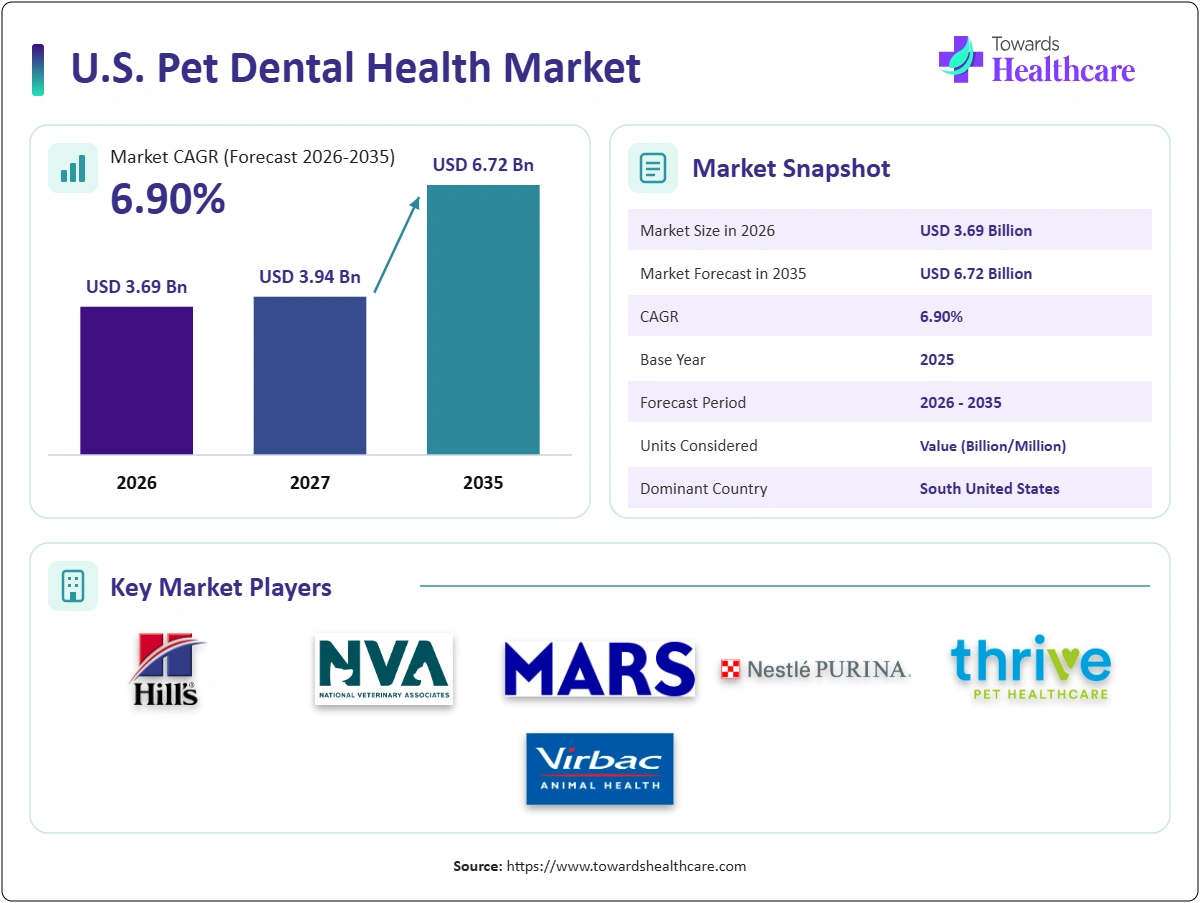
The U.S. pet dental health market is forecast to rise from $3.45 billion in 2025 to $6.72 billion by 2035 as most adult dogs and cats suffer from periodontal disease and more pet owners are now willing to pay for the dental treatment and products required for dental hygiene. The rise in pet insurance and wellness programs, increasing cat adoption, high-quality VOHC-approved chews, an increase in e-commerce channels, and growth in dental radiography will drive market growth to $4.82 billion by 2030.
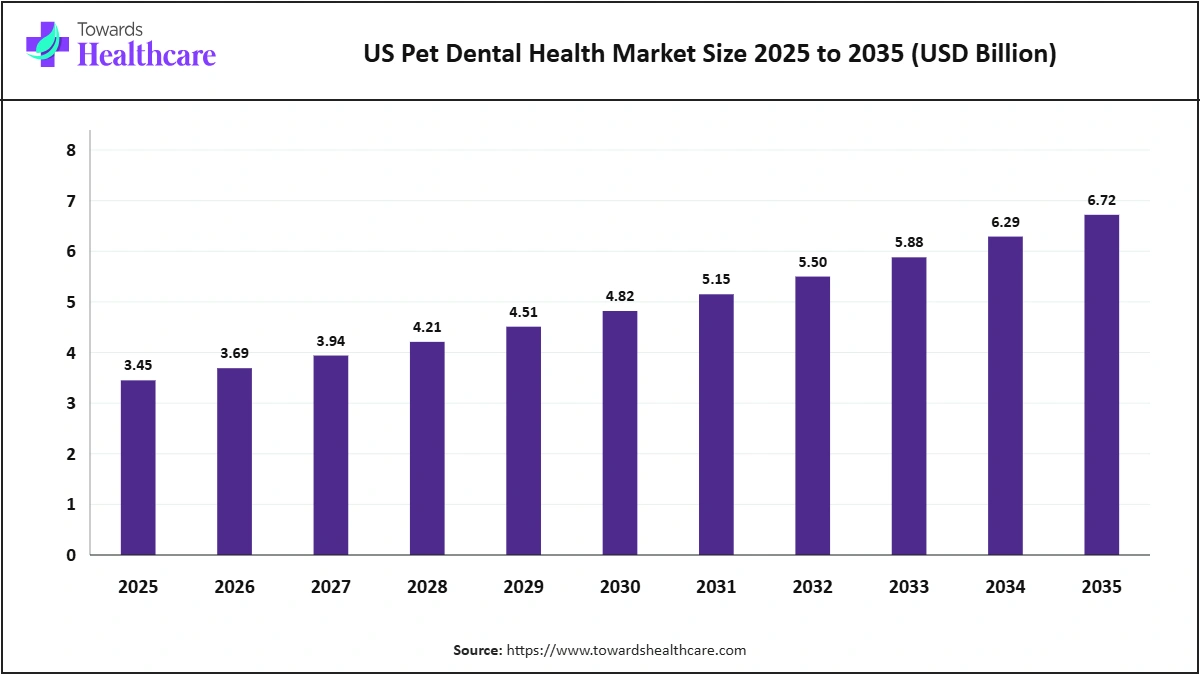
Analyst View: The estimate was calculated based on the number of US cats and dogs, the percentage receiving professional dental care services per year, the price per procedure, and the sales figures of various dental chews, diets, and oral care products for pets. The volume data was based on the pet population size, the rate of visits to the vet, awareness and insurance penetration, while the sales figures were influenced by the penetration rates of households in pet food and the premiumization trend. The estimated total was validated against the practice data from vets, the income levels of major pet care companies, and estimates found in publications. Our base-year figure is slightly higher than the highest plausible estimate found.
Driver: Periodontal disease is very common among pets. Owners treat pets as family members. Dental procedures are covered through insurance and wellness plans. Awareness programs promote cleanings. Chewing treats are widely adopted.
Restraint: Anaesthetic procedures are expensive. Owners fear anaesthetic procedures. Most owners don’t brush their pet’s teeth. Lack of veterinary professionals limits capacity. Marketing claims have variable evidence.
Opportunity: Cat dentistry remains underpenetrated. Subscription models enable recurring revenue. Teledentistry and screening increase visits. Functional treats become premium. Wellness plans facilitate spreading costs.
| Segments | 2025 Share | 2025 Value (USD Billion) | 2035 Value (USD Billion) | CAGR 2026–2035 |
| Veterinary Dental Services | 64.60% | 2.23 | 4.18 | 6.50% |
| Oral Care Products | 30.80% | 1.06 | 2.23 | 7.70% |
| Medicines & Equipment | 4.60% | 0.16 | 0.31 | 6.90% |
Note: 2025 is the base year; 2035 values are forecasts.
Sources: Expert interviews, secondary sources, Towards Healthcare database and Towards Healthcare analysts.
Veterinary Dental Services: This segment accounted for 64.60% (USD 2.23 billion) of the U.S. pet dental healthcare market in 2025 and is forecasted to grow to USD 4.18 billion by 2035 at a CAGR of 6.50% during 2026-2035. Services offered by veterinary dentists include oral examinations, teeth scaling and polishing performed under general anesthesia, complete mouth dental X-rays, tooth extraction, root canals, and oral surgery. The services dominate due to the high cost of a single dental procedure (several hundred dollars to over a thousand dollars) and periodontal disease being the most common disorder among adult pets. Some big veterinary chains like Mars Veterinary Health, NVA, and Thrive Pet Healthcare are delivering most of them.
Oral Care Products: This category constituted 30.80% (USD 1.06 billion) of the U.S. pet dental health market in 2025 and is expected to grow to USD 2.23 billion in 2035, growing at a CAGR of 7.70% during the period of 2026-2035. Oral care products consist of dental chews and treats like Greenies and Purina DentaLife, dental diets like Hill's Prescription Diet t/d, toothpaste, toothbrush, water additive, gels, and sprays. These are the fastest-growing category due to the owner's preference for daily easy care and VOHC approval, as well as increasing online sales.
Medicines & Equipment: This section had an overall share of 4.60% (USD 0.16 billion) of the total market for the pet dental health industry in the U.S. in 2025 and is expected to grow to USD 0.31 billion by 2035 at a CAGR of 6.90% from 2026 to 2035. This includes medicines and equipment that include antibiotics, painkillers, and antiseptics in dentistry and dental equipment like ultrasonic scalers.
| Segments | 2025 Share | 2025 Value (USD Billion) | 2035 Value (USD Billion) | CAGR 2026–2035 |
| Dogs | 68.40% | 2.36 | 4.40 | 6.43% |
| Cats | 27.20% | 0.94 | 2.03 | 8.03% |
| Others | 4.40% | 0.15 | 0.29 | 6.83% |
Note: 2025 is the base year; 2035 values are forecasts.
Sources: Expert interviews, secondary sources, Towards Healthcare database and Towards Healthcare analysts.
Dogs: This segment held 68.40% (USD 2.36 billion) of the U.S. pet dental health market in 2025 and is estimated to reach USD 4.40 billion by 2035, growing at a CAGR of 6.43% between 2026 and 2035. The highest contribution of this segment can be attributed to high dog populations in the country, high vulnerability of smaller dogs to periodontal disease, and high purchase of dental chews and treats.
Cats: This segment held 27.20% (USD 0.94 billion) of the U.S. pet dental health market in 2025 and is estimated to reach USD 2.03 billion by 2035, growing at a CAGR of 8.03% between 2026 and 2035. The highest growth of this segment can be attributed to the increasing trend of cat ownership, higher vulnerability of cats to tooth resorption and gingivostomatitis, and the introduction of cat-specific products like brushing-free gels and dental treats.
Others: This segment held 4.40% (USD 0.15 billion) of the U.S. pet dental health market in 2025 and is estimated to reach USD 0.29 billion by 2035, growing at a CAGR of 6.83% between 2026 and 2035. This segment includes rabbits, guinea pigs, and other small mammals that require dental care due to their overgrown teeth.
| Segments | 2025 Share | 2025 Value (USD Billion) | 2035 Value (USD Billion) | CAGR 2026–2035 |
| Gum & Periodontal Disease | 39.60% | 1.37 | 2.56 | 6.51% |
| Dental Calculus & Plaque | 28.80% | 0.99 | 1.94 | 6.91% |
| Endodontic Diseases | 14.20% | 0.49 | 1.05 | 7.91% |
| Tooth Resorption & Fractures | 10.60% | 0.37 | 0.71 | 6.91% |
| Oral Tumors & Others | 6.80% | 0.23 | 0.46 | 6.91% |
Note: 2025 is the base year; 2035 values are forecasts.
Sources: Expert interviews, secondary sources, Towards Healthcare database and Towards Healthcare analysts.
Gum & Periodontal Disease: The segment held a share of 39.60% (USD 1.37 billion) of the total U.S. pet dental health market in 2025 and is forecasted to reach USD 2.56 billion by 2035, exhibiting a CAGR of 6.51% during 2026–2035. The most prominent indication for the treatment is gum and periodontal disease, which affects dogs and cats aged above three years, causing them pain, tooth loss, and even affecting their overall well-being. Professional dental cleaning, tooth extraction, and other dental hygiene practices are used as treatment.
Dental Calculus & Plaque: The segment occupied a share of 28.80% (USD 0.99 billion) of the total U.S. pet dental health market in 2025 and is expected to be worth USD 1.94 billion by 2035, exhibiting a CAGR of 6.91% from 2026 to 2035. The focus of the dental chew, diet, water additives, and other cleaning products is on dental calculus and plaque control to prevent periodontal disease.
Endodontic Diseases: Endodontic disease accounted for 14.20% (USD 0.49 billion) of the U.S. pet dental health market in 2025 and is expected to reach USD 1.05 billion by 2035, growing at a CAGR of 7.91% between 2026 and 2035. Endodontic diseases involve fractured teeth that expose pulp and tooth infections that are managed via root canals or tooth extractions. This is the fastest-growing condition because more pet owners are seeking services from veterinary dentists.
Tooth Resorption & Fractures: Oral tumors & others accounted for 10.60% (USD 0.37 billion) of the U.S. pet dental health market in 2025 and are expected to reach USD 0.71 billion by 2035, growing at a CAGR of 6.91% between 2026 and 2035. Resorption of tooth enamel, mainly experienced by cats, and tooth fractures in dogs involve tooth extraction or restoration using X-rays.
Oral Tumors & Others: Periodontal disease accounted for 6.80% (USD 0.23 billion) of the U.S. pet dental health market in 2025 and is expected to reach USD 0.46 billion by 2035, growing at a CAGR of 6.91% between 2026 and 2035. Other oral tumors involve oral masses, malocclusions, and stomatitis.
| Segments | 2025 Share | 2025 Value (USD Billion) | 2035 Value (USD Billion) | CAGR 2026–2035 |
| Veterinary Hospitals & Clinics | 62.40% | 2.15 | 4.01 | 6.41% |
| Retail Stores | 18.80% | 0.65 | 1.25 | 6.81% |
| E-commerce | 15.20% | 0.52 | 1.22 | 8.81% |
| Others | 3.60% | 0.12 | 0.24 | 6.81% |
Note: 2025 is the base year; 2035 values are forecasts.
Sources: Expert interviews, secondary sources, Towards Healthcare database and Towards Healthcare analysts.
Veterinary Hospitals & Clinics: This segment represented 62.40% (USD 2.15 billion) of the U.S. pet dental health market in 2025 and is expected to reach USD 4.01 billion by 2035, growing at a CAGR of 6.41% during 2026 to 2035. Veterinary hospitals and clinics represent the biggest channel since they offer all types of dental procedures and prescription diets and veterinary-specific oral care products.
Retail Stores: This segment represented 18.80% (USD 0.65 billion) of the U.S. pet dental health market in 2025 and is expected to reach USD 1.25 billion by 2035, growing at a CAGR of 6.81% during 2026 to 2035. Retail stores include specialty pet chain stores such as PetSmart and Petco, along with grocery and mass merchandisers. They sell dental chews, treats, and oral care products.
E-commerce: This segment accounted for 15.20% (USD 0.52 billion) of the U.S. pet dental health market in 2025 and is projected to grow to USD 1.22 billion by 2035, at a CAGR of 8.81% during 2026–2035. E-commerce is the fastest-growing channel, due to subscriptions via Chewy, Amazon, and brand sites, as well as promotions via social media channels such as TikTok Shop.
Others: This segment accounted for 3.60% (USD 0.12 billion) of the U.S. pet dental health market in 2025 and is projected to grow to USD 0.24 billion by 2035, at a CAGR of 6.81% during 2026–2035. Other categories include mobile vet services and direct sales.
Analyst View: Segment values were allocated based on aligning service procedure volumes, products sold, and prices with type, animal, indication, and channel. Services, dogs, periodontal disease, and veterinary clinics dominate the category. We believe oral care products, cats, endodontics, and e-commerce will become more dominant.
| Region | 2025 Share | 2025 Value (USD Billion) | 2035 Value (USD Billion) | CAGR 2026–2035 |
| South | 38.40% | 1.32 | 2.64 | 7.14% |
| West | 24.20% | 0.83 | 1.60 | 6.74% |
| Midwest | 19.60% | 0.68 | 1.30 | 6.74% |
| Northeast | 17.80% | 0.61 | 1.18 | 6.74% |
Note: 2025 is the base year; 2035 values are forecasts.
Sources: Expert interviews, secondary sources, Towards Healthcare database and Towards Healthcare analysts.
South: This region constituted 38.40% (USD 1.32 billion) of the U.S. pet dental health market in 2025 and will grow to USD 2.64 billion by 2035, at a CAGR of 7.14% during 2026-2035. The South is home to a large number of pets and includes the states of Texas, Florida, Georgia, and North Carolina, with rapid population and household growth. An increasing presence of veterinary hospitals and increasing penetration of pet insurance make this region not only the largest but also the fastest-growing region.
West: This region constituted 24.20% (USD 0.83 billion) of the U.S. pet dental health market in 2025 and will grow to USD 1.60 billion by 2035, at a CAGR of 6.74% during 2026-2035. The West, headed by the states of California, Washington, and Colorado, is known for heavy expenditure on pets and the availability of more veterinary specialists.
Midwest: This region accounted for 19.60% (USD 0.68 billion) of the U.S. pet dental health market in 2025 and is expected to be valued at USD 1.30 billion by 2035, recording a CAGR of 6.74% during the period 2026-2035. Midwest is home to large numbers of pet-owning households in Illinois, Ohio, and Michigan, with consistent demand for veterinary dental services and retail chews.
Northeast: This region accounted for 17.80% (USD 0.61 billion) of the U.S. pet dental health market in 2025 and is expected to be valued at USD 1.18 billion by 2035, recording a CAGR of 6.74% during the period 2026-2035. Northeast, comprising regions such as New York, Pennsylvania, and Massachusetts, offers high veterinary prices, specialty dental practices, and high spending per pet.
Analyst View: The regional shares have been derived on the basis of pet population, density of veterinary practices, and spending per pet in each region. South leads in terms of pet population. We give the South region a modest growth premium due to its rapidly growing pet population.
| Rank | Company Name | Market-Specific Revenue (USD Billion) | 2025 Share | Key Products / Business | Headquarters |
| 1 | Mars, Incorporated | 0.62 | 17.97% | Greenies, Pedigree Dentastix; Banfield and VCA dental services | United States |
| 2 | National Veterinary Associates | 0.18 | 5.22% | Veterinary dental services | United States |
| 3 | Nestlé Purina PetCare | 0.14 | 4.06% | DentaLife and Pro Plan Dental Chewz | United States |
| 4 | Colgate-Palmolive (Hill's Pet Nutrition) | 0.10 | 2.90% | Hill's Prescription Diet t/d | United States |
| 5 | Thrive Pet Healthcare | 0.08 | 2.32% | Veterinary dental services | United States |
| 6 | Virbac | 0.07 | 2.03% | C.E.T. chews, toothpaste and oral care | France |
| 7 | Central Garden & Pet (Nylabone) | 0.06 | 1.74% | Nylabone dental chews | United States |
| 8 | PetIQ | 0.04 | 1.16% | Pet wellness services and products | United States |
| 9 | Dechra | 0.03 | 0.87% | Oral care and dental medicines | United Kingdom |
| 10 | Vetoquinol | 0.02 | 0.58% | Enzadent and oral care products | France |
Note: Company revenues and shares are 2025 estimates.
Sources: Company press releases, expert interviews, secondary sources, Towards Healthcare database and Towards Healthcare.
In terms of the U.S. pet dental health market shares, the leading company is Mars, Inc. It held an estimated 17.97% (USD 0.62 billion) market share of 2025 revenues. The second largest company in this market is National Veterinary Associates with a market share of 5.22% (USD 0.18 billion). The third one is Nestlé Purina PetCare with a 4.06% (USD 0.14 billion) market share. Mars, Incorporated dominates the market due to its Greenies and Pedigree Dentastix chews, as well as dental services offered at its Banfield and VCA veterinary hospitals. National Veterinary Associates offers veterinary dental services through its large network of practices, while Nestlé Purina provides DentaLife and Pro Plan dental chews. Colgate-Palmolive's Hill's, Thrive Pet Healthcare, Virbac, Central Garden & Pet, PetIQ, Dechra, and Vetoquinol compete in the market using dental diets, veterinary services, veterinary oral care products, dental chews, wellness services, and dental medicines. The total revenue share held by the top 10 companies amounts to an estimated 38.84% (USD 1.34 billion), while the remaining 61.16% (USD 2.11 billion) belongs to independent veterinary practices, specialty dental clinics, and small oral care brands.
The U.S. pet dental health ecosystem links product makers and equipment suppliers with distributors, retailers, veterinary practices, insurers and pet owners.
| Ecosystem Stage | Role in the Market | Key Companies |
| Product Makers | Produce chews, diets and oral care products | Mars, Nestlé Purina, Hill's, Virbac, Central Garden & Pet |
| Equipment & Medicines | Supply dental equipment and drugs | Dental equipment makers, Dechra, Vetoquinol |
| Distribution & Retail | Sell products to clinics and owners | Covetrus, Chewy, PetSmart, Petco, Amazon |
| Veterinary Providers | Deliver dental services | Banfield, VCA, NVA, Thrive, independent clinics |
| Payers & Owners | Fund and choose care | Pet owners, pet insurers, wellness plans |
Sources: Company press releases, expert interviews, secondary sources, Towards Healthcare database and Towards Healthcare analysts.
The Towards Healthcare Quadrant positions the most prominent players in the United States pet dental health market based on market strength, which denotes the size of revenue, market share, and geographical presence of the companies, and on innovation and growth strategies, which denotes the scope of products and R&D activities of the companies.
Sources: Company press releases, expert interviews, secondary sources, Towards Healthcare database and Towards Healthcare analysts.
Leaders: Mars, National Veterinary Associates, Nestlé Purina PetCare and Colgate-Palmolive (Hill's Pet Nutrition) combine large dental revenue with strong brands or broad veterinary networks.
Challengers: Thrive Pet Healthcare has large service or product reach but less product innovation.
Innovators: Virbac, Central Garden & Pet (Nylabone) and PetIQ bring specialised veterinary oral care and wellness products.
Niche Players: Dechra and Vetoquinol serve narrower product segments.
By Type
By Animal Type
By Indication
By Distribution Channel
By Region
The U.S. pet dental health market consisted of veterinary dental procedures, oral care products, dental medicines, and devices for dogs, cats, and other pets in the United States. The base year 2025 was developed using a bottom-up approach on the basis of procedure volume and price and oral care product sales by type, animal, indication, channel, and region, and then validated using a top-down approach based on data on veterinary practices and revenues of leading pet care companies in the U.S. Segmentation, regional, and company-level numbers were assigned by type, animal, indications, channels, and regions in terms of number of pets. All estimates were verified using cross-referencing with company reports, regulatory data, industry statistics, and independent estimates; inconsistent inputs were disregarded. All figures for segments, regions, and companies were harmonized into the base year 2025, and the 2026-2035 forecast was recalculated assuming a constant CAGR starting from 2025.
Analyst View: The U.S. pet dental health market is a mix of premium-priced veterinary services and rapidly growing pet healthcare products, and both of these segments enjoy the benefits of pet anthropomorphisation. Our forecast ties demand to pet population numbers, procedure rates, prices, and sales of products; thus, it tracks changes in pet ownership, veterinary capacity, and expenditure of pet owners. The key driver for growth will be cats, home care products and insurance.