


The global X-ray market size was estimated at USD 16.21 billion in 2025 and is predicted to increase from USD 17.25 billion in 2026 to approximately USD 30.25 billion by 2035, expanding at a CAGR of 6.44% from 2026 to 2035.
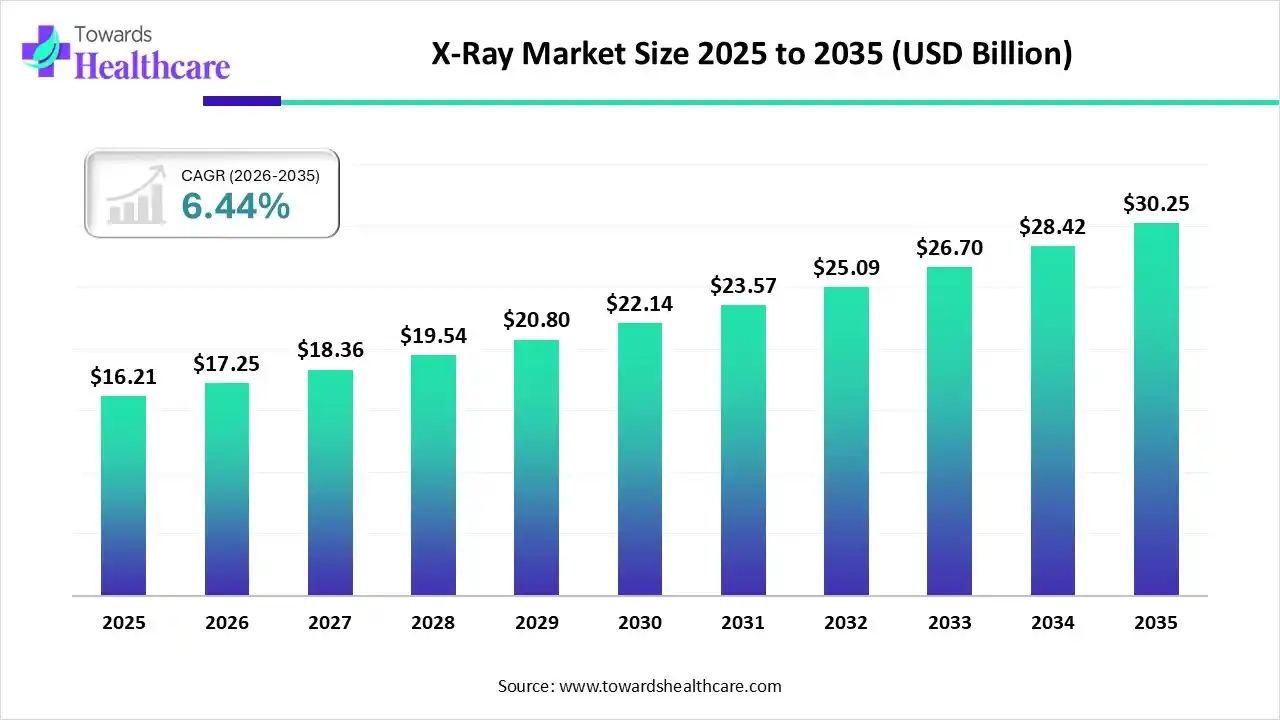
The X-ray market is growing, as an explosion of well-developed imaging technologies, shifts in where patients receive care, novel therapies that depend on imaging, and the pressures of an aging population.
The X-ray market is increasing because X-ray imaging is significant in evolving care for diagnosing traumatic injuries, leading to a consistently high demand for X-ray solutions in alternative departments. A healthcare x-ray produces a picture that support find broken bones, cancer, and foreign objects in the body. X-rays are applied in other types of examinations and processes, involving CT scans, fluoroscopy, and mammograms. These images allow medical care providers and dentists to see that there are challenges, such as a broken bone or a cavity. X-rays are a form of electromagnetic radiation that penetrates or passes through the human body and produces shadow-like images of bones and organs. X-ray services are often used for preventive screening for conditions such as tuberculosis or lung cancer, particularly in high-risk individuals.
For Instance,
Integration of AI-driven technology in X-ray drives market growth, as AI-driven technology has the potential to improves precision and effectiveness of interpreting healthcare images such as X-rays. The incorporation of AI-based technology in X-ray imaging and radiotherapy shows promising potential for improving the radiation protection of patients by lowering radiation exposure in imaging and enhancing the precision of treatment planning. AI-driven advancements, like real-time patient dose estimation and automated segmentation, have the capacity to streamline medical care workflows and enhance patient results, although these technologies are still in different stages of research, development, and validation.
| Table | Scope |
| Market Size in 2026 | USD 17.25 Billion |
| Projected Market Size in 2035 | USD 30.25 Billion |
| CAGR (2026 - 2035) | 6.44% |
| Leading Region | North America |
| Historical Data | 2020 - 2023 |
| Base Year | 2025 |
| Forecast Period | 2026 - 2035 |
| Measurable Values | USD Millions/Units/Volume |
| Market Segmentation | By Technology, By Portability, By End-User, By Region |
| Top Key Players | Koninklijke Philips N.V., Shimadzu Corporation, Siemens, Hologic Inc., Mindray Medical International Limited, Onex Corporation |
How the Digital Imaging Segment Led the X-Ray Market in 2025?
In 2025, the digital imaging segment held the dominant market in 2025 and is projected to register the highest CAGR during the forecast period, due to the implementation of digital imaging technology in scan centers, which has brought about a revolt in healthcare diagnostics. It improved image quality and rapid diagnoses to enhance accessibility and lessen radiation exposure. The advantages of digital imaging are undeniable. Digital imaging technology has transformed medical diagnostics, creating the opportunity for advancements in healthcare and improving the lives of patients. Digital radiography shows a significant development in medical imaging technology, with its advanced image quality and lower radiation exposure.
Why did the Stationary Segment Dominate the Market in 2025?
The stationary segment is dominant in the X-ray market in 2025, as stationary x-rays has major advantage of being installed in a dedicated room, permitting greater control of the atmosphere, patient safety, and radiation exposure. Stationary X-rays are generally large and bulky and need a dedicated space. Stationary digital X-rays are known for their high-resolution images and outstanding image quality. It is more cost-effective than their mobile counterparts.
Mobile
Whereas the mobile segment is the fastest-growing in the market, as mobile digital X-rays offer significant expense savings in certain scenarios. Mobile digital X-rays are more compact and can be simply shifted from room to room. This makes mobile digital X-rays a great choice for services that need frequent relocation or require offering imaging services in multiple locations. Mobile digital X-rays are much easier to transport to patients, making them a great option for home medical care providers.
Why did the Diagnostic Imaging Centers Segment Dominate the Market in 2025?
The diagnostic imaging centers segment is dominant in the X-ray market in 2025, as these centers offers advance MRI and diagnostic imaging devices that produce high-quality images and enhance diagnostic precision. A major diagnostic centre is an opportunity for early identification and prevention of diseases. These centres provide a broad range of screening tests and diagnostic procedures that can detect potential health issues at an early stage, even before the arrival of symptoms.
Hospital
Whereas the hospital segment is the fastest-growing in the market, as medical imaging aids the doctors in understanding the difficulties in the human body and allows them to make better decisions. The medical imaging technologies are entirely painless, non-invasive, and most of them don’t need any special preparation, except when contrast media is applied. Major techniques such as X-rays, CT scans, MRI, ultrasound, and nuclear medicine provide important insights for precise diagnosis, treatment planning, and current monitoring.
In 2025, North America dominated the X-ray market, as this region, the world’s best, provides expedient access to a highly subspecialized network of doctors who work at the forefront of developing and utilizing new, advanced procedures and medications. North American hospitals are at the forefront of integrating AI-based technology for diagnostics and robotics in surgery, to increase precision and lower recovery times, which contributes to the growth of the market.
For Instance,
U.S. Market Trends
In the U.S., the development of X-ray technology from analog to digital represents a monumental shift in healthcare diagnostics, bringing related improved image quality, lower radiation exposure, and faster diagnosis. Through AI-aided X-ray interpretation, radiology professionals enhance the quality of patient care by speeding up and enhancing the precision of the diagnosis and management of injuries and diseases.
Canada Market Trends
Canada's X-ray market is growing steadily because of increasing chronic diseases, rising orthopedic cases, and strong healthcare infrastructure. Hospitals and diagnostic imaging centers are replacing older systems with advanced digital X-ray equipment. Government investments in healthcare modernization support technology adoption. Demand for portable X-ray systems is increasing in emergency care and remote locations. Artificial intelligence is improving image analysis and workflow efficiency. Growing focus on early disease detection, preventive healthcare, and faster diagnosis will continue creating opportunities for X-ray technology across the Canadian healthcare system.
Asia Pacific is expected to see rapid growth in the X-ray market, driven by increasing adoption of AI-driven imaging systems, which presents a significant opportunity in digital radiography. The presence of main manufacturers such as Canon Medical Systems, Fujifilm, and Samsung. Increased healthcare awareness, better insurance coverage, and regulatory initiatives, particularly in developing economies such as India and China, have widened access to imaging solutions, which drives the growth of the market.
India Market Trends
India holds a reputable position worldwide in X-ray research, specifically in X-ray crystallography. Indians have a massive prevalence of background scars on chest radiographs, often as a result of childhood infections or infections throughout the course of their lifetime. The government's push for indigenous production has lowered reliance on imports and increased the availability of cost-effective and high-tech X-ray equipment.
China Market Trends
China's X-ray market is expanding rapidly with increasing healthcare spending, growing patient numbers, and continuous hospital modernization. Government initiatives to improve healthcare access encourage the adoption of advanced diagnostic imaging systems. Hospitals are investing in digital X-ray technologies to enhance diagnostic accuracy and efficiency. Rising cases of respiratory diseases, fractures, and chronic conditions support demand. Local manufacturers are introducing cost-effective imaging solutions. Continuous investments in artificial intelligence, smart hospitals, and healthcare infrastructure will strengthen future market development across the country.
Europe is growing significantly in the X-ray market, as Europe provides advanced technologies and methods for zero-defect and zero-downtime high-precision productions, including predictive quality and non-destructive inspection processes. The European start-up ecosystem is growing, offering advanced support to new entrants in the production sector.
UK Market Trends
The UK's X-ray market is growing because of increasing demand for diagnostic imaging, an aging population, and rising chronic disease cases. Hospitals and community healthcare centers are adopting advanced digital X-ray systems to improve patient care and reduce examination time. Government support for healthcare digitalization encourages equipment upgrades. Portable imaging devices are gaining popularity in emergency and outpatient settings. Artificial intelligence is improving image interpretation and workflow efficiency. Continued investments in healthcare technology and diagnostic services will support future market growth.
Germany Market Trends
Germany's X-ray market is growing steadily with strong healthcare infrastructure, advanced medical technology, and increasing demand for accurate diagnostic imaging. Hospitals and diagnostic centers are adopting digital X-ray systems to improve efficiency and patient outcomes. Rising cases of orthopedic disorders, cancer, and cardiovascular diseases support demand for imaging services. Research institutions and medical technology companies continue developing innovative imaging solutions. Increasing use of artificial intelligence, modernization of healthcare facilities, and continuous investments in advanced diagnostic equipment will drive future market expansion across Germany.
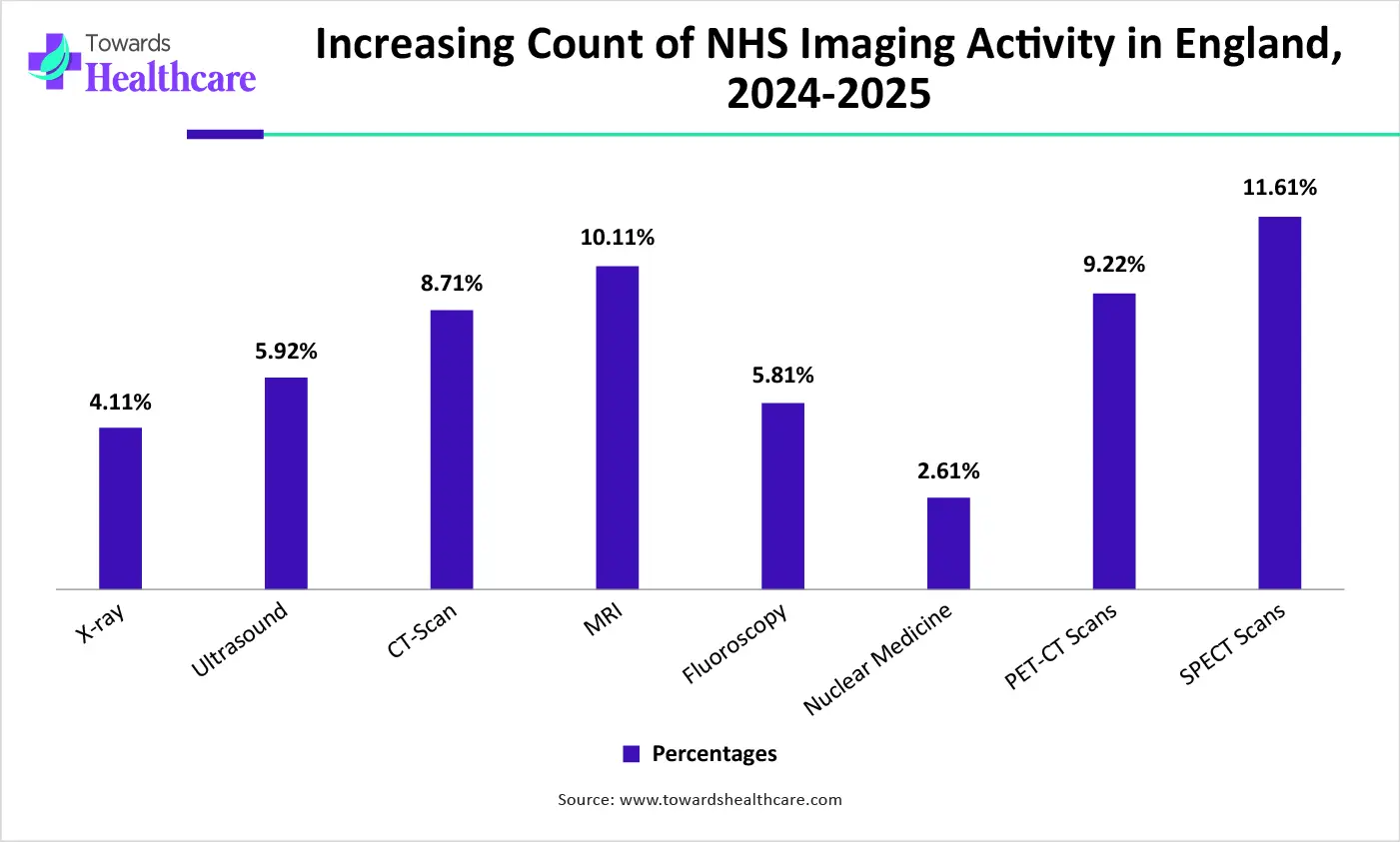
| Imaging Technology | Percentages |
| X-ray | 4.1% |
| Ultrasound | 5.9% |
| CT-Scan | 8.7% |
| MRI | 10.1% |
| Fluoroscopy | 5.8% |
| Nuclear Medicine | 2.6% |
| PET-CT Scans | 9.2% |
| SPECT Scans | 11.6% |
R&D
Manufacturing Processes
Patient Support & Services
| Company | Headquarters | Latest Update |
| Koninklijke Philips N.V. | Netherlands | In January 2025, Philips unveils AI-Enabled CT 5300 and showcases helium-free MRI at AOCR 2025 · Healthcare professionals explore AI-driven imaging solutions. |
| Shimadzu Corporation | Japan | In October 2025, Shimadzu Corporation launched the inspeXio 7000 microfocus X-ray CT system. This model retains the high-resolution, high-contrast CT imaging capabilities of its predecessor, inspeXio SMX-225CT FPD HR Plus. |
| Siemens | Germany | In November 2025, Siemens Healthineers launched artificial intelligence-driven solutions to support healthcare providers in addressing a range of challenges from hands-on image interpretation to complex scenario planning for entire healthcare environments. |
| Hologic Inc. | United States | Hologic is a foremost developer, manufacturer, and supplier of premium diagnostic and healthcare imaging systems devoted to serving the healthcare requirements of women. |
| Mindray Medical International Limited | China | Mindray launched its BeneVision V Series patient monitoring solution at Euroanaesthesia 2025 in Lisbon. |
| Onex Corporation | Canada | In February 2025, Onex completed the $7 billion acquisition of Convex, a field insurance and reinsurance organization, with AIG as a partner |
In July 2025, “Burdened with the stress and pressure to keep radiology departments running smoothly and profitably, we aim to empower technologists with a system that consistently makes the first image count,” said Sharad Sharma, Global General Manager, X-ray, at GE HealthCare. “With its advanced digital capabilities and automation, Definium Pace Select ET allows technologists of all experience levels to deliver consistent high-quality images to serve the full range of anatomies and patient populations.”
Strengths
Weaknesses
Opportunities
Threats
By Technology
By Portability
By End-User
By Region




Principal Consultant
Payal Rabde is a Healthcare Market Research Analyst at Towards Healthcare Research & Consulting with 4+ years of experience in pharmaceuticals, biotechnology, medical devices, and life sciences.
Learn more about Payal Rabde

Reviewed By
Aditi Shivarkar is a seasoned professional with over 14 years of experience in healthcare market research. As a content reviewer, Aditi ensures the quality and accuracy of all market insights and data presented by the research team.
Learn more about Aditi Shivarkar










