
The veterinary DNA testing market is expected to reach USD 1,489.15 million by 2035, starting from USD 534.00 million in 2025, due to growing demand from pet owners who purchase DNA kits to find out about the ancestry and potential health issues of their pets, use genetic data for making treatment decisions in clinics, and breed for inherited conditions. Expansion of health panels, introduction of DNA testing for cats and microbiomes, veterinary clinic routes, and decreasing costs of genotyping drive test volume and value per test up to USD 891.74 million by 2030.
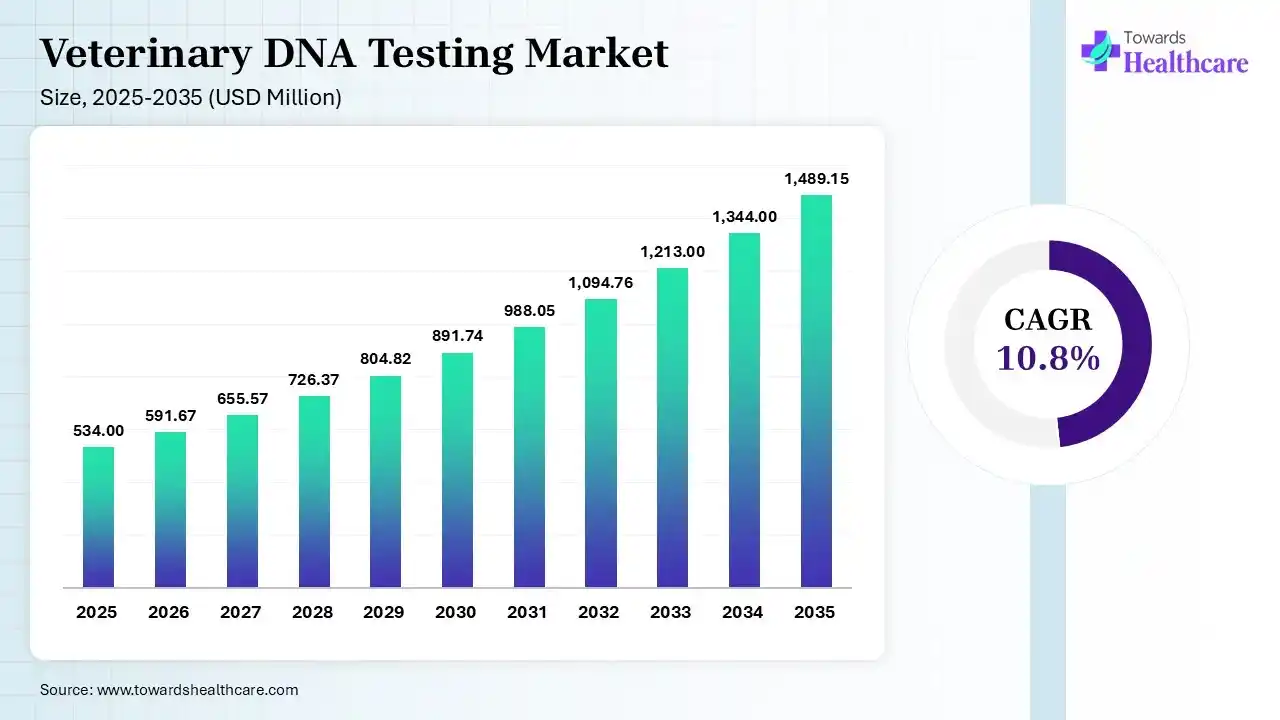
Analyst View: The estimate is based on the number of DNA tests conducted by the kind of tests, sample types, animals, and end users in the different regions, multiplied by the average selling price of consumer tests and professional tests. The number of DNA tests takes into account the population of pets, consumer uptake, breeding test requirements, and use by veterinarians. The figure was compared to the number of DNA tests conducted and the estimated revenue generated by the top companion animal genetic testing companies and also with available estimates, placing our base year slightly higher than the highest comparable one.
Driver: Owners seek ancestry and health risks. Breeders conduct screening to prevent genetic disorders. Vets rely on genetic information during treatments. The cost of genotyping is decreasing. Plans by kennel clubs facilitate testing.
Restraint: Competition drives down the price, resulting in reduced income per test. There is skepticism among some owners regarding the accuracy of the test. The practical significance of some findings may be limited. Data privacy issues are raised. There are limited repeat purchases due to single-time use of the product.
Opportunity: Subscriptions related to health and microbiomes generate recurring income. The veterinary segment expands the scope of application. There is low penetration of cat and exotic animal testing. There are growth prospects in Asian countries. Genetic information facilitates pet insurance and nutrition collaborations.
| Segments | 2025 Share | 2025 Value (USD Million) | 2035 Value (USD Million) | CAGR 2026–2035 |
| Breed Profile | 40.60% | 216.80 | 568.26 | 10.12% |
| Genetic Disease Testing | 28.40% | 151.66 | 412.17 | 10.52% |
| Health & Wellness (Traits, Microbiome) | 18.60% | 99.32 | 328.76 | 12.72% |
| Parentage & Identity | 12.40% | 66.22 | 179.96 | 10.52% |
Note: 2025 is the base year; 2035 values are forecasts.
Sources: Expert interviews, secondary sources, Towards Healthcare database, and Towards Healthcare analysts.
Profile breed tests represented 40.60% (US$ 216.80 million) in 2025, genetic disease tests represented 28.40% (US$ 151.66 million), health and wellness tests represented 18.60% (US$ 99.32 million), and parentage and identity tests represented 12.40% (US$ 66.22 million). Breed tests dominate consumer purchases, and health and wellness tests grow at the fastest pace.
Breed Profile: The segment represented 40.60% (USD 216.80 million) of the global veterinary DNA test kits market in 2025 and is expected to reach USD 568.26 million by 2035, growing at a CAGR of 10.12% during 2026-2035. The breed profile tests look at hundreds of thousands of genetic markers in order to calculate the proportion of breeds that comprise an individual dog. It is the most popular product line for consumers since there are millions of mixed-breed dogs in homes and in shelters that require an estimate of their breed composition, physical attributes, and behaviour. Breed tests can be purchased through online retailers, pet stores, and gift channels, and are priced competitively. Most major breed tests come bundled with health and trait analysis.
Genetic Disease Testing: This segment represented 28.40% (USD 151.66 million) of the global veterinary DNA testing market in 2025 and is expected to grow to reach USD 412.17 million by 2035, growing at a CAGR of 10.52% from 2026 to 2035. Genetic disease testing involves detecting genetic diseases like degenerative myelopathy, progressive retinal atrophy, MDR1 drug sensitivity, and hypertrophic cardiomyopathy, as well as identifying carriers. It is employed by breeders to prevent breeding dogs that may give birth to affected offspring, while kennel clubs insist on specific tests in health programs. Veterinarians use it for monitoring, preventing adverse effects of drugs, and informing owners. Increasing demand is due to an increase in the number of breed-related mutations and panel tests that detect many diseases at once.
Health & Wellness (Traits, Microbiome): This segment accounted for 18.60% (USD 99.32 million) of the total share of the global veterinary DNA testing market in 2025 and is estimated to grow to USD 328.76 million by 2035 at a CAGR of 12.72% during 2026-2035. This category includes trait tests for fur color, body size, and other traits; age and wellness reports for genetic information; and gut microbiome testing through fecal samples. This is the fastest-growing category as organizations have shifted their focus from ancestry to more health-related tests in some cases. Microbiome tests are linked with diets and probiotics, creating connections with pet food and supplement brands.
Parentage & Identity: This segment constituted 12.40% (USD 66.22 million) of the total veterinary DNA testing market in 2025 and will attain USD 179.96 million in value by 2035, growing at a CAGR of 10.52% during 2026-2035. Parentage and identity testing services authenticate the parentage of the litter, confirm pedigree registration, and provide DNA profiles for identification. The major adopters of parentage and identity testing include kennel clubs, dog breed registries, professional breeders, horse breed registries, as well as some local authorities and community groups that employ DNA identification for dog waste.
| Segments | 2025 Share | 2025 Value (USD Million) | 2035 Value (USD Million) | CAGR 2026–2035 |
| Saliva & Cheek Swab | 68.40% | 365.26 | 977.99 | 10.35% |
| Blood | 22.20% | 118.55 | 329.11 | 10.75% |
| Fecal and Others | 9.40% | 50.20 | 182.05 | 13.75% |
Note: 2025 is the base year; 2035 values are forecasts.
Sources: Expert interviews, secondary sources, Towards Healthcare database, and Towards Healthcare analysts.
Cheeks and saliva samples comprised 68.40% (USD 365.26 million) of the total market value in 2025, whereas blood comprised 22.20% (USD 118.55 million) and feces and other samples comprised 9.40% (USD 50.20 million).
Saliva & Cheek Swab: The segment captured 68.40% (USD 365.26 million) of the overall veterinary DNA testing market in 2025 and is forecasted to be worth USD 977.99 million by 2035, registering a CAGR of 10.35% between 2026 and 2035. Cheek swab is the standard method used for sample collection in both home and breeder testing since it is painless, easy to collect by the pet owner, and stable during postal transit.
Blood: The blood segment held 22.20% (USD 118.55 million) of the total global Veterinary DNA Testing market share in 2025 and is expected to rise to USD 329.11 million in 2035, growing at a CAGR of 10.75% between 2026 and 2035. The use of blood is primarily done in veterinary clinics, along with some disease testing and parentage tests that require more DNA or are combined with other blood testing. Collection of blood can be done easily by veterinarians during regular visits along with other diagnostic tests.
Fecal and Others: The fecal and others segment captured 9.40% (USD 50.20 million) of the overall Veterinary DNA Testing market share in 2025 and is anticipated to witness a growth rate of 13.75% from 2026 to 2035, achieving a value of USD 182.05 million. These are used for gut microbiome tests, while others include hair follicles and tissues. This particular segment is the fastest-growing due to growing tests for gut microbiomes of pets and linking the result to diet and supplements.
| Segments | 2025 Share | 2025 Value (USD Million) | 2035 Value (USD Million) | CAGR 2026–2035 |
| Dogs | 76.80% | 410.11 | 1,103.21 | 10.40% |
| Cats | 17.60% | 93.98 | 302.54 | 12.40% |
| Other Animals | 5.60% | 29.90 | 83.40 | 10.80% |
Note: 2025 is the base year; 2035 values are forecasts.
Sources: Expert interviews, secondary sources, Towards Healthcare database, and Towards Healthcare analysts.
Dogs held 76.80% (USD 410.11 million), followed by cats holding 17.60% (USD 93.98 million) and other animals taking up 5.60% (USD 29.90 million). Dogs have a developed and massive testing market, while cats are growing faster since there are more testing panels available.
Dogs: It accounted for 76.80% (USD 410.11 million) of the overall market in 2025 and will attain USD 1,103.21 million by 2035 at a CAGR of 10.40% between 2026 and 2035. It comprises mostly dog testing since there are many pet dogs, the popularity of mixed-breed ancestry testing, diseases that are characterised by specific breeds, and testing by breeders/kennel clubs. There are millions of DNA records in the dog DNA database, which increases the accuracy of the testing process and provides relative-matching capabilities.
Cats: The segment captured 17.60% (USD 93.98 million) of the global market size for the year 2025 and is expected to be worth USD 302.54 million in 2035, growing at a CAGR of 12.40% during 2026-2035. Cats are the fastest-growing animal species due to the introduction of cat breed, health, and trait tests, along with rising pet cat adoption. Cat testing panels test for diseases like polycystic kidney disease and hypertrophic cardiomyopathy, and blood typing helps in transfusions or breeding purposes.
Other Animals: This segment contributed 5.60% (USD 29.90 million) to the global veterinary DNA testing market share in 2025 and is expected to reach USD 83.40 million by 2035, growing at a CAGR of 10.80% from 2026 to 2035. Other animals include horses, birds, and exotic animals. Horse DNA testing is carried out for parentage, coat color, and genetic diseases in the registry process, and bird DNA sexing is widely conducted in pet birds and breeders.
| Segments | 2025 Share | 2025 Value (USD Million) | 2035 Value (USD Million) | CAGR 2026–2035 |
| Animal Owners | 52.40% | 279.82 | 738.40 | 10.19% |
| Veterinarians & Researchers | 28.20% | 150.59 | 467.28 | 11.99% |
| Animal Breeders | 19.40% | 103.60 | 283.47 | 10.59% |
Note: 2025 is the base year; 2035 values are forecasts.
Sources: Expert interviews, secondary sources, Towards Healthcare database, and Towards Healthcare analysts.
Animal owners represented 52.40% (USD 279.82 million) in 2025, veterinarians and researchers represented 28.20% (USD 150.59 million), and animal breeders represented 19.40% (USD 103.60 million).
Animal Owners: This segment represented 52.40% (USD 279.82 million) of the global veterinary DNA testing market in 2025 and is estimated to grow to USD 738.40 million by 2035, exhibiting a CAGR of 10.19% during 2026 to 2035. Animal owners purchase do-it-yourself kits, and the growth rate of veterinarian end-users is expected to be the highest in the global market. Animal owners purchase home DNA testing kits through online channels as well as brick-and-mortar stores due to curiosity and concern over their health risks.
Veterinarians & Researchers: The share of this segment in the global veterinary DNA testing market was 28.20% (USD 150.59 million) in 2025 and is forecasted to grow up to USD 467.28 million by 2035 at a CAGR of 11.99%. The genetic tests are ordered by veterinarians to confirm or rule out any inherited disease, assess sensitivity to medication, and prevent health risks, while scientists employ genetic data in the process of studying diseases, aging, and behavior. This is the segment that grows the fastest.
Animal Breeders: The animal breeders segment had a share of 19.40% (USD 103.60 million) in the veterinary DNA testing market in 2025 and is expected to achieve USD 283.47 million in revenues in 2035 with a CAGR of 10.59% from 2026 to 2035. Breeders undertake various tests for diseases, traits, and paternity in order to pair up suitable mates, to comply with kennel club standards, and to offer buyers health certificates for their purchase.
Analyst View: Segmented market values have been derived based on matching the volume and price of tests with respect to the types of tests, sample types, animal species, and end-users. Health and wellness tests, fecal samples, cats, and veterinary channel segments should perform better due to increased sales of consumer kits in breed tests, swabs, dogs, and owners segments.
| Region | 2025 Share | 2025 Value (USD Million) | 2035 Value (USD Million) | CAGR 2026–2035 |
| North America | 46.80% | 249.91 | 662.88 | 10.25% |
| Europe | 30.40% | 162.34 | 446.47 | 10.65% |
| Asia Pacific | 15.60% | 83.30 | 274.06 | 12.65% |
| Latin America | 4.20% | 22.43 | 61.68 | 10.65% |
| Middle East & Africa | 3.00% | 16.02 | 44.06 | 10.65% |
Note: 2025 is the base year; 2035 values are forecasts.
Sources: Expert interviews, secondary sources, Towards Healthcare database, and Towards Healthcare analysts.
North America: The region had a 46.80% (USD 249.91 million) share of the global veterinary DNA testing market in 2025 and was forecast to be valued at USD 662.88 million in 2035, growing at a CAGR of 10.25% during 2026-2035. North America comprises the United States, which is the largest market due to the presence of millions of households that own dogs and cats, huge spending on pets, and awareness about consumer DNA testing. Companies like Wisdom Panel (tests conducted on more than 5 million pets as of March 2025), and Embark operate in this region, and their kits are widely available through online vendors and pet shops. Testing programs through veterinary associations and shelters that test adopted dogs generate additional volume.
Europe: The region captured 30.40% (USD 162.34 million) of the global market share in 2025 and is expected to attain USD 446.47 million by 2035, growing at a CAGR of 10.65% between 2026 and 2035. Europe has had great breeder and kennel clubs testing practices with the Royal Kennel Club of the United Kingdom having health schemes which have DNA tests. The most profitable market in Europe has been the United Kingdom, followed by Germany, France and the Nordic regions. Some laboratories providing services in the region include Laboklin, Antagene and VHL Genetics.
Asia Pacific: This region represented 15.60% (USD 83.30 million) of the global veterinary DNA testing market in 2025, with an expected value of USD 274.06 million in 2035, with a CAGR of 12.65% from 2026 to 2035. Asia Pacific is the most rapidly growing region due to increasing pet ownership and premium pet care in countries like China, Japan, South Korea, and Australia. Orivet, an Australian company, provides services for breeders and veterinarians, while Asian laboratories are starting to participate in pet DNA testing for consumers.
Latin America: This region had a share of 4.20% (USD 22.43 million) in the veterinary DNA testing market in 2025 and is forecasted to rise to USD 61.68 million by 2035, registering a CAGR of 10.65% during 2026-2035. Latin America is a developing region, with demand coming from Brazil, Mexico, and Argentina from urban pet owners and breeders. International companies are increasing their online sales, whereas regional laboratories carry out breeding tests.
Middle East & Africa: This region had a share of 3.00% (USD 16.02 million) in the veterinary DNA testing market in 2025 and is forecasted to rise to USD 44.06 million by 2035, registering a CAGR of 10.65% during 2026-2035. The Middle East and Africa are emerging regions, with demand from pet owners and breeders in the UAE, Saudi Arabia, and South Africa. Equine DNA testing for Arabian horses and pet bird DNA sexing are specialized demands.
Analyst View: Regional shares were estimated based on test volumes and pricing in each region. North America is dominant due to its higher consumer adoption and company presence. Asia Pacific is awarded the highest growth premium due to faster growth in pet ownership and spending.
| Rank | Company Name | Market-Specific Revenue (USD Million) | 2025 Share | Key Products / Business | Headquarters |
| 1 | Wisdom Panel | 120.00 | 22.47% | Dog and cat breed and health DNA tests | United States |
| 2 | Embark Veterinary | 85.00 | 15.92% | Dog and cat DNA tests | United States |
| 3 | Neogen | 25.00 | 4.68% | Companion animal genomics | United States |
| 4 | Zoetis (Basepaws) | 20.00 | 3.75% | Cat and dog DNA and health tests | United States |
| 5 | Laboklin | 18.00 | 3.37% | Veterinary genetic testing | Germany |
| 6 | Orivet | 14.00 | 2.62% | Breed and health DNA tests | Australia |
| 7 | IDEXX Laboratories | 10.00 | 1.87% | Veterinary genetic tests | United States |
| 8 | Paw Print Genetics | 8.00 | 1.50% | Canine and feline genetic disease tests | United States |
| 9 | Animal Genetics | 8.00 | 1.50% | Avian, equine and canine DNA testing | United States |
| 10 | VHLGenetics | 6.00 | 1.12% | Animal DNA testing | Netherlands |
Note: Company revenues and shares are 2025 estimates.
Sources: Company press releases, expert interviews, secondary sources, Towards Healthcare database and Towards Healthcare analysts.
The most dominant company in the market was Wisdom Panel, accounting for 22.47% (USD 120.00 million) of the market revenue in 2025, followed by Embark Veterinary with 15.92% (USD 85.00 million), and Neogen, representing 4.68% (USD 25.00 million). Wisdom Panel, a brand owned by Mars Inc., leads the market with its large database of DNA and breed and health tests of dogs and cats available online, in retail stores, and through veterinarians. Embark Veterinary markets itself as offering research-quality DNA tests for dogs and cats along with health screening and relative matching features, and Neogen offers companion animal genomic tests along with its livestock genomics operations. Other companies such as Zoetis, Laboklin, Orivet, IDEXX Laboratories, Paw Print Genetics, Animal Genetics and VHLGenetics compete through microbiome and DNA tests, breeder and veterinary tests, regional laboratories and specialised animal tests. The top ten companies accounted for 58.80% (USD 314.00 million) of the market revenue, while the rest of the 41.20% (USD 220.00 million) market share went to regional laboratories, canine club tests and consumer DNA start-up companies.
The veterinary DNA testing ecosystem links genotyping and sequencing technology suppliers with testing companies and laboratories, sales channels, veterinarians and breeders, and pet owners.
| Ecosystem Stage | Role in the Market | Key Companies |
| Technology Suppliers | Provide genotyping arrays and sequencing platforms | Illumina, Thermo Fisher Scientific |
| Testing Companies & Labs | Develop panels and analyse samples | Wisdom Panel, Embark, Neogen, Laboklin, Orivet |
| Sales Channels | Sell kits and tests | Online retailers, pet stores, veterinary clinics |
| Breed Organisations | Set health testing schemes | Kennel clubs and breed registries |
| End Users | Use results for care and breeding | Pet owners, veterinarians, breeders, researchers |
Sources: Company press releases, expert interviews, secondary sources, Towards Healthcare database and Towards Healthcare analysts.
Towards Healthcare companies quadrant is based on market power, including revenue size, market share, and geography, and innovation/growth orientation, including breadth of product range, research and development efforts, and partnerships. The position of each company in the quadrant takes into account our estimates of 2025 revenues in veterinary DNA testing and the nature of its test panels, database, and channel partnerships.
Sources: Company press releases, expert interviews, secondary sources, Towards Healthcare database and Towards Healthcare analysts.
Leaders: Wisdom Panel, Embark Veterinary, Neogen and Zoetis (Basepaws) combine large test volumes with extensive databases, broad health panels and strong consumer and veterinary channels.
Challengers: Laboklin has established laboratory testing businesses but less consumer innovation.
Innovators: Orivet and Paw Print Genetics bring microbiome, breeder and disease-focused testing that is gaining users.
Niche Players: IDEXX Laboratories, Animal Genetics and VHLGenetics serve specialised species or regional testing segments.
By Test Type
By Sample Type
By Animal Type
By End Use
By Region
The global veterinary DNA testing market comprises DNA tests based on breeds, genetic diseases, health and wellness, traits, microbiomes, and parentage DNA tests for companion and other non-food animals. The base year of 2025 was calculated using the bottom-up method by considering the number of DNA tests for test type, sample type, animal, and end-user in all regions, along with average prices of the tests. The base year was also verified using the top-down approach, where test volumes and revenues of leading companion animal genetic testing companies were considered. The values of segments, regions, and companies were determined using test types, sample types, animal types, end use, and regional demand. The most reliable estimates were chosen, and those which couldn't be reconciled with one another were not considered. All segment, regional, and company values were brought to the same base year of 2025, and the forecast from 2026 to 2035 using the CAGR of the 2025 base year was redone.
Analyst View: The veterinary DNA testing market is growing as pet owners, breeders, and veterinarians utilize genetic testing in making various decisions. In our forecast, we consider demand to be related to the volume of tests and price levels; hence the forecast tracks adoption by consumers, utilization by veterinarians, and new tests. The upside is mainly in health and microbiome testing and in the veterinarian channel, and the downside is mainly price competition and lack of repeat business.