
Veterinary ECG systems are expected to increase from a value of USD 116.00 million in 2025 to USD 232.49 million in 2035 owing to the increasing diagnoses of heart diseases among pets due to their longer lifespan, increasing use of ECG before any anaesthesia, and the availability of telemedicine where ECGs can be sent to cardiologists through general practices. The use of digital and wearable equipment, artificial intelligence interpretation, equine cardiology, and veterinary hospital expansion in Asia will drive steady growth to reach USD 164.22 million by 2030.
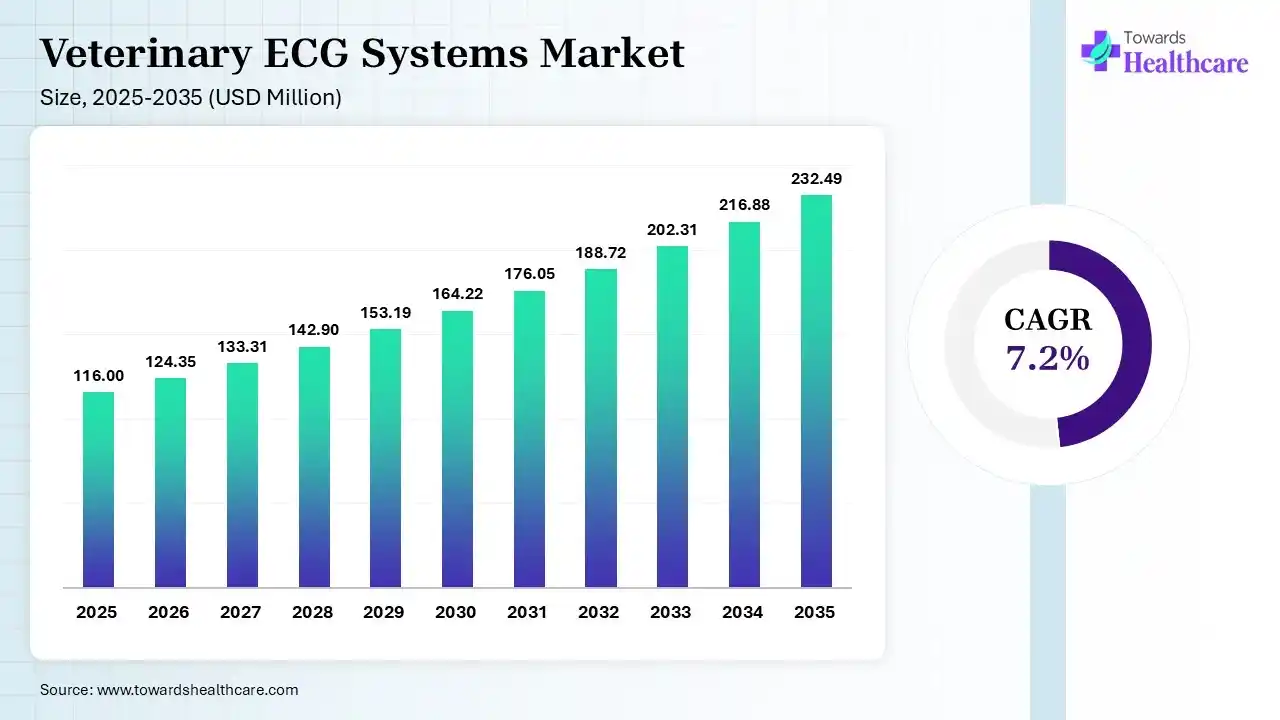
Analyst View: The market size is calculated by using the installed base and new installations of veterinary ECG systems based on modalities, technologies, and geographical regions and multiplying by average selling price and other components such as accessories, consumables, and software. The installations are driven by the number of veterinary hospitals and clinics, specialty cardiology centers, replacement cycle of equipment, and use of digital and portable equipment. The figure is also verified by comparing with veterinary ECG and monitoring revenues of key vendors and industry estimates; the base year value for us is slightly higher than the maximum of these figures.
Driver: Ageing animals have an increased incidence of heart conditions. The ECG is used during pre-anaesthesia screening. Telemedicine provides practices with access to cardiologists. Cardiac evaluation is required in equine sports medicine. Digital devices make recording easy.
Restraint: There are many practices lacking cardiologists. Cheap devices put pricing pressures on other manufacturers. Quality of recording differs from one species to another. Small practices have budget constraints. Echocardiography competes for funds.
Opportunity: AI-assisted interpretation can be beneficial to general practices. Wearable technology allows for remote monitoring. Veterinary markets in Asia present an opportunity. Telemetry for horses is underpenetrated. Software integration provides added value.
| Segments | 2025 Share | 2025 Value (USD Million) | 2035 Value (USD Million) | CAGR 2026–2035 |
| ECG Systems | 82.40% | 95.58 | 192.51 | 7.25% |
| Accessories & Consumables | 17.60% | 20.42 | 39.98 | 6.95% |
Note: 2025 is the base year; 2035 values are forecasts.
Sources: Expert interviews, secondary sources, Towards Healthcare database, and Towards Healthcare analysts.
The ECG systems category held 82.40% (USD 95.58 million) of the total market share, whereas accessories and consumables accounted for 17.60% (USD 20.42 million) of it. The equipment category holds the major share of revenue, whereas electrodes and cables generate regular revenue.
ECG Systems: The ECG systems market is expected to be valued at USD 192.51 million by 2035, growing at a CAGR of 7.25% during 2026-2035. The ECG systems market includes bench-top ECG recorders, hand-held ECG recorders, wearable or Holter ECG monitors, and ECG-capable patient monitors. The category holds a large market share in terms of revenue because of one-time purchases and often includes software for ECG data analysis, storage, and transfer to telemedicine cardiologists.
Accessories & Consumables: This market segment was worth 17.60% (US$ 20.42 million) of the veterinary ECG systems market in 2025 and is expected to grow to US$ 39.98 million by 2035, growing at a CAGR of 6.95% during 2026–2035. The accessories & consumables market segment comprises electrodes, alligator clips, adhesive pads, lead wires, conductive gels, and recording paper. This category provides consistent revenue as a function of the number of ECGs performed.
| Segments | 2025 Share | 2025 Value (USD Million) | 2035 Value (USD Million) | CAGR 2026–2035 |
| Benchtop | 57.00% | 66.12 | 126.49 | 6.70% |
| Handheld & Portable | 31.40% | 36.42 | 72.34 | 7.10% |
| Wearable | 11.60% | 13.46 | 33.66 | 9.60% |
Note: 2025 is the base year; 2035 values are forecasts.
Sources: Expert interviews, secondary sources, Towards Healthcare database, and Towards Healthcare analysts.
Benchtop devices held 57.00% (USD 66.12 million), handheld and portable devices held 31.40% (USD 36.42 million), and wearables held 11.60% (USD 13.46 million) in the market in 2025. The wearables segment is the fastest-growing one.
Benchtop: The segment contributed 57.00% (USD 66.12 million) to the global veterinary ECG systems market in 2025 and is expected to reach USD 126.49 million by 2035, witnessing growth at a CAGR of 6.70% between 2026 and 2035. Benchtop ECGs are multi-channel devices that are used in hospitals and clinics for diagnostic purposes as well as pre-anaesthesia evaluation. This segment leads owing to high-quality 6-lead and 12-lead recordings, interpretation facilities and printing, and compatibility with software and telemedicine such as IDEXX CardioPet.
Handheld & Portable: This segment had a market share of 31.40% (USD 36.42 million) in the year 2025 and will grow to a value of USD 72.34 million by 2035, with a CAGR of 7.10% between 2026 and 2035. The category encompasses handheld and portable systems that include pocket ECG recorders and ECG recording devices with smartphone connectivity and enable quick ECG recording in examination rooms and even in farms and stables. These products are widely used by mobile, equine, and general practitioners because they are cost-effective and easy to use.
Wearable: This segment had a market share of 11.60% (USD 13.46 million) in the year 2025 and will grow to a value of USD 33.66 million by 2035, with a CAGR of 9.60% between 2026 and 2035. The category consists of wearable ECG systems that include vest-based and adhesive sensors capable of performing long-term (hours or days) ECG recording during normal animal movements, such as the Bionet VEMO system for dogs and cats. The modality is the fastest-growing one since it is able to detect intermittent arrhythmias missed by short-term rest recordings.
| Segments | 2025 Share | 2025 Value (USD Million) | 2035 Value (USD Million) | CAGR 2026–2035 |
| Resting ECG | 54.60% | 63.34 | 121.50 | 6.73% |
| Monitoring ECG | 23.00% | 26.68 | 53.14 | 7.13% |
| Holter & Ambulatory ECG | 22.40% | 25.98 | 57.85 | 8.33% |
Note: 2025 is the base year; 2035 values are forecasts.
Sources: Expert interviews, secondary sources, Towards Healthcare database, and Towards Healthcare analysts.
Resting ECG constituted 54.60% (USD 63.34 million) of the market share in 2025, with monitoring ECG holding 23.00% (USD 26.68 million) share and Holter and ambulatory ECG accounting for 22.40% (USD 25.98 million). Resting ECG is the conventional test, whereas Holter monitoring is showing growth at the fastest rate.
Resting ECG: This segment held 54.60% (USD 63.34 million) of the global market in 2025 and is expected to reach USD 121.50 million by 2035, exhibiting a CAGR of 6.73% from 2026 to 2035. Resting ECG is the traditional method for identifying arrhythmias, conduction disturbances, and chamber enlargement patterns. It is the largest usage type owing to the fact that resting ECG tests are performed during cardiac work-ups, pre-anesthetic testing of older animals, and regular health checks of breeds susceptible to heart problems.
Monitoring ECG: This segment contributed to 23.00% (USD 26.68 million) of the total global veterinary ECG systems market in 2025 and is expected to grow up to USD 53.14 million by 2035 with a CAGR of 7.13% during 2026–2035. ECG monitoring is employed in anaesthesia, surgical procedures, intensive care units, and recovery procedures to monitor heart rhythm continually, often via multiparameter monitors. The increasing number of veterinary surgeries and ICU procedures drives the demand for ECG monitoring systems.
Holter & Ambulatory ECG: This segment constituted 22.40% (USD 25.98 million) of the total global veterinary ECG systems market in 2025 and is expected to grow up to USD 57.85 million by 2035 with a CAGR of 8.33% during 2026–2035. Holter & Ambulatory ECG monitors heart activity for more than 24 hours. Holter & Ambulatory ECG is currently the fastest-growing application since it is indispensable in diagnosing intermittent arrhythmias, monitoring such diseases as arrhythmogenic cardiomyopathy in Boxers and Dobermans.
| Segments | 2025 Share | 2025 Value (USD Million) | 2035 Value (USD Million) | CAGR 2026–2035 |
| Small Companion Animals | 62.00% | 71.92 | 146.18 | 7.35% |
| Large Animals | 38.00% | 44.08 | 86.31 | 6.95% |
Note: 2025 is the base year; 2035 values are forecasts.
Sources: Expert interviews, secondary sources, Towards Healthcare database, and Towards Healthcare analysts.
The market was valued at USD 71.92 million for small companion animals and at USD 44.08 million for large animals in 2025. The market dominance of dogs and cats is a result of the high prevalence of heart diseases among these animals.
Small Companion Animals: In 2025, the share of small companion animals was 62.00% (USD 71.92 million). By 2035, the market is expected to be worth USD 146.18 million, growing at a CAGR of 7.35% from 2026 to 2035. Small companion animals include dogs and cats, whose heart diseases are widespread. The market share is dominated by dogs that often suffer from myxomatous mitral valve disease and large breeds suffering from dilated cardiomyopathy and hypertrophic cardiomyopathy in cats.
Large Animals: In 2025, the share of large animals was 38.00% (USD 44.08 million). By 2035, the market is expected to be worth USD 86.31 million, growing at a CAGR of 6.95% from 2026 to 2035. Large animals include horses, cattle, and other livestock. ECG of horses is useful in assessing performance issues, arrhythmia (atrial fibrillation), and readiness for racing.
| Segments | 2025 Share | 2025 Value (USD Million) | 2035 Value (USD Million) | CAGR 2026–2035 |
| Veterinary Hospitals & Clinics | 72.40% | 83.98 | 164.24 | 6.94% |
| Academic & Research Institutes | 14.20% | 16.47 | 36.69 | 8.34% |
| Others | 13.40% | 15.54 | 31.56 | 7.34% |
Note: 2025 is the base year; 2035 values are forecasts.
Sources: Expert interviews, secondary sources, Towards Healthcare database, and Towards Healthcare analysts.
Veterinary hospitals and clinics contributed 72.40% (USD 83.98 million) in 2025, followed by 14.20% (USD 16.47 million) from academic and research institutes and 13.40% (USD 15.54 million) from others. The use of clinical practices dominates the end uses of the veterinary ECG systems market.
Veterinary Hospitals & Clinics: This segment contributed 72.40% (USD 83.98 million) to the veterinary ECG systems market in 2025 and is expected to grow to USD 164.24 million by 2035, growing at a CAGR of 6.94% between 2026 and 2035. Veterinary hospitals and clinics constitute major buyers in the market for diagnosing, pre-anaesthetic screening, and monitoring through the use of ECG. Networked corporate hospital systems are standardizing their equipment and using telemedicine for interpretation of cardiology ECGs by general practitioners.
Academic & Research Institutes: This segment contributed 14.20% (USD 16.47 million) to the veterinary ECG systems market in 2025 and is expected to grow to USD 36.69 million by 2035, growing at a CAGR of 8.34% between 2026 and 2035. The academic and research institutes include veterinary schools and research institutes using ECG for research and education. This is the fastest-growing end-use category owing to increasing veterinary cardiology research and education.
Others: This segment represented 13.40% (USD 15.54 million) of the overall market for veterinary ECG systems in 2025 and is expected to grow to reach USD 31.56 million in 2035, growing at a CAGR of 7.34% between 2026 and 2035. Other segments are specialized cardiology referral centers, equine veterinary facilities, mobile veterinarians, zoos, and animal shelters.
Analyst View: Values were estimated based on the allocation of product placements and prices to products, modalities, types of use, animals, and end users, based on data from the suppliers and veterinary practices. Systems, bench-top systems, resting ECG, small animals and clinics dominate due to the regularity of their use in practice. Wearables and Holter monitoring are expected to grow their share.
| Region | 2025 Share | 2025 Value (USD Million) | 2035 Value (USD Million) | CAGR 2026–2035 |
| North America | 37.60% | 43.62 | 83.06 | 6.65% |
| Europe | 27.00% | 31.32 | 61.92 | 7.05% |
| Asia Pacific | 23.40% | 27.14 | 59.99 | 8.25% |
| Latin America | 7.00% | 8.12 | 16.05 | 7.05% |
| Middle East & Africa | 5.00% | 5.80 | 11.47 | 7.05% |
Note: 2025 is the base year; 2035 values are forecasts.
Sources: Expert interviews, secondary sources, Towards Healthcare database, and Towards Healthcare analysts.
North America: The North America veterinary ECG systems market was valued at 37.60% (USD 43.62 million) in 2025 and is forecast to increase to USD 83.06 million in 2035 with a CAGR of 6.65% during 2026 to 2035. There are plenty of veterinary clinics in the United States; besides, there is high companion animal care expenditure and the development of telemedicine ECG interpretation services, such as the IDEXX CardioPet one that provides fast access to the reports of cardiologists for general practitioners. Advanced Holter and wearable monitoring devices are used by board-certified veterinary cardiologists and specialty hospitals.
Europe: Europe held a share of 27.00% (USD 31.32 million) in the global veterinary ECG systems market in 2025 and is expected to rise to USD 61.92 million by 2035, exhibiting a CAGR of 7.05% during 2026-2035. Europe is well-versed in veterinary cardiology in countries like the UK, Germany, France, and the Netherlands, with existing breed screening programs for hereditary heart disease in dogs and cats. Equine ECG has significance in horse racing and sports, and there are regional players like Eickemeyer and Aspel in the region.
Asia Pacific: Asia Pacific held a share of 23.40% (USD 27.14 million) in the global veterinary ECG systems market in 2025 and is expected to reach USD 59.99 million by 2035, growing at a CAGR of 8.25% from 2026-2035. Asia Pacific is the fastest-growing region due to the fast growth of veterinary hospitals in China, Japan, South Korea, and Australia, and the presence of regional players like Contec, Comen, Edan, and Mindray offering affordable digital ECG devices.
Latin America: Latin America held a 7.00% (USD 8.12 million) share of the veterinary ECG systems market in 2025 and is expected to achieve USD 16.05 million by 2035, registering a CAGR of 7.05% from 2026 to 2035. The development in Latin America is driven by increased pet ownership and investment in veterinary hospitals in Brazil and Mexico, where there is demand for cost-effective digital and portable systems.
Middle East and Africa: The Middle East and Africa held a 5.00% (USD 5.80 million) share of the veterinary ECG systems market in 2025 and is expected to achieve USD 11.47 million by 2035, registering a CAGR of 7.05% from 2026 to 2035. Middle East & Africa is propelled by equine medicine in the Gulf regions, including horses used in racing and endurance activities.
Analyst View: Regional shares were derived based on placements and pricing in each region. North America leads due to veterinary spending and specialists. We have assigned Asia Pacific the highest growth premium because veterinary hospitals expand the fastest in this region.
| Rank | Company Name | Market-Specific Revenue (USD Million) | 2025 Share | Key Products / Business | Headquarters |
| 1 | IDEXX Laboratories | 20.00 | 17.24% | CardioPet ECG with telemedicine | United States |
| 2 | Antech Diagnostics | 9.00 | 7.76% | Veterinary ECG and monitoring | United States |
| 3 | Mindray Animal Medical | 6.00 | 5.17% | Veterinary monitors with ECG | China |
| 4 | Bionet America | 6.00 | 5.17% | VEMO wearable ECG | United States |
| 5 | Contec Medical Systems | 6.00 | 5.17% | Veterinary ECG machines | China |
| 6 | Dextronix | 5.00 | 4.31% | Veterinary ECG systems | United States |
| 7 | Edan Instruments | 5.00 | 4.31% | Veterinary ECG and monitors | China |
| 8 | Shenzhen Comen | 4.00 | 3.45% | Veterinary ECG and monitors | China |
| 9 | Eickemeyer | 3.00 | 2.59% | Veterinary ECG devices | Germany |
| 10 | Aspel | 2.00 | 1.72% | Veterinary ECG recorders | Poland |
Note: Company revenues and shares are 2025 estimates.
Sources: Company press releases, expert interviews, secondary sources, Towards Healthcare database and Towards Healthcare analysts.
IDEXX Laboratories dominated the market for veterinary ECG systems with a projected 17.24% (USD 20.00 million) share of 2025 revenues, followed by Antech Diagnostics with 7.76% (USD 9.00 million), and Mindray Animal Medical with 5.17% (USD 6.00 million). IDEXX Laboratories dominates through the CardioPet ECG machine associated with telemedicine-based interpretation of cardiology by general practices. Antech Diagnostics, a subsidiary of Mars, distributes ECG and monitoring equipment through their diagnostics unit that includes previously produced by Heska devices. Mindray Animal Medical provides patient monitors equipped with ECG functionality for veterinarians. Other key players include Bionet America, Contec Medical Systems, Dextronix, Edan Instruments, Shenzhen Comen, Eickemeyer and Aspel, competing with wearable ECG, affordable digital devices, veterinary-specific recorders and regional distributors. The top 10 companies have a combined projected 56.90% (USD 66.00 million) share of 2025 revenues, while the rest 43.10% (USD 50.00 million) is split between manufacturers of monitoring equipment, smartphone ECG solutions and regional distributors. The veterinary ECG systems market is highly fragmented, and competition revolves around high-quality recording capabilities for various animals, user-friendliness, connectivity and interpretation services, portability, durability and cost.
The veterinary ECG systems ecosystem links component suppliers with device manufacturers, interpretation and software providers, distributors and veterinary practices.
| Ecosystem Stage | Role in the Market | Key Companies |
| Components | Supply sensors, electronics, and electrodes | Electronic component and electrode makers |
| Device Manufacturers | Build veterinary ECG and monitoring devices | IDEXX, Mindray, Bionet, Contec, Edan, Dextronix |
| Interpretation & Software | Provide telecardiology and analysis software | IDEXX telemedicine, cardiology consultants, AI developers |
| Distribution | Sell equipment to practices | Covetrus, MWI Animal Health, regional distributors |
| End Users | Perform ECG on animals | Veterinary hospitals, cardiologists, equine practices, universities |
Sources: Company press releases, expert interviews, secondary sources, Towards Healthcare database and Towards Healthcare analysts.
The Towards Healthcare companies quadrant positions companies that play a role in the veterinary ECG systems market based on their market strength, determined by their revenues and market shares geographically, and innovation and growth strategy, based on product diversification and R&D efforts. Positions are based on the estimated 2025 revenue for each company in the field of veterinary ECG systems.
Sources: Company press releases, expert interviews, secondary sources, Towards Healthcare database and Towards Healthcare analysts.
Leaders: IDEXX Laboratories, Antech Diagnostics, Mindray Animal Medical and Bionet America combine significant veterinary ECG revenue with digital, wearable or telemedicine-linked products and broad veterinary reach.
Challengers: Contec Medical Systems offers established, affordable ECG equipment with less innovation.
Innovators: Edan Instruments brings connected monitoring products that are gaining veterinary use.
Niche Players: Dextronix, Shenzhen Comen, Eickemeyer and Aspel serve specific regional and product segments.
October 2026: Animal model ECG labeling using MaxYield ™ had an agreement between AIML subsidiary NeuralCloud and Etisense. NeuralCloud’s footprint in animal monitoring pre-clinically gets expanded by the collaboration with Etisense’s LASA telemetry software.
By Product
By Modality
By Usage
By Animal Type
By End Use
By Region
The veterinary ECG systems market consists of veterinary benchtop, veterinary handheld, veterinary wearable, and veterinary monitoring ECG systems and veterinary accessories and software for veterinary ECG systems, globally. The 2025 base was developed using the bottom-up approach based on the number of veterinary ECG placements by modality, technology, and region; average selling prices and accessory revenues; and was validated using the top-down approach based on the revenues of veterinary ECG and monitoring systems of major vendors. Values for segments, regions, and companies were derived using products, modalities, usage, animal type, end users, and regional demand. The critical estimates were verified through cross-validation using company, regulatory, and industry reports, and third-party sources. Values for all segments, regions, and companies were reconciled to the common 2025 base year and 2026-2035 forecast, which assumed a constant CAGR from the 2025 base year, and were reforecasted and validated.
Analyst View: The veterinary ECG systems market is small but growing steadily. Our revenue estimate is based on units sold and pricing, and therefore our projection is consistent with the growth in veterinary hospitals, cardiac disease recognition, and the use of digital and wearable technologies. The key opportunities lie in wearables, telemedicine, and AI diagnostics, whereas the biggest threat lies in pricing.